Cephalopods like the octopus or squid are some of the fastest marine creatures, able to accelerate to many body lengths per second by jetting water behind them. Part of what makes its high speed achievable, though, is the way the animal changes its shape. In general, drag forces are proportional to the square of velocity, meaning that doubling the velocity increases the drag by a factor of four. The energy necessary to overcome such large drag increases generally prevents marine animals from going very fast (compared to those of us used to moving through air!) But drag is also proportional to frontal area. Like the bio-inspired rocket in the video above, jetting cephalopods begin their acceleration from a bulbous shape and then shrink their exposed area as they accelerate. Not only does this shape change help mitigate increases in drag due to velocity, it prevents flow from separating around the animal, shielding it from more drag. The result is incredible acceleration using only a simple jet for thrust. For example, the octopus-like rocket in the video above reaches velocities of more than ten body lengths per second in less than a second. (Video credit: G. Weymouth et al.)
Search results for: “jet”

Impacts on Sand
Granular materials like sand are sometimes very fluid-like in their behaviors. The high-speed video above shows a ball bearing being dropped into packed sand. Many features of the splash are fluid-like; the initial impact creates a spreading crownlike splash, followed by a strong upward jet that eventually collapses back into the medium. At the same time, many of the impact characteristics are decidedly non-fluidic. Sand has no surface tension, so both the crown and the jet readily break up into small particles. The granular jet is very narrow and energetic, reaching heights greater than the impacter’s drop height. Interestingly, the column begins collapsing on its lower end before the jet even reaches its highest peak. This may be due to the lower energy of the sand particles that were ejected later in the crater formation process. (Video credit: J. Verschuur, B. van Capelleveen, R. Lammerink and T. Nguyen)
Vibrating Paint
Paint is probably the Internet’s second favorite non-Newtonian fluid to vibrate on a speaker–after oobleck, of course. And the Slow Mo Guys’ take on it does not disappoint: it’s bursting (literally?) with great fluid dynamics. It all starts at 1:53 when the less dense green paint starts dimpling due to the Faraday instability. Notice how the dimples and jets of fluid are all roughly equally spaced. When the vibration surpasses the green paint’s critical amplitude, jets sprout all over, ejecting droplets as they bounce. At 3:15, watch as a tiny yellow jet collapses into a cavity before the cavity’s collapse and the vibration combine to propel a jet much further outward. The macro shots are brilliant as well; watch for ligaments of paint breaking into droplets due to the surface-tension-driven Plateau-Rayleigh instability. (Video credit: The Slow Mo Guys)
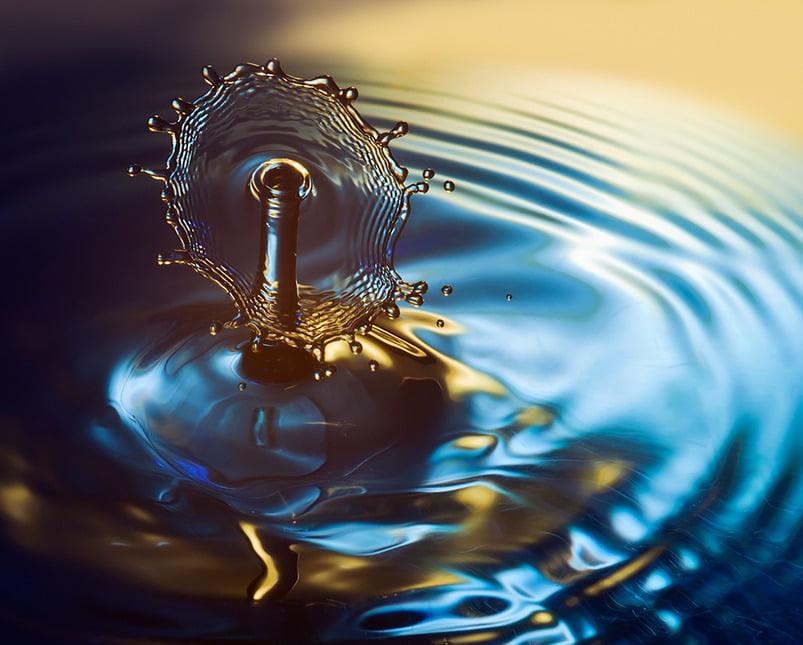
Liquid Umbrella
When a water drop strikes a pool, it can form a cavity in the free surface that will rebound into a jet. If a well-timed second drop hits that jet at the height of its rebound, the impact creates an umbrella-like sheet like the one seen here. The thin liquid sheet expands outward from the point of impact, its rim thickening and ejecting tiny filaments and droplets as surface tension causes a Plateau-Rayleigh-type instability. Tiny capillary waves–ripples–gather near the rim, an echo of the impact between the jet and the second drop. All of this occurs in less than the blink of an eye, but with high-speed video and perfectly-timed photography, we can capture the beauty of these everyday phenomena. (Photo credit: H. Westum)
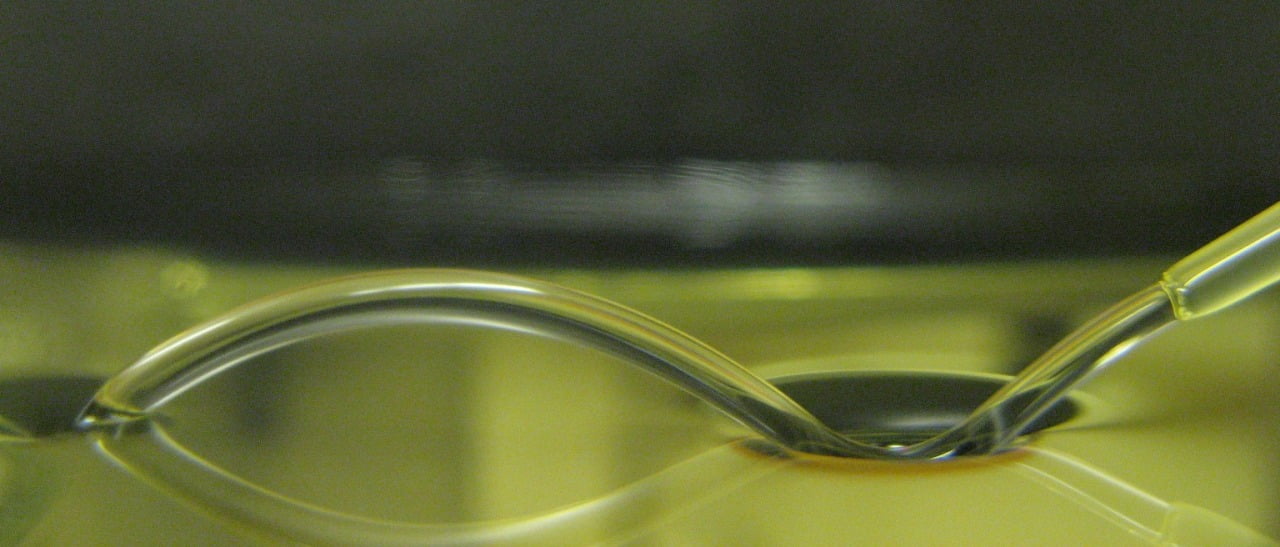
Bouncing Off The Surface
For the right angles and flow rates, it’s possible to bounce a fluid jet off a pool of the same fluid. As the jet flows, it pulls a thin layer of air with it, entraining the air. This air film is what keeps the jet separate from the pool when it initially hits. In the photo above, the jet is flowing right to left; notice how it maintains its integrity within the dimple during the bounce. The pool’s surface tension acts almost like a trampoline, redirecting the jet’s momentum into the bounce. It’s even possible to get a double bounce. In this video, the mechanism is the same, although the apparatus is different. In the photo above, the jet is introduced with a horizontal velocity to induce air entrainment and bouncing. In the video, the pool is spinning, which provides the necessary horizontal velocity between the jet and the liquid pool. (Photo credit: J. Bomber and T. Lockhart)
Liquid Sculptures
[original media no longer available]
Water sculptures–a marriage of liquids, photography, and timing–are spectacular form of fluid dynamics as art. Artist Markus Reugels is a master of the form. This video captures the life and death of such water sculptures at 2,000 fps, beginning with the fall of the initial blue droplet. The droplet’s impact causes a rebounding Worthington jet, which reaches its pinnacle just as a second droplet strikes. The impact spreads into an umbrella-like skirt consisting of a thin, expanding liquid sheet with a thicker rim. The rim itself is unstable, breaking into regularly spaced filaments and tiny satellite droplets that shoot outward before the entire structure collapses into the pool. One especially cool aspect of watching this in video is seeing how the blue dye from each droplet spreads as the water splashes and rebounds. You can see the set-up Reugels uses for his photography here. (Video credit: M. Reugels and L. Lehner)

Mixing Flows
Turbulence is an excellent mixer. Here two fluorescent dyes are injected into a turbulent water jet. Flow is from the bottom of the image toward the top. The dyes are quickly mixed into the background fluid by momentum convection, their concentration decreasing with increased distance from the source. Large-scale structures like the eddies visible in this image drive this convection of momentum in turbulent flows. In contrast, consider laminar flows, where momentum and molecular diffusion dominate how fluids move. In such laminar flows, it’s even possible to unmix two fluids, a feat that cannot be accomplished in the jet above. (Photo credit: M. Kree et al.; via @AIP_Publishing)
Fluid Juggling
It’s that time of the year – the 2013 APS Division of Fluid Dynamics meeting is not far off, and entries to this year’s Gallery of Fluid Motion are starting to appear. This week we’ll be taking a look at some of the early video submissions, beginning with one that you can recreate at home. This video demonstrates a neat interaction between a slightly-inclined liquid jet and a lightweight ball. The jet can stably support–or, as the authors suggest, juggle–the ball under many circumstances, as seen in the video. Initially, the jet impacts near the bottom of the ball and then spreads into a thin film over the surface. This decrease in thickness between the jet and the film is accompanied by an increase in speed due to conservation of mass. That velocity increase in the film corresponds to a pressure decrease because of Bernoulli’s principle. This means that there is a region of higher pressure where the jet impacts the ball and lower pressure where the film flows around the ball. Just as with airflow over an airfoil, this generates a lift force that holds the ball aloft. (Video credit: E. Soto and R. Zenit)
Fluids Round-up – 13 October 2013
There were so many good fluids links this week that I decided for an off-week fluids round-up. Here we go!
- Jefferson Lab has a cool demo on how to make a cloud chamber using dry ice, isopropyl alcohol, and a radioactive source. There is all kinds of fun physics to explain in this one!
- io9 has a great article and videos on the efficiency of jellyfish propulsion (spoiler alert: there are vortex rings).
- Half-blimp, half-jet transport option could change shipping landscape. In a similar vein, Jalopnik takes a look back at the golden age of the dirigible.
- For the armchair daredevils, check out this 360-degree view of BASE jumping with a wingsuit off a Swiss mountain. (via Janeen M)
- Also from io9, an article on my favorite fluids demo: reversible laminar flow. If you’d like to try this at home, here’s a DIY version.
- National Geographic talks about the differences between hurricanes, cyclones, and typhoons.
- Finally, our lead video comes from #5facts and Sesame Street’s Grover who bring us 5 DIY science experiments, 4 of which are fluids demos. Sit back and enjoy!
(Video credit: #5facts/Sesame Street)

Hydraulic Bumps
If you’ve ever noticed the circular jump in your kitchen sink when you turn on the faucet, you’re familiar with what a jet does when it plunges into a horizontal layer of liquid. If the liquid is deep enough, the jet will perturb the surface into a circular depression, as in Figure (a) above. As the flow rate increases, a recirculating vortex ring and hydraulic bump forms (Figure b photo and flow schematic). At a critical flow rate, the bump will become unstable and form polygons instead of circles. At even larger flow rates, the system will shift toward a hydraulic jump, with a larger change in fluid elevation. Like bumps, these jumps can also appear in a variety of shapes. (Image credit: M. Labousse and J. W. M. Bush)