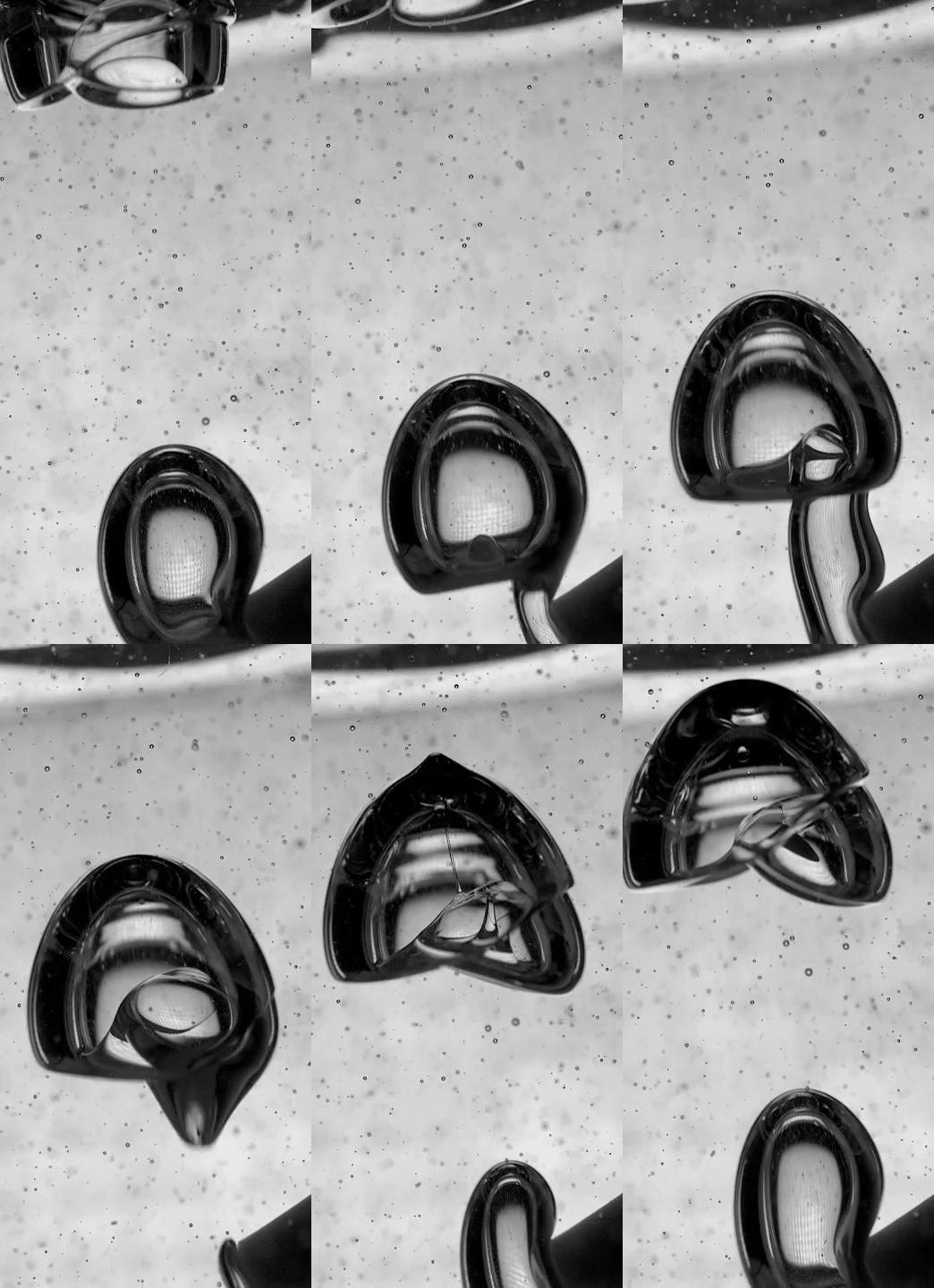
Here we see high-speed video of air bubbles rising through sesame oil. The flow rate of air is just right for one bubble to catch up to and merge with the previous bubble. As it the trailing bubble pinches off from the valve, it shoots a small jet through itself and into the prior bubble. For information on how to recreate this and related experiments, check out this article. (Image credit: C. Kalelkar and S. Paul, source; see also C. Kalelkar)
Search results for: “high-speed video”

“Dancing With Danger”


Filmmaker Chris Bryan captures surfer Kipp Caddy as he rides an enormous wave in “Dancing With Danger.” Nothing quite captures the majesty of these powerful flows like high-speed videography. Enjoy the break, the spray, and those awesome rib vortices. (Image and video credit: C. Bryan)
A Dance of Hydrogen Bubbles


Hydrogen bubbles rise off zinc submerged in hydrocholoric acid in this short film from the Beauty of Science team. In high-speed video, the rise of the bubbles is stately and mesmerizing. Notice how the smallest bubbles appear as perfect spheres; for them, surface tension is strong enough to maintain that spherical shape even against the viscous drag of their buoyant rise. Larger bubbles, formed from mergers both seen and unseen, have a harder time staying round. In them, surface tension must battle gravitational forces and drag from the surrounding fluid. (Image and video credit: Beauty of Science; via Laughing Squid)

Surfing Honeybees


Honeybees have superpowers when it comes to their aerodynamics and impressive pollen-carrying, but their talents don’t end in the air. A new study confirms that honeybees can surf. Wet bees cannot fly–their wings are too heavy for them to get aloft when wet–but falling into a pond isn’t the end for a foraging honeybee.
Instead, the bee flaps its wings, using them like hydrofoils to lift and push the water. This action generates enough thrust to propel the bee three body lengths per second. It’s a workout the bee can only maintain for a few minutes at a time, but researchers estimate honeybees could cover 5-10 meters in that time. Once ashore, the bee spends a few minutes drying itself, and then flies away no worse for the wear. (Image and research credit: C. Roh and M. Gharib; via NYTimes; submitted by Kam-Yung Soh)

“Transient 2”
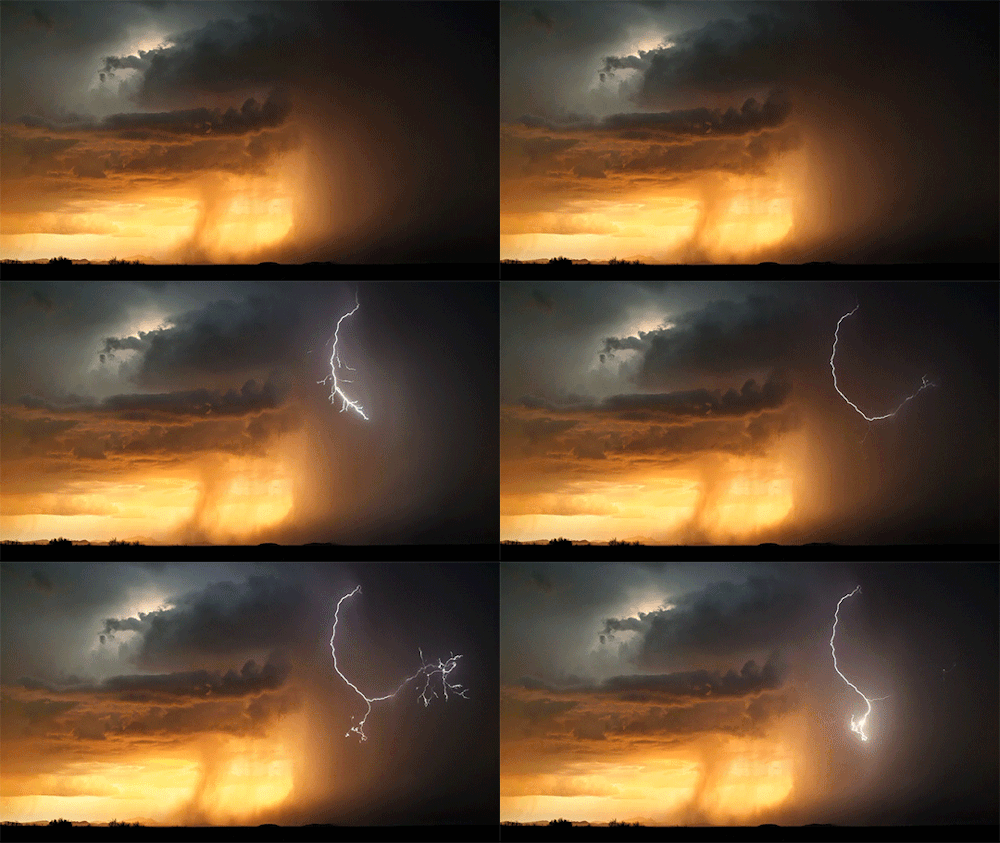
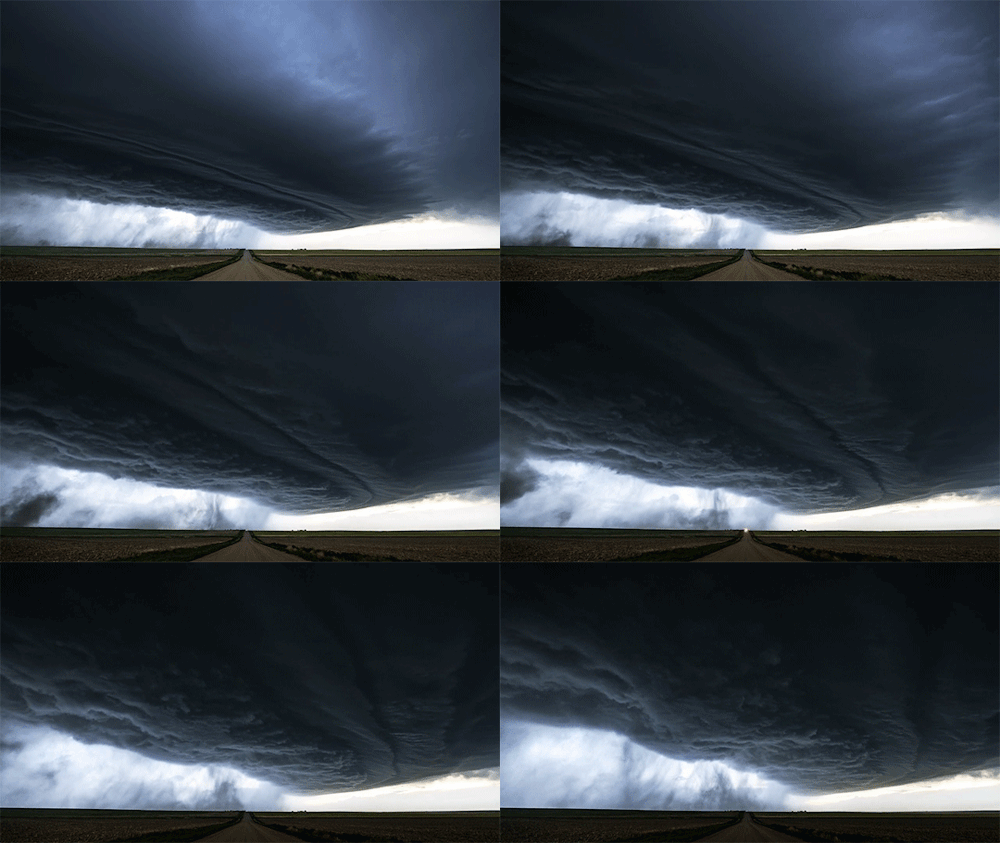
Where cold and warm air meet, our atmosphere churns with energy. From the turbulence of supercell thunderclouds to the immense electrical discharge of lightning, there’s much that’s breathtaking about stormy skies. Photographer Dustin Farrell explores them, with a special emphasis on lightning, in his short film, “Transient 2″.
As seen in high-speed video, lightning strikes begin with tree-like leaders that split and spread, searching out the path of least resistance. Once that line from cloud to ground is discovered, electrons flow along a plasma channel that arcs from sky to earth. The estimated temperatures in the core of this plasma reach 50,000 Kelvin, far hotter than the Sun’s surface. It’s this heating that generates the blue-white glow of a lightning bolt. The heating also expands the air nearby explosively, producing the shock wave we hear as a crash of thunder. (Images and video credit: D. Farrell et al.; via Colossal)

The Impressive Take-Off of Pigeons
One reason that peregrine falcons are such amazing fliers is that their prey, pigeons, are no slouches in flight, either. Able to take off vertically and accelerate to 100 kph in two seconds, pigeons are pint-sized powerhouses. With this high-speed video, BBC Earth highlights the mechanics of this vertical take-off. Pigeons begin by bending their legs and jumping high enough that their first downstroke can extend fully and still clear the ground. That gives them a headstart on generating the force they need to propel themselves upward.
Note the way the pigeon’s wings move, sweeping from directly behind the bird’s back to a full extension in front of it. With the bird moving vertically, this motion tells us that it’s thrust – not aerodynamic lift – from the wingstroke that’s powering this take-off. In that sense, the pigeon is something like a Harrier jet, using the thrust of air downward to take off vertically. (Image and video credit: BBC Earth)

Plant Week: Citrus Jets
Bartenders and citrus lovers the world over are familiar with the mist of oil that bursts from a bent citrus peel. These microjets are about the width of a human hair, but they can spray at nearly 30 m/s in some citrus species. That’s an acceleration g-force of more 5,100, comparable to a bullet fired from a gun!
The key to the jets is the structure of the fruit’s peel. Citrus fruits have a relatively thick, soft inner material, known as the albedo, which houses the oil reservoirs. The thin, stiff outer layer of the peel, called the flavedo or zest, covers that. When the peel is bent, the albedo compresses, increasing the pressure inside the oil reservoirs up to an additional atmosphere’s worth. Meanwhile, the flavedo is stretched. When that outer layer fails, it releases the oil pressure and a jet spurts out. For more on this work, including some awesome high-speed videos, check out my interview (starting at 2:59) with one of the authors in the video below. (Image and research credit: N. Smith et al.; video credit: N. Sharp and T. Crawford)
FYFD is celebrating Plant Week all this week. Check out our previous posts on how moisture lets horsetail plant spores walk and jump, the incredible aerodynamics of dandelion seeds, and the ultra-fast suction bladderworts use to hunt.

Foam Collapse
Introduce the right additive and the bubble arrays in foam will collapse catastrophically. What you see above is high-speed video of a quasi-two-dimensional soap bubble foam collapsing. There are two main mechanisms in the collapse. The first is a propagating mode. When one section of the film breaks, a stream of liquid from the broken film can impact an adjacent section, causing it to break as well. This accounts for much of the breakage you see above.
The second mode is through penetration by droplets. Watch carefully, and you’ll see that some of the breaking films generate tiny droplets which can fly through the wall of the next cell and impact against the far side. With the right conditions, that impact can trigger a new break along a non-adjacent film. Together, these two mechanisms can destroy foam in the blink of an eye. (Image and research credit: N. Yanagisawa and R. Kurita)
Slow Mo Geyser


Geysers are one of the most surreal wonders of our planet – pools of turquoise that periodically erupt into towers of water and steam. But what we see from the surface is only a small part of the story. Geysers require two main ingredients: an intense geothermal heat source and the right plumbing. Below ground, that plumping needs both a reservoir for water to gather and narrow constrictions that encourage the build-up of pressure.
A cycle begins with water filling the reservoir; this can be both geothermally heated water and groundwater seeping in. As the geyser fills, the pressure at the bottom increases. Eventually, the water becomes superheated, meaning that it’s hotter than its boiling point at standard atmospheric pressure. That’s when the steam bubbles you see above rise to the surface. When they break through, it causes a sudden drop in the reservoir pressure. The superheated water there flashes into steam, causing the geyser to erupt. Check out the full video below for some awesome high-speed video of those eruptions, and, if you’re curious what the inside of an active geyser looks like check out Eric King’s video. (Image and video credit: The Slow Mo Guys; submitted by @eclecticca)
Worthington and His Jets
If you’ve been around fluid mechanics for very long, you’ve probably noticed that we like to name things after people. (Mostly dead, white guys, but that’s another subject.) Whenever someone describes or explains a new phenomenon, it tends to get their name attached to it. Some of the common names in fluid dynamics – Reynolds, Rayleigh, Kelvin, Taylor, von Karman, Prandtl – read like a who’s-who of nineteenth and twentieth century physics. This video gives some historical insight into a couple of those figures – particularly Arthur Worthington, who is known for his contributions to the understanding of splashes. Be sure to check out some of his awesome illustrations and photos. Can you imagine being able to piece together splash physics like that without high-speed video?! (Video credit: Objectivity; submitted by Kam-Yung Soh)