Search results for: “droplet”

  • Granular Instabilities

    Granular Instabilities

    Granular mixtures show surprising similarities to fluids, even though their underlying physics differ. The latest example of this is a Rayleigh-Taylor-like instability that occurs when heavy particles sit atop lighter ones. By combining vertical vibration and an upward gas flow, researchers found that the lighter particles form fingers and bubbles that seep up between the heavier grains (upper left). Visually, it looks remarkably similar to a lava lamp or other Rayleigh-Taylor-driven instability (upper right).

    But the physics behind the two are distinctly different. In the fluid, buoyancy drives the instability while surface tension acts as a stabilizing force. There’s no surface tension in a granular material, though. Instead, the drag force from gas flowing upward provides the vertical impetus while friction between the grains – essentially an effective viscosity – replaces surface tension as a stabilizing influence.

    The similarities don’t stop there, though. When the researchers tested a “bubble” of heavy grains suspended in lighter ones (lower left), they found that, instead of sinking, the granular bubble split in two and drifted downward on a diagonal. Eventually, those daughter bubbles also split. Again, visually, this looks a lot like what happens to a drop of ink or food coloring falling through water (lower right), but the physics aren’t the same at all. 

    In the fluid, the breakup happens when a falling vortex ring splits. In the granular example, gas moving upward tends to channel around the heavy grains because they’re harder to move through. Eventually, this builds up a solidified region under the bubble. When the heavy grains can’t move directly down, they split and sink through the surrounding suspended particles until they build up another jammed area and have to split again. (Image credits: granular RTI – C. McLaren et al.; RTI simulation – M. Stock; bag instability – D. Zillis; research credit: C. McLaren et al.; submitted by Kam-Yung Soh)

  • The Bouncing Drop

    The Bouncing Drop

    For a droplet to bounce, we expect it to hit a wall or a sharp interface of some kind. But in a new study, researchers demonstrate a droplet that bounces with neither. Shown above is an oil droplet sinking through a stratified mixture of ethanol (toward the top) and water (toward the bottom). Because the oil is heavier than ethanol, it initially sinks, dragging some of the ethanol with it as it falls. Over time, some of that ethanol rises again, forming what’s known as a buoyant jet.

    Simultaneously, the gradient of ethanol to water between the top and bottom of the drop creates an imbalance in surface tension. The ethanol near the top of the drop has a lower surface tension than the water at the bottom. This creates a downward Marangoni flow along the drop interface.

    The bounce itself happens quickly after a long, slow sinking period. As the drop’s sinking slows, the buoyant jet weakens until it disappears completely. At the same time, the downward Marangoni flow pulls fresh ethanol-rich fluid toward the top of the drop. That increases the surface tension difference and strengthens the Marangoni flow, creating a positive feedback loop. In less than a second, the Marangoni flow increases by two orders of magnitude, pulling so hard that the drop shoots upward.

    That resets the cycle by weakening the Marangoni flow and strengthening the buoyant jet. The droplet can continue bouncing for about 30 minutes until the concentration gradient is so well-mixed that the cycle can’t continue. (Image and research credit: Y. Li et al.; via APS Physics; submitted by Kam-Yung Soh)

  • Freezing Stains

    Freezing Stains

    When they evaporate, drops of liquids like coffee and red wine leave behind stains with a darker ring along the edges, thanks to capillary action and surface tension pulling particles to that outer edge. In contrast, sublimating a frozen droplet leaves a stain pattern that concentrates at the center (top). When droplets freeze from the surface upward, particles within the droplet are driven toward the center as the freeze front pushes toward the drop apex. The final shape of the stain depends on the initial geometry of the droplet, and the concentration of particles toward the center occurs because of the way that the particle freezes, not how it sublimates (bottom). 

    Since many industrial processes rely on droplet evaporation to spread coatings, this work offers a new way to control the final outcome. (Image and research credit: E. Jambon-Puillet, source)

  • Featured Video Play Icon

    Breaking

    As waves fold over and break, they trap air, creating bubbles of many sizes. The smallest of these bubbles can be only a few microns across and persist for long times compared to larger bubbles. When they burst, they create tiny droplets that can carry sea salt up into the atmosphere to seed rain. Understanding how these bubbles form and how many there are of a given size is key to predicting both oceanic and atmospheric behaviors. Numerical simulations like the one featured in the video above reveal the dynamic collisions that create these tiny bubbles and help researchers learn how to model the tiniest bubbles so that future simulations can be faster. (Image and video credit: W. Chan et al.)

  • Resonating on a Bounce

    Resonating on a Bounce

    When we think of resonance, we often think of it in simple terms: hit the one right note, and the wine glass will shatter. But resonance isn’t always about a one-to-one ratio between a driving frequency and the resonating system. Especially in fluid dynamics, we often see responses that occur at other, related frequencies.

    One of the simplest places to see this is with a droplet bouncing on a bath of fluid. Above you see a liquid metal droplet bouncing on a bath of the same metal. At low amplitude, the pool surface moves at the driving frequency and a droplet bounces simply upon that surface, with one bounce per oscillation. Increase the amplitude, though, and the droplet’s bounce changes. It bounces twice – one large bounce and one small bounce – in the time it takes for the pool surface to go through one cycle. This is called period doubling because the bouncing occurs at twice the driving frequency.

    Turn the amplitude up further, and the system undergoes another change. Faraday waves form on the surface. They resonate at half the driving frequency, and a droplet’s bouncing will sync up with the waves. That means the droplet returns to a one-to-one bounce with the waves, but the waves themselves are no longer reacting at the driving frequency. It’s this kind of complexity that makes fluid systems fertile grounds for studying paths toward chaos. (Image and research credit: X. Zhao et al.)

  • Coalescence at the Smallest Scales

    Coalescence at the Smallest Scales

    The coalescence of two water droplets happens so quickly, it’s essentially impossible to see, even with high-speed cameras. For this reason, researchers have turned to simulating molecular dynamics – essentially building computer programs that model the actions of all the molecules contained in the water droplets. Viewed this way, the very first contact between drops comes from thermal fluctuations – the random jumping of molecules across the separating gap. Once the bridge starts to form, it continues to grow, driven by thermal forces and opposed by surface tension. Eventually, this thermal regime gives way to the more familiar hydrodynamic one, where the bridge is large enough for flow to drive its growth. (Image credits: experiment – S. Nagel et al.; simulation – S. Perumanath et al.; research credit: S. Perumanath et al.; submitted by Rohit P.)

  • Foam Collapse

    Foam Collapse

    Introduce the right additive and the bubble arrays in foam will collapse catastrophically. What you see above is high-speed video of a quasi-two-dimensional soap bubble foam collapsing. There are two main mechanisms in the collapse. The first is a propagating mode. When one section of the film breaks, a stream of liquid from the broken film can impact an adjacent section, causing it to break as well. This accounts for much of the breakage you see above.

    The second mode is through penetration by droplets. Watch carefully, and you’ll see that some of the breaking films generate tiny droplets which can fly through the wall of the next cell and impact against the far side. With the right conditions, that impact can trigger a new break along a non-adjacent film. Together, these two mechanisms can destroy foam in the blink of an eye. (Image and research credit: N. Yanagisawa and R. Kurita)

  • Phase-Switching to Avoid Icing

    Phase-Switching to Avoid Icing

    Preventing ice and frost from forming on surfaces – especially airplane wings – is a major engineering concern. The chemical de-icing cocktails currently used in aviation are a short-lived solution, and while superhydrophobic surfaces can be helpful, they tend to be easily damaged and therefore impractical. Another possible solution, shown here, are so-called phase-switching liquids – substances like cyclohexane that have freezing points higher than that of water. This means that they form a solid coating near the freezing temperature of water.

    Water droplets on these coatings move in a random stick-slip walk (above) but they tend not to freeze. This is because freezing requires the droplets to release heat, which melts part of the phase-switching liquid. Now, instead of solidifying to the surface, the droplet moves on a film of the phase-switching liquid. Re-freezing that liquid is tough because it’s thermodynamically unfavorable, and the smoothness of the liquid layer makes it harder for ice to find a nucleation point. In lab tests, the phase-switching liquid surfaces resisted ice and frost more than an order of magnitude longer than conventional materials. (Image and research credit: R. Chatterjee et al.; video credit: Univ. of Illinois at Chicago; submitted by Night King)

  • Water Impacts

    Water Impacts

    In the clean and simplified world of the laboratory, a droplet’s impact on water is symmetric. From a central point of impact, it sends out a ring of ripples, or even a crown splash, if it has enough momentum. But the real world is rarely so simple.

    Here we see how droplets impact when the wind is blowing against them. The drops fall at an angle, creating an oblique cavity. Rings of ripples spread from the impact, but the ligaments of a splash crown form only on the leeward side. As the wind speed increases, so does the violence of the impact, eventually beginning to trap tiny pockets of air beneath the surface. Those miniature bubbles can spray droplets and aerosols into the air when they finally pop. (Image and video credit: A. Wang et al.)

  • Featured Video Play Icon

    Freezing Drop Impact

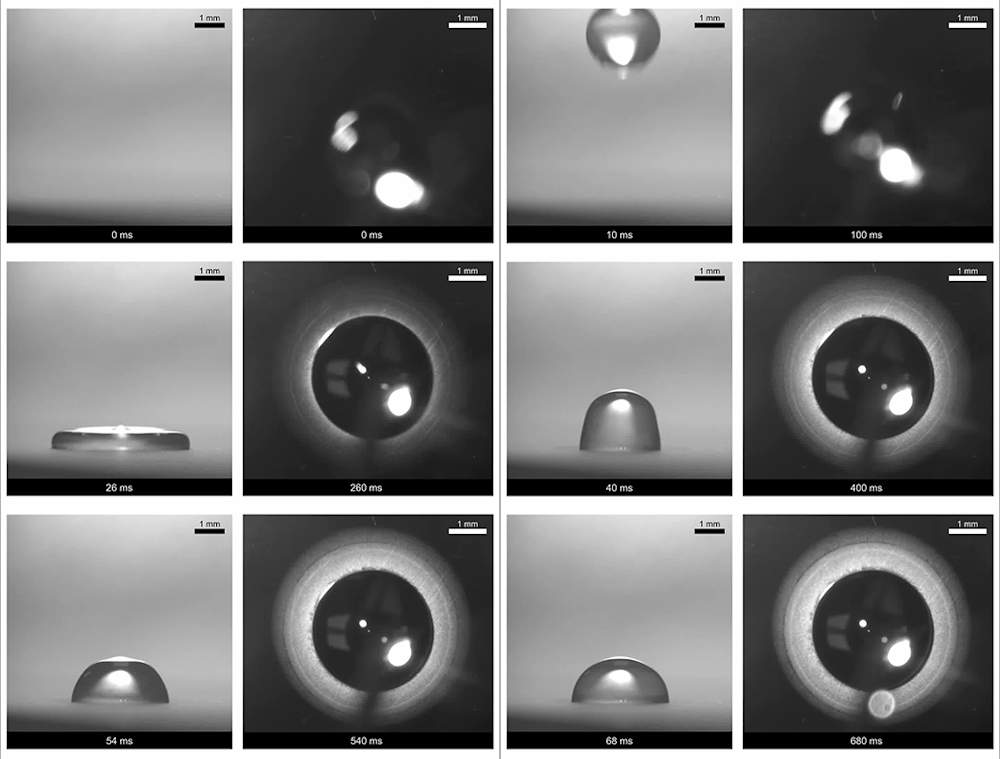
    At the altitudes where aircraft fly, it’s often cold enough for water drops to freeze in seconds or less. Once attached to a wing, such frozen drops disrupt the flow, reducing lift and increasing drag. To help understand how such droplets freeze, scientists study droplet impact on cold surfaces. Starting at room temperature (counter-clockwise from upper left), a drop will spread on the surface, then retract. When the temperature is colder, parts of the droplet freeze before retraction completes, leaving a thin sheet with a thicker center. At even colder temperatures, the droplet’s rim destabilizes and freezing occurs before the droplet has time to retract fully. And at the coldest temperatures, the droplet breaks apart into a frozen splash. (Image and video credits: V. Thievenaz et al.)