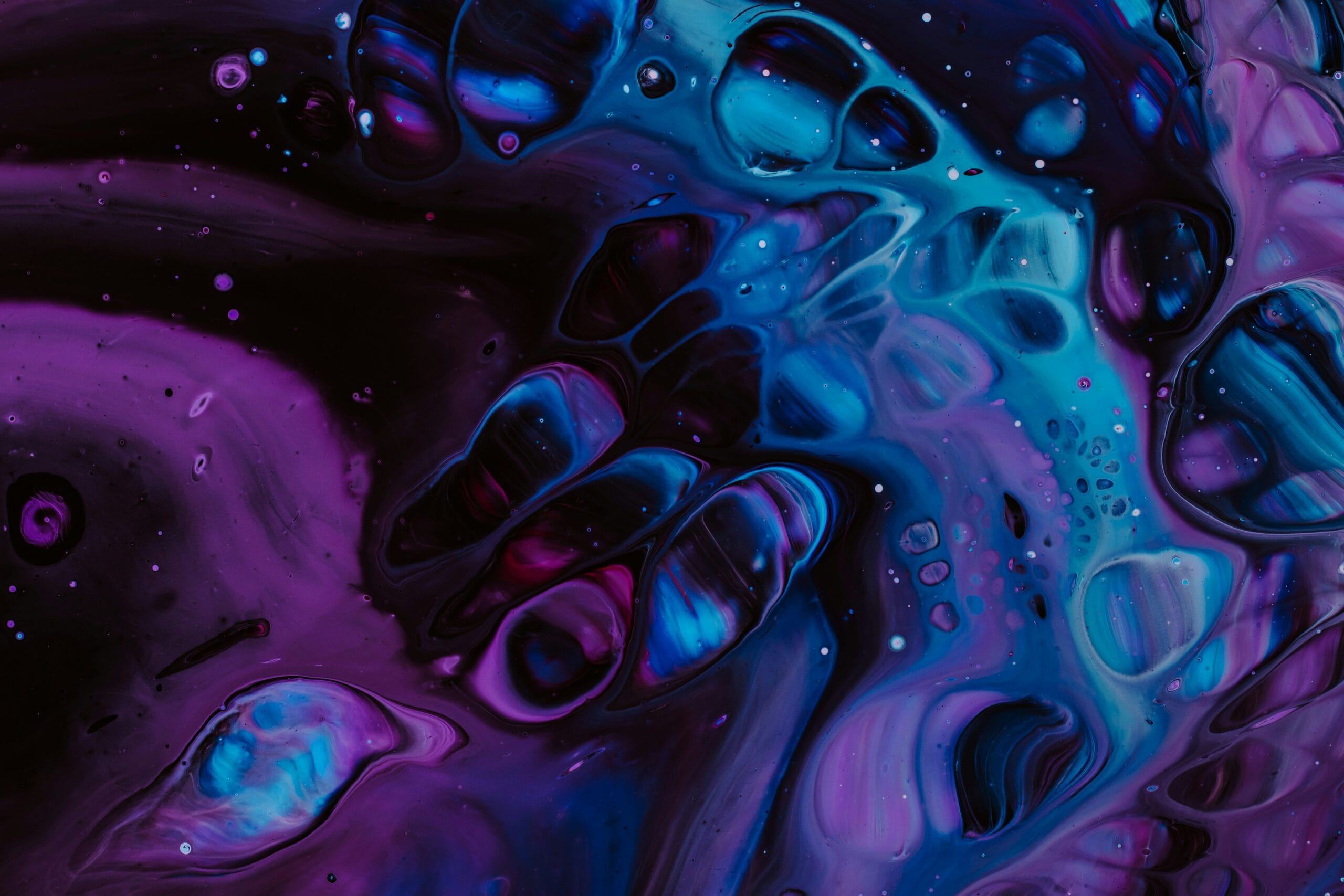
In “Paradolia,” filmmaker Susi Sie plays with pareidolia, our tendency to seek patterns in nebulous data — like faces on a slice of toast. Droplets of miscible and immiscible fluids collide, part, and mix in each sequence, providing plenty of fodder for an active imagination. For myself, my brain especially likes assigning cartoon expressions to well-spaced drops in the video. What do you see? (Video and image credit: S. Sie)
Astronaut Don Pettit posted this image of a Jupiter-like water globe he created on the International Space Station. In microgravity, surface tension reigns as the water’s supreme force, pulling the mixture of water and food coloring into a perfect sphere. It will be interesting to see a video version of this experiment, so that we can tell what tools Pettit used to swirl the droplet into the eddies we see. Is the full droplet rotating (as a planet would), or are we just seeing the remains of a wire passed through the drop? We’ll have to stay tuned to Pettit’s experiments to find out. (Image credit: NASA/D. Pettit; via space.com; submitted by J. Shoer)
Hi, folks! As the social media landscape fractured, I’ve been dragging my feet about making some needed changes. But no longer. As of November 2024, I am no longer updating FYFD’s X/Twitter account. Here are the places you can currently follow FYFD online:
Most of those services get autoposts rather than regular check-ups, so I rarely see messages on Instagram/Tumblr/YouTube. Fediverse replies autopost as comments to the blog, so I do see those, and I will probably hang around on Bluesky some, but email is your best bet these days if you want me to see your message.
Fluids like air and water are called Newtonian because their viscosity does not vary with the force that’s applied to them. But many common fluids — almost everything in your fridge or bathroom drawer, for example — are non-Newtonian, meaning that their viscosity changes depending on how they’re deformed.
Non-Newtonian droplets can behave very differently than Newtonian ones, as this video demonstrates. Here, their fluid of choice is water with varying amounts of silica particles added. Depending on how many silica particles are in the water, the behavior of an impacting drop varies from liquid-like to completely solid and everything in between. Why such a great variation? It all has to do with how quickly the droplet tries to deform and whether the particles within it can move in that amount of time. Whenever they can’t, they jam together and behave like a solid. (Image, video, and research credit: S. Arora and M. Driscoll)
When surface tension varies along an interface, fluids move from regions of low surface tension to higher surface tension, a behavior known as the Marangoni effect. Here, a drop of (dyed) water is placed on glycerol. The two fluids are miscible, but water has much a lower viscosity and density yet a higher surface tension. The drop’s interface quickly becomes unstable; viscous fingers form along the edge as the less viscous water pushes into the more viscous glycerol. Eventually, the surface-tension-driven Marangoni flow breaks those fingers off into lip-like daughter drops. The researchers also show how the interplay between viscosity and surface tension affects the size of fingers that form by varying the water/glycerol concentration. (Image and video credit: A. Hooshanginejad et al.)
The intense heat from wildfires fuels updrafts, lifting smoke and vapor into the atmosphere. As the plume rises, water vapor cools and condenses around particles (including ash particles) to form cloud droplets. Eventually, that creates the billowing clouds we see atop the smoke. These pyrocumulus clouds, like this one over California’s Line fire in early September 2024, can develop further into full thunderstorms, known in this case as pyrocumulonimbus. The storm from this cloud included rain, strong winds, lightning, and hail. Unfortunately, storms like these can generate thousands of lightning strikes, feeding into the wildfire rather than countering it. (Image credit: L. Dauphin; via NASA Earth Observatory)
When a drop settles gently against a pool of the same liquid, it will coalesce. The process is not always a complete one, though; sometimes a smaller droplet breaks away and remains behind (to eventually do its own settling and coalescence). When this happens, it’s known as partial coalescence.
Here, researchers investigate ways to tune partial coalescence, specifically to produce more than a single droplet. To do so, they add surfactants to the oil layer surrounding their water droplet. The surfactants make the rebounding column of water skinnier, which triggers the Rayleigh-Plateau instability that’s necessary to break the column into more than one droplet. (Image and video credit: T. Dong and P. Angeli)
Pour the Greek liquor ouzo into water, and your glass will billow with a milky, white cloud, formed from tiny oil droplets. The drink’s unusual dynamics come from the interactions of three ingredients: water, oil, and ethanol. Ethanol is able to dissolve in both water and oil, but water and oil themselves do not mix.
In this video, researchers explore the turbulent effects of pouring ouzo into water. In particular, pouring from the top creates a fountain-like effect, due to a tug-of-war between the ouzo’s momentum and its buoyancy. Momentum wants the ouzo to push down into the water, and buoyancy tries to lift it back up. For an extra neat effect, they also show what happens when the ouzo is confined to a 2D plane and what happens when momentum and buoyancy act together instead of oppositely. (Image and video credit: Y. Lee et al.)
In our collective imagination, a raindrop is pendant shaped, wide at the bottom and pointed at the top. But, in fact, a falling raindrop experiences much more complicated shapes. Here, researchers blow a jet of air onto a still droplet, a good facsimile for a raindrop falling through the atmosphere. The jet of air first squishes the drop, then inflates it into a shape known as a bag. The thin sides of the bag stretch and eventually break, spraying tiny droplets. As the disintegration continues, the thick rim of the bag breaks up into big droplets. As the video demonstrates, viscosity and viscoelasticity can affect the break-up, too. (Image and video credit: I. Jackiw and N. Ashgriz)
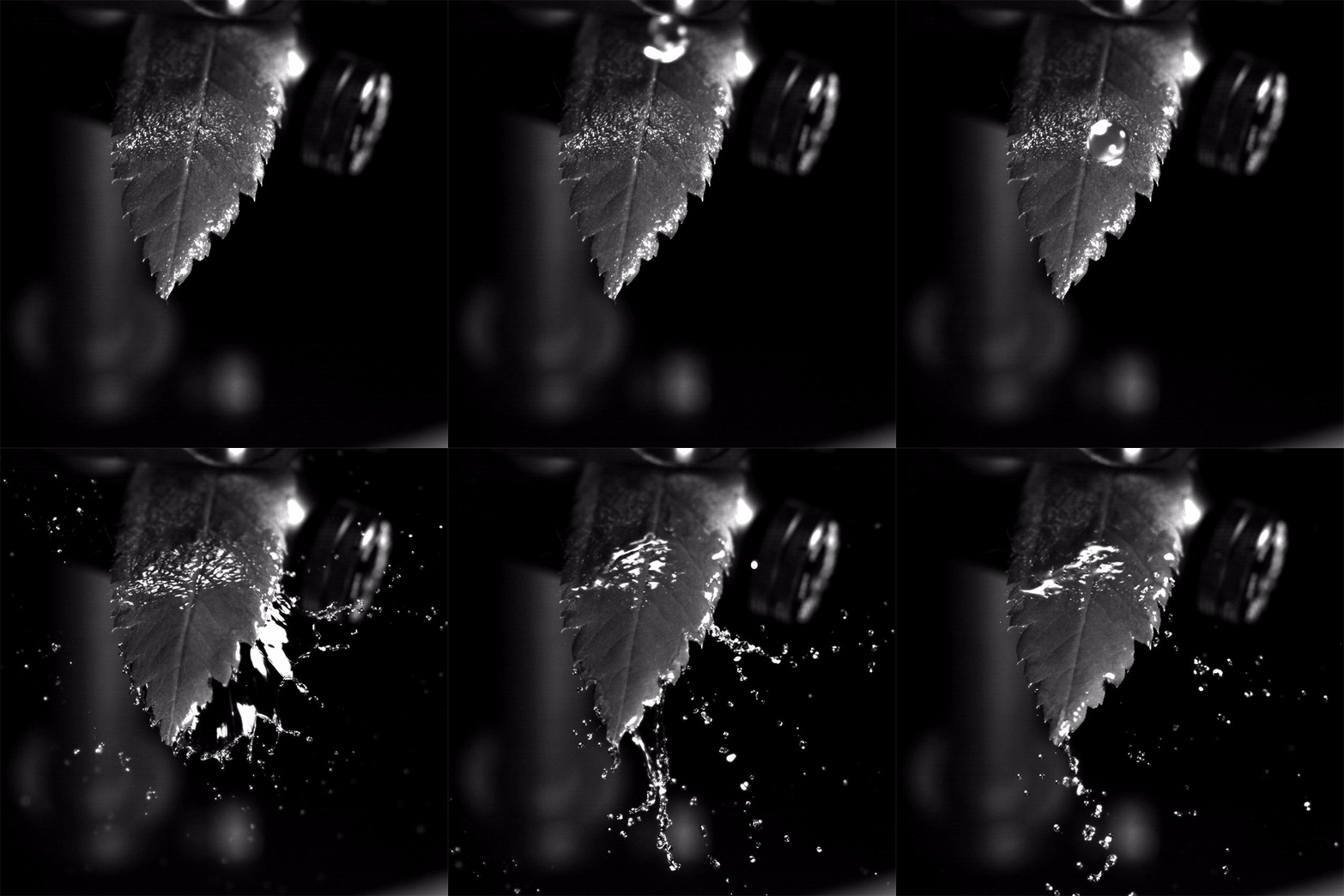
When a raindrop hits a leaf, it spreads out into a rimmed sheet that breaks up into droplets. These tiny drops can carry dust, spores, and even pathogens as they fly off. But many leaves aren’t smooth-edged; instead they have serrations or teeth. How does that affect a splash? That’s the question at the heart of today’s study.
A water drop hits a star-shaped pillar and breaks up.
To simplify from a leaf’s shape, the team studied water dropping onto star-shaped pillars. As seen above and below, the pillar’s edge shaped the splash sheet, with the sheet extending further in the edge’s troughs. This asymmetry extends into the rim also, concentrating the liquid — and the subsequent spray of droplets — along lines that extend from the edge’s troughs and peaks.
A viscous water-glycerol drop hits a star-shaped pillar, spreads, and breaks into droplets.
The team found that, in addition to sending drops along a preferred direction, the shaped edge made the droplets larger and faster than a smooth edge did. (Image and research credit: T. Bauer and T. Gilet)