Search results for: “droplet”

  • Imitating a Cough

    Imitating a Cough

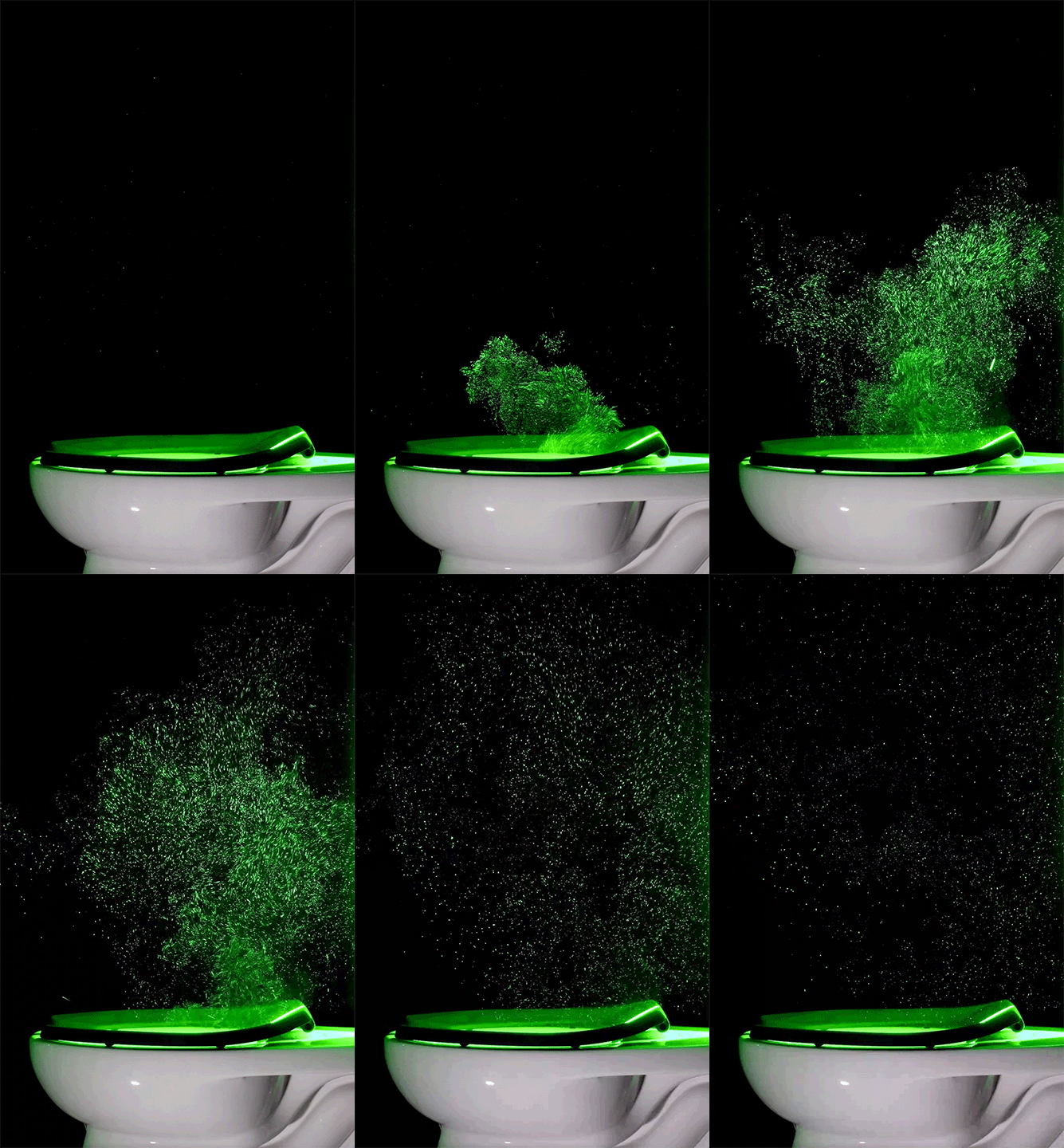
    Coughing and sneezing create violent air flows in and around our bodies. As that fast air rushes over mucus layers in our lungs, throat, and sinuses, the resulting flow breaks up the mucus into droplets. To explore the details of that process, researchers built a “cough machine” that sends a rush of air over a thin film of water mixed with glycerol. The setup allows them to observe the physics in a way that’s nearly impossible in a human cough or sneeze.

    Imitating a cough: high-speed video shows how a thin film made of water and glycerol breaks down in a strong airflow. Parts of the film inflate into hollow bags that form thinner weak spots. When the film breaks in those places, it forms rims and ligaments that break up into droplets.
    Imitating a cough: high-speed video shows how a thin film made of water and glycerol breaks down in a strong airflow. Parts of the film inflate into hollow bags that form thinner weak spots. When the film breaks in those places, it forms rims and ligaments that create a spray of droplets.

    As seen above, air flowing past shears the viscous fluid, stretching it out. The leading edge of the film destabilizes and breaks into large drops, but it’s what comes next that really gets things going. Areas of the film inflate to form hollow bags. When sections of the bag thin to about 1 micron, the film ruptures and the bags burst. This triggers a cascade of instabilities in the film’s rim that ultimately rip the film into a spray of tiny aerosol droplets. The researchers found that, despite their tiny size, these droplets collectively carry a large volume of liquid, making them all the more important for understanding transmission of respiratory illnesses. (Image credit: top – A. Piacquadio, experiment – P. Kant et al.; research credit: P. Kant et al.)

  • Leidenfrost Collapse

    Leidenfrost Collapse

    When a droplet encounters a surface much hotter than its boiling point, it forms a thin layer of vapor that insulates the liquid from the surface. But this Leidenfrost effect can’t last forever. Eventually, the vapor layer destabilizes and the drop touches the surface, causing explosive boiling that destroys the drop.

    To determine how the layer destabilizes, researchers simulated the breakdown. To their surprise, they found that inertial forces in the micron-thin vapor layer were critical for destabilization. The gas inertia caused reductions in pressure that pulled the liquid toward the surface. Usually at these small scales, we’d ignore inertial effects and focus instead on viscosity, but, for Leidenfrost drops, that simplification doesn’t work. (Image credit: L. Gledhill; research credit: D. Harvey and J. Burton)

  • Viscoelasticity and Bubbles

    Viscoelasticity and Bubbles

    Bursting bubbles enhance our drinks, seed our clouds, and affect our health. Because these bubbles are so small, they’re easily affected by changes at the interface, like surfactants, Marangoni effects, or, as a recent study shows, viscoelasticity.

    A bubble released in pure water pops at the surface, creating a rebounding jet and a daughter droplet.
    A bubble released in pure water pops at the surface, creating a rebounding jet and a daughter droplet.

    In clean water, a bubble’s burst generates a rebounding jet that shoots off one or more daughter droplets, as seen in the animation above. But when researchers added proteins that modify only the water’s surface, they found something very different. As seen below, the bursting bubble no longer generated a jet, and, instead of forming droplets, it made a single, tiny daughter bubble. The difference, they found, comes from the added viscoelasticity of the surface. The long protein molecules resist getting stretched, which damps out the tiny waves that surface tension usually produces on the collapsing bubble cavity. (Image and research credit: B. Ji et al.; submission by Jie F.)

    When the surface of water is viscoelastic, a bursting bubble creates no jet and a daughter bubble instead of a drop.
    When the surface of water is viscoelastic, a bursting bubble creates no jet and a daughter bubble instead of a drop.
  • Featured Video Play Icon

    Hitting Molten Steel

    Watching droplets burst is often fascinating, but it’s rare that we get to watch droplets of molten metal. In this Slow Mo Guys video, though, they’re shattering globs of molten steel and filming the results in slow motion. It’s the kind of starburst that breaks compression algorithms but remains beautiful regardless. (Video and image credit: The Slow Mo Guys)

  • Featured Video Play Icon

    Aquatic Escape Artists

    Springtails are tiny hexapods found living on the air-water interface. Like other creatures living at the interface, they sometimes need to make a quick escape. For the springtail, that means a high-flying leap, driven by their fork-shaped furcula. The springtail soars into the air, where it contorts its body and uses aerodynamic forces — along with a droplet it carries on its belly — to orient itself. For landing, it uses that droplet as a sticky anchor that helps it adhere to water (or ground) instead of bouncing. Nailing that landing sets it up to make another daring escape as quickly as needed. (Video and image credit: Deep Look; research credit: V. Ortega-Jimenez et al.)

  • Featured Video Play Icon

    “Emerald and Stone”

    “Emerald and Stone” is filmmaker Thomas Blanchard’s tribute to the music of Brian Eno. The short film is made, as Blanchard puts it, with “inks and painting,” but I suspect there’s some oil in there, too, to coat the droplets we see. Much of the movement is likely driven by surface tension variations in the background fluid. I love the effect this has on the droplets. If you watch closely, some of them appear to rotate like a miniature planet; others have counter-rotating sections within the drop. The difference, I suspect, is one of scale: I think the smaller drops rotate altogether while larger ones develop more complex internal flows. (Video and image credit: T. Blanchard)

  • Clouds Down Under

    Clouds Down Under

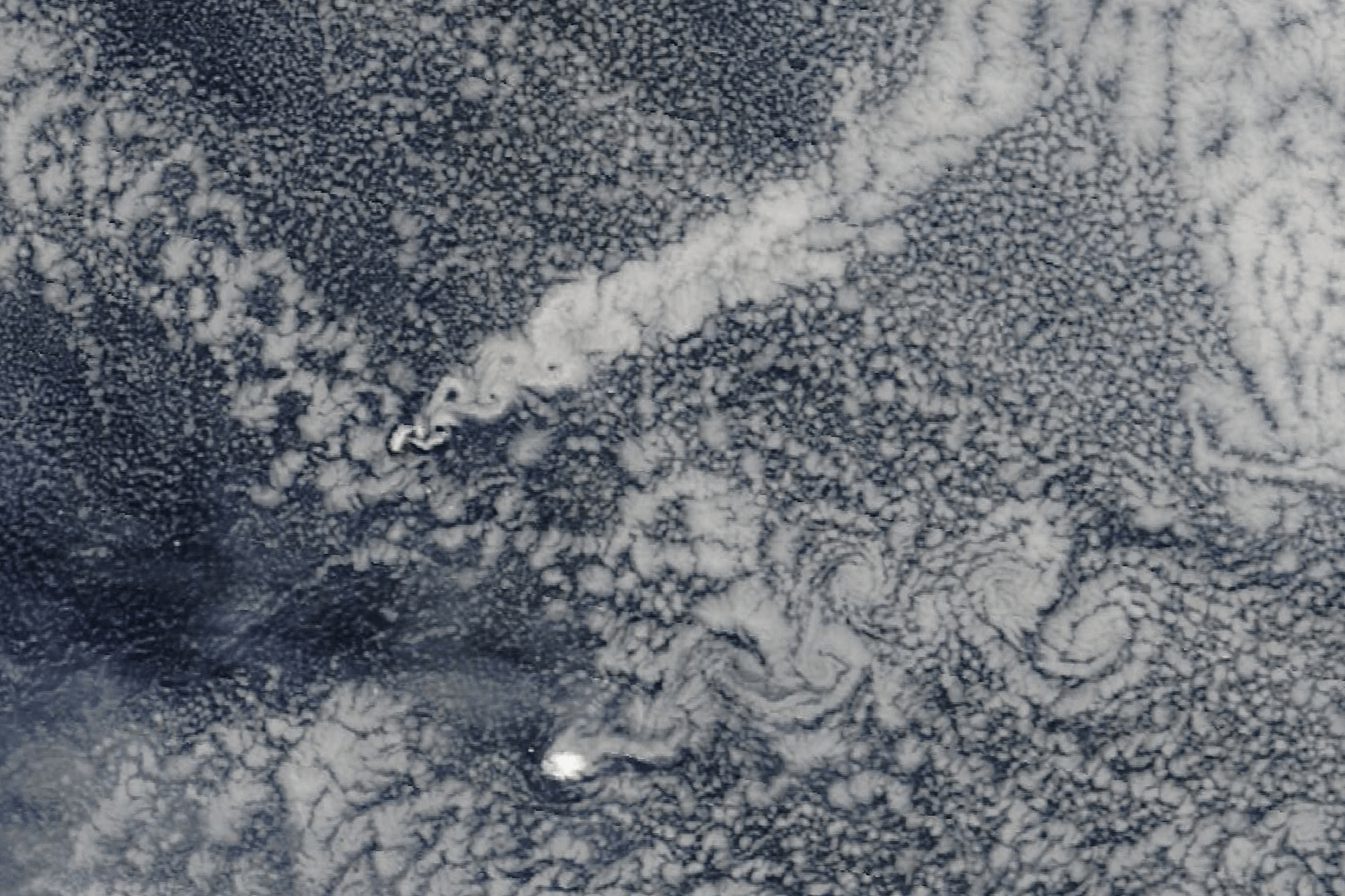
    This large and unusual cloud formation was captured one July morning over western Australia. Stretching over 1,000 kilometers, the clouds have interesting features at both the large and small scale. The small-scale ripples within the clouds are gravity waves triggered by the terrain below. The larger, arced features are tougher to explain, though they may also be related to gravity waves and terrain, just on a much larger scale. They also resemble fallstreak clouds where supercooled droplets evaporate from the inside of the cloud out. (Image credit: W. Liang; via NASA Earth Observatory)

  • Featured Video Play Icon

    “Discovery”

    Colors stream and mix in Rus Khasanov’s short film “Discovery.” Droplet-like liquid lenses float in the mixture until ethanol or other ingredients cause them to spontaneously rupture, sending their interior flowing outward until the lens reaches a new equilibrium. Gradients in surface tension guide Marangoni flows across the screen. There’s never-ending beauty in the world of macro fluids. (Video and image credit: R. Khasanov)

  • Puddle Depth Matters for Stalagmites

    Puddle Depth Matters for Stalagmites

    In a cave, mineral-rich water drips from the ceiling, spreading ions used to build stalagmites. A recent study considers how the depth of a pool affects the droplet’s splash and how material from the droplet spreads. The authors found several scenarios that vary widely depending on pool depth.

    A droplet falling into a shallow pool creates a splash that quickly breaks up into droplets. This flings the red droplet material in many directions.
    A droplet falling into a shallow pool creates a splash that quickly breaks up into droplets. This flings the red droplet material in many directions.

    A drop falling into a shallow pool had a splash that quickly broke up into droplets (above). By dyeing the pool green and the droplet red, they could track where the droplet’s material wound up. The spray of small droplets carried fluid far, but the main point of impact had a strong concentration of the drop’s fluid.

    With a deeper pool, the drop's impact creates a thick crown splash that collapses in on itself. The drop's fluid is quickly mixed into the pool.
    With a deeper pool, the drop’s impact creates a thick crown splash that collapses in on itself. The drop’s fluid is quickly mixed into the pool.

    In contrast, a deeper pool sent up a thick-walled splash crown that collapsed in on itself. This droplet’s material saw lots of mixing with the pool, but only near the point of impact. From their work, the authors concluded that models of stalagmite growth should incorporate pool depth in order to capture how minerals actually concentrate and move. (Image credit: cave – H. Roberson, others – J. Parmentier et al.; research credit: J. Parmentier et al.; via APS Physics; submitted by Kam-Yung Soh)

  • How a Leak Can Stop Itself

    How a Leak Can Stop Itself

    Some leaks can actually stop themselves, and a new analysis shows how. When a vertical pipe has a small hole, water initially spouts out of it, then dribbles, and, finally, drips as the water level in the pipe falls, decreasing the driving pressure of the flow. But the pipe doesn’t have to empty to a level below the hole for the leak to stop. Instead, a final droplet can form a cap over the hole, with its shape providing enough pressure to balance the remaining pressure from fluid in the pipe.

    Water leaking from a vertical pipe transitions from continuous flow to discrete drops (left). Dripping continues until the final droplet forms at t = 0 seconds.
    Water leaking from a vertical pipe transitions from continuous flow to discrete drops (left). Dripping continues until the final droplet forms at t = 0 seconds.

    The researchers found that the final drop’s kinetic energy (as well as its potential energy) was critical to determining which drop would stop the flow. The last drop behaves like a lightly-damped harmonic oscillator; it needs enough potential energy to counter the flow and a small enough inertia that it doesn’t slip away down the pipe. (Image credit: top – G. Crofte, experiment – C. Tally et al.; research credit: C. Tally et al.; via APS Physics)