Search results for: “drag”

  • The Jumping Flea

    The Jumping Flea

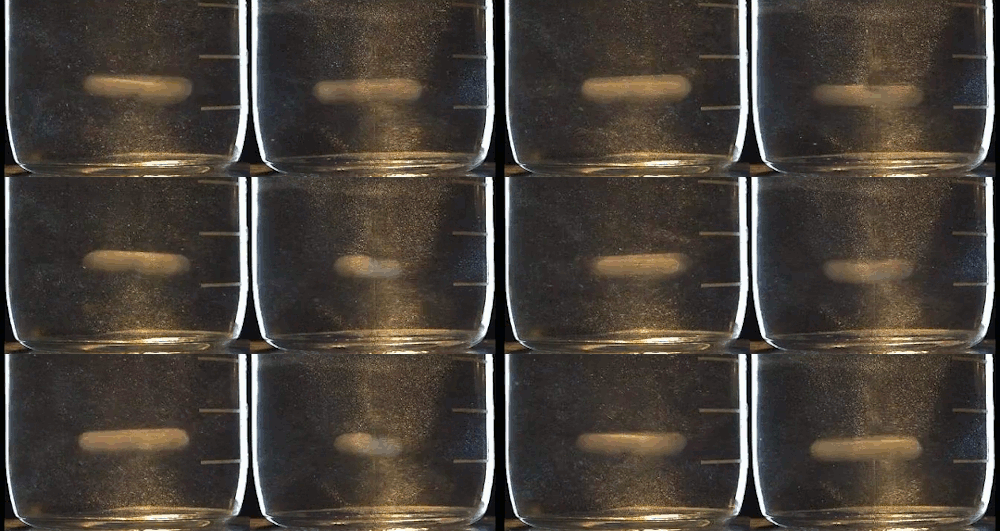
    Nearly every lab has a magnetic stirrer for mixing fluids, but this ubiquitous tool still holds some surprises, like its ability to unexpectedly levitate. Magnetic stirrers consist of two main parts, a driving magnet that creates a rotating magnetic field, and a bar magnet – commonly referred to as the flea – that is submerged in the fluid to be stirred. When the driver’s rotating field is active, the flea will spin at the bottom of its container, keeping its magnetic field in sync with the driver.

    But if you place the flea in a viscous enough fluid, the drag forces on the flea can pull it out of sync with the driver’s field. Above a certain speed, the flea will jump so that its field repulses the driver’s. That makes the flea levitate as it spins. Depending on the interplay of viscous and magnetic forces, that spin can be unstable (left) or stable (right). The researchers suggest that this peculiar behavior could help artificial swimmers propel themselves or lead to new methods for measuring fluid viscosity. (Image and research credit: K. Baldwin et al.; via APS; submitted by Kam-Yung Soh)

  • The Protection of the Peloton

    The Protection of the Peloton

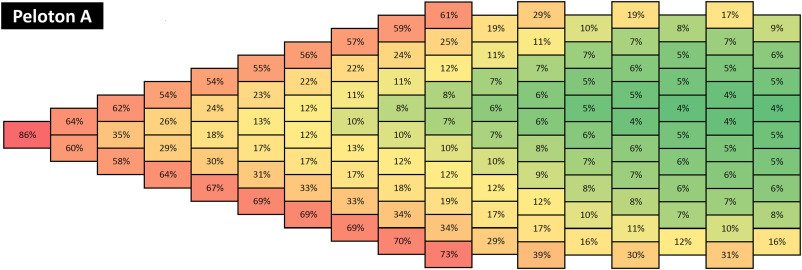
    It’s well-known by professional cyclists that sitting in the middle of the peloton requires little effort to overcome aerodynamic drag, but now, for the first time, there’s a scientific study to back that up. Researchers built their own quarter-scale peloton of 121 riders to investigate the aerodynamic effect of cycling in such a large group versus riding solo. Through wind tunnel studies and numerical simulation, they found that riders deep in the peloton can experience as little as 5-10% of the aerodynamic drag of a solo cyclist. 

    Tactically, this means teams should aim to position their protected leader or sprinter mid-way in the pack, where they’ll receive lots of shelter without risking one of the crashes common near the back of the peloton. It also suggests that teams wanting to isolate another team’s leader should try to push them toward the outer edges of the peloton rather than letting them sit in the middle. It will be interesting to see whether pro teams shift their race strategies at all with these numbers in hand.

    Of course, this study considers only a pure headwind. But other groups are looking at the effects of side winds on cyclists. (Image credit: J. Miranda; image and research credit: B. Blocken et al.; submitted by 1307phaezr)

  • The Swimming of a Dead Fish

    The Swimming of a Dead Fish

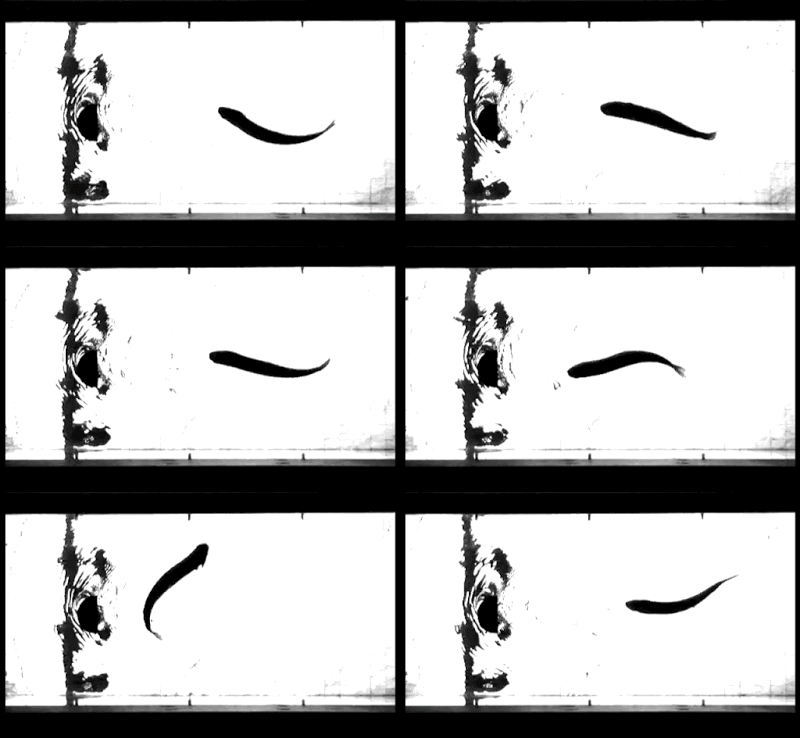
    When I was a child, my father would take me trout fishing, and I spent hours marveling from the riverbank at the trouts’ ability to, seemingly effortlessly, hold their position in the fast-moving water. As it turns out, those trout really were swimming effortlessly, in a manner demonstrated above. The fish you see here swimming behind the obstacle is dead. There’s nothing powering it, except the energy its flexible body can extract from the flow around it.

    The obstacle sheds a wake of alternating vortices into the flow, and when the fish is properly positioned in that wake, the vortices themselves flex the fish’s body such that its head and its tail point in different directions. Under just the right conditions, there’s actually a resonance between the vortices and the fish’s body that generates enough thrust to overcome the fish’s drag. This means the fish can actually swim upstream without expending any energy of its own! The researchers came across this entirely by accident, and one of the questions that remains is how the trout is able to sense its surroundings well enough to intentionally take advantage of the effect. (Image and research credit: D. Beal et al.; via PhysicsBuzz; submitted by Kam-Yung Soh)

  • Flying Backwards

    Flying Backwards

    Spend a summer afternoon floating in a kayak and chances are you’ll see some impressive aerial acrobatics from dragonflies. One of the dragonfly’s superpowers is its ability to fly backwards, which helps it evade predators and take-off from almost any orientation. To do this, the dragonfly rotates its body so that it is nearly vertical, thereby changing the direction it generates lift. In engineering terms, this is “force-vectoring,” similar to the techniques used by helicopters and vertical-take-off jets. 

    Scientists found that backwards-flying dragonflies could generate forces two to three times their body weight, in part due to the strong leading-edge vortices (bottom image) formed on the forewings. They also found that the hind wings are timed so that their lift is enhanced by catching the trailing vortex of the first pair of wings. Engineers hope to use what they’re learning from insect flight to build more capable flying robots. (Image and research credit: A. Bode-Oke et al., source; via Science)

  • Star Wars Aerodynamics

    Star Wars Aerodynamics

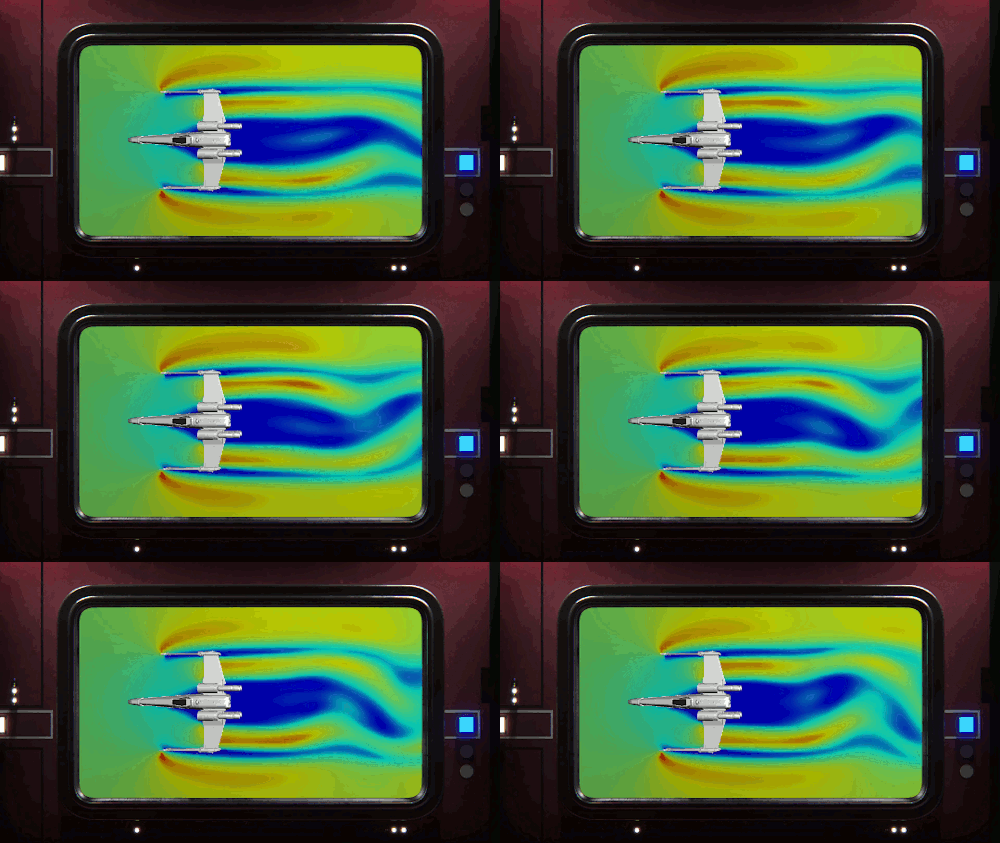
    Science fiction is not always known for hewing to scientific fact, so it will probably come as little surprise that Star Wars’ ships have terrible aerodynamics. But it’s nevertheless fun to see EC Henry’s analysis of drag coefficients of various Rebel and Imperial ships and just how poorly they fare against our own designs.

    Drag coefficients really only give a tiny piece of the story, though. We don’t know what speed Henry is testing the ships at, and we get no information about properties like lift or lift-to-drag ratio, which can be even more important than just the drag when it comes to evaluating an aircraft.

    There are some intriguing hints about other aerodynamic properties in the clips of flow around an X-wing and TIE fighter, though. Notice that the wake of both ships meanders back and forth. This is an indication of vortex shedding, and it means that both spacecraft would tend to be buffeted from side-to-side when flying in an atmosphere. Either the ships would need some kind of active control to counter those forces, or pilots would need iron constitutions to operate under those conditions! (Video and image credit: EC Henry)

    [original video no longer available]

  • Bouncing Off a Moving Wall

    Bouncing Off a Moving Wall

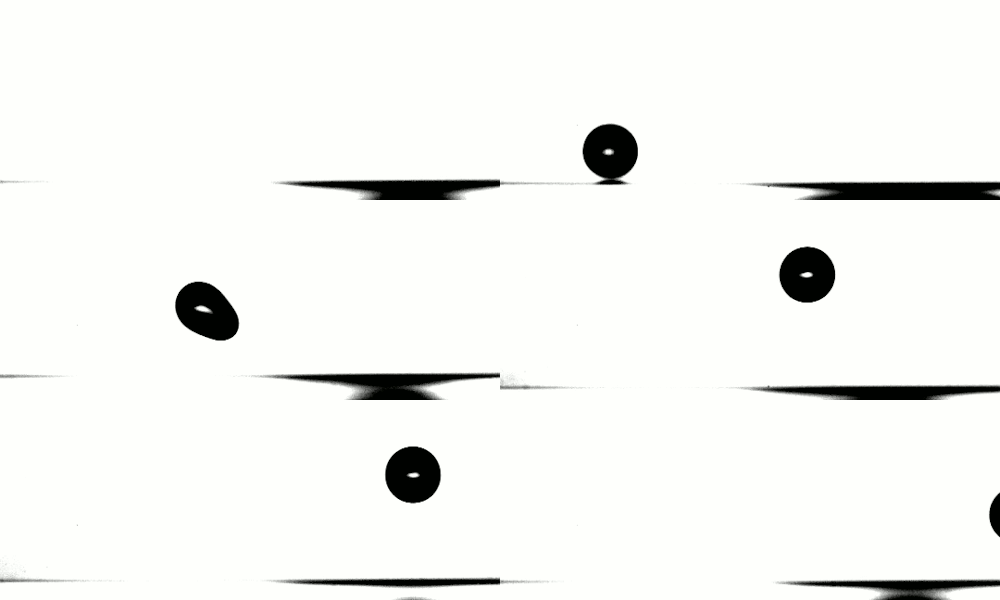
    There are many ways to repel droplets from a surface: water droplets will bounce off superhydrophobic surfaces due to their nanoscale structures; a vibrating liquid pool can keep droplets bouncing thanks to its deformation and a thin air layer trapped under the drop; and heated surfaces can repel droplets with the Leidenfrost effect by vaporizing a layer of liquid beneath the droplet. But all of these methods will only work for certain liquids under specific circumstances. 

    More recently, researchers have begun looking at a different way to repel droplets: moving the surface. The motion of the plate drags a layer of air with it; how thick that layer of air is depends on the plate’s speed. (Faster plates make thinner air layers.) Above a critical plate speed, a falling droplet will impact without touching the plate directly and will rebound completely. This works for many kinds of liquids – the researchers used silicone oil, water, and ethanol – across many droplet sizes and speeds. The key is that the air dragged by the plate deforms the droplet and creates a lift force. If that lift force is greater than the inertia of the droplet, it bounces. (Image and research credit: A. Gauthier et al., source)

  • Hydrofoils and Stability

    Hydrofoils and Stability

    Today’s fastest boats use hydrofoils to lift most of a boat’s hull out of the water. This greatly reduces the drag a boat experiences, but it can also make the boat difficult to handle. One style of hydrofoil boat, called a single-track hydrofoil, uses two hydrofoils in line with one another to support and steer the boat. The pilot can steer the lead hydrofoil into the direction of a fall to correct it. Stability-wise, this is the same way that you keep a bicycle upright. On a boat, the situation is a bit tougher to manage, and, like riding a bike, it takes practice. A group of students published a full mathematical model for the dynamics of this kind of boat, which allows designers to test a prototype’s stability early in the design process and enables student teams to use computer simulators to train their pilots to drive a boat before putting them out on the water, similar to the way that airplane pilots train. (Image credit: TU Delft Solar Boat Team, source; research credit: G. van Marrewijk et al., pdf; via TU Delft News; submitted by Marc A.)

  • The Hairyflower Wild Petunia

    The Hairyflower Wild Petunia

    Dispersing seeds is a challenge when you’re stuck in one spot, but plants have evolved all sorts of mechanisms for it. Some rely on animals to carry their offspring away, others create their own vortex rings. The hairyflower wild petunia turns its fruit into a catapult. As the fruit dries out, layers inside it shrink, building up strain that bends the fruit outward. Once a raindrop strikes it, the pod bursts open, flinging out around twenty tiny, spinning, disk-shaped seeds. That spin is important for flight. The best-launched seeds may spin as quickly as 1600 times in a second, which helps stabilize them in a vertical orientation that minimizes their frontal area and reduces their drag. Researchers found that these vertically spinning seeds have almost half the drag force of a spherical seed of equal volume and density. That means the hairyflower wild petunia is able to spread its seeds much further without a larger investment in seed growth. (Image and research credit: E. Cooper et al., source; via NYTimes; submitted by Kam-Yung Soh)

  • PyeongChang 2018: Cross-Country Skiing

    PyeongChang 2018: Cross-Country Skiing

    Cross-country skiing, also known as Nordic skiing, is a part of many longstanding disciplines in the Winter Games. Unlike downhill skiing, cross-country events typically involve mass starts, which allow athletes to interact, using one another for pacing and tactics. Drafting can be a valuable method to save energy and reduce drag. A following skier sees a 25% drag reduction while drafting; the lead skier gets about a 3% reduction in drag compared to skiing solo. Competitors usually wear tight-fitting suits to minimize drag, but unlike speedskating, for example, cross-country skiers don’t get much benefit from roughened surfaces and impermeable fabrics. Typical race speeds are 4 – 9 m/s, and most of these high-tech fabrics don’t provide tangible benefits until higher speeds. (Image credit: Reuters/S. Karpukhin, US Biathlon, GettyImages/Q. Rooney)

  • PyeongChang 2018: Speedskating

    PyeongChang 2018: Speedskating

    Four years ago in Sochi, Under Armour’s suits for the U.S. speedskating team took a lot of flak after the team failed to medal. The company defended the physics and engineering of their suits, and an internal audit of the speedskating program ultimately placed blame on flaws in their training regimen, unfamiliarity with the new suits, and overconfidence.

    This time around Under Armour has taken a more hands-on approach with the team, helping with training regimens in addition to providing suits. Under Armour spent hundreds of hours testing the suits in Specialized’s wind tunnel, including testing many fabrics before settling on the slightly rough H1 fabric used in patches on the skater’s arms and legs. Like the previous suit’s dimpled design, the roughness of the fabric promotes turbulent flow near it. Because turbulent flow follows curved contours better than laminar flow does, air stays attached to the athlete for longer, thereby reducing their drag. The suit is also designed with asymmetric seams that help the athlete stay low and comfortable in the sport’s frequent left turns.

    U.S. speedskaters have been competing in a version of the suits since last winter, ensuring that athletes are familiar with the equipment this time around. Whether the new suits and training program will pay off remains to be seen. After their disastrous experience in Sochi, both the team and the company are shy about setting expectations. (Image credits: D. Maloney/Wired; US Speedskating)