Search results for: “art”

  • Megaripples Beneath Louisiana

    Megaripples Beneath Louisiana

    Approximately 66 million years ago, a 10-km asteroid struck our planet near Chicxulub on the Yucatán Peninsula. The impact was globally catastrophic, causing tsunamis, wildfires, earthquakes, and so much atmosphere-clogging sediment that about 75% of all species on the planet — including the non-avian dinosaurs — died out. A new study points to another remnant of the impact: giant ripples buried in the sediment of Louisiana.

    Seismic data shows giant ripples left behind by the tsunami following the Chicxulub impact.

    Using seismic data collected by petroleum companies, the researchers describe the ripples as approximately 16 meters tall with a spacing around 600 meters, making them the largest known ripples on the planet. Currently, they are buried about 1500 meters underground, just below a layer of fine debris associated with the impact. The ripples show no evidence of erosion from storms or wind, leading the authors to conclude that they were deposited by an impact-associated tsunami and remained unaffected by smaller natural disasters before their burial. It’s very likely, according to the authors, that many other such megaripples exist, hidden away in proprietary petroleum data sets. (Image credits: top – D. Davis/SWRI, ripples – G. Kinsland et al.; research credit: G. Kinsland et al.; via Gizmodo)

  • Hydrodynamic Spin Lattices

    Hydrodynamic Spin Lattices

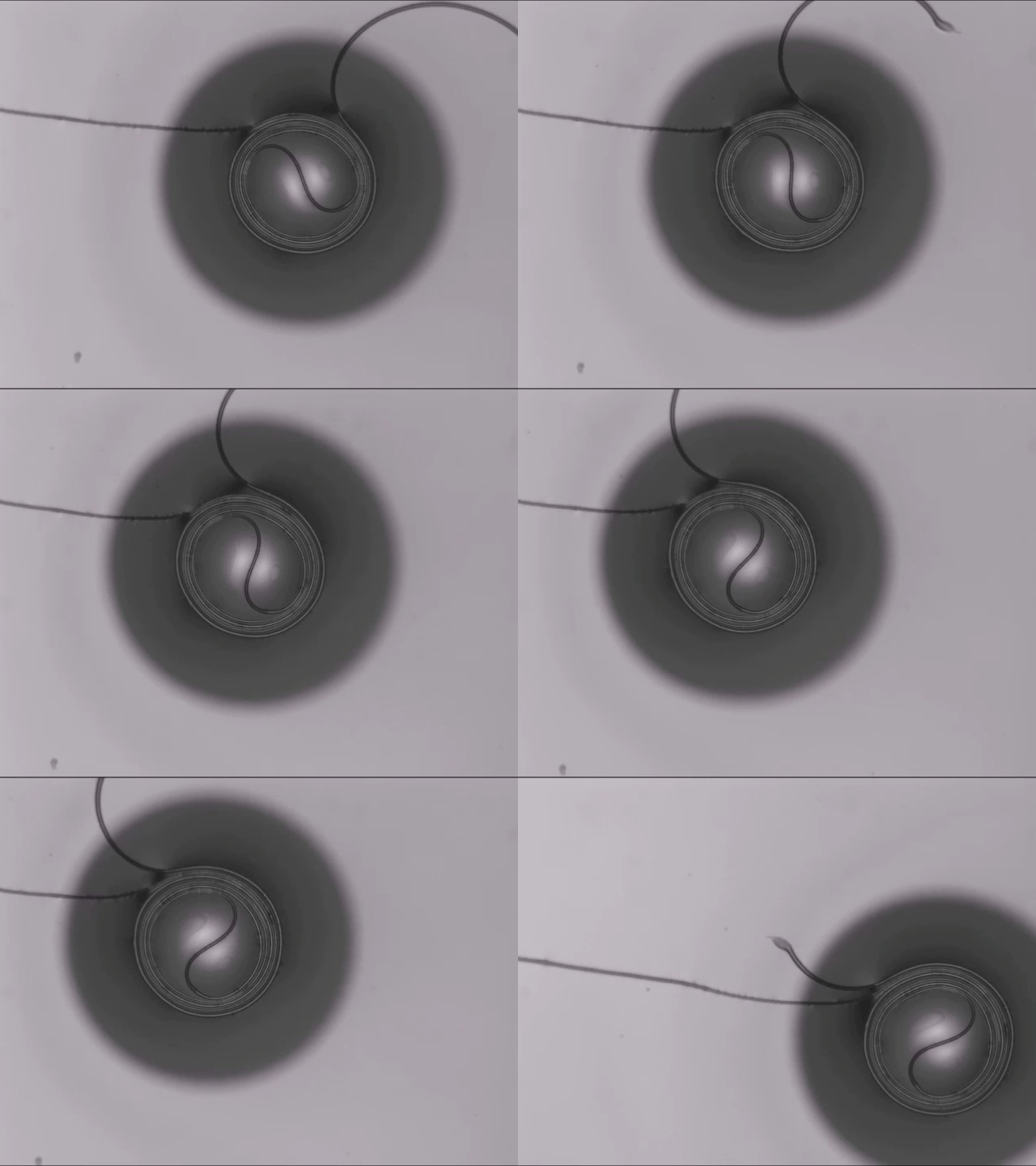
    Droplets bouncing on a fluid bath display some strikingly quantum-like behaviors thanks to the interactions between a drop and its guiding surface wave. Here, researchers use submerged wells beneath the drop to confine each droplet into a space where it bounces in a clockwise or anticlockwise trajectory.

    (a) An illustration of the experimental set-up and (b) top-down image of the spin lattice.

    With an array of these wells, the droplets form a lattice. Each drop remains in its well, but its wave travels beyond and interacts with nearby wells. Through this interaction, the researchers found that lattices tended to synchronize, similar to the way groups of fireflies will synchronize their flashing. This sort of behavior is also observed in quantum systems, and the researchers hope that further studying their bouncing droplets will give insight into quantum spin systems and their behaviors. (Image and research credit: P. Saenz et al.; via Nature; submitted by Kam-Yung Soh)

  • Flying Out of the Water

    Flying Out of the Water

    Flying fish and diving birds often navigate the interface between water and air in their flight, but few studies have actually looked at the effects of this transition on lift. In this work, researchers measured forces on a small, fixed wing as it egresses from water into air at a constant velocity.

    The tests showed that exit velocity had a large effect on lift generation. At low speeds, an exiting wing experienced a strong, positive lift spike as soon as the leading edge broke the surface. But that lift changed to strongly negative as the wing continued out of the water. At higher speeds, the wings had no lift reversal but also reached lower peak lift coefficients. The team studied the effects of angle of attack and starting depth as well, concluding that any vehicles intended to navigate the water-air transition will need robust control systems prepared to deal with fast-changing forces. (Image credit: fish – J. Cobb, wing – W. Weisler et al.; research credit: W. Weisler et al.)

  • Featured Video Play Icon

    “Kármán Vortex Street”

    Although engineers often consider fluid mechanics through the lens of mathematics, that’s far from the only way to understand fluid physics. Today’s video is an alternative interpretation of a classic flow — the flow around a cylinder — created in a collaboration between dancers and engineers. The result is what they call a “physics-constrained dance improvisation” that shows how the flow changes as its speed increases. I love this concept! It highlights the visual and qualitative differences between flow states and maintains space for artistic creativity. Be sure to watch the full video! (Video and submission credit: J. Capecelatro et al.)

  • Featured Video Play Icon

    Moths in Flight

    As student engineers, we often use fixed-wing aircraft to build our intuition for flight, but nature has so many other incredible examples to offer. Here we see high-speed video of seven different moth species taking off, and understanding fixed-wing flight won’t help you here at all! These moths have small, rough, and incredibly flexible wings — all characteristics an aircraft designer typically avoids. Yet these insects are agile, fast, and capable fliers at a scale that continues to thwart engineers. Some of the earliest pioneers of flight watched birds for inspiration; for small crafts, there’s no better teacher than insects. (Image and video credit: A. Smith/AntLab)

  • Whiffling Geese

    Whiffling Geese

    This wild photograph shows a goose flying upside down with its head turned 180 degrees in a behavior known as whiffling. In this orientation, the bird’s typical lift characteristics are reversed, but as you can see in the video below, this doesn’t exactly make them fall out of the sky. I suspect the geese compensate by changing their angle of attack (unless descending rapidly is their goal). There are numerous theories as to why the birds whiffle, including escaping hunters by using an erratic flight path or just showing off to the other geese. Maybe they’re just out to have a little fun! (Image credit: V. Cornelissen; video credit: Flightartists Project; via Colossal; submitted by jpshoer)

  • Sea Sponge Hydrodynamics

    Sea Sponge Hydrodynamics

    The Venus’s flower basket is a sea sponge that lives at depths of 100-1000 meters. Its intricate latticework skeleton has long fascinated engineers for its structural mechanics, but a new study shows that the sponge’s shape benefits it hydrodynamically as well.

    The sea sponge’s skeleton is predominantly cylindrical, with tiny gaps that allow water to flow through it and helical ridges alongside its outer surface to strengthen it against the deep-sea currents surrounding it. Through detailed numerical simulations, researchers found that both of these features — the holes and the ridges — serve fluid mechanical purposes for the sponge. The porous holes of the sea sponge drastically reduce flow in the sponge’s wake (third image), which provides major drag reduction for the sea sponge. That drag reduction makes it easier for the sponge to stay rooted to the ocean floor.

    The helical ridges, on the other hand, create low-speed vortices within the sea-sponge’s body cavity (second image). Such vortices increase the time water spends inside the sponge, likely helping it to filter-feed more efficiently. The additional vorticity comes at the cost of slightly increased drag but not enough to outweigh the savings from its porosity. (Image and research credit: G. Falcucci et al.; via Nature; submitted by Kam-Yung Soh)

  • Featured Video Play Icon

    Fish Versus Bird

    You’ve seen birds catch fish, but have you ever seen a fish that catches birds? In this video, giant trevally fish hunt fledgling terns — including those in flight! To do so, the fish must correctly assess the bird’s speed and trajectory across the water interface, a feat reminiscent of the archer fish’s aim. They also need the power and control to leap from the water and catch the birds in their mouth without relying on the suction technique so many fish use underwater. (Image and video credit: BBC Earth, from “Blue Planet II”)

  • The Froghopper’s Incredible Suction

    The Froghopper’s Incredible Suction

    The tiny froghopper feeds on the sap in xylem, a feat that requires overcoming more than a megapascal of negative pressure. Plants, as you may recall, transport water and nutrients from their roots to their leaves through negative pressure, essentially pulling on the water as if it were a rope. So drinking that sap is not as simple as making a hole and waiting for sap to flow. Instead, froghoppers must generate even more suction than the plant. Some scientists have been so skeptical that such a feat is even possible that they’ve disputed whether plants are truly at such high negative pressures.

    But a new study shows that froghoppers can, indeed, generate immense suction – up to nearly 1.5 megapascals. (By comparison, humans generate less than a tenth of that suction, even on a stubborn milkshake.) The researchers used two complementary methods to prove the insects’ ability. First, they studied the anatomy of the pumplike structure in the froghoppers’ heads, where the suction is generated, and determined the insects’ sucking potential from a simple calculation of force divided by area. Then, they observed feeding froghoppers in a chamber where they could measure their metabolic rates through carbon dioxide output. As the froghoppers fed, their metabolic rates spiked to 50 – 85% higher than when at rest. Only when the xylem tensions exceeded the theoretical biomechanical limits for froghopper suction did the tiny insects seem to stop feeding. (Image and research credit: E. Bergman et al.; via Science News; submitted by Kam-Yung Soh)

  • Featured Video Play Icon

    “Starlit”

    In “Starlit” filmmaker Roman De Giuli explores a universe in a fish tank. The planets and asteroids we see are droplets of paint and ink floating in a transparent, gel-like medium. I particularly like the sequences where paint stretches, beads up, and breaks into a string of droplets! (Image and video credit: R. De Giuli)