Search results for: “art”

  • Featured Video Play Icon

    Hand-Making Artist-Grade Pastels

    I’m constantly fascinated by the intersections of art and fluid mechanics. In this video, we get an inside look at a French atelier making artist-grade pastels using centuries-old methods. And although the final product doesn’t appear to have much to do with fluids — compared to, say, paint — the process behind each pastel involves a lot of fluid mechanics: mixing, pressing, drying, and rolling. It’s a neat look at how a niche product gets made. (Video and image credit: Business Insider)

    P.S. – Next week we’ll kick off our Paris Olympics coverage, but if you’d like a head start on the celebration, you can find our coverage of previous Olympics here. – Nicole

  • Featured Video Play Icon

    “The Art of Flying”

    Like schools of fish, starlings gather in massive undulating crowds. Known as murmurations, these gatherings are a type of collective motion. Scientists often try to mimic these groups through simulations and lab experiments where individuals in a swarm obey simple rules that depend only on observing their neighbors. It requires very little, it turns out, to form swarms that move in this beautiful manner! (Video and image credit: J. van IJken; via Colossal)

  • “Earth’s Treasure”

    “Earth’s Treasure”

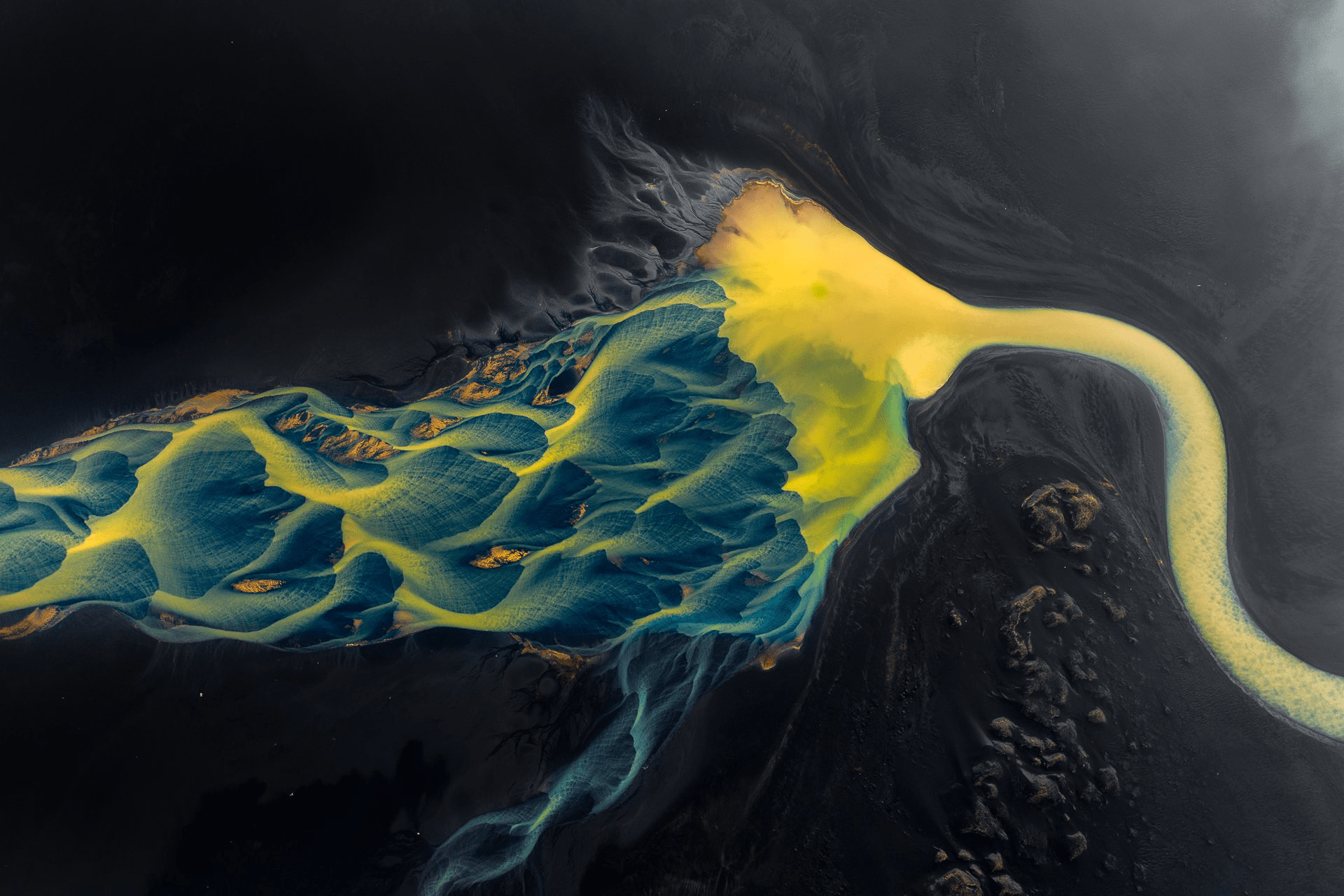
    Streams of blue and yellow braid across Iceland’s volcanic landscape in this award-winning photo from Miki Spitzer. Glacial water shows an icy blue and sediments glisten in gold. Together, their interplay creates an arresting delta viewed from above. (Image credit: M. Spitzer; via WNPA)

  • Parting a Flame

    Parting a Flame

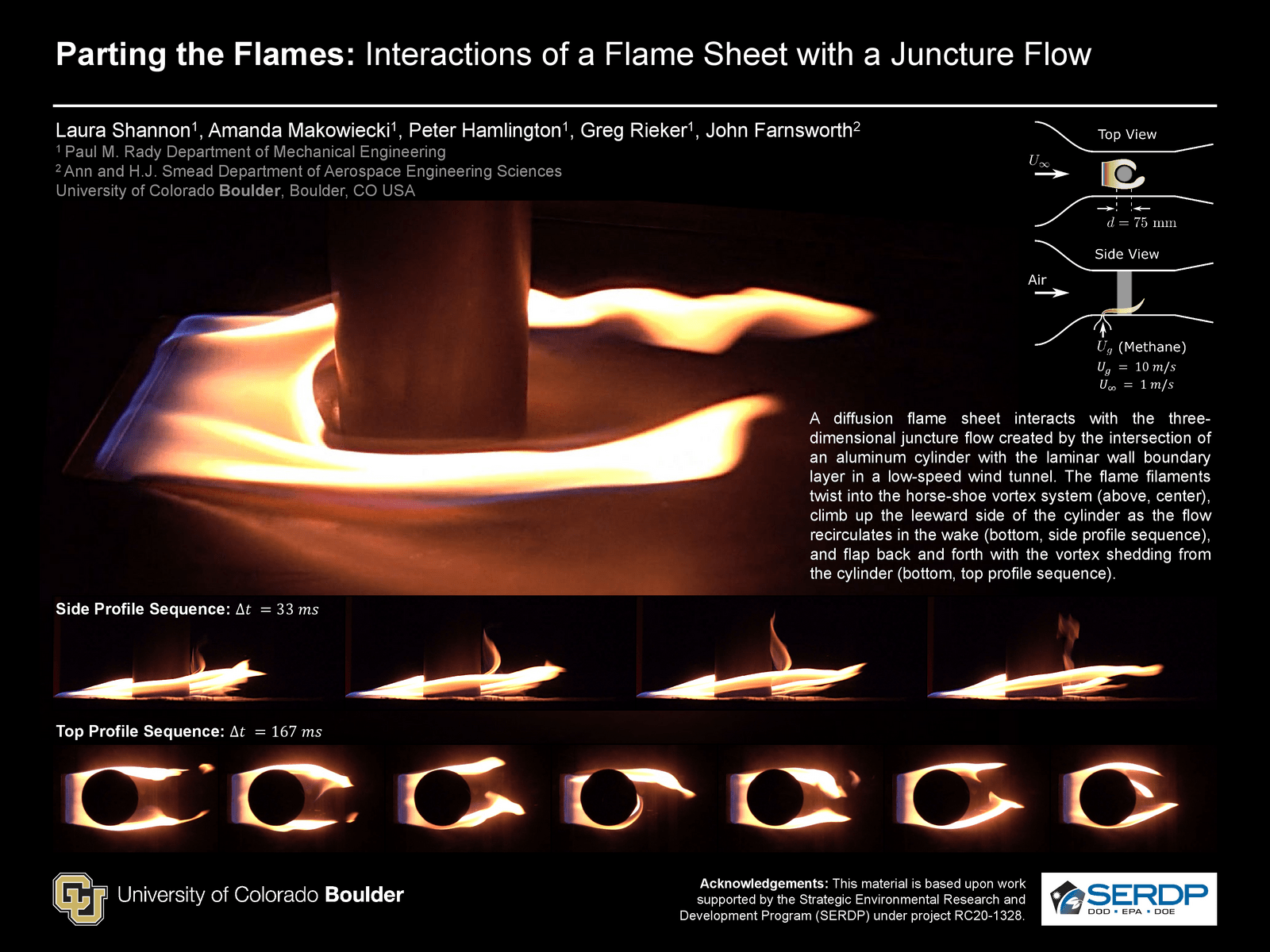
    A sheet of flame splits around a cylinder in this Gallery of Fluid Motion poster. Looking at the image sequences, you can see how the flames lift up as they flow around the cylinder, following the arms of a horseshoe vortex. Researchers study situations like this one to better understand how wildfires move as they encounter obstacles. Understanding and predicting how fires flow is increasingly important with more wildfires encountering human-built infrastructure. (Image credit: L. Shannon et al.)

  • Featured Video Play Icon

    Inside a Zebrafish Heart

    This glimpse inside a 5-day-old zebrafish’s heart shows why they’re often used as a model organism in cardiac studies. The fish’s heart rate is similar to humans and its two-chamber heart — one atrium and one ventricle, both seen here — serves as a simplified version of ours. Check out the slowed-down section of the video to clearly see blood filling and expanding one chamber before it’s pumped onward. Perhaps the most unusual feature of the zebrafish’s heart is its ability to regenerate; after amputation of up to 20% of its ventricle, the fish can fully regenerate its heart. That’s a pretty incredible recovery, especially when you consider that the heart has to keep pumping the entire time! (Video credit: M. Weber/2023 Nikon Small World in Motion Competition)

  • Featured Video Play Icon

    Aquatic Escape Artists

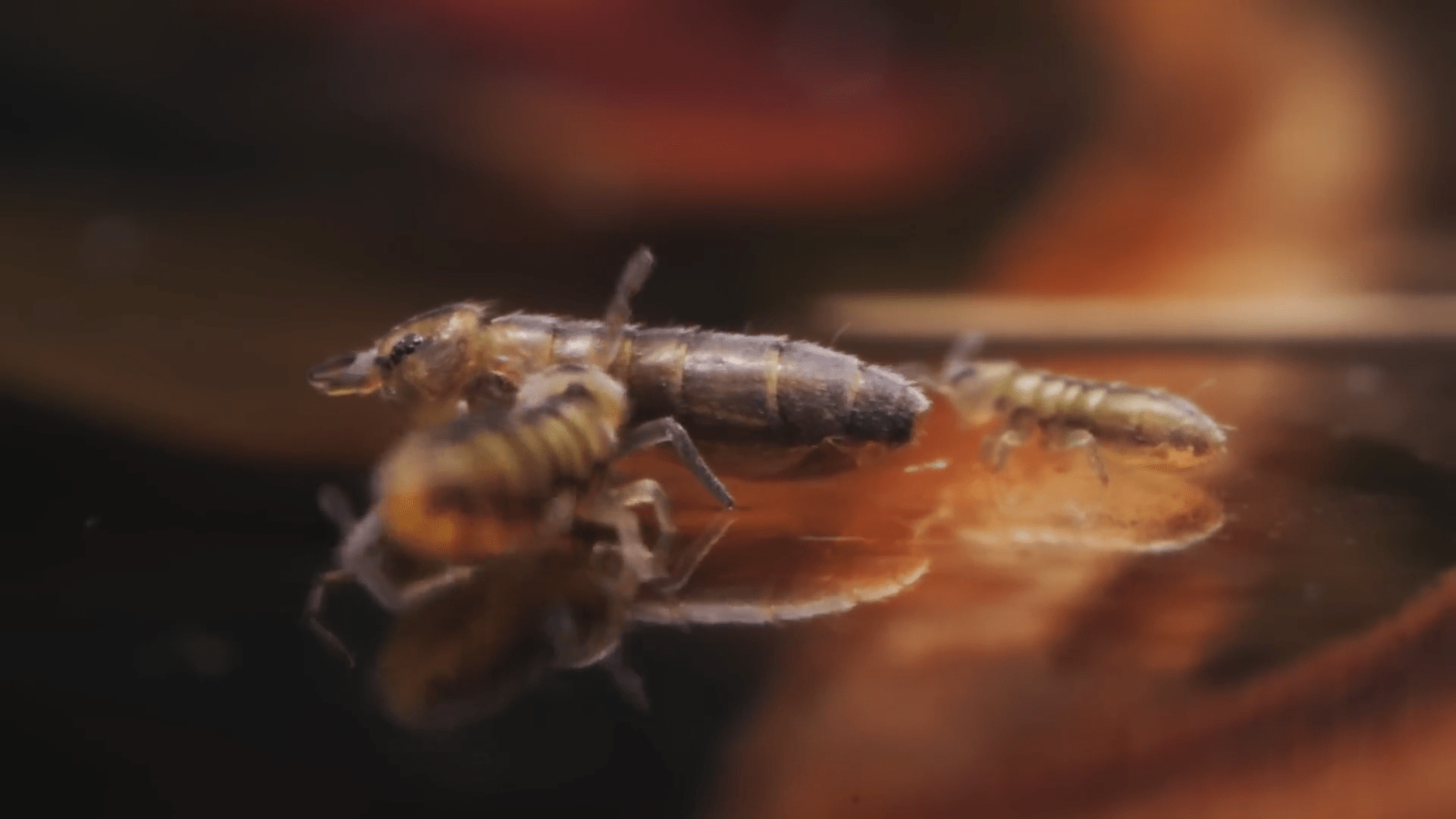
    Springtails are tiny hexapods found living on the air-water interface. Like other creatures living at the interface, they sometimes need to make a quick escape. For the springtail, that means a high-flying leap, driven by their fork-shaped furcula. The springtail soars into the air, where it contorts its body and uses aerodynamic forces — along with a droplet it carries on its belly — to orient itself. For landing, it uses that droplet as a sticky anchor that helps it adhere to water (or ground) instead of bouncing. Nailing that landing sets it up to make another daring escape as quickly as needed. (Video and image credit: Deep Look; research credit: V. Ortega-Jimenez et al.)

  • Bubble Growth, Inspired By Art

    Bubble Growth, Inspired By Art

    Eighteenth- and nineteenth-century French painters like Chardin and Manet had a certain fascination with bubble-blowing physics. Both left behind artwork depicting children blowing soap bubbles through straws. Now researchers are exploring this bubble-making method in a recent study.

    To blow a bubble from a straw or other narrow constriction, there are three basic stages. In the first, the soapy interface bulges and takes on a spherical shape. That’s followed by a period of rapid growth in less than 100 milliseconds. And, finally, the bubble will pinch off and detach from the straw. So far, most studies have focused on that third phase. Instead, this team focused on those early stages.

    In that first stage, the bubble’s growth depends on air getting forced out of an attached reservoir. For children, that’s their lungs reducing in volume as they blow air into the straw. In their experiments, the team found that the initial volume of the air reservoir is an important (and previously overlooked) factor in controlling bubble growth. (Image credit: J. Chardin; research credit: M. Grosjean and E. Lorenceau; via Ars Technica)

  • Featured Video Play Icon

    Studying Earth’s Interior

    The Earth’s interior is almost entirely inaccessible to humanity, so how do we know what it consists of? As explained in this video, our knowledge of the planet’s interior is based on measuring waves sent out by earthquakes and nuclear blasts. Both produce two kinds of waves — pressure waves (P-waves) and shear waves (S-waves) that travel through the earth and get picked up by seismometers. Scientists noticed that pressure waves travel through the center of the planet while shear waves — which get dissipated in liquids — do not. This led them to conclude that part of Earth’s interior is a liquid. The idea of a solid inner core came from observations of pressure waves scattering in a way that only made sense if they’d hit something solid. (Video and image credit: Science)

  • Fast-Moving Martian Rivers

    Fast-Moving Martian Rivers

    For the first time, scientists have found evidence of deep, fast-flowing ancient rivers on Mars. After examining images taken recently by the Perseverance rover in Jezero Crater, fluvial experts have spotted familiar signs of turbulent river flow. The mosaic above shows an area nicknamed “Shrinkle Haven,” where curved bands of rock mark the landscape. Although scientists are confident that a powerful river deposited these rocks, they’re still debating whether that river was a meandering one like the Mississippi or a braided river like the Platte.

    Nicknamed "Pinestand," this hill's sedimentary layers were likely formed by a deep fast-moving river.
    Nicknamed “Pinestand,” this hill’s sedimentary layers were likely formed by a deep, fast-moving river.

    In another area, known as “Pinestand,” scientists spotted hills as high as 20 meters tall with clear sedimentary layers. Like Shrinkle Haven’s rock bands, formations like this are most often associated with a large, fast-flowing river. (Image credits: NASA/JPL-Caltech/ASU/MSSS; via Gizmodo; see also NASA JPL)