Search results for: “art”

  • Slipping Ice Streams

    Slipping Ice Streams

    The Northeast Greenland Ice Stream provides about 12% of the island’s annual ice discharge, and so far, models cannot accurately capture just how quickly the ice moves. Researchers deployed a fiber-optic cable into a borehole and set explosive charges on the ice to capture images of its interior through seismology. But in the process, they measured seismic events that didn’t correspond to the team’s charges.

    Instead, the researchers identified the signals as small, cascading icequakes that were undetectable from the surface. The quakes were signs of ice locally sticking and slipping — a failure mode that current models don’t capture. Moreover, the team was able to isolate each event to distinct layers of the ice, all of which corresponded to ice strata affected by volcanic ash (note the dark streak in the ice core image above). Whenever a volcanic eruption spread ash on the ice, it created a weaker layer. Even after hundreds more meters of ice have formed atop these weaker layers, the ice still breaks first in those layers, which may account for the ice stream’s higher-than-predicted flow. (Image credit: L. Warzecha/LWimages; research credit: A. Fichtner et al.; via Eos)

    Fediverse Reactions
  • Imaging a New Era of Supersonic Travel

    Imaging a New Era of Supersonic Travel

    Supersonic commercial travel was briefly possible in the twentieth century when the Concorde flew. But the window-rattling sonic boom of that aircraft made governments restrict supersonic travel over land. Now a new generation of aviation companies are revisiting the concept of supersonic commercial travel with technologies that help dampen the irritating effects of a plane’s shock waves.

    One such company, Boom Supersonic, partnered with NASA to capture the above schlieren image of their experimental XB-1 aircraft in flight. The diagonal lines spreading from the nose, wings, and tail of the aircraft mark shock waves. It’s those shock waves’ interactions with people and buildings on the ground that causes problems. But the XB-1 is testing out scalable methods for producing weaker shock waves that dissipate before reaching people down below, thus reducing the biggest source of complaints about supersonic flight over land. (Image credit: Boom Supersonic/NASA; via Quartz)

    The XB-1 test aircraft in flight.
    Fediverse Reactions
  • Featured Video Play Icon

    Seeing Sound

    Sound, vibration, and motion are all inextricably linked. In this BBC video, physicist Helen Czerski shows how an object’s sound and vibrations relate through the classic Chladni experiment. She vibrates a metal plate scattered with sand. At most vibration frequencies, the particles of sand bounce all over the place with no distinctive pattern. But at an object’s natural frequencies, there are standing waves and the sand gathers in spots where the standing wave has no vertical motion. The higher the vibration frequency, the more complex the pattern the sand makes. All of this plays into the sounds we hear, too. When struck, an object vibrates at many of its natural frequencies at once. That’s what gives us a rich, musical tone — all those layered frequencies. (Video and image credit: BBC)

    Fediverse Reactions
  • Ultra-Soft Solids Flow By Turning Inside Out

    Ultra-Soft Solids Flow By Turning Inside Out

    Can a solid flow? What would that even look like? Researchers explored these questions with an ultra-soft gel (think 100,000 times softer than a gummy bear) pumped through a ring-shaped annular pipe. Despite its elasticity — that tendency to return to an original shape that distinguishes solids from fluids — the gel does flow. But after a short distance, furrows form and grow along the gel’s leading edge.

    Front view of an ultra-soft solid flowing through an annular pipe. The furrows forming along the face of the gel are places where the gel is essentially turning itself inside out.
    Front view of an ultra-soft solid flowing through an annular pipe. The furrows forming along the face of the gel are places where the gel is essentially turning itself inside out.

    Since the gel alongside the pipe’s walls can’t slide due to friction, the gel flows by essentially turning itself inside out. Inner portions of the gel flow forward and then split off toward one of the walls as they reach the leading edge. This eversion builds up lots of internal stress in the gel, and furrowing — much like crumpling a sheet of paper — relieves that stress. (Image and research credit: J. Hwang et al.; via APS News)

    Fediverse Reactions
  • Featured Video Play Icon

    Strandbeest Evolution

    Theo Jansen’s Strandbeests are massive, wind-powered kinetic sculptures designed to roam Dutch beaches. Conceived in the late 1980s as a way to kick up sand that would replenish nearby dunes, the beests have grown into a decades-long obsession for the artist and his followers. This Veritasium video charts the development and evolution of the Strandbeest from its original concept through Jansen’s increasingly self-sufficient versions. I found the leg linkage of the Strandbeest especially fascinating. How neat to find a relatively simply proportion of linkages capable of turning a small crank’s motion into a stable walking gait. Anyone else feel like building a miniature Strandbeest now? (Video and image credit: Veritasium)

    Fediverse Reactions
  • Anti-Icing Polar Bear Fur

    Anti-Icing Polar Bear Fur

    Despite spending their lives in and around frigid water, snow, and ice, polar bears are rarely troubled by ice building up on their fur. This natural anti-icing property is one Inuits have long taken advantage of by using polar bear fur in hunting stools and sandals. In a new study, researchers looked at just how “icephobic” polar bear fur is and what properties make it so.

    The key to a polar bear’s anti-icing is sebum — a mixture of cholesterol, diacylglycerols, and fatty acids secreted from glands near each hair’s root. When sebum is present on the hair, the researchers found it takes very little force to remove ice; in contrast, fur that had been washed with a surfactant that stripped away the sebum clung to ice.

    The researchers are interested in uncovering which specific chemical components of sebum impart its icephobicity. That information could enable a new generation of anti-icing treatments for aircraft and other human-made technologies; right now, many anti-icing treatments use PFAS, also known as “forever chemicals,” that have major disadvantages to human and environmental health. (Image credit: H. Mager; research credit: J. Carolan et al.; via Physics World)

    Fediverse Reactions
  • A Drop’s Shape Effects

    A Drop’s Shape Effects

    Falling raindrops get distorted by the air rushing past them, ultimately breaking large droplets into many smaller ones. This research poster shows how variable this process is by showing two different raindrops, both of the same 8-mm initial diameter. On the left, the drop is prolate — longer than it is wide — and on the right, the drop is oblate — wider than it is long. Moving from bottom to top, we see a series of snapshots of each drop’s shape as it deforms and, eventually, breaks into smaller drops. The overall process is similar for each: the drop flattens, dimples, and then inflates like a sail, with part of the drop thinning into a sheet and ultimately breaking into smaller droplets. Yet, each drop’s specific details are entirely different. (Image credit: S. Dighe et al.)

    Fediverse Reactions
  • Disappearing Sea Ice Ridges

    Disappearing Sea Ice Ridges

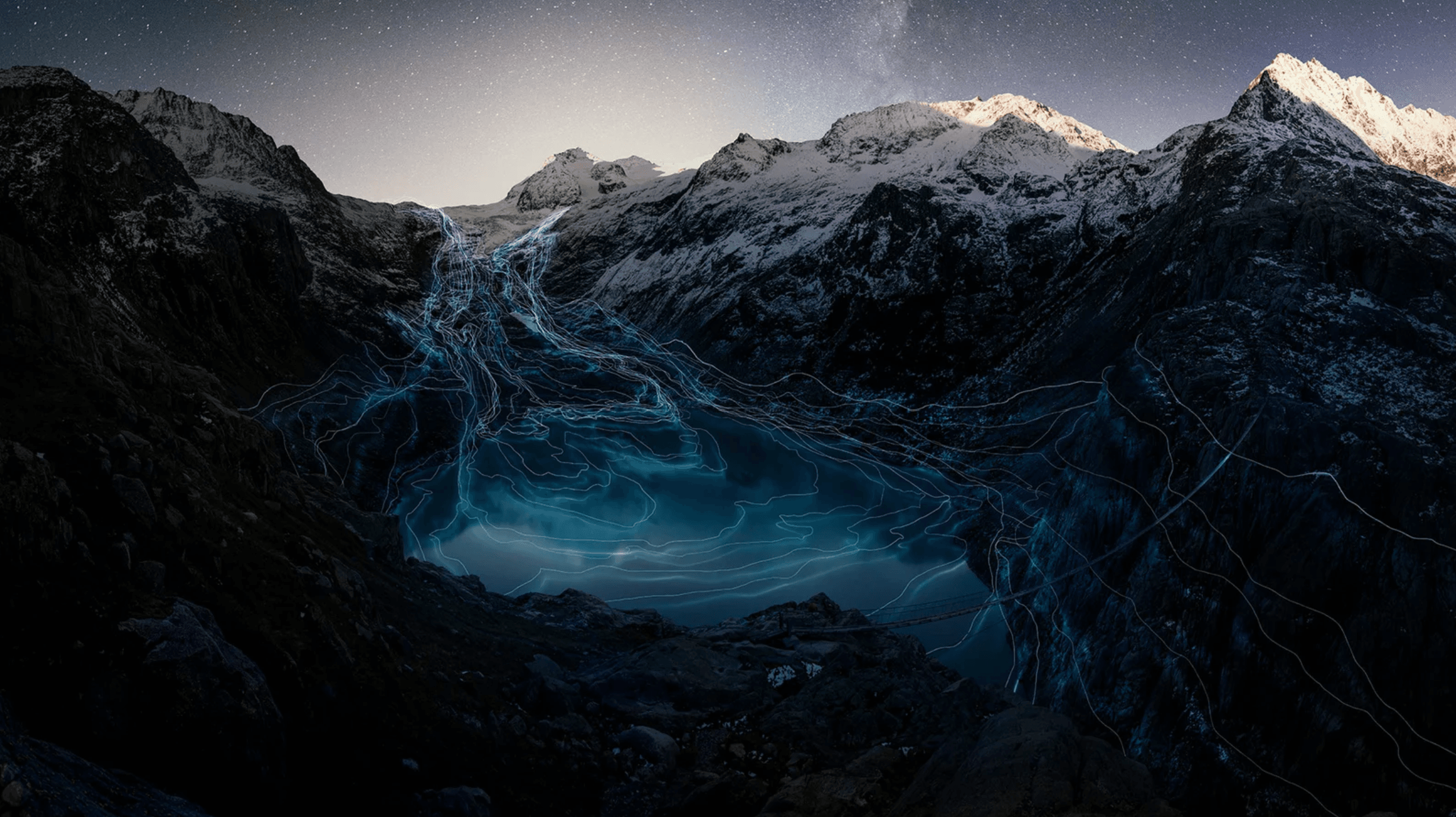
    As blocks of sea ice shift and float, they can press together, forming ridges spaced every few hundred meters or so. A new study uses aerial observations from recent decades to show that these sea ridges are getting smaller in both size and number, a smoothing of Arctic topography that has many consequences.

    The team showed that the overall changes in the sea ridges correspond to a loss of older sea ice. The current smoother sea ice presents less drag to winds and currents, which might suggest that the ice is slower-moving, but instead the opposite seems true. Scientists are not sure why the ice is moving faster, though faster ocean currents may play a role.

    Another consequence of smoother sea ice is wider, shallower melt ponds each summer. These wider ponds increase the amount of sunlight the ice absorbs, hastening melting even further. (Image credit: USGS; research credit: T. Krumpen et al.; via Eos)

  • Featured Video Play Icon

    “Trinity”

    Inspired by the film Oppenheimer, artist Thomas Blanchard created “Trinity,” a short film imagining a nuclear explosion with macro-scale fluid motion. There’s clever video editing and compositing in this video, but no CGI. Instead, Blanchard filmed fire, sparklers, alcohol inks, pigments and more up close and in stunning detail. As always, his work is a reminder of the amazing possibilities of analog-based art. (Video and image credit: T. Blanchard)

  • Baseball’s Mysterious Rubbing Mud

    Baseball’s Mysterious Rubbing Mud

    Since 1938, every ball in Major League Baseball has been covered in a special “rubbing mud” harvested from a secret location in New Jersey. Although the league has tried in the past to replace the mud with an alternative, it’s never stuck. Researchers wondered just what makes this mud so special, so naturally, they brought some to the lab to study its composition and rheology.

    The mud consists of clay, silt, and sand with a smattering of organic particles. The make-up was pretty typical of river mud in the region, although researchers noted a drop-off in large particle sizes that probably indicates some sieving. In terms of rheology, the mud is shear-thinning, meaning it behaves a bit like lotion. It sits solidly in the hand until it’s deformed, at which point it smoothly coats the surface as a liquid would.

    So how does the mud change the baseballs? The researchers found three effects. First, the mud’s shear-thinning allowed it to fill in any pores or imperfections in the ball’s surface, creating a more uniform surface. Second, the dried mud’s residue doubled the ball’s contact adhesion. And, finally, the occasional large sand particles glued to the ball by the dried mud added friction. As the researchers put it, the rubbing mud “spreads like skin cream and grips like sandpaper.” (Image credit: L. Juarez; research credit: S. Pradeep et al.; via EOS)
    Fediverse Reactions