Not all fluids are, well, fluid. Traffic, flocks of birds, ants, and even sheep can behave like fluids. This video shows an aerial perspective on sheep being herded, and despite the four-legged nature of these particles, they have a lot of fluid-like characteristics. You can watch ripples and waves travel through the herd and see how disturbances propagate. The herd is actually a brilliant example of compressible flow; notice how the sheep slow down and bunch up as they near the gate then speed up and spread out once they pass the constriction. This is exactly how supersonic fluids behave! (Video credit: T. Whittaker; submitted by Simon H and John B)
If you’re in the DC area, I’ll be speaking at the Annals of Improbable ResearchShow at the AAAS meeting Saturday evening. Our session is open to the public, but it’s likely to be crowded, so you may want to arrive early!
I’m not a winter person, but there’s something almost magical about the way water freezes. From instant snow to snow rollers and weird ice formations to slushy waves, winter brings all kinds of bizarre and unexpected sights. The video above is an artistic look at one of my favorites – freezing soap bubbles. Normally, the thin film of a soap bubble is in wild motion, convecting due to gravity, surface tension differences, and the surrounding air. Such a thin layer of liquid loses its heat quickly, though, and, as ice crystals form, the bubble’s convection and rotation slow dramatically, often breaking the thin membrane. Happily photographer Paweł Załuska had the patience to capture the beautiful ones that didn’t break! (Video credit: P. Załuska; via Gizmodo)
If you enjoy FYFD and want to help support it, please consider becoming a patron!
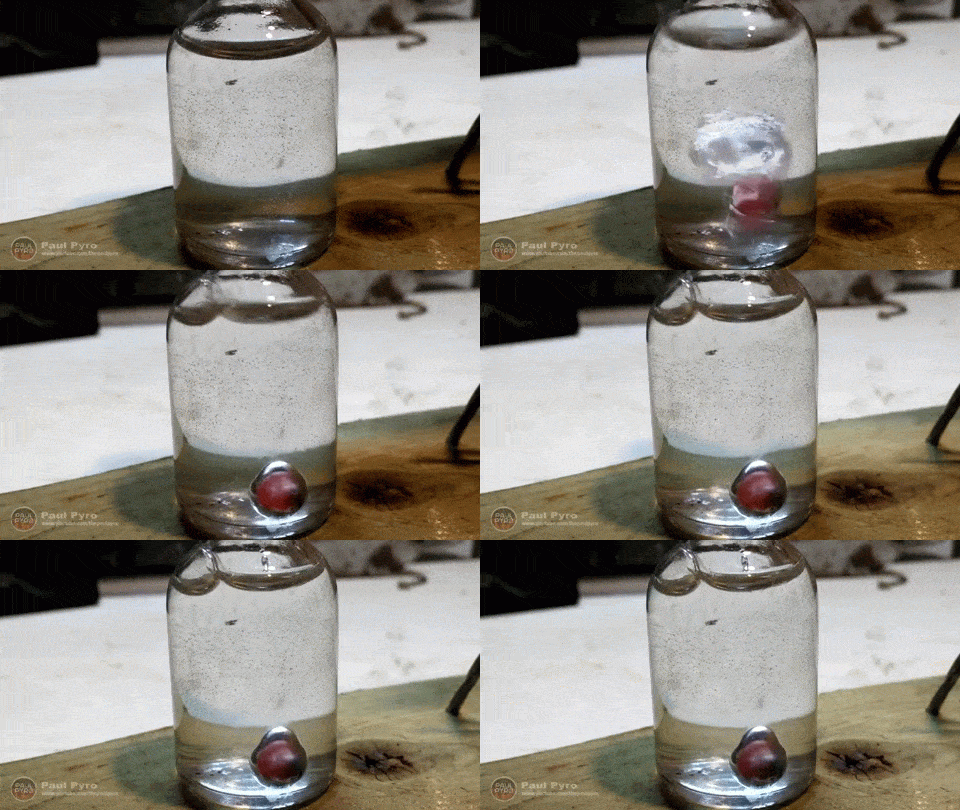
The Leidenfrost effect occurs when a liquid is exposed to a surface so hot that it instantly vaporizes part of the liquid. It’s typically seen with a drop of water on a very hot pan; the drop will slide around, nearly frictionless, upon a cushion of its own vapor. You can see the effect when plunging a hot object into a bath of liquid, too. This is what happens when you quickly dunk a hand in liquid nitrogen (not recommended, incidentally) or when you drop a red hot steel ball into water like above. In this case, the object is so hot that it gets encased in a layer of water vapor. If you could maintain the temperature difference necessary to keep the vapor layer intact, you could move underwater at high speeds with low drag, similar to the effects of supercavitation. (Image credit: Paul Pyro, source)
If you enjoy FYFD, please consider supporting the site by becoming a patron!
Give your wine glass a swirl and afterward you may notice little rivulets of wine along the side of your glass. These so-called “tears of wine” or “wine legs” are caused by a combination of evaporation, surface tension, and gravity. After the glass has been swirled, alcohol from the thin layer of wine on the glass wall quickly evaporates, leaving behind a fluid that is more watery than the wine in the glass. Since water has a higher surface tension than alcohol or wine, it pulls more fluid up the wall via the Marangoni effect. This carries on until enough wine is pulled up to form a droplet that’s heavy enough to slide down the glass. This up-and-down exchange of fluid is nicely illustrated in the video above, where the tiny particles in the wine help show how flow gets drawn up even as your eye follows the drops sliding down. (Video credit: A. Athanassiadis and K. Khalil; submitted by Thanasi A.)
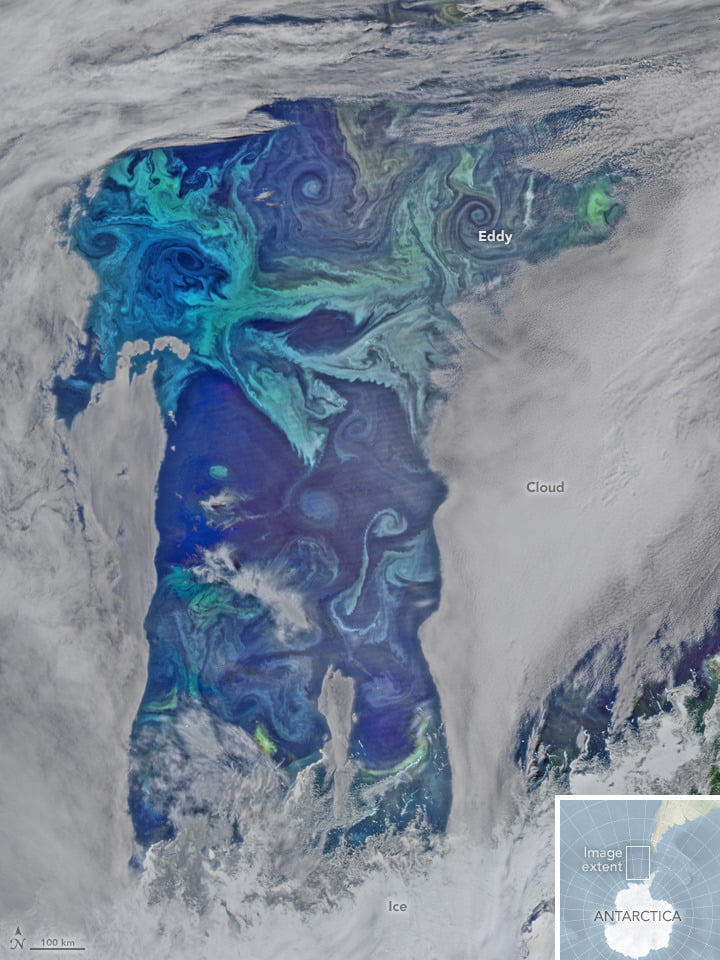
Phytoplankton, tiny plant-like organisms that live in ocean waters, act like nature’s tracer particles, making visible flows that would otherwise go unnoticed. In this satellite imagery, a phytoplankton bloom in the Southern Ocean off the coast of Antarctica highlights the turbulence of this region. Strong, steady winds and currents are typical for this area, which helps drive heat exchange between the ocean and atmosphere. The swirling eddies we see – many of them 100 km across! – are evidence of that turbulence. They’re also a sign of nitrogen and other nutrients getting mixed up in the action; it’s these nutrients that help generate the bloom in the first place. (Image credit: N. Kuring/NASA Earth Observatory)
Here’s to another fluids round-up, our look at some of the interesting fluids-related stories around the web:
– Above is a music video by Roman Hill that relies on mixing and merging different fluids and perturbing ferrofluids for its visuals as it re-imagines the genesis of life.
– What happens when you bathe in 500 pounds of putty? Let’s just say that bathing in an extremely viscous non-Newtonian fluid is not recommended. (via Gizmodo)
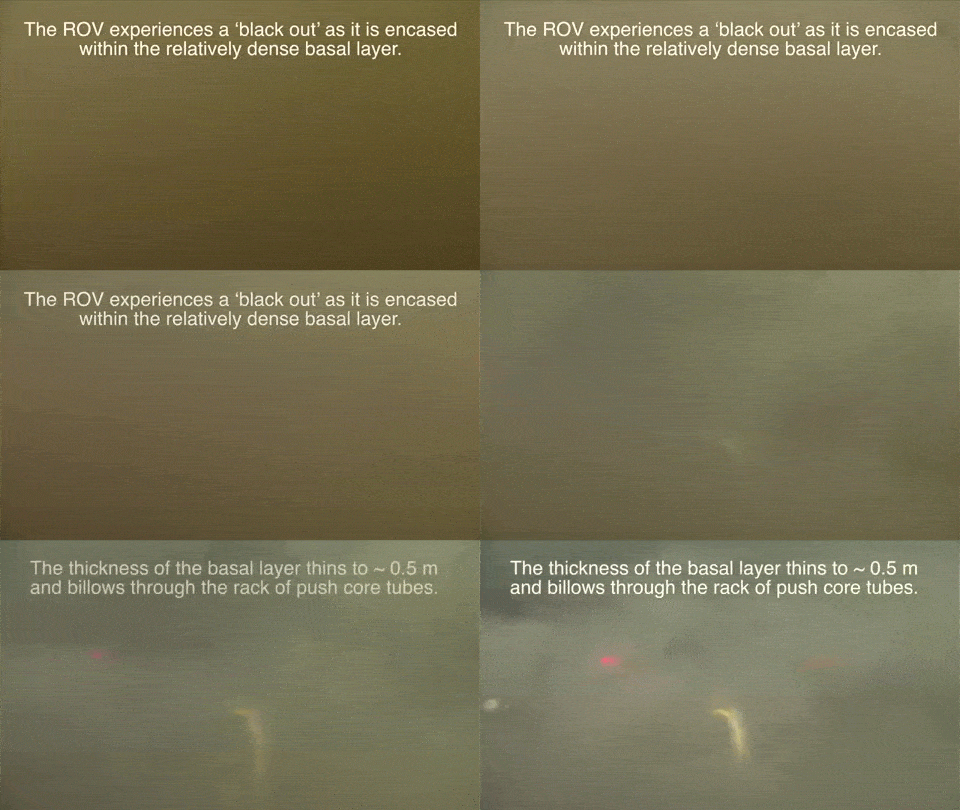
Turbidity currents are a gravity-driven, sediment-laden flow, like a landslide or avalanche that occurs underwater. They are extremely turbulent flows with a well-defined leading edge, called a head. Turbidity currents are often triggered by earthquakes, which shake loose sediments previously deposited in underwater mountains and canyons. Once suspended, these sediments make the fluid denser than surrounding water, causing the turbidity current to flow downhill until its energy is expended and its sediment settles to form a turbidite deposit. By sampling cores from the seafloor, scientists studying turbidites can determine when and where magnitude 8+ earthquakes have occurred over the past 12,000+ years! (Video credit: A. Teijen et al.; submitted by Simon H.)
Do you enjoy FYFD and want to help support it? Then please consider becoming a patron!
tl;dr version: FYFD is launching a Patreon campaign. If you enjoy FYFD and want to help support its continued growth, please become a patron today!
And the longer version: At the start of the year, I hinted that there were big things ahead for FYFD. Today’s announcement is part of that. In the past five years, FYFD has grown beyond my wildest dreams. I’m so excited, grateful, and happy to share my love for science with all of you. As FYFD’s audience has grown, so have my plans and dreams for expanding the site and what it does. I want to bring you more: videos that take you behind-the-scenes to see the scientific process firsthand, interviews that let you meet the people behind the work, and articles that explore new and exciting fluid phenomena.
All of the research, filming, writing, and editing necessary to bring those dreams to life takes time and money. I can provide the first: from now on, I’ll be dedicating my full-time attention to FYFD. But I need your help and support to make this possible. That’s why I’m launching a campaign on Patreon. If you enjoy FYFD and want to help it continue and grow, please consider becoming a patron. Your monthly support will enable me to dedicate my full energy to FYFD and will provide funding for materials, equipment, and travel so that I can bring the science back to you.
There are also some pretty cool rewards available to patrons! All patrons will have access to a patrons-only activity feed where I post behind-the-scenes content and extras like video outtakes. It’s also a place where I’ll look for feedback on new ideas. Think of it as an extra dose of FYFD. Other rewards include getting your name added to the FYFD supporter page, getting a handwritten postcard from me, and access to a monthly webcast where I’ll chat with guest scientists and patrons. (I’m really excited about that last one!)
Whether you become a patron or not, I want to thank you for your support. None of those would be possible without you and your enthusiasm. As always, the best thing you can do to support FYFD is to tell others how much you like it.Thank you!
If you have any questions, I’ll be online all day. You can reach me via Tumblr, Twitter, or email.
Paint getting flung from a spinning drill bit can create some incredible art. Here the Slow Mo Guys recreate the effect in high-speed video. What we’re seeing is tug of war between centrifugal force, which tries to fling the paint outward, and internal forces in the paint, which struggle to hold the the fluid together. Primarily, it’s surface tension keeping the fluid together, but, depending on what sort of non-Newtonian fluid the paint may be, there could be other internal forces helping keep the paint intact. In this case, centrifugal force is clearly winning out, though the paint stretches pretty far before it thins enough to break. It would be interesting to see how the balance plays out with the drill bit spinning at a lower RPM. (Image credit: Slow Mo Guys, source)