
Imagine that you partially fill a horizontal cylinder with a viscous fluid, like corn syrup or honey. If that cylinder is still, the fluid will simply pool along the bottom. On the opposite extreme, if you spin it very fast, that cylinder will become coated in an even layer of fluid that rotates along with the cylinder thanks to centrifugal force. Between those two extremes in rotational velocity, some interesting fluid behaviors occur. Start spinning the cylinder and some of the pooled fluid will be pulled up the sides, eventually forming a thicker film with a straight front along the bottom of the cylinder. Spin faster and that straight front starts to break down, forming sharper cusp-like waves known as shark teeth. (Image credit: S. Morris et al., source; research credit: S. Thoroddsen and L. Mahadevan)
Search results for: “art”

Reader Question: Rudders
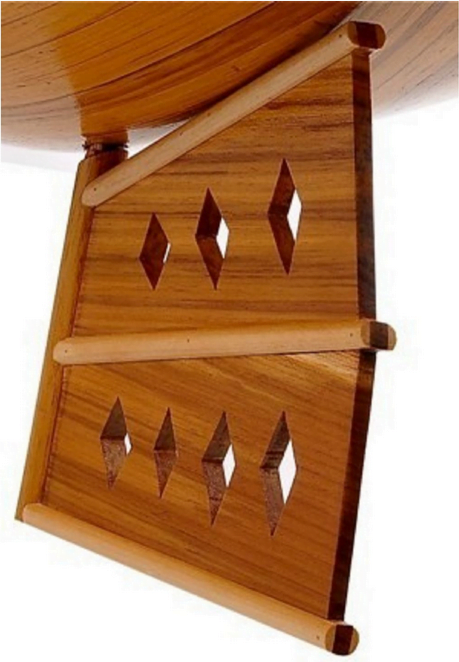
Reader le-mec writes:
My question involves “fenestrated rudders”, a Chinese invention that
involved cutting diamond-shaped holes in the rudders of ancient Chinese
sailing ships (known as Junks). According to several articles (on the
internet, ha ha), it reduces the amount of effort required to steer the
ship at higher speeds with “no loss of function”. All I can find is
anecdotal evidence and I’d like to know if these claims hold water or if
they’re just steering us in the wrong direction.First off:

Now, I’m no expert on ships or sailing, but let’s talk rudders. Ships use rudders for steering. The rudder is completely submerged and turning it deflects water and creates a side force that helps steer a boat. In essence, it’s an underwater wing that generates lift in the side-to-side direction. Modern rudders even have the same shape as airfoils. That’s clearly not the case with the rudders of Chinese junks, but flat plates are a lot easier to make.
There’s another key feature of the junk’s rudder, and that’s the way it’s mounted. The junk’s rudder attaches to the ship such that it rotates about its leading edge. This makes it an unbalanced rudder. More modern rudders are typically mounted so that they rotate around an axis that’s partway back on the rudder. This is called a balanced rudder; I’ve illustrated both below.

The advantage of the balanced rudder is that it’s easier to turn. You can see this for yourself without adding water into the equation. Imagine holding a big rectangular sheet. If you hold it by one edge and try to rotate it, you can do it, but it’s kind of difficult. If you instead hold it about a third of the way across, you’ll find rotating it easier. Once you have a fluid moving past, it will only magnify how hard it is to turn the rudder.
So the Chinese junks had rudders that were harder to handle (by later ship-building standards) to begin with. By putting holes in the rudder, they equalized the pressure on either face of the rudder. That does make it easier to steer, since the helmsman is no longer fighting pressure differences across the rudder, but it would also reduce steering efficiency. It’s likely, however, given the slow speed of the junks, large rudder area, and their low hydrodynamic efficiency to begin with, that any drop in efficiency was negligible compared to the reduction in force necessary to steer.
Since modern designs rely on foil shapes to generate pressure differences (and therefore side force) across the rudder, adding holes to them would be a bad idea. But back in the Song dynasty, the fenestrated rudder was major advance in nautical engineering!
(Image credits: Chinese junk ship model – Premier Ship Models; Joffrey applauding – HBO; Rudder diagram – N. Sharp)

Happy 50th, Star Trek!
Today’s post is largely brought to you by the fact that I have been sick the past four days and my fiance and I have been bingeing on Star Trek Voyager. At some point, we began wondering about the sequence from 0:30-0:49 in which Voyager flies through a nebula and leaves a wake of von Karman vortices. Would a starship really leave that kind of wake in a nebula?
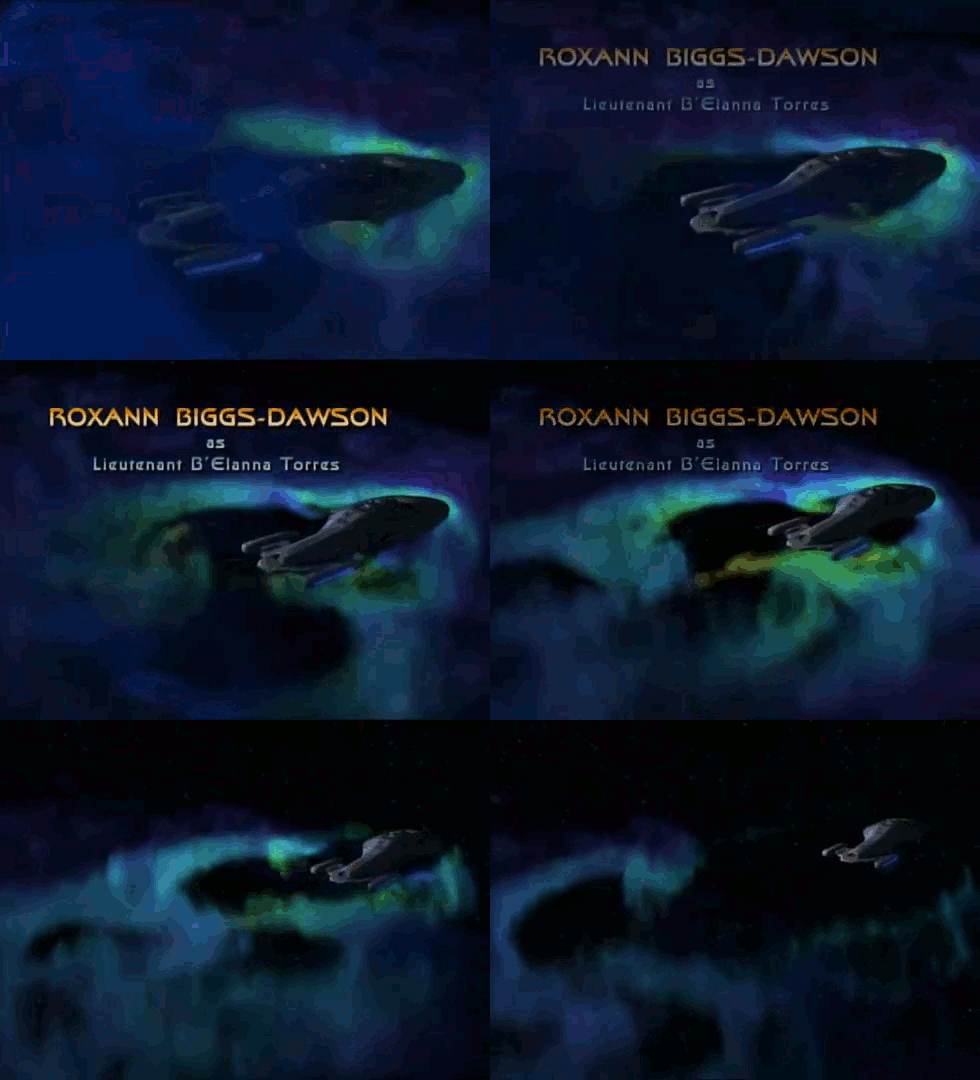
My first question was whether the nebula could be treated as a continuous fluid instead of a collection of particles. This is part of the continuum assumption that allows physicists to treat fluid properties like density, temperature, and velocity as well-defined quantities at all points. The continuum assumption is acceptable in flows where the Knudsen number is small. The Knudsen number is the ratio of the mean free path length to a characteristic flow length, in this case, Voyager’s size. The mean free path length is the average distance a particle travels before colliding with another particle. Nebulae are much less dense than our atmosphere, so the mean free path length is larger (~ 2 cm by my calculation) but still much smaller than Voyager’s length of 344 m. So it is reasonable to treat the nebula as a fluid.
As long as the nebula is acting like a fluid, it’s not unreasonable to see alternating vortices shed from Voyager. But are the vortices we see realistic relative to Voyager’s size and speed? Physicists use the dimensionless Strouhal number to describe oscillatory flows and vortex shedding. It’s a ratio of the vortex shedding frequency times the characteristic length to the flow’s velocity. We already know Voyager’s size, so we just need an estimate of its velocity and the number of vortices shed per second. I visually estimated these as 500 m/s and 2.5 vortices/second, respectively. That gives a Strouhal number of 0.28, very close to the value of 0.2 typically measured in the wake of a cylinder, the classical case for a von Karman vortex street.
So far Voyager’s wake is looking quite reasonable indeed. But what about its speed relative to the nebula’s speed of sound? If Voyager is moving faster than the local speed of sound, we might still see vortex shedding in the wake, but there would also be a bow shock off the ship’s leading edge. To answer this question, we need to know Voyager’s Mach number, its speed relative to the local speed of sound. After some digging through papers on nebulae, I found an equation to estimate speed of sound in a nebula (Eq 9 of Jin and Sui 2010) using the specific gas constant and temperature. Because nebulae are primarily composed of hydrogen, I approximated the nebula’s gas constant with hydrogen’s value and chose a representative temperature of 500 K (also based on Jin and Sui 2010). This gave a local speed of sound of 940 m/s, and set Voyager’s Mach number at 0.53, inside the subsonic range and well away from any shock wave formation.
Of course, these are all rough estimates and back-of-the-envelope fluid dynamics calculations, but my end conclusion is that Voyager’s vortex shedding wake through the nebula is realistic after all! (Video credit: Paramount; topic also requested by heuste11)
Happy 50th anniversary, Star Trek! Some of my earliest memories of TV are of watching TNG with my parents. Star Trek taught me that curiosity and scientific inquiry were vital and valuable, and that anyone could grow up to be a scientist, engineer, and leader. Thank you for such an inspiring and hopeful vision for humanity’s future!
And, seriously, those von Karman vortices are awesome.

Roll Cloud Over Chicago
A cold front passing through Chicago last week triggered a roll cloud, shown in the timelapse above. These clouds look like spinning horizontal tubes and form in areas where cool, sinking air displaces warmer, moist air to higher altitudes. The moist air is forced up along the cloud’s leading edge, causing it to cool and condense into cloud. Air on the trailing edge sinks downward again, warming and dissipating the cloud. The clouds are a visible form of soliton, or solitary wave, traveling through the atmosphere. They go by several other names, too, including Morning Glory clouds and arcus clouds. (Image credit: A. King; via Colossal)

Bioluminescent Shrimp


Trevor Williams and Jonathan Galione of Tdub Photo captured these beautiful images of bioluminescent shrimp along the Japanese coast. The duo collected the tiny shrimp and poured them over and near rocks to create the effect they wanted. With their blue light, the shrimp act like tracer particles in the water, and with long exposures, the photos track the movements of the shrimp and waves. Technically speaking, they trace out pathlines – the trajectory that a specific fluid (or shrimp) particle takes in a flow. It’s a lovely way of capturing the water’s dynamic motion in a still photo. (Image credit: Tdub Photo; via Colossal)
Where Does the Sun End?
How do you define the edge of our sun? There’s a distinct surface to it, but our star is also surrounded by the corona, an even hotter region of plasma twisted by magnetic fields. The corona is sort of like the sun’s atmosphere. Farther out in the solar system, we receive a constant barrage of charged particles, known as the solar wind, that streams out from the sun. So where does the corona end and the solar wind begin?
Scientists have been studying the flow structure of the solar wind in search of an answer to this question, and they’ve found that there’s a clear transition point about 32 million kilometers from the sun. At this distance, the sun’s magnetic field weakens to the point where it no longer exerts the same hold on the solar particles and they begin to move turbulently, behaving more like a gas than a plasma. With special measurements and image processing, scientists were able to actually see this flow change in the solar wind! (Video/image credit: NASA; research credit: C. DeForest et al.; via FlowViz)

Microburst
Earlier this week a Columbus, OH TV station tower camera caught this awesome timelapse footage of several microbursts in a thunderstorm. A microburst is a sudden, localized downdraft inside the storm. You can see a clear microburst starting at about 0:30 seconds. Note how it flares up and out as it hits the ground, eventually settling around the time a rainbow appears on the left edge of the frame. These strong winds moving down then curling out can be dangerous, both to structures on the ground and to any aircraft unfortunate enough to be taking off or landing in the storm. (Video credit: WCMH; submitted by
A. Bcstractor)
Leidenfrost Atop Gasoline
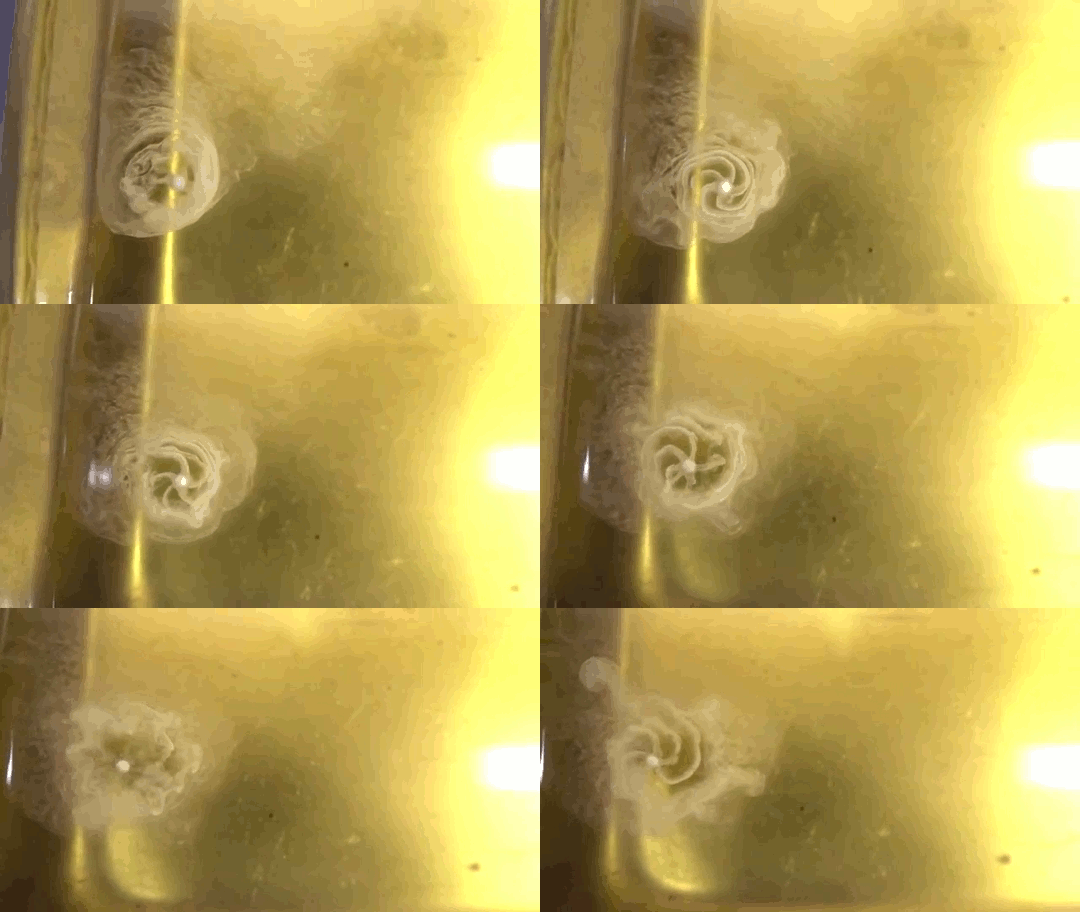
The animations above show a little of what happens when you pour a spoonful of liquid nitrogen onto a container of gasoline. A couple of things are happening simultaneously here. First of all, the liquid nitrogen is experiencing the Leidenfrost effect. Because of the extreme difference in temperature between the gasoline (~20 degrees C) and the liquid nitrogen (-196 degrees C), part of the nitrogen is evaporating immediately, creating a vapor layer that insulates the remainder of the liquid nitrogen and allows it to float above the gasoline surface. The same thing happens to water drops on a very hot skillet.
The extreme cold of the nitrogen also seems to have formed some ice that’s further protecting the nitrogen drop. I’m not 100% sure what that would be made of, though – a mixture of water and gasoline?
Finally, there’s the simultaneous evaporation of the liquid nitrogen and the sublimation of the ice. This is the white vapor we see propelling and spinning the ice/drop. Note the “bounce” that happens in the top animation. The drop never actually impacts the wall. When it gets close, the escaping vapors are affected by the wall and start pushing the drop in a new direction! Check out the whole video below. (Image credit: carsandwater; via Gizmodo)

Where Jupiter’s Heat Comes From
Exactly what goes on in Jupiter’s atmosphere has confounded scientists for decades. Its upper atmosphere – essentially the only part we can observe – is hundreds of degrees warmer than solar heating can account for. Although it has bright auroras at its poles, that energy is trapped at high altitudes by the same rotational effects that create Jupiter’s stunning bands.
Observations of Jupiter’s Great Red Spot, a storm that’s lasted for hundreds of years, may provide clues as to where all the extra heat is coming from. Spectral mapping shows that the area over the Spot is over 1000K warmer than the rest of the upper atmosphere. Because of its isolated location, the best explanation for the Great Red Spot’s extra heat comes from below: scientists suspect that the raging storm is generating so much turbulence and such a deafening roar that these gravity and acoustic waves propagate upward and heat the atmosphere above. If so, a similar coupling mechanism to the clouds below may account for the widespread warmth in Jupiter’s upper atmosphere. (Image credit: NASA; research credit: J. O’Donoghue et al.)
Quantum Droplets
Over the past decade, fluid dynamicists have been investigating tiny droplets bouncing on a vibrating fluid. This seemingly simple experiment has remarkable depth, including the ability to recreate quantum behaviors in a classical system. In this video, some of the researchers demonstrate their experimental techniques, including how they vary the frame rate relative to the bouncing of the drops. At the right frame rate, this sampling makes the droplets appear to glide along with their ripples, giving us a look at a system that is simultaneously a particle (drop) and wave (ripple). (Video credit: D. Harris et al.)