Search results for: “art”

  • Featured Video Play Icon

    Mimicking Quantum Effects

    Over the last 15 years or so, researchers have been exploring pilot-wave theory–originally proposed by De Broglie in the 1920s as a way to understand quantum mechanics–using hydrodynamic quantum analogs. In these experiments, researchers vibrate pools of silicone oil, which allows oil drops to bounce–and in some conditions, walk–indefinitely on the pool. By mixing in obstacles that mimic classic quantum mechanical experiments, they reproduce effects like the double-slit experiment in a macroscopic system.

    In this video and the accompanying papers, a team recreates the Kapitsa-Dirac effect where a standing electromagnetic wave diffracts electrons. Here, the standing wave is instead a Faraday wave in the surface of the pool. Yet the droplets, too, diffract in a manner resembling the quantum version. (Video credit: B. Primkulov et al.; research credit: B. Primkulov et al. 1, 2)
  • Featured Video Play Icon

    When the Meniscus Disappears

    When we first learn about states of matter, we’re taught about three: solid, liquid, and gas. In a solid, atoms are held close to one another–typically, but not always, in an orderly lattice structure. In liquids and gases, atoms are free to slip, slide, bounce, and move. So what really separates a liquid from a gas?

    Animation of liquid and gaseous carbon dioxide reaching the supercritical phase.

    That’s the question at the heart of this video by Steve Mould, in which he explores a weird fourth phase of matter: supercritical fluids. This phase has the diffusive properties of a gas and the solvent properties of a liquid–without really being either one.(Video and image credit: S. Mould)

  • “Frozen”

    “Frozen”

    For tiny invertebrates like this one, water is a very different substance than we’re used to. At this scale, surface tension is a force as powerful–or more so–than gravity. Droplets remain spherical, caught on long, spike-like hairs. Even the surface of a pond is different, forming a trampoline creatures can skim but that requires special techniques to escape. (Image credit: N. Baumgartner/CUPOTY; via Colossal)

  • Featured Video Play Icon

    Understanding Schlieren

    Schlieren techniques are one of my favorite forms of flow visualization. They cleverly make the invisible visible through an optical set-up that’s sensitive to changes in density. They’re great–as seen in the examples here–for seeing local buoyant flows like the plumes that rise from a candle, or for making gases like carbon dioxide visible. They’re also excellent for visualizing shock waves.

    In this video, physicist David Jackson explains how one particular flavor of schlieren–one using a spherical mirror–works. There are lots of other possible schlieren set-ups, too, though each one has its quirks. (Video and image credit: All Things Physics; submitted by David J.)

    Fediverse Reactions
  • Featured Video Play Icon

    Connecting Canals

    Before the rise of railroads, canals provided critical commercial shipping infrastructure for many locations worldwide. But connecting canals at different elevations required locks–sometimes a whole series of them–as in the case of Scotland’s Union Canal and the Forth and Clyde Canal. In the canals’ heyday, navigating the 11 locks between them took the better part of a day–one of many reasons that canals fell out of use over time.

    When Scotland decided to reconnect the canals in the 1990s, they picked a very different solution for this elevation challenge: the Falkirk Wheel. Grady walks us through the clever engineering of this impressive piece of infrastructure in this Practical Engineering video. (Video and image credit: Practical Engineering)

    Fediverse Reactions
  • “Liquid Colors”

    “Liquid Colors”

    Light shining through misty spray creates a liquid rainbow in this photo by Ronja Linssen. Although mists and sprays–from waterfalls, waves, and more–seem insubstantial, they can be a major source of material transfer between the water and atmosphere. Teratons of salt, biomass, and even microplastics make their way yearly from the ocean into the sky through droplets launched from popping bubbles. (Image credit: R. Linssen/CUPOTY; via Colossal)

  • Milano Cortina 2026: Ski Jumping Suits

    Milano Cortina 2026: Ski Jumping Suits

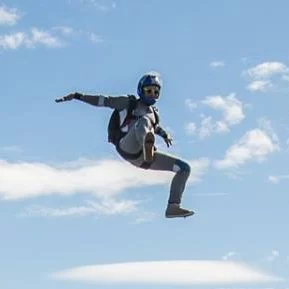
    Ski jumping is in the news this Olympic cycle after rumors that male competitors may be cheating in order to wear larger suits. In particular, the suggestion is that male athletes are injecting fillers into their genitals before their pre-season 3D body scan in order to appear large enough to allow them to wear a larger suit. This comes after two Norwegian ski jumpers were punished for illegally restitching the crotches of their suits to make them larger.

    Ski jumping is a sport that relies heavily on aerodynamics; during the flight phase, jumpers try to maximize their lift-to-drag ratio so that they stay aloft as long as possible. A 2025 study underscores the importance of suit size in this calculus. In the work, the researchers used a baseline suit that was 4 centimeters larger in circumference than their jumper–the loosest configuration that regulations allow. They compared that suit’s flight performance (in wind tunnels and simulation) to a suit 2 cm larger and one 2 cm smaller. The extra 2 centimeters of circumference made a notable difference: the larger suit increased the drag by ~4% and lift by ~5%. That was enough, in their simulation, to let a jumper fly an extra 5.8 meters.

    It’s worth noting, though, that the study was looking at the effects of adjusting the suit’s circumference along the entire length between the arm pits and the knees; they never changed anything about the suit’s crotch. I don’t think there’s enough scientific data to say that packing a bit more there would really offer aerodynamic advantages. And the risks of such injections are non-negligible. (Image credit: T. Trapani; research credit: M. Virmavirta et al.; via Ars Technica)

    A ski jumper in flight, viewed from behind.
    Fediverse Reactions
  • Milano Cortina 2026: Cortina Sliding Center

    Milano Cortina 2026: Cortina Sliding Center

    This year’s sliding events–bobsleigh, luge, and skeleton–will take place at the brand-new Cortina Sliding Center. Built on the site of a historic sliding track, this new venue came together in only the last couple of years. It features a state-of-the-art refrigeration system that pumps a mixture of water and ethylene glycol beneath the track surface to keep the ice properly chilled. Each section of the track is continuously monitored to optimize the flow rate, temperature, and pressure of the refrigerant to keep the track at maximum performance while minimizing environmental impact.

    According to the designers, it’s the first competition track to use a glycol-based refrigeration system, which should be more sustainable than the ammonia-based systems used elsewhere. For a sense of what a run is like, check out this skeleton driver POV run from the facility’s shakedown competition last year. (Image credit: LMSteel; video credit: tuff sledding)

    Fediverse Reactions
  • Milano Cortina 2026: Ice’s Many Forms

    Milano Cortina 2026: Ice’s Many Forms

    Welcome to another Olympic year and another FYFD celebration of the fluid physics that enable these sports! All Winter Olympic sports are required, per the IOC, to take place on snow or ice–one of the strangest substances we know of.

    Despite consisting of two simple elements–hydrogen and oxygen–water manages to find a shocking number of ways to configure itself into a solid. So far, scientists have described 21 different configurations for solid water ice. The latest one was created at room temperature and extreme pressures. (The apparatus used can reach pressures 20,000 times atmospheric pressure.)

    This particular form of ice is metastable, meaning that it balances on a knife’s edge, existing briefly at conditions where other ice structures are energetically preferable. It’s likely that many such high-temperature, metastable ice forms exist. How many more do you suppose researchers will discover before the next Olympics? (Image credit: L. Borghese; research credit: Y. Lee et al.; via Gizmodo)

    P.S. – Dig into past Olympics with posts from Beijing, PyeongChang, and Sochi.

    Fediverse Reactions
  • Watching Waves on the Nanoscale

    Watching Waves on the Nanoscale

    It’s tough to simulate nonlinear wave dynamics, so scientists often test theories in wave flumes, where they can create more controlled waves than what we see in the wild. But conventional wave flumes are big–meters-long, complicated equipment–and can only test a small range of conditions. To reach more extreme nonlinear dynamics, researchers have turned to a chip-based approach. These 100-micron-long wave flumes carry a film of superfluid helium less than 7 nanometers thick. But despite that tiny size, the system can reach levels of nonlinearity five orders of magnitude greater than their full-sized counterparts. (Image and research credit: M. Reeves et al.; via Physics Today)

    Labeled diagram of a 100-micron-long wave flume.
    Fediverse Reactions