Hummingbirds are impressive, acrobatic flyers. Their figure-8 wing stroke pattern produces about 70% of their lift on the downstroke, and the remainder during the backward upstroke. But their tails and body motions also play an important role in stabilizing them, especially in gusty winds. They also have some impressive feeding dynamics. Altogether, they’re one of the most precise flyers in the animal kingdom! (Video and image credit: BBC Earth)
A glacier’s snowline marks the location where the amount of summer melting and accumulated snowmass are equal. If, over the course of a season, a glacier experiences more snowfall than melting, its snowline will advance. If melting outweighs accumulation, then the snowline will retreat to higher altitudes. Tracking the snowline gives scientists important data about how the glacier is changing.
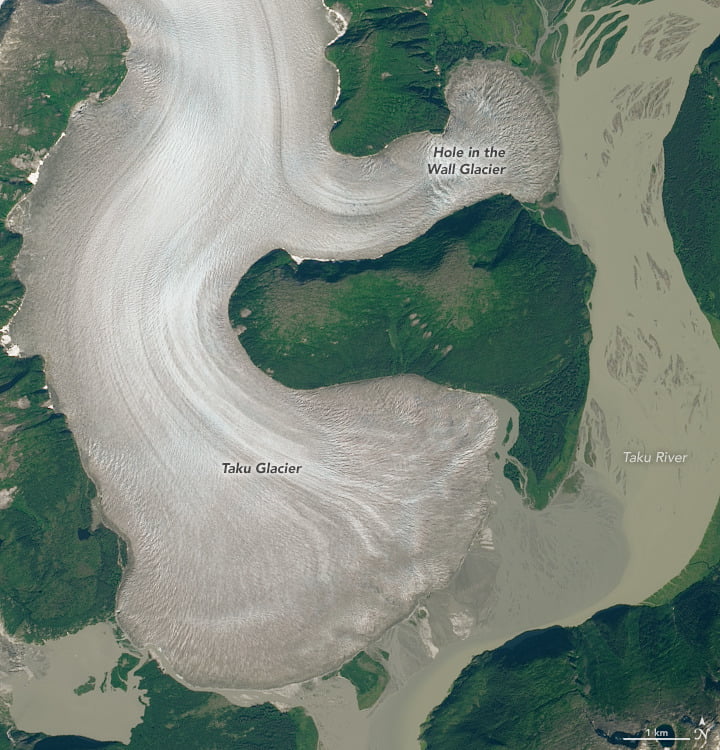
And that change is typically slow. When glaciers stop advancing, their snowlines can remain unmoving for decades. Or, at least, they used to. In recent years, Alaska’s Taku Glacier was one of the only alpine glaciers holding out against the warming Arctic. Its slow advance stopped in 2013–the left image shows Taku in 2014–and researchers hoped the massive glacier would maintain its mass for a few decades at least. Instead, the glacier was retreating by 2018 and doing so with the highest mass loss ever recorded at the glacier. The 2019 image on the right shows the glacier’s visible losses.
For such a massive glacier–the largest in Juneau Icefield at nearly 1.5 km thick–to reverse fortunes so quickly is disturbing and serves as yet more evidence of climate change overriding natural cycles of advance and retreat. (Image credit: L. Dauphin/USGS; via NASA Earth Observatory)
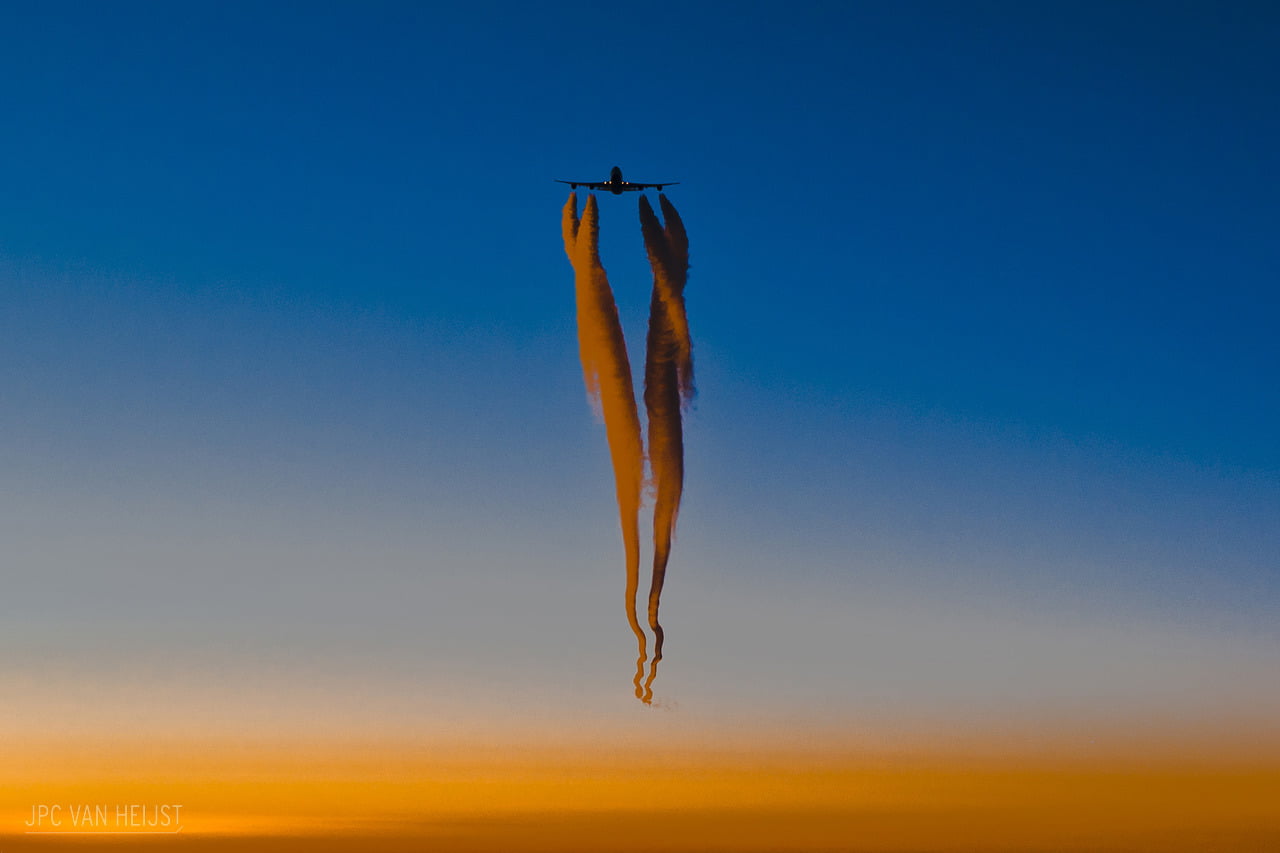
The wingtip vortices of aircraft provide a veritable cornucopia of gorgeous imagery. There’s something inherently fascinating about these vortices that stretch behind moving aircraft. But four-engine aircraft add an extra twist to the imagery, as seen here.
With four engines, these aircraft produce four separate contrails, each of which acts like a streakline for the flow behind the wing. So what we see in these images is not the wingtip vortices themselves, but what their effect is on flow moving across different parts of the wing.
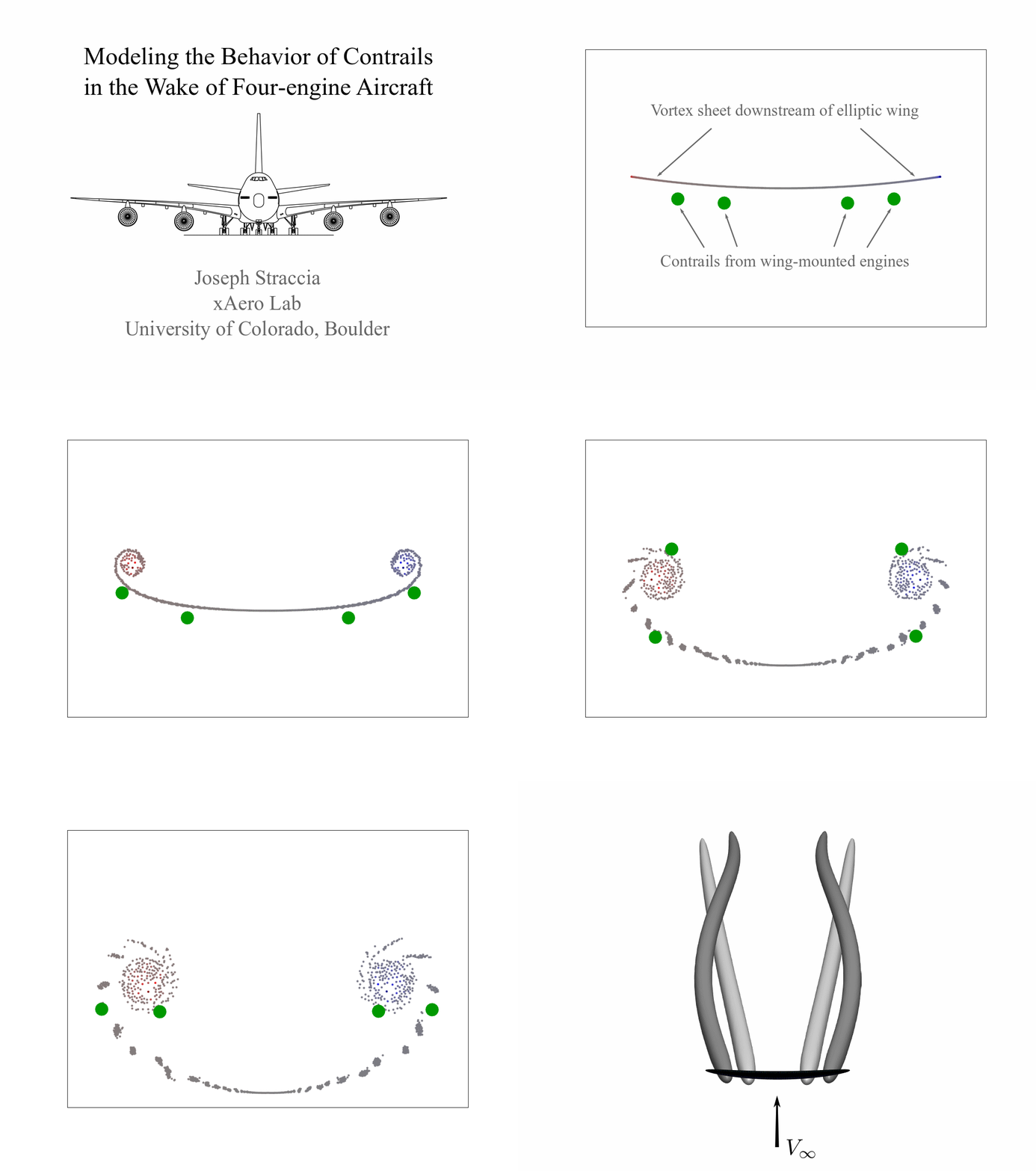
Nearby vortices influence one another, and one of the earliest models of aircraft physics takes advantage of this by modeling the wing itself as a series of vortices. Odd as it sounds, such models are quite good for capturing the basic flow physics behind a finite wing.
Using one of these models, Joseph Straccia explored the physics of a 4-engine aircraft’s wake (Image 4), predicting that the outboard engine contrails should initially move outward before getting rolled up and inward by the wingtip vortices. That’s exactly what we see in these images, particularly Image 1. The inboard contrails undergo less deflection, as expected since they are further from the wingtips. (Image credits: aircraft and contrails – JPC Van Heijst, J. Willems, and E. Karakas; modeling and submission – J. Straccia)
The Dutch have been exceptional water engineers for centuries, a necessity in a country where more than a quarter of its territory lies below sea level. After a devastating flood in the early 1950s, the country embarked on a decades’ long endeavor to build the massive Delta Works that now protect a large portion of the population from oceanic storm surges that would otherwise flood the countryside.
As part of their efforts to instill resiliency both along the coast and upstream, the Netherlands has shifted dykes, created floodplain habitats, and built water storage into new buildings. With communities around the world at greater flood risk than ever as our climate changes, the Netherlands serves as a shining example of what’s possible with proper planning and investment. (Video and image credit: TED-Ed)
In the 19th century, botanist Robert Brown observed pollen granules beneath his microscope jittering randomly. Einstein showed that this motion resulted from the impacts of much-smaller atoms against the particles. For small enough objects, the random walk of Brownian motion dominates their dynamics. A new study explores how flexible objects move at this Brownian scale.
The researchers used trios of colloids — microscopic particles — held together by a lipid fluid layer that allows the three particles to change shape without losing contact. Essentially, each trio forms a tiny hinge. As atoms strike the colloids, they both move and change shape.
Compared to rigid shapes, the researchers found their flexible hinges moved around in space about 3-15% faster. They also found coupling between the shape changes and motion. When the colloids hinge closed, it propels them in the direction the hinge points. Because this resembles the propulsion of scallops, the researchers refer to this as the “Brownian quasi-scallop mode.” (Image and research credit: R. Verweij et al.; via phys.org)
When excited, a group of particles can behave much like a gas. These granular gases exhibit many similarities to molecular gases but contain one vital difference: without a constant input of energy, granular gases lose kinetic energy to collisions.
Over the years, scientists have developed a special theory to describe the behaviors of granular gases, but most of its predictions could only be tested numerically. A new study used a microgravity experiment aboard a sounding rocket to physically test the theory.
The experiment, shown above, consists of nearly 2800 magnetic particles, which the researchers could stir up using pairs of magnets. Once they shut off the magnets (which occurs at t=0 in the image above), the granular gas begins to “cool” as collisions sap away its energy. With this set-up, the researchers were able to confirm several key predictions of the granular gas theory. (Image and research credit: P. Yu et al.; via APS Physics)
“What happens when two scientists, a composer, a cellist, and a planetarium animator make art?” The answer is “Dendritic,” a musical composition built directly on the tree-like branching patterns found when a less viscous fluid is injected into a more viscous one sandwiched between two plates.
Normally this viscous fingering instability results in dense, branching fingers, but when there’s directional dependence in the fluid, the pattern transitions instead to one that’s dendritic. In this case, that directionality comes from liquid crystals, whose are rod-like shape makes it easier for liquid to flow in the direction aligned with the rods.
For more on the science, math, and music behind the piece, check out this description from the scientists and composer. (Video, image, and submission credit: I. Bischofberger et al.)
Every day human activity pumps aerosol particles into the atmosphere, potentially altering our weather patterns. But tracking the effects of those emissions is difficult with so many variables changing at once. It’s easier to see how such particles affect weather patterns somewhere like the Sandwich Islands, where we can observe the effects of a single, known source like a volcano.
That’s what we see in this false-color satellite image. Mount Michael has a permanent lava lake in its central crater, and so often releases sulfur dioxide and other gases. As those gases rise and mix with the passing atmosphere, they can create bright, persistent cloud trails like the one seen here. The brightening comes from the additional small cloud droplets that form around the extra particles emitted from the volcano.
As a bonus, this image includes some extra fluid dynamical goodness. Check out the wave clouds and von Karman vortices in the wake of the neighboring islands! (Image credit: J. Stevens; via NASA Earth Observatory)
Conventional fluid dynamical wisdom posits that any flows at the microscale should be laminar. Tiny swimmers like microorganisms live in a world dominated by viscosity, therefore, there can be no turbulence. But experiments with bacterial colonies have shown that’s not entirely true. With enough micro-swimmers moving around, even these viscous, small-scale flows become turbulent.
That’s what is shown in Image 2, where tracer particles show the complex motion of fluid around a bacterial swarm. By tracking both the bacteria motion and the fluid motion, researchers were able to describe the flow using statistical methods similar to those used for conventional turbulence. The characteristics of this bacterial turbulence are not identical to larger-scale turbulence, but they are certainly more turbulent than laminar. (Image credits: bacterium – A. Weiner, bacterial turbulence – J. Dunkel et al.; research credit: J. Dunkel et al.; submitted by Jeff M.)
For thousands of years, boats have been a critical component of trade, efficiently enabling transport of goods over large distances. But water’s self-leveling creates challenges when moving up and downstream through rivers and canals. To get around this, engineers use locks, which act as a sort of gravity-driven elevator to lift and lower boats to the appropriate water level. In this video from Practical Engineering, we learn about the basic physics behind locks as well as some of the methods engineers use to limit water loss through the lock. (Image and video credit: Practical Engineering)