Category: Research

  • Featured Video Play Icon

    Keeping Cool in the Cretaceous

    I love that fluid dynamics can bring new insights to other subjects, like this study on how heavily-armored ankylosaurs avoided heat stroke. Scans of ankylosaur skulls show a complicated, twisty nasal cavity that researchers likened to a child’s crazy straw. Using numerical simulations, they showed that the airflow through these passages acts like a heat exchanger. As air gets drawn into its body, it warms up from exposure to blood vessels lining the nasal cavity; that means that, simultaneously, the hot blood is getting cooled. Those blood vessels lead up to the animal’s brain, indicating that these twisted cavities essentially serve as air-conditioning for the sauropod’s brain! (Image and video credit: Scientific American; research credit: J. Bourke et al.; via J. Ouellette)

  • Flying Out of the Water

    Flying Out of the Water

    Flying fish and diving birds often navigate the interface between water and air in their flight, but few studies have actually looked at the effects of this transition on lift. In this work, researchers measured forces on a small, fixed wing as it egresses from water into air at a constant velocity.

    The tests showed that exit velocity had a large effect on lift generation. At low speeds, an exiting wing experienced a strong, positive lift spike as soon as the leading edge broke the surface. But that lift changed to strongly negative as the wing continued out of the water. At higher speeds, the wings had no lift reversal but also reached lower peak lift coefficients. The team studied the effects of angle of attack and starting depth as well, concluding that any vehicles intended to navigate the water-air transition will need robust control systems prepared to deal with fast-changing forces. (Image credit: fish – J. Cobb, wing – W. Weisler et al.; research credit: W. Weisler et al.)

  • Microjets and Needle-Free Injection

    Microjets and Needle-Free Injection

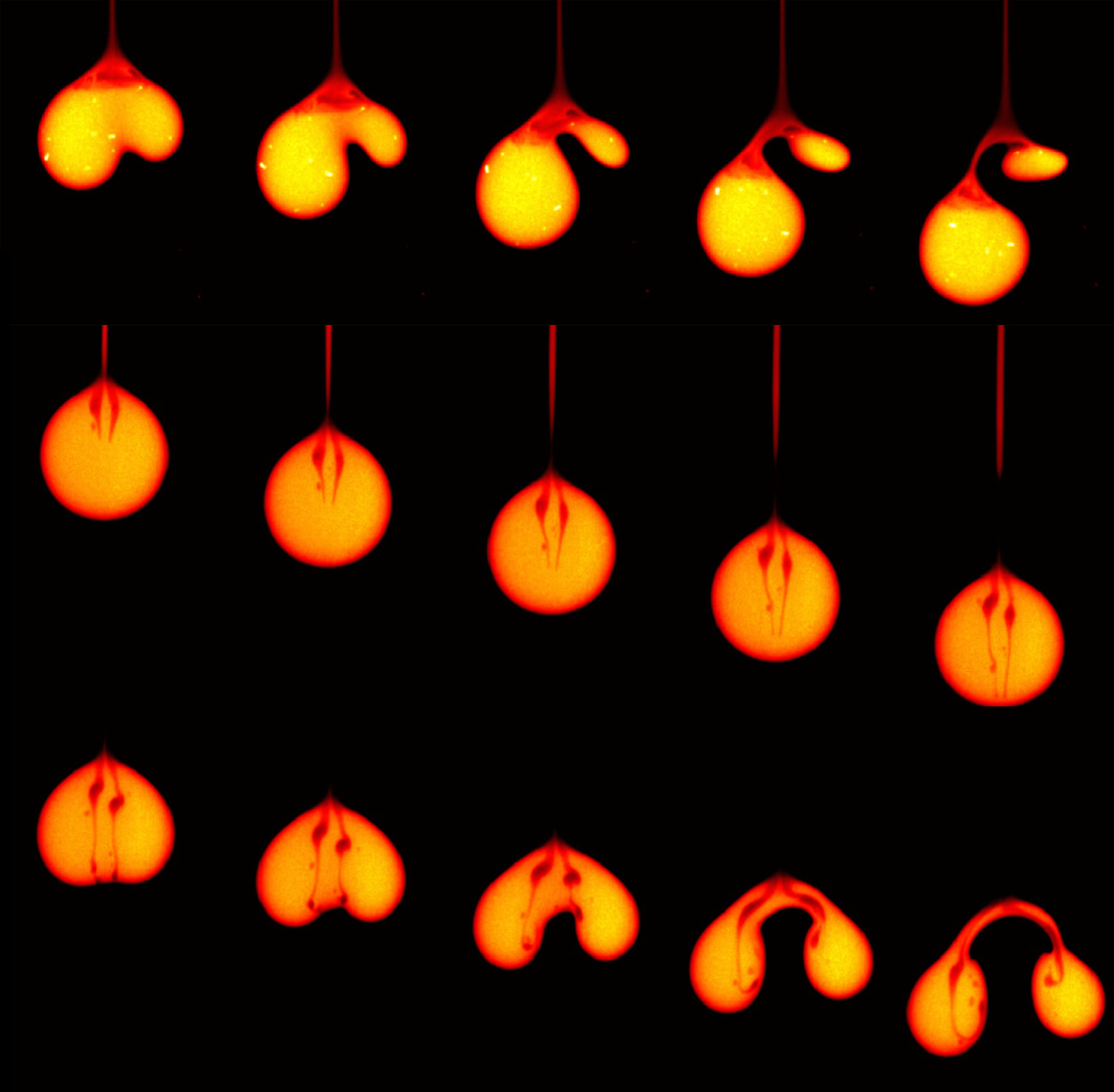
    Some people don’t mind needles, and others absolutely detest them. But to replace needles with needle-free injections, we have to understand how high-speed microjets pass through skin. Given skin’s opacity, that’s tough, so researchers are instead using droplets as a model. If we can understand the dynamics of a microjet passing through different kinds of droplets, getting jets of medicine into arms becomes easier.

    Researchers found that jets passed completely through a droplet if they impacted above a critical velocity. For Newtonian droplets, the jet creates a cavity and shoots straight through because the inertia of the impact outweighs the countering force of surface tension. But with viscoelastic drops, the jet goes through, slows down, and gets sucked back into the droplet. In this case, the combination of surface tension and viscoelasticity can, eventually, overpower the jet’s inertia. (Image, research, and submission credit: M. Quetzeri-Santiago et al.)
  • Sea Sponge Hydrodynamics

    Sea Sponge Hydrodynamics

    The Venus’s flower basket is a sea sponge that lives at depths of 100-1000 meters. Its intricate latticework skeleton has long fascinated engineers for its structural mechanics, but a new study shows that the sponge’s shape benefits it hydrodynamically as well.

    The sea sponge’s skeleton is predominantly cylindrical, with tiny gaps that allow water to flow through it and helical ridges alongside its outer surface to strengthen it against the deep-sea currents surrounding it. Through detailed numerical simulations, researchers found that both of these features — the holes and the ridges — serve fluid mechanical purposes for the sponge. The porous holes of the sea sponge drastically reduce flow in the sponge’s wake (third image), which provides major drag reduction for the sea sponge. That drag reduction makes it easier for the sponge to stay rooted to the ocean floor.

    The helical ridges, on the other hand, create low-speed vortices within the sea-sponge’s body cavity (second image). Such vortices increase the time water spends inside the sponge, likely helping it to filter-feed more efficiently. The additional vorticity comes at the cost of slightly increased drag but not enough to outweigh the savings from its porosity. (Image and research credit: G. Falcucci et al.; via Nature; submitted by Kam-Yung Soh)

  • Leidenfrost Without the Heat

    Leidenfrost Without the Heat

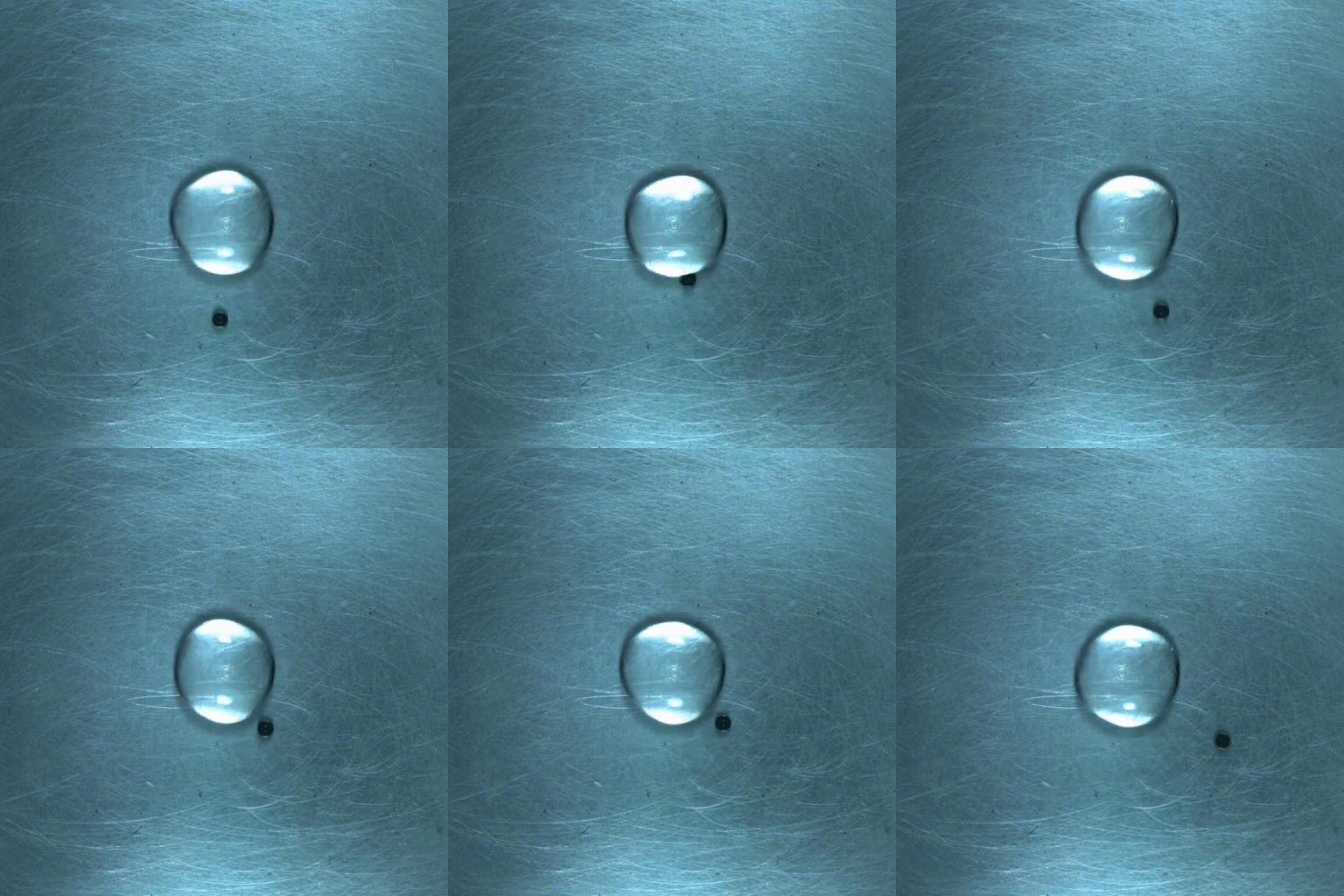
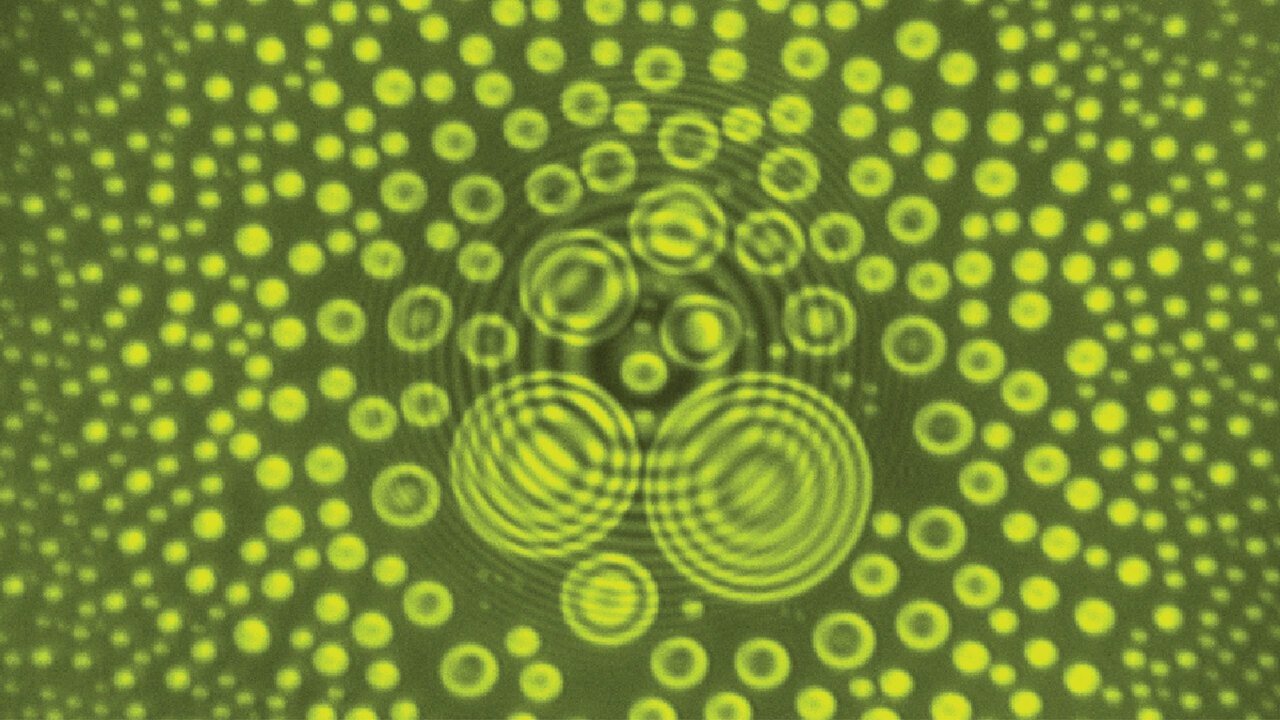
    Leidenfrost drops slide almost frictionlessly on a layer of their own vapor, generated by extremely hot surfaces nearby. But in this experiment researchers recreated many of the classic behaviors of a levitating Leidenfrost drop without the added heat. Instead, they supersaturated water droplets with carbon dioxide to create “fizzy droplets” that slide and self-propel along superhydrophobic surfaces.

    Initially, the drops don’t levitate. It takes a little while for the carbon dioxide layer to build up beneath them, as seen by the slowly appearing interference fringes in the second image. But once the layer forms, the drops behave like conventional Leidenfrost drops until their carbon dioxide is depleted. They’re even able to self-propel on a racheted surface (third image)! (Image and research credit: D. Panchanathan et al.; via Physics World; submitted by Kam-Yung Soh)

  • The Froghopper’s Incredible Suction

    The Froghopper’s Incredible Suction

    The tiny froghopper feeds on the sap in xylem, a feat that requires overcoming more than a megapascal of negative pressure. Plants, as you may recall, transport water and nutrients from their roots to their leaves through negative pressure, essentially pulling on the water as if it were a rope. So drinking that sap is not as simple as making a hole and waiting for sap to flow. Instead, froghoppers must generate even more suction than the plant. Some scientists have been so skeptical that such a feat is even possible that they’ve disputed whether plants are truly at such high negative pressures.

    But a new study shows that froghoppers can, indeed, generate immense suction – up to nearly 1.5 megapascals. (By comparison, humans generate less than a tenth of that suction, even on a stubborn milkshake.) The researchers used two complementary methods to prove the insects’ ability. First, they studied the anatomy of the pumplike structure in the froghoppers’ heads, where the suction is generated, and determined the insects’ sucking potential from a simple calculation of force divided by area. Then, they observed feeding froghoppers in a chamber where they could measure their metabolic rates through carbon dioxide output. As the froghoppers fed, their metabolic rates spiked to 50 – 85% higher than when at rest. Only when the xylem tensions exceeded the theoretical biomechanical limits for froghopper suction did the tiny insects seem to stop feeding. (Image and research credit: E. Bergman et al.; via Science News; submitted by Kam-Yung Soh)

  • Featured Video Play Icon

    Adhering Through Vibration

    This little robot relies on vibration to generate its adhesion. By vibrating its flexible disk, it generates low pressure in the thin air layer between the disk and the surface. The force created is strong in the normal direction — meaning that the robot won’t come off the surface, even when carrying large weights — but relatively weak in the plane of the surface, allowing the robot to move freely. The system does have some disadvantages, though. It requires a relatively smooth surface to work, and the necessary frequency of vibration is around 200 Hz — well inside of human hearing — which makes the robot very noisy. (Image, video, and research credit: W. Weston-Dawkes et al.; via IEEE Spectrum; submitted by Kam-Yung Soh)

  • Programmable Capillary Action

    Programmable Capillary Action

    Capillary action combines the cohesive forces within a liquid and the adhesive forces between a liquid and solid to enable a liquid to fill narrow spaces, even against the force of gravity. To control capillary action, researchers are 3D-printing what they call “unit cells,” tiny structures that water and other liquids can climb. There’s no pump raising the liquid through these structures, just capillary action.

    In a particularly neat demonstration of the technology, the researchers built a tree-like structure out of many open-walled unit cells and placed the “root” system in a closed reservoir. Capillary action drew liquid up the structure to the tips of its branches, where the dyed water evaporated. The process is similar to transpiration in trees, though in trees, capillary action provides much less of the lift. (Image and research credit: N. Dudukovic et al.; via Nature; submitted by Kam-Yung Soh)

  • Digging Into Acoustic Levitation

    Digging Into Acoustic Levitation

    Acoustic levitation is a fascinating phenomenon in which small objects, like the Styrofoam balls seen here, are levitated by a standing acoustic wave. In this image, a color schlieren system shows regions of increasing pressure with height (red) and decreasing pressure with height (green). The balls sit within the colored bands, indicating that they’re levitated near the standing wave’s pressure nodes.

    Interestingly, a basic (linear) analysis of the acoustics indicates that the balls should levitate at the pressure anti-nodes, but this clearly isn’t the case in reality. As the authors show, understanding acoustic levitation requires a nonlinear analysis, which reveals the acoustic radiation pressure as the force responsible for holding the balls in place near the nodes. Check out their paper for the full analysis! (Image and research credit: D. Jackson and M. Chang; via Physics Today)

  • Controlling Aerosols Onstage

    Controlling Aerosols Onstage

    Few industries saw more disruption from the pandemic than the performing arts. To help orchestras return to the concert hall in a way that keeps performers and audience members safe, researchers have simulated air flow and aerosols around musicians onstage. Some instruments — like the trumpet — are super-spreaders when it comes to aerosol production, and, in the conventional organization of orchestras, those aerosols have to travel through other sections of the orchestra before reaching air vents, putting more musicians at risk.

    (Upper left) Aerosol concentration for an orchestra performing in their original arrangement, with doors to the hall closed; (Upper right) Aerosol concentration in the modified musician arrangement, with doors open; (Bottom row) Time-averaged aerosol concentration in the breathing zone of performers for (left) the original arrangement and (right) with modified seating.
    (Upper row) Aerosol concentration for the orchestra’s original seating arrangement (left) and in the modified arrangement (right). (Bottom row) Time-averaged concentration of aerosol particles in the breathing zone of each musician in the original (left) and modified arrangements (right).

    Using Large Eddy Simulation, researchers looked at alternate seating arrangements for the Utah Symphony that could mitigate these risks. By rearranging the musicians so that instruments that produce lots of aerosols are closer to the air vents and open doors, the team reduced the average concentration of aerosols around musicians by a factor of 100, giving the performers a chance to return to the stage far more safely. (Image credit: top – M. Nägeli, simulation – H. Hedworth et al.; research credit: H. Hedworth et al.; via NYTimes; submitted by Kam-Yung Soh)