When you turn on your kitchen faucet, you may have noticed a big circle that forms on the bottom of the sink. This is a hydraulic jump, a region where fast-moving, shallow flow shifts to a slower-moving, deeper flow. Although these jumps start out circular, if the fluid is deeper than a critical value, the jump will break down and form polygons, like the one above. Exactly what shape the jump forms depends on many factors: flow speed, fluid depth, and flow history. The same flow conditions can even form more than one shape. But all of these shapes have one thing in common: their corners are universally around 114 degrees with a radius of 3.5 millimeters. (Image and research credit: S. Tamim et al.; via PRF)
Category: Research

Honeybee Feeding
Busy bees feed on millions of flowers for each kilogram of honey they produce. To gather nectar, bees use their hairy tongues, which project out of a sheath-like cover. Protraction (i.e., sticking their tongue out) is relatively fast because all the hairs on the tongue initially lie flat. In the nectar, those hairs flare out, creating a miniature forest that traps viscous nectar and drags it back into the bee during retraction.

Bees feed by projecting their tongues into nectar. Tongue extension is faster because the tongue’s hairs lie flat. During the slower retraction phase, the hairs flare out, trapping nectar and pulling it back into the bee. Through modeling and experiments, researchers found that the time it takes a bee to retract its tongue depends on the bee’s overall mass. Smaller bees are slower to the retract their tongues, likely to allow enough time for their shorter tongues to capture enough nectar. With bee populations on the decline, the team’s predictions may help communities select flowers with nectar concentrations that best fit their local bees’ needs. (Image credits: top – J. Szabó, bee eating – B. Wang et al.; research credit: B. Wang et al.; via APS Physics)

Water-Jumping Springtails
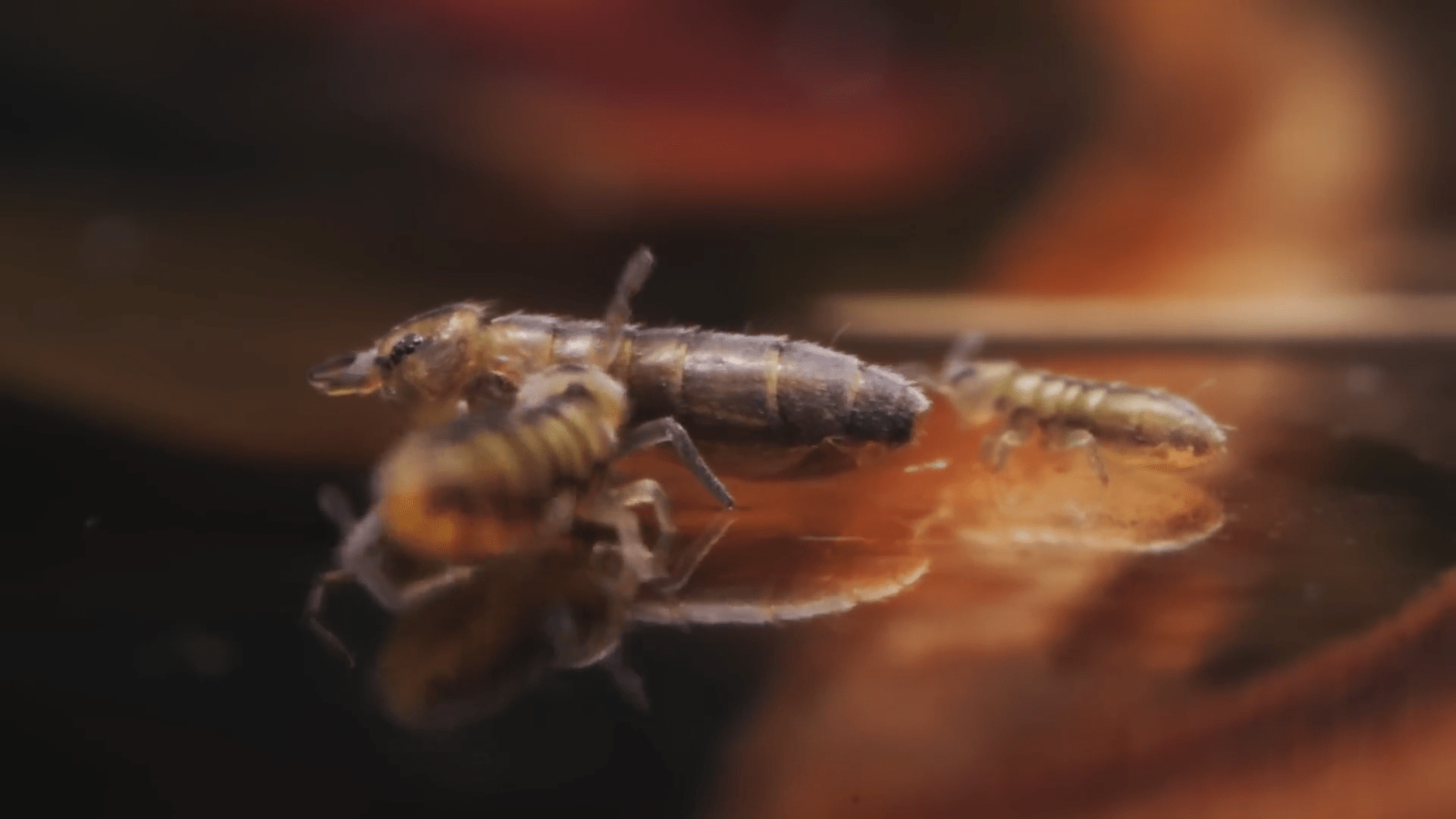
Springtails are small, jumping insects. Semiaquatic varieties use their tails to jump off water in order to move around and escape predation. Among these water jumpers, results vary; some, like in the third image, have little to no control over their landings and will frequently faceplant or land on their backs. But some species in the family have a better technique.
These springtails grab a water droplet with their hydrophilic ventral tube (seen in the second image with a red identifying arrow) during take-off. This tiny water droplet serves several purposes. First, it adds extra weight to the insect, allowing it to better orient its body to land belly-down. Second, the drop gives the insect a way to adhere to the water during landing, preventing it from bouncing. Check out the video to see lots of high-speed video of these tiny acrobats! (Video and image credit: A. Smith/Ant Lab; research credit: V. Ortega-Jimenez et al.)

Pee-Flinging Sharpshooters
The tiny glassy-winged sharpshooter feeds exclusively on nutrient-poor sap from plant xylem. Since the sap is 95% water, the insects have to consume massive amounts, necessitating lots of urination — up to 300 times their body weight each day! With so much urine to get rid of and so little energy to spare, the sharpshooter has developed an ingenious, low-energy method to expel its waste. The insect forms a droplet on its anal stylus and flings it. A recent study reveals just how clever the insect’s method is.
Researchers found that sharpshooters fling their droplets 40% faster than their stylus moves. This superpropulsion is only possible because the stylus’s motion is finely tuned to the droplet’s elasticity. Essentially, the insects achieve single-shot resonance with every throw. The energy-savings for the insects is substantial; researchers estimate that making a jet of urine instead would cost four to eight more times energy. (Video credit: Georgia Tech; image and research credit: E. Challita et al.; via Ars Technica; submitted by Kam-Yung Soh)

Water Builds Static Charge
The ancient Greeks first recognized static electricity, but the mechanisms behind it remain somewhat mysterious. In particular, it’s unclear how two pieces of the same material can build a charge between them simply by touching. Yet we regularly see examples of this when volcanic ash creates enough charge to discharge lightning. A new study sheds light on the question by studying the impact of a single grain of silica on a silica disk.
The researchers used acoustic levitation to hold their silica particle in place. By turning the acoustic waves off, they could bounce the grain off the disk, then catch the particle again with the acoustic field. After a bounce, they swept an electrical field across the particle and observed its oscillations to determine how much charge the particle held. When necessary, they could also discharge the particle.

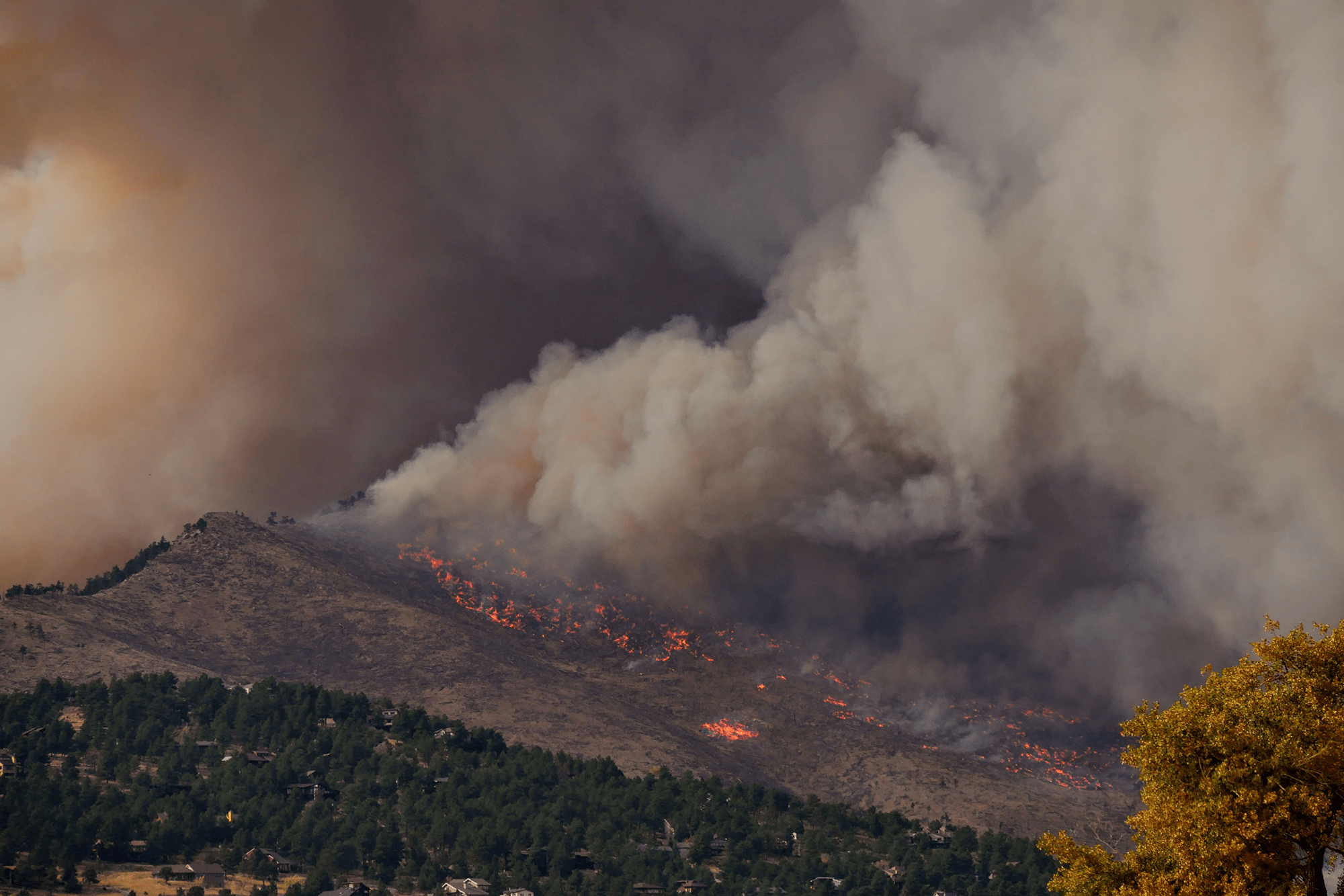
This animation demonstrates the three phases of an experiment. In the first (left), the acoustic field is shut off, allowing the silica grain to fall and strike the disk. Then the field is turned back on to “catch” the particle. In the second phase (middle), the researchers use a sweeping electrical field to determine the charge built up on the grain. In the third phase (right), they periodically discharge the built-up charge on the particle. What they found was that charge on the particle grew with the number of impacts. They also saw that they could reverse the polarity of the charge with careful cleaning and baking of their objects. Their conclusion is that adsorption of water from the surrounding air is what enables the build-up of static charge on identical materials. (Image credit: volcano – M. Szeglat, experiment – G. Grosjean and S. Waitukaitis; research credit: G. Grosjean and S. Waitukaitis; via APS Physics)

Explaining Salt Polygons
Around the world, salt playas are criss-crossed with meter-sized polygons formed by ridges of salt. The origins of these structures — and the reason for their consistency across different regions of the world — have been unclear, but a new study shows that salt polygons form due to convection happening in the soil underground.
Through a combination of numerical modeling, simulation, lab-scale experiment, and field work, the team revealed the mechanism underlying salt polygons. Areas that form polygons have much greater rates of evaporation than precipitation, and, as water evaporates, these areas draw groundwater from nearby. Salt gets carried with this groundwater.
With strong evaporation, the lake bed forms a highly-concentrated layer of salty water near the surface. Convection cells form, with some regions drawing less saline water upward, while denser, saltier water sinks in other areas. The subsurface convection lines up exactly with the surface structures. The interior regions of polygons are areas where less salty water rises, and salt instead concentrates along the edges of polygons, where saltier water sinks below the surface while evaporation draws solid salt to the surface.

This snapshot shows a numerical simulation of the subsurface convection and surface evaporation that lead to salt polygon formation. Low salinity areas are yellow, while high salinity ones are black. At the surface, blue regions have the maximum upward flow and red regions have the maximum downward flow. The dark, highly saline fingers under the surface align to the red areas on the surface, indicating areas where salty water is sinking. It’s a beautiful result that matches the size, shape, and development time observed for salt polygons in the real world. The team even excavated below salt polygons in Death Valley to confirm that the salt content below ground matched their model’s patterns. Since salt playas are a major source for dust and aerosols that affect climate, their work will be an important factor in future climate modelling. (Image credit: feature – T. Nevidoma, simulation – J. Lasser et al.; research credit: J. Lasser et al.; via APS Physics; submitted by Kam-Yung Soh)

Soap Film Ruptures
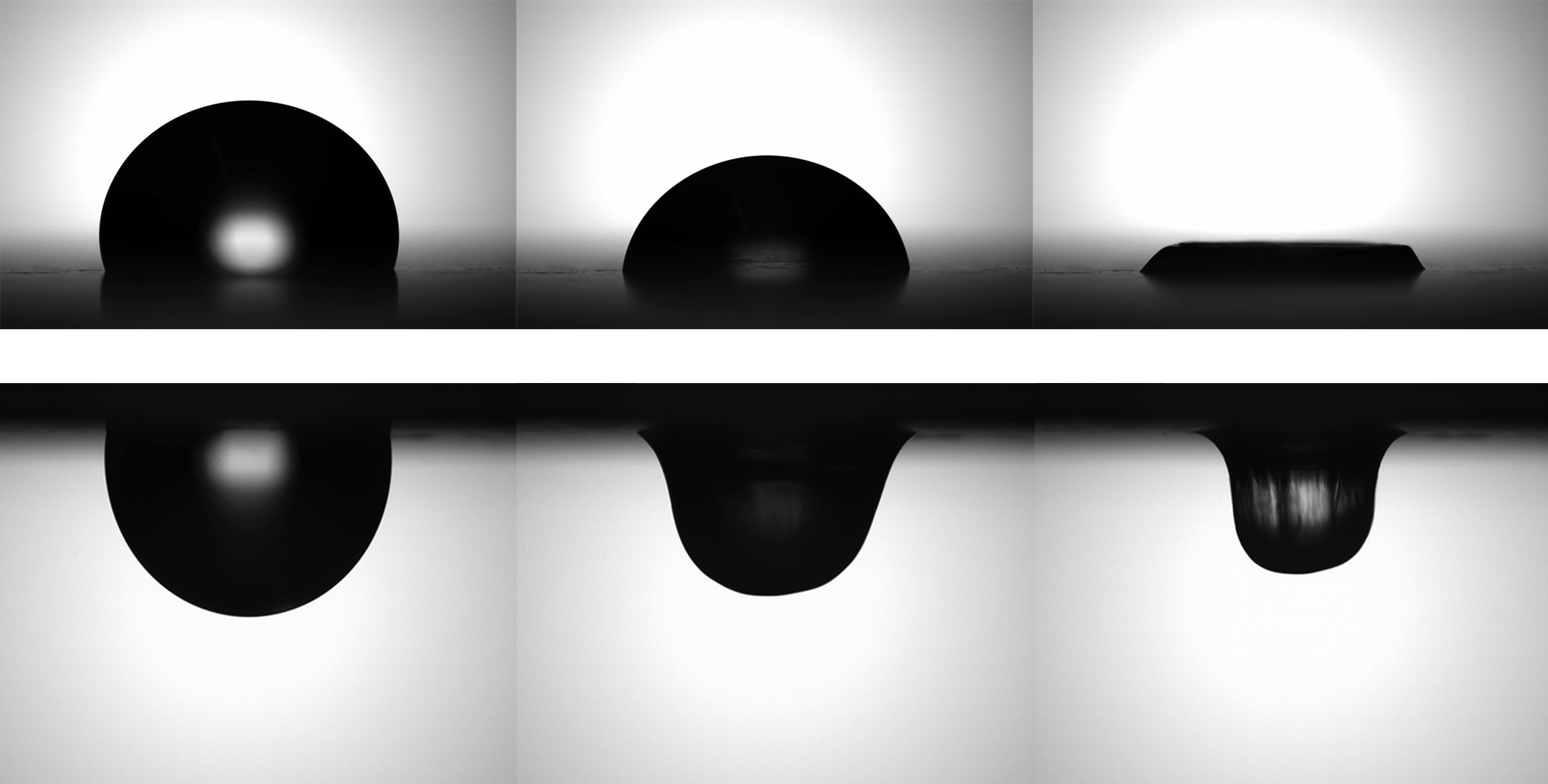
Soap film ruptures are well understood for your typical bubble solution, but what happens when tiny particles get added to the soap film? That’s the question in this recent study. Researchers added 660-nanometer particles, in varying amounts, to their soap films to see how it affected rupture. When they broke the films just after formation (top image), they found results that were quite similar to the usual, particle-free case. But when the films sat for awhile before breaking spontaneously (bottom image), the rupture caused wrinkling and folding similar to a piece of fabric. The researchers hypothesize that aging allowed the soap film to thin until the film and the particles were similar in size. Then, when the film ruptured, the particles affected how it broke up. (Image and research credit: P. Shah et al.)

After aging and thinning, a colloidal film ruptures spontaneously, forming fabric-like wrinkles. 
Curved Cracks
When mixtures of particles and fluids dry, they typically leave a pattern of straight cracks. Here researchers explore what happens when the drying film contains bacteria from the family E. coli. Instead of straight cracks, the films form curved ones. With bacteria that rotate or tumble, the crack pattern is spiral-like. With bacteria that swim, the remaining pattern consists of circular cracks. Thus, the motility of the bacteria affects how cracks form and spread. (Image and research credit: Z. Liu et al.)

Superradiance in Fluids
A group of excited atoms can collectively emit more photons than they could individually in a phenomenon known as superradiance. Now researchers have shown that vibrating fluids can produce superradiance as well.

Two different wave fields used in the experiment, each with a different distance between the circular cavities. Similar to other hydrodynamic quantum analogs, the researchers vertically vibrated a pool of liquid at a frequency that produced Faraday waves. Beneath the pool, they placed two circular wells, varying the distance between them to observe how their wave fields interacted. With a large enough vibration, the two circular wells emitted droplets (top image), and the number of droplets they produced was higher than expected for two independent wells, indicating superradiance. The results suggest that it may be possible to build even more hydrodynamic analogs of quantum systems than previously thought! (Image and research credit: V. Frumkin et al.; via APS Physics)

A Game of Toss
Over the past few years, we’ve seen lots of droplets bouncing and walking on waves. But today’s example is a little different. In this set-up, the wave is a large standing wave that sloshes from side-to-side in a narrow container. As it does, the wave catches and tosses a large ~3mm water droplet. The system is surprisingly stable, with this game of catch lasting for tens of thousands of cycles and up to 90 minutes before the droplet coalesces. The researchers found that, if the droplet tries to wander from its spot, the oscillating surface wave corrects it, guiding the droplet back to the optimal position. (Image and research credit: C. Sandivari et al.; via APS Physics; submitted by Kam-Yung Soh)