The coalescence of two liquid droplets takes less than the blink of an eye, but it is the result of an intricate interplay between surface tension, viscosity, and inertia. The high-speed video above was filmed at 16000 frames per second, yet the initial coalescence of the silicone oil drops is still nearly instantaneous. At the very instant the drops meet, an infinitesimally small neck is formed between the droplets. Mathematically speaking, the pressure and curvature of the droplets diverge as a result of this tiny contact area. This is an example of a singularity. Surface tension rapidly expands the neck, sending capillary waves rippling along the drops as they become one. (Video credit: S. Nagel et al.; research credit: J. Paulsen)
Category: Research

Sneezes Vs. Coughs
Sneezing and coughing are major contributors to the spread of many pathogens. Both are multiphase flows, consisting of both liquid droplets and gaseous vapors that interact. The image on the left shows a sneeze cloud as a turbulent plume. The kink in the cloud shows that plume is buoyant, which helps it remain aloft. The right image shows trajectories for some of the larger droplets ejected in a sneeze. Like the sneeze cloud, these droplets persist for significant distances. The buoyancy of the cloud also helps keep aloft some of the smaller pathogen-bearing droplets. Researchers are building models for these multiphase flows and their interactions to better predict and counter the spread of such airborne pathogens. For similar examples of fluid dynamics in public health, see what coughing looks like, how hospital toilets may spread pathogens, and how adjusting viscoelastic properties may counter these effects. For more about this work, see the Bourouiba research group’s website. (Image credit: L. Bourouiba et al.)

Harnessing Ocean Waves
Ocean waves contain substantial amounts of energy, and many projects are underway to harness them as renewable energy sources. Most of these projects use the motion caused by waves to generate electrical energy. In this example, a flexible carpet is attached to hydraulic pumps. As the waves move over the carpet, it oscillates, raising and lowering the piston of the pumps. This adds hydraulic pressure to the discharge lines that run from the wave carpet to the shore. Once on dry land, that hydraulic pressure can be converted to electrical energy. This design addresses one of the major challenges in ocean-wave-energy technologies–namely how to safely transmit power from the wave farm to the shore. (Video credit: University of California Television)

Supernova Core Collapse
A core-collapse, or Type II, supernova occurs in massive stars when they can no longer sustain fusion. For most of their lives, stars produce energy by fusing hydrogen into helium. Eventually, the hydrogen runs out and the core contracts until it reaches temperatures hot enough to cause the helium to fuse into carbon. This process repeats through to heavier elements, producing a pre-collapse star with onion-like layers of elements with the heaviest elements near the center. When the core consists mostly of nickel and iron, fusion will come to an end, and the core’s next collapse will trigger the supernova. When astronomers observed Supernova 1987A, the closest supernova in more than 300 years, models predicted that the onion-like layers of the supernova would persist after the explosion. But observations showed core materials reaching the surface much faster than predicted, suggesting that turbulent mixing might be carrying heavier elements outward. The images above show several time steps of a 2D simulation of this type of supernova. In the wake of the expanding shock wave, the core materials form fingers that race outward, mixing the fusion remnants. Hydrodynamically speaking, this is an example of the Richtmyer-Meshkov instability, in which a shock wave generates mixing between fluid layers of differing densities. (Image credit: K. Kifonidis et al.; see also B. Remington)

Viscosity’s Impact
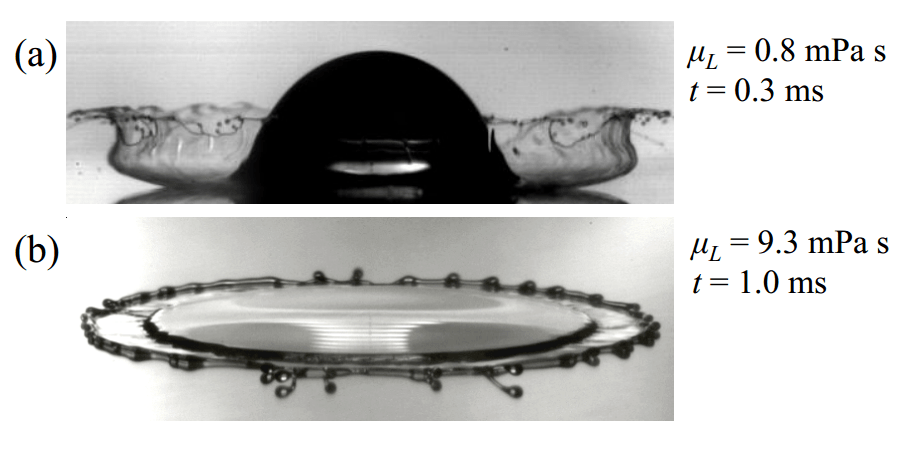
Everyone has seen drops of liquid falling onto a dry surface, yet the process is still being unraveled by researchers. We have learned, for example, that lowering the ambient air pressure can completely suppress splashing. Viscosity of the fluid also clearly plays a role, but the relationship between these and other variables is unclear. The images above show two droplet impacts in which the viscosity differs. The top image shows a low viscosity fluid, which almost immediately after impact forms a thin expanding sheet of fluid that lifts off the surface to create a crownlike splash. In contrast, the higher viscosity fluid in the bottom image spreads as a thick lamella with a thinner outer sheet that breaks down at the rim. Researchers found that both the high- and low-viscosity fluids have splashes featuring these thin liquid sheets, but the time scales on which the sheet develops differ. Moreover, lowering the ambient pressure increases the time required for the sheet to develop regardless of the fluid’s viscosity. (Image credit: C. Stevens et al.; submitted by @ASoutIglesias)
When Jets Collide
When two jets of a viscous liquid collide, they can form a chain-like stream or even a fishbone pattern, depending on the flow rate. This video demonstrates the menagerie of shapes that form not only with changing flow rates but by changing how the jets collide – from a glancing impingement to direct collision. When just touching, the viscous jets generate long threads of fluid that tear off and form tiny satellite droplets. At low flow rates, continuing to bring the jets closer causes them to twist around one another, releasing a series of pinched-off droplets. At higher flow rates, bringing the jets closer to each other creates a thin webbing of fluid between the jets that ultimately becomes a full fishbone pattern when the jets fully collide. The surface-tension-driven Plateau-Rayleigh instability helps drive the pinch-off and break-up into droplets. (Video credit: B. Keshavarz and G. McKinley)

Spinning Polygons


Nature is full of surprising behaviors. If one imagines putting a bucket of water on a rotating plate and spinning it, one would expect the water’s free surface to take on a curved, axially symmetric shape. The photos above are from a similar experiment, but instead of the entire container rotating, only the bottom plate spins. Surprisingly, the water’s surface does not remain symmetric around the axis of rotation. Instead, the water forms stable polygon shapes that rotate slower than the spinning plate. As the plate’s rotation speed increases, the number of corners in the polygon increases. Shapes up to a hexagon were observed in the experiment. Photos of the set-up and more experimental results are available, as is the original research paper. Symmetry breaking and polygons can also be found in hydraulic jumps and bumps, liquid sheets, and planetary polar vortices. (Photo credit: T. Jansson et al.; research paper)
Knotting Vortices
Knots have long fascinated humans, appearing in art for thousands of years and generating entire fields of study. Until recently, however, the idea of a knotted fluid was purely theoretical. To knot fluids, researchers used 3D printing to create twisted hydrofoil shapes. When towed through water, fluid travels around the shape and spins up at the trailing edge, creating a knotted vortex ring. The knotted vortices were captured with 3D imaging, allowing scientists to observe how they evolve. So far the knots they’ve created have all been unstable, deforming until two vortex lines approach one another. Upon contact, the vortices disconnect and reconnect with one another, unraveling the knot. Intriguingly, these vortex reconnections seem remarkably similar to the vortex reconnections observed between quantized vortices in superfluids. (Video credit: D. Kleckner et al.)

Sochi 2014: Why is Ice Slippery?
Ice is a key component of many Winter Olympic disciplines, including figure skating, hockey, speed skating, curling, and the sliding sports. The low friction and slippery nature of the ice are vital to the events, but oddly enough, scientists don’t yet fully understand why ice is slippery. A common explanation is that the narrow blades on which athletes compete cause extremely high pressures that locally melts the ice, creating a thin layer of water upon which the athlete glides. The trouble with this explanation is that it only accounts for ice being slippery within a few degrees of its melting point. Not only that, anyone who has fallen when walking on ice knows that it is slippery even without ice skates. In 1859 physicist Michael Faraday suggested that ice may be covered in a thin liquid-like layer even at temperatures well below freezing. Experiments since then suggest that this layer is tens or hundreds of nanometers thick, depending on the purity of the surface film. Robert Rosenberg has an excellent review of the subject in Physics Today. (Image credit: Reuters/D. Gray via The Big Picture)
This post opens up our series on fluid dynamics in the Winter Olympics. Stay tuned for more over the next two weeks. Got a question in mind? Seen a great article? Feel free to ask questions or submit links on Tumblr, Twitter, or by email.
The Structure of Turbulence
Though they may appear random at first glance, turbulent flows do possess structure. The video above shows a numerical simulation of a mixing layer, a flow in which two adjacent regions of fluid move with different velocities. The upper third of the frame shows a top view, and the bottom frame shows a side view, in which the upper fluid layer moves faster than the lower one. The difference in velocities creates shear which quickly drives the mixing layer into turbulence. But watch the chaos carefully, and your eye will pick out vortices rolling clockwise in the largest scales of the mixing layer. These features are known as coherent structures, and they are key to current efforts to understand and model turbulent flows. (Video credit: A. McMullan)