Many situations can generate high-speed liquid jets, including droplet impacts, vibrated fluids, and surface charges. In each of these cases, a concave liquid surface is impulsively accelerated, which causes the flow to focus into a jet. The image above shows snapshots of a microjet generated from a 50 micron capillary tube visible at the right. This jet formed when the meniscus inside the capillary tube was disturbed by a laser pulse that vaporized fluid behind the interface. Incredibly, the microjets generated with this method can reach speeds of 850 m/s, nearly 3 times the speed of sound in air. Researchers have found the method produces consistent results and suggest that it could one day form the basis for needle-free drug injection. You can read more in their freely available paper. (Photo credit: K. Tagawa et al.)
Category: Research

Droplets Surfing
The Leidenfrost effect can make water droplets skitter across a hot griddle or briefly protect a hand dunked in liquid nitrogen. When a liquid is exposed to a solid surface much, much hotter than its boiling point, the contact vaporizes part of the liquid, and, in the case of a droplet, forms a thin lubricating layer of vapor that the liquid drop can skate around on. Researchers have found that releasing these Leidenfrost droplets on textured surfaces creates self-propelling drops by directing the flow of vapor. In this video, one team demonstrates some of the neat tracks they’ve built for their drops. (Video credit: D. Soto et al.)

Advantages of Schooling

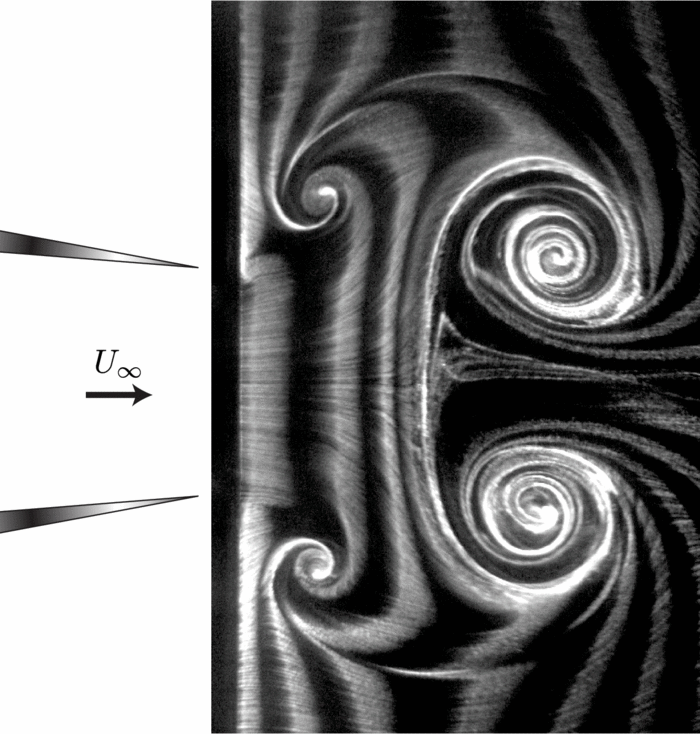
Many fish swim in close proximity to one another in large schools, causing scientists to wonder if this behavior is motivated primarily by defense against predators or whether fish derive some hydrodynamic advantages from schooling. Examining the fluid dynamics of an entire school of fish is rather impractical, so researchers approximate two neighboring swimmers using flapping hydrofoils. The images above show flow visualizations of the wakes of these two mechanical swimmers. When the two hydrofoils flap in-phase with one another (top image), one oscillation period produces a complicated pattern of many vortices zig-zagging behind the foils. This configuration produces more efficient propulsion than a single hydrofoil, meaning that more of the energy in the wake is used to produce thrust. The cost, however, is reduced thrust overall. The bottom image shows the wake pattern for hydrofoils flapping out-of-phase. This behavior enhanced thrust without reducing propulsive efficiency. The results suggest that schooling fish might choose different swimming strategies depending on the situation. (Image credits: P. Dewey et al.)

Putting Out Wildfires Using Explosives

Wildfires damage millions of acres of land per year in the United States alone. Using explosives to put out an uncontrolled wildfire sounds a bit crazy, but it’s actually not that far-fetched. The animations above are taken from high-speed footage of a propane fire interacting with a blast wave. The first animation shows what the human eye would see, and the second is a shadowgraph video, a technique which highlights differences in density and makes the flame’s convection and the blast wave itself visible. At close range, the shock wave from the explosion and the high-speed gas behind it push the flames away from their fuel source, stopping combustion almost immediately. For a flame farther away from the blast, the shock wave introduces turbulent disturbances that can destabilize the flame. Much work remains to be done before the technique could be scaled from the laboratory to the field, but it is an exciting concept. You can read more about the work here. (Research credit: G. Doig/UNSW Australia; original videos: here and here; submitted by @CraigOverend)
Oily Foams
It is common in many industries to use oil as a defoamer to break up existing foams or prevent foams from forming. But with the right surfactants–additives that change the foam’s surface tension–it’s possible to make aqueous foams that are actually stabilized by the presence of oil. This video explores some of the ways that oil can interact with these kinds of foam, beginning with capillary action, which draws the oil up into the junctions between foam films. For more, see Piroird and Lorenceau. (Video credit and submission: K. Piroird)
Pointed Drops
When water droplets sit on a cold substrate, they freeze into a shape with a pointed tip. At first glance, this behavior seems very odd since surface tension usually acts to prevent such sharp protrusions. The shape is, however, a result of water’s expansion as it freezes. The droplet freezes from the substrate upward, with a concave shape to the solidification front. The angle of the point does not depend on the substrate temperature or the wetting angle between the water and surface. Instead, it turns out that this concave front shape and water’s expansion are the key factors that determine the pointed cusp’s angle, and that the final geometry of the cusp is essentially universal. (Video credit: M. Nauenberg; additional research credit: A. Marin et al.)
Granular Jet
Sometimes the similarity between fluid flow and granular flows is quite striking. This video shows a stream of sand falling down a tube and impacting a rod. (Note: the view is rotated 90 degrees counter-clockwise, so down points to the right.) As the sand strikes the rod, it’s deflected into a conical sheet, very much like a water bell. There are even ripple-like instabilities that form in the granular sheet, though they move differently than in a liquid due to the sand’s lack of surface tension. (Video credit: S. Nagel et al.)

Inside a Splash

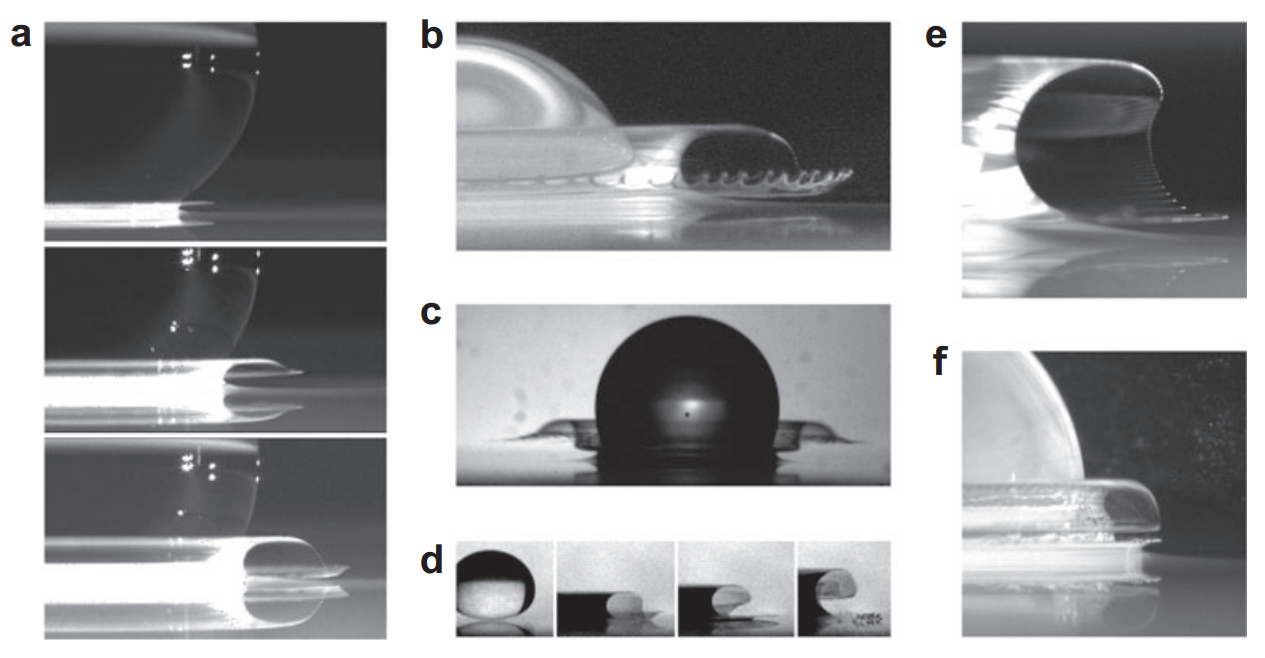
When a droplet strikes a pool, a thin, fast-moving sheet of liquid expands outward from the region of contact. These ejecta sheets come in many forms depending on surface tension, viscosity, air pressure, and droplet momentum. When the ejecta sheet curls downward to touch the pool, it can spray microdroplets outward or trap a layer of air underneath the droplet. For more, see this video by S. Nagel et al., and the papers Thoroddsen (2002) and Thoroddsen et al. (2008). (Photo credits: S. Thoroddsen et al.; GIF from this video by S. Thoroddsen et al.)

Viscous Fingers
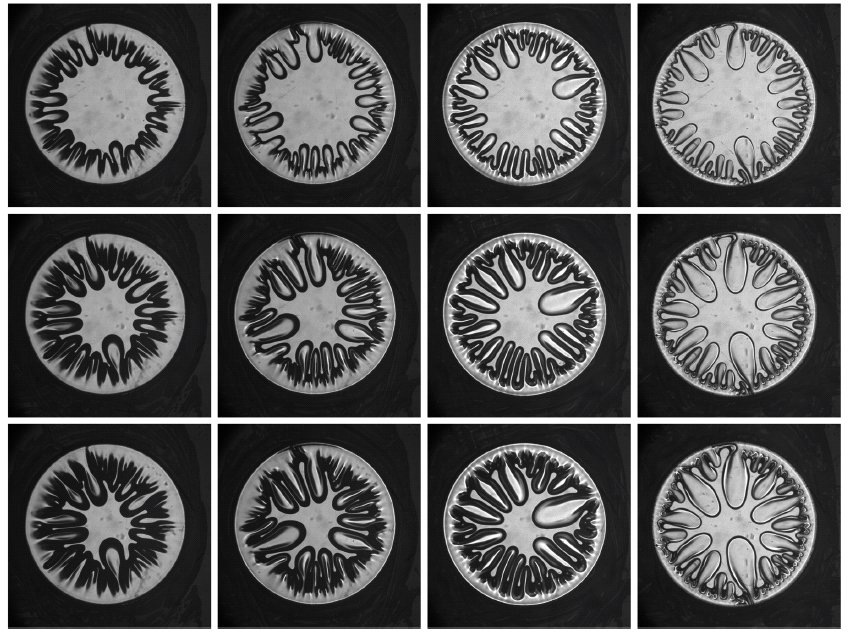
Viscous liquid placed between two plates forms a finger-like instability when the top plate is lifted. The photos above show the evolution of the instability for four initial cases (top row, each column) in which the initial gap between the plates differs. Each row shows a subsequent time during the lifting process. As the plate is pulled up, the viscous liquid adheres to it and air from the surroundings is entrained inward to replace the fluid. This forms patterns similar to the classic Saffman-Taylor instability caused when less viscous fluid is injected into a more viscous one. (Photo credit: J. Nase et al.)
Tiny Fliers
There’s an apocryphal story claiming that, aerodynamically speaking, honeybees should not be able to fly. Obviously, they can, but it’s true that a small, flapping creature and a large, fixed-wing aircraft will not generate lift exactly the same way. NYU professor Leif Ristroph has a lot of projects exploring flapping flight on smaller scales, as seen in this video. His oscillatory fliers and rotating flapping flight simulator have both been featured previously. Part of the beauty of these projects is their size; in a field that’s historically required giant wind tunnels and room-length wave tanks, Ristroph’s work provides insight into long-standing problems using apparatuses that fit on a countertop. (Video credit: Cool Hunting/L. Ristroph et al.)