Category: Research

  • A Water Balloon on a Bed of Nails

    A Water Balloon on a Bed of Nails

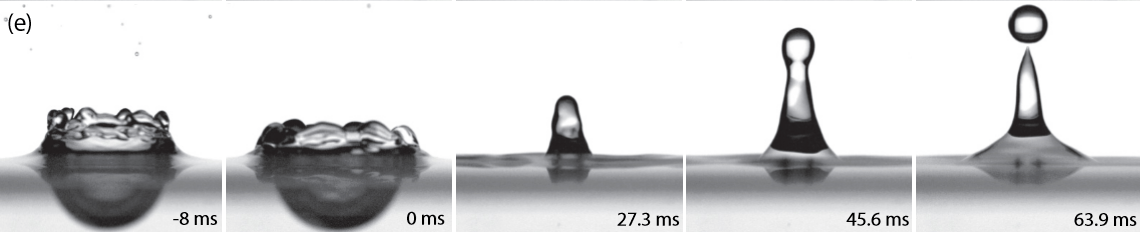
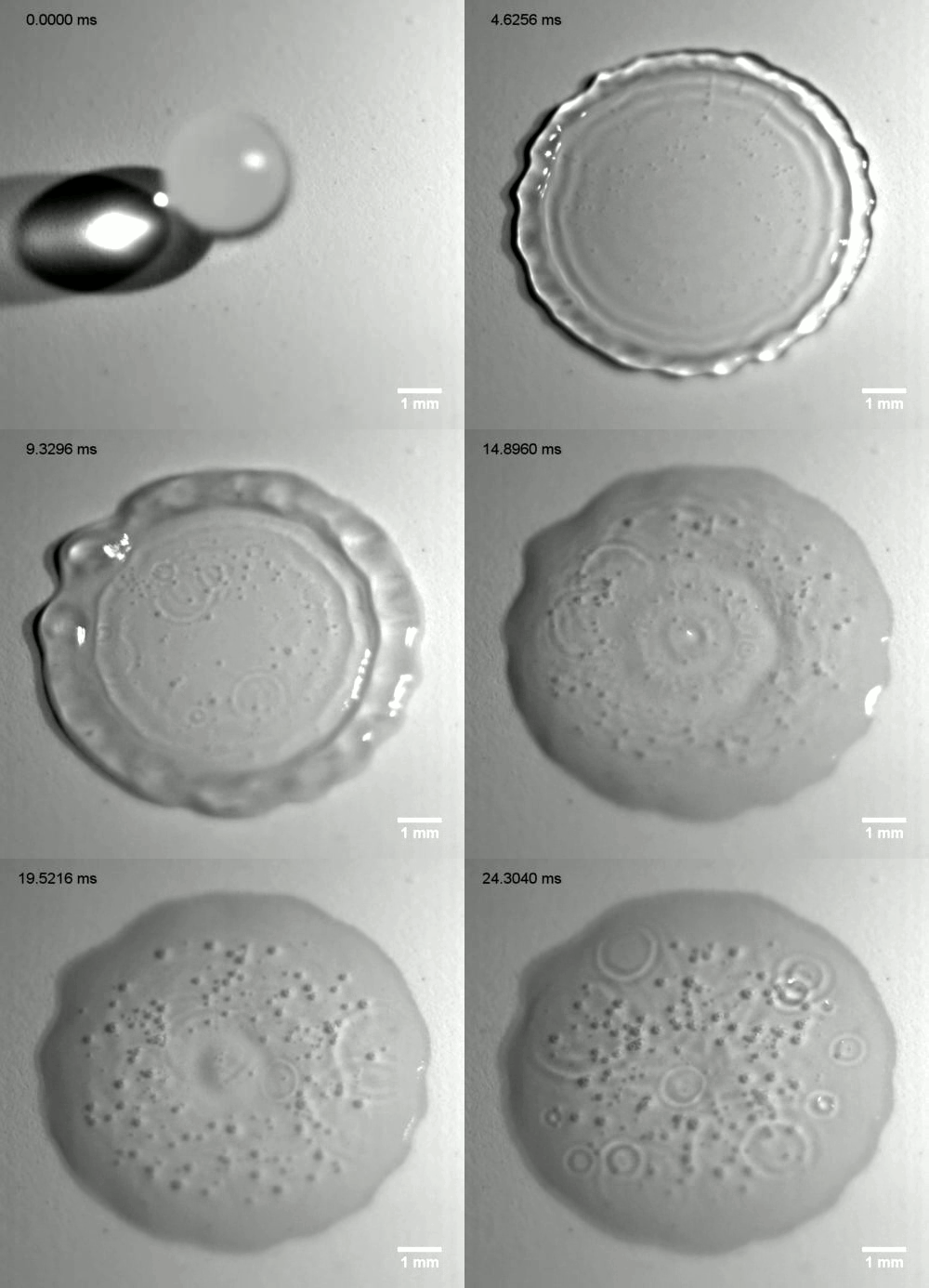
    If you dropped a water balloon on a bed of nails, you’d expect it to burst spectacularly. And you’d be right – some of the time. Under the right conditions, though, you’d see what a high-speed camera caught in the animation above: a pancake-shaped bounce with nary a leak. Physically, this is a scaled-up version of what happens to a water droplet when it hits a superhydrophobic surface.

    Water repellent superhydrophobic surfaces are covered in microscale roughness, much like a bed of tiny nails. When the balloon (or droplet) hits, it deforms into the gaps between posts. In the case of the water balloon, its rubbery exterior pulls back against that deformation. (For the droplet, the same effect is provided by surface tension.) That tension pulls the deformed parts of the balloon back up, causing the whole balloon to rebound off the nails in a pancake-like shape. For more, check out this video on the student balloon project or the original water droplet research. (Image credits: T. Hecksher et al., Y. Liu et al.; via The New York Times; submitted by Justin B.)

    image
  • Geological Flowers

    Geological Flowers

    These strange flower-like formations appear in a former limestone quarry in France. The black that you see is bitumen, or asphalt. These dendritic structures appear in spots where the rock has fractured. Originally, two rock faces met here, with a thin layer of bitumen glued between them. As one face pulled away, air began to seep into the space between, slowly injecting itself into the more viscous bitumen. Just as we observe in the laboratory, the air and bitumen formed viscous fingers, creating a classic pattern known as the Saffman-Taylor instability. It’s so cool to see an example of this in nature! You can see more photos of the formations here. (Image credit: P. Thomas)

  • Shot Through a Drop

    Shot Through a Drop

    Shoot a sphere through a drop with sufficient speed, and you’ll see something like the composite photo above. Going from right to left, the projectile is initially coated in liquid and stretches the fluid behind it as it continues flying. This forms a thin sheet of fluid called a lamella with a thicker, uneven rim at its far end. The lamella continues stretching until the projectile breaks through and detaches. Now the lamella starts rebounding back on itself as surface tension struggles to keep the fluid together. A new rim forms on the front, and both the front and back rims thicken as the lamella collapses. Along the rims thicker portions start forming droplets – like spikes on a crown – as the surface-tension-driven Plateau-Rayleigh instability starts breaking the structure down. The untenable sheet of fluid will break up into a cloud of smaller, satellite droplets when it can hold together no longer. (Image credit: V. Sechenyh et al., video)

  • Crowns On Impact

    Crowns On Impact

    Dropping a partially-filled test tube of water against a table makes the meniscus at the air-water interface invert into a jet of liquid. In some cases, the impact is strong enough to generate splashing crowns of water around the base of the jet. These crowns come in two forms – one with many splashes layered upon one another and the other with only a few splashes and a faster jet. 

    The many-layered splash crowns come from the pressure wave that reflects back and forth from the bottom of the tube to the surface and back. This pressure wave moves at the speed of sound and vibrates the water surface, creating the many splashes. The same reflected pressure wave occurs in the second type of splash crown, but it gets disrupted by cavitation bubbles that form in the water (visible in the lower left image). Instead the splash crowns form from the shock waves generated when the cavitation bubbles collapse. (Image credits: A. Kiyama et al.)

  • Featured Video Play Icon

    Paint Spilling Physics

    There is a remarkable amount of physics contained in art. In this video, scientists from The Splash Lab explore some of the physics involved in pouring paint atop a rectangular post. The spreading paint transforms its shape repeatedly, and, at the corners of the post, it preserves a tiny history of all the colors poured. Paint sliding down the sides shifts from a thin sheet to a thicker jet that deposits color in waves. For tall posts, the distance the paint falls is long enough for instabilities to set in, producing a paint puddle that’s riddled with curves and waves between each color of paint. It’s a lovely reminder of the complexity inherent even within a simple action. (Video credit: R. Hurd et al.)

  • When Jets Collide

    When Jets Collide

    Two liquids that collide don’t always coalesce. The image above shows two jets of silicone oil colliding. On the left, the jets collide and bounce off one another. On the right, at a slightly higher flow rate, the two jets coalesce. This bouncing, or noncoalescence, observed at lower speeds is due to an incredibly thin layer of air separating the two jets. This air layer is constantly being replenished by air that gets dragged along by the flowing oil. But if the oil flows too quickly, that air layer becomes unstable–in the same way that a droplet that falls too quickly will splash on impact. When the separating air layer becomes unstable and breaks down, the jets collide and merge. (Image credit: N. Wadhwa et al., pdf)

  • Featured Video Play Icon

    Simulating the Earth

    Computational fluid dynamics and supercomputing are increasingly powerful tools for tracking and understanding the complex dynamics of our planet. The videos above and below are NASA visualizations of carbon dioxide in Earth’s atmosphere over the course of a full year. They are constructed by taking real-world measurements of atmospheric conditions and carbon emissions and feeding them into a computational model that simulates the physics of our planet’s oceans and atmosphere. The result is a visualization of where and how carbon dioxide moves around our planet.

    There are distinctive patterns that emerge in a visualization like this. Because the Northern Hemisphere contains more landmass and more countries emitting carbon, it contains the highest concentrations of carbon dioxide, but winds move those emissions far from their source. As seasons change and plants begin photosynthesizing in the Northern Hemisphere, concentrations of carbon dioxide decrease as plants take it up. When the seasons change again, that carbon is re-released.

    These visualizations underscore the fact that these carbon emissions impact everyone on our planet–nature does not recognize political borders–and so we share a joint responsibility in whatever actions we take. (Video credit: NASA Goddard; h/t to Chris for the second vid)

  • Falling Atop Sheets

    Falling Atop Sheets

    A sphere falling into water is a classic problem in fluid dynamics, but scientists are becoming increasingly interested in what happens when they introduce new dimensions to the problem. Here researchers float an extremely thin elastic sheet atop water and study how it wrinkles when a steel sphere impacts it. Despite its elasticity, the sheet does not stretch when the ball hits. Instead it compresses and forms wrinkles. Some of those wrinkles deepen into folds, but the wrinkle pattern that forms right at impact determines the way the film will bunch up. If the ball is heavy enough, it will drag the sheet entirely underwater; if not, the sheet will catch the ball and continue floating. Scientists are interested in these interactions between liquids and thin solids because sheets could be used to encapsulate liquids for applications like targeted drug delivery. (Image credit: M. Inizan et al., source)

  • Featured Video Play Icon

    Visualizing Flow with Snowfall

    One of the challenges in engineering and operating wind turbines is that full-scale turbines rarely behave as predicted in smaller-scale laboratory experiments and simulations. One way to reconcile these differences (and discover what our experiments and simulations are missing) is to take the experiments out into the field. One research group has done this by using snowfall to visualize the flow around wind turbines. In this video, they share some of their observations, which include interactions of tip vortices with one another and with the vortex from the tower. My favorite part starts around 1:50 where you can observe tip vortices leap-frogging one another behind the wind turbine! (Video credit: Y. Liu et al.)

  • Featured Video Play Icon

    Freezing Drops

    A water droplet deposited on a cold surface freezes from the bottom up. As anyone who has made ice cubes knows, water expands when it freezes. But watch the outline of the drop carefully. The drop isn’t expanding radially outward while it freezes. Instead the remaining liquid part of the drop forms what’s known as a spherical cap, a shape like the sliced-off top of a sphere. Surface tension creates that spherical shape, but the water still has to expand when it freezes. The result? The last bit of the drop freezes into a point! This means that surface tension maintains the drop’s spherical shape, for the most part, and all the expansion the water does takes place vertically. (Video credit: D. Lohse et al.)