Some plants in the Pelargonium family produce seeds with long helical tails. These appendages, formally known as awns, are humidity-sensitive. On humid nights or after rainfall, the awn begins to straighten. With its end anchored on the ground, this unfurling spins the seed and helps it burrow into the soil. A study looking at the physics of this system found that rotating reduces the drag a burrowing seed experiences in a granular material. Normally much of the force that opposes motion into a granular material is the result of intergranular contacts creating what are known as force chains. (Many science museums have great displays that visualize force chains.) The rotating seed drags grains near its surface along with it, helping to break up the force chains and reduce resistance. (Image and research credit: W. Jung et al., source)
Category: Research

When Chaos is Not So Chaotic

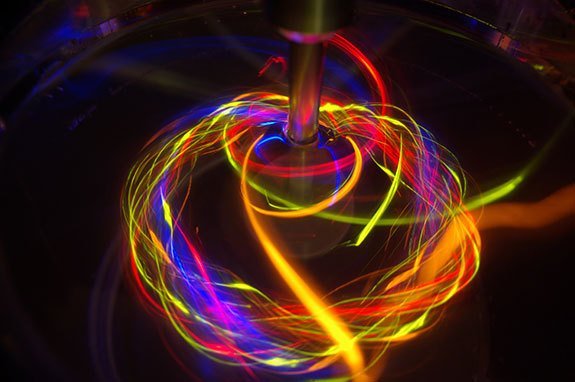
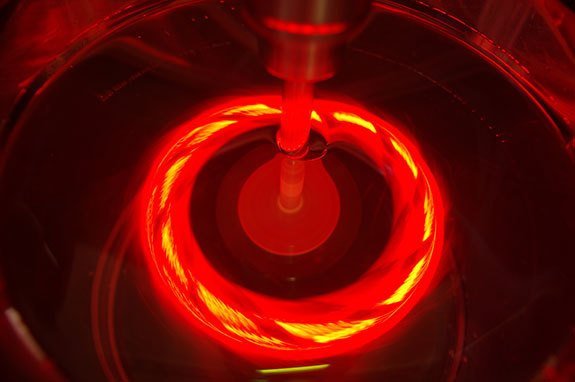
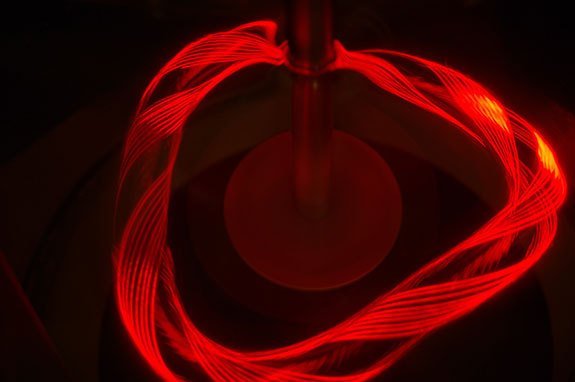
In industry, tanks are often agitated or stirred to mix different elements. The goal is to create a laminar but chaotic flow field throughout the mixture. Introducing particles to such a system reveals that things are not quite as chaotic as they might seem. The photographs above show the pathlines of various large, glowing particles initially poured into the tank from above. Over time, the particles scatter off of structures in the mixed sections of the tank and end up trapped in vortex tubes that form above and below the agitator. Once trapped in the vortex tube, the particles follow helical paths inside the tube, creating patterns like those seen in the lower two photos. (Image and research credit: S. Wang et al., 1, 2, 3)

The Tibetan Singing Bowl
Rubbing a Tibetan singing bowl creates sound and a spray of droplets inside the container. But the reverse works, too! Instead of rubbing the bowl, one can project sound at it to make the droplets dance. In the video above, the speaker plays a sinusoidal wave at a frequency that resonates with the bowl. It activates the most basic vibrations in the bowl, making it bulge slightly front-to-back and then side-to-side. This is called the fundamental vibrational mode. The bowl doesn’t change shape enough to see by eye, but you can tell where the bowl is flexing the most – at the four points where the droplets are ejected! The larger vibrations there are what create the spray of droplets. (Video credit: D. Terwagne)

Escaping Quicksand


Quicksand is complicated stuff. It’s typically a mixture made up of sand, clay, and water. To get those ingredients into a proper quicksand mixture, you have to liquefy the particles by saturating the spaces between them with water, as the jumping tourists in the top animation are doing. (That’s not to say that you can’t just find a patch of quicksand – just that something has to have pumped that area full of water first.)
If you end up in quicksand, don’t panic. Quicksand is denser than a human, which means that, at the worst, you won’t sink in much further than your waist (middle image). It’s tough to move once you sink because your weight has squeezed a lot of the water out from between the sand and clay particles, thereby drastically increasing the viscosity. To get out, try putting weight on one leg and wiggling the other back and forth (bottom image). This lets water back in the mixture and hopefully lets you free that leg. Once one leg is free, try to kneel on it and work the other leg out. (Image credits: making quicksand – T. L. Nguyen, source; stuck – National Geographic, source; escape – Tech Insider, source; research credit: G. Evans et al., A. Khaldoun et al.)

Flow Above the Treetops
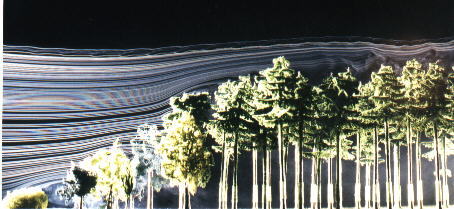
As this smoke visualization shows, trees have a significant impact on airflow around them. Flow in the image is from left to right. On the left, the upstream air is traveling in smooth, laminar lines that are quickly disrupted as the flow moves into the trees. After the first shorter trees, flow inside the wooded area has been broken up and slowed. Above the canopy, the smoke streaklines have also slowed and become more turbulent. Understanding how wind and trees interact is important in a variety of applications, including when adding renewable energy options to buildings and when predicting the spread of forest fires. (Image credit: W. Frank et al.)

Sniffing Underwater
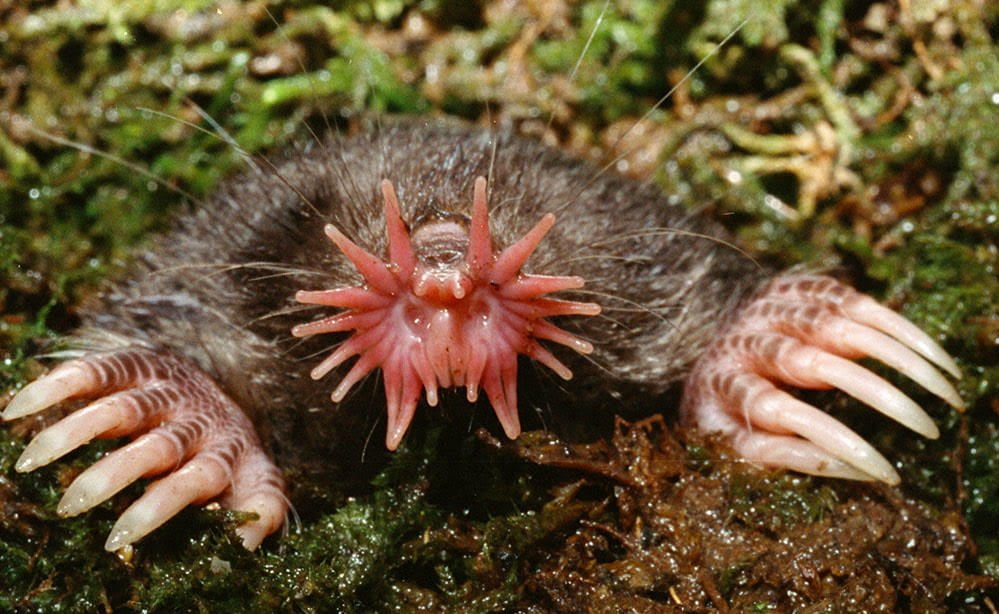
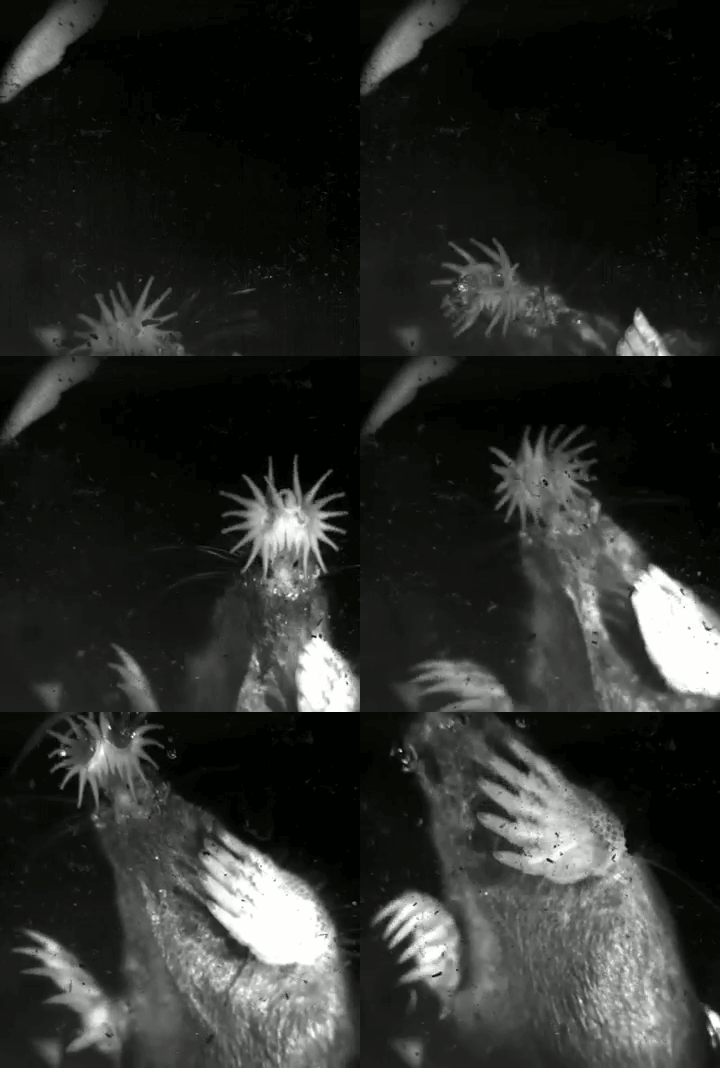

You’d be forgiven for thinking that the star-nosed mole looks funny. Its distinctive star-shaped nose is a highly-sensitive organ, but the mole doesn’t just use it for finding its way through the underground tunnels it lives in. These moles can actually sniff underwater. By exhaling a bubble and then re-inspiring it, the moles collect scent particles that they can use to locate food. In experiments, both star-nosed moles and water shrews could use this technique to successfully follow a scent trail, demonstrating exploring and pausing behaviors similar to terrestrial sniffing as they did. To learn more about this impressive mammal, listen to the latest episode of Science Friday, where research Ken Catania describes his work with them. (Image credits: K. Catania; via Science Friday)

How the Jellyfish Stings


Many jellyfish are capable of venomously stinging both their prey and their predators. The stings originate from specialized cells in their tentacles called nematocysts (middle image) that, when activated, rapidly extend a thin tubule that acts like a hypodermic needle to deliver venom into the jellyfish’s victim (bottom image). The tubules can elongate in about 50 ms – about one-sixth of the time needed to blink your eye. This rapid extension is driven by osmotic pressure – pressure generated when water flows across a semi-permeable membrane in response to chemical changes.
Researchers originally thought all of the osmotic pressure resided in the nematocyst’s capsule end from which the tubule expands, but new work indicates that the tubule is instead pulled along by high osmotic pressure along its moving front. That means that disrupting osmosis at the front – by say, wearing a material with no osmotic potential – can slow down the tubule expansion and stop the jellyfish’s sting. (Image credits: jellyfish – A. Kongprepan; nematocyst – D. Brand; tubule expansion – S. Park et al.; research credit: S. Park et al.; submitted by L. Buss)

Growing Droplets on a Trampoline

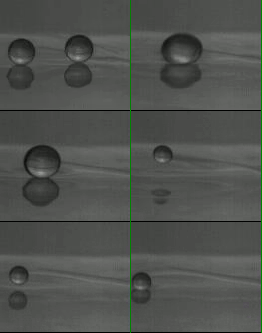
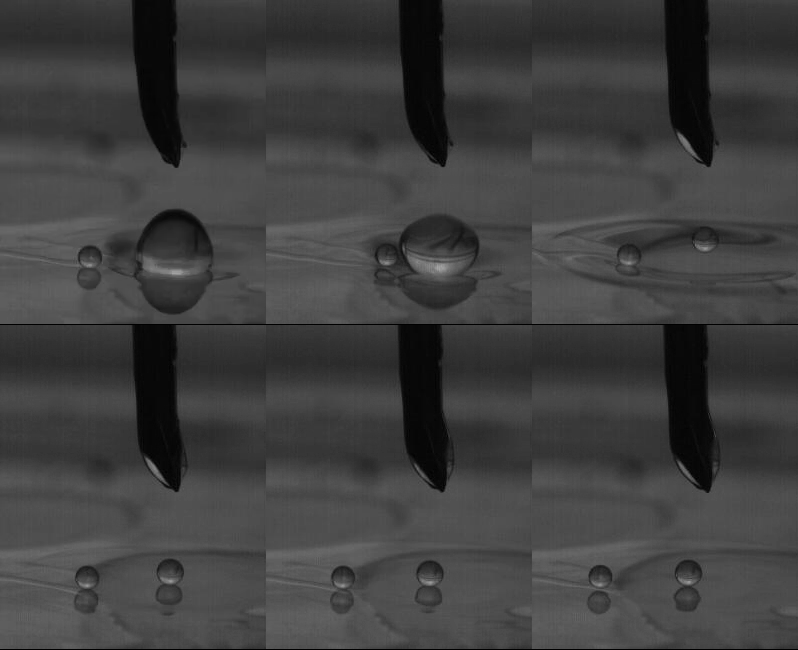
Droplets on a liquid surface will typically coalesce, thanks to gravity and the low viscosity of the air layer between them and the pool. In certain cases, droplets will partially coalesce, producing smaller and smaller droplets until they finally coalesce completely. Vibrating the liquid surface can help prevent this coalescence but only when droplets are small.
In fact, if the pool is more viscous than the droplets, bouncing can be used to produce droplets of a desired size, as shown above. Because the droplets are less viscous, they deform more than the pool does – behaving somewhat like a bouncy ball hitting a rigid wall. In this system, large droplets are unstable and will undergo partial coalescence until they are small enough to bounce stably. The size of stable drops is determined by the frequency and acceleration of the bouncing bath; by tuning these parameters, researchers can select what size droplets they want to end up with. (Research credit: T. Gilet et al.; images and submission by N. Vandewalle)

Gravity Waves on Mars
It may look like grainy, black and white static from a 20th-century television, but this animation shows what may be the first view of gravity waves seen from the ground on another planet. The animation was stitched together from photos taken by the Mars Curiosity rover’s navigation camera, and it shows a line of clouds approaching the rover’s position.
Gravity waves are common on Earth, appearing where disturbances in a fluid propagate like ripples on a pond. In the atmosphere, this can take the form of stripe-like wave clouds downstream of mountains; internal waves under the ocean are another variety of gravity wave. If these are, in fact, Martian gravity waves, they are likely the result of wind moving up and over topography, much like their Terran counterparts. (Image credit: NASA/JPL-Caltech/York University; research credit: J. Kloos and J. Moores, pdf; via Science; h/t Cocktail Party Physics)
How We Sweat
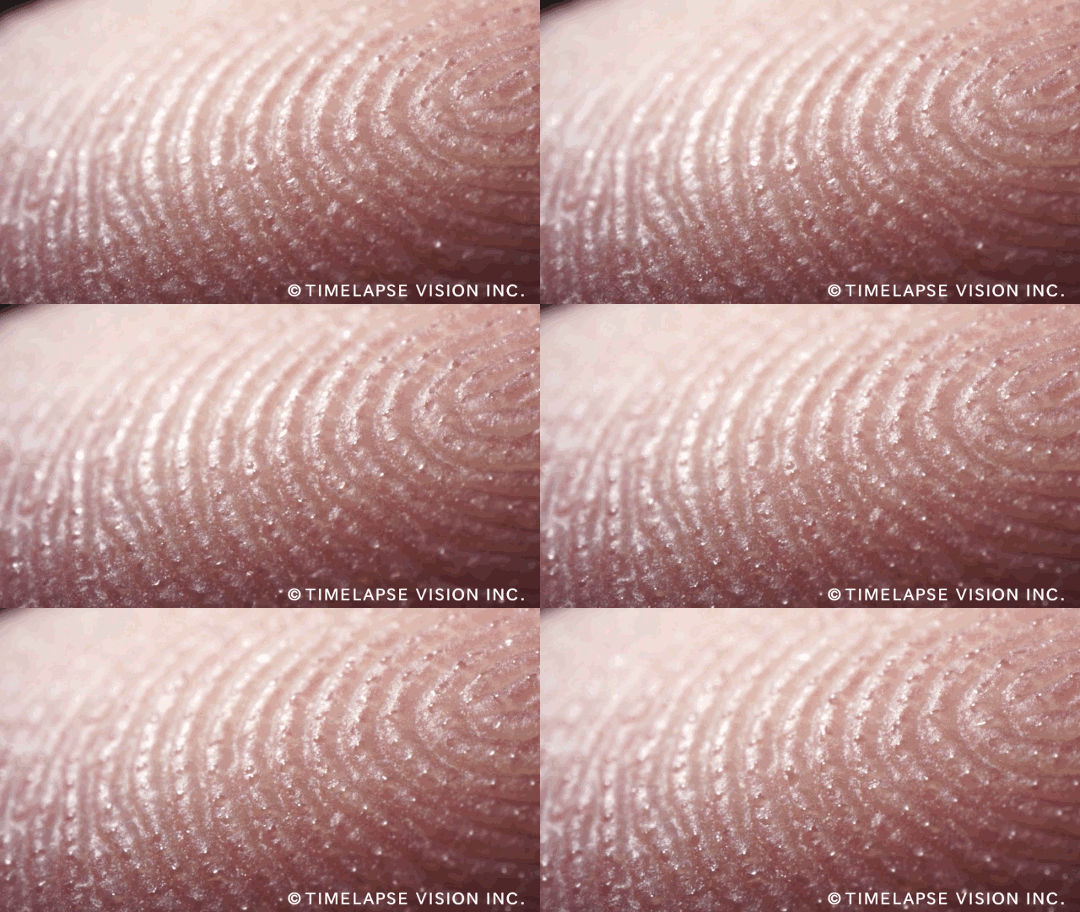
Sweat plays a critical role in controlling body temperature for humans. Most of the sweat glands on our bodies are eccrine sweat glands, which pump out a mixture of water and electrolytes in response to temperature changes or emotional stimuli. Beneath the surface, these glands consist of three major areas, the tightly bunched secretory coil, where the cells that produce sweat are located; a long dermal duct that transports sweat to the skin surface; and the upper coiled duct just below the pore where sweat exits. Eccrine glands can produce an impressive amount of pressure – about 70 kN/m^2, equivalent to 70% of sea-level atmospheric pressure – to help drive sweat up and out onto the skin. Flow from pores is not steady; like many other biological processes, sweat flow is pulsatile. (Image credit: Timelapse Vision Inc., source; Z. Sonner et al.; submitted by Marc A.)