During winter, the polar skies can ignite with mother-of-pearl-like iridescence. Polar stratospheric clouds – also known as nacreous clouds – are a rare, beautiful, and destructive type of cloud found only in high latitudes at altitudes of 15 – 25 km. They are formed from tiny crystals of ice and nitric acid, and they shine brightest a few hours before sunrise or after sunset, when sunlight shines on them but not the surface. Their destructive side is connected with ozone depletion; they serve as reaction sites for chlorofluorocarbons in the atmosphere to react and produce ozone-destroying molecules. The clouds may have cultural significance as well; at least one study suggests they were part of Munch’s inspiration for “The Scream”. (Image credit: A. Light; via Gizmodo)
Category: Phenomena

What Makes Turbulence So Hard


Turbulence – that pestersome, unpredictable, and chaotic state of flow – has been a thorn in the sides of mathematicians, physicists, and engineers for centuries. It is certainly one of – if not the – oldest unsolved problem in physics. Over at Ars Technica, Lee Phillips has a nice overview of the situation, including what makes the problem so difficult:
The Navier-Stokes equation is difficult to solve because it is nonlinear. This word is thrown around quite a bit, but here it means something specific. You can build up a complicated solution to a linear equation by adding up many simple solutions. An example you may be aware of is sound: the equation for sound waves is linear, so you can build up a complex sound by adding together many simple sounds of different frequencies (“harmonics”). Elementary quantum mechanics is also linear; the Schrödinger equation allows you to add together solutions to find a new solution.
But fluid dynamics doesn’t work this way: the nonlinearity of the Navier-Stokes equation means that you can’t build solutions by adding together simpler solutions. This is part of the reason that Heisenberg’s mathematical genius, which served him so well in helping to invent quantum mechanics, was put to such a severe test when it came to turbulence.
Phillips goes on to describe some of the many methods researchers use to unravel the mysteries of turbulence computationally, experimentally, and theoretically. This is a great introduction for those curious to get a sense of how turbulence, stability theory, and computational fluid dynamics all fit together. (Image credits: L. Da Vinci; NASA; see also: Ars Technica; submitted by Kam Yung-Soh)

Hydraulics Make Spiders So Creepy
There’s something about the way spiders move that many of us find inherently creepy. And that something, it turns out, is fluid dynamical. Unlike humans and other vertebrates, spiders don’t move using two sets of opposing muscles. The natural state of their multi-jointed legs causes them to flex inward. This is why dead spiders have their legs all curled up.
To walk, spiders use hydraulic pressure. They pump a fluid called hemolymph into their legs to force them to straighten. If you look closely, you’ll notice that spiders’ legs always connect to the front section of their body. This is called the cephalothorax, and it acts like a sort of bellows that controls the pressure and flow of hemolymph. It moves the hemolymph around the spider’s body in a fraction of a second, allowing spiders to be quite fast, but something about the movement still feels off for those of us used to vertebrate motion. Happy Halloween, everyone! (Image credit: R. Miller, source; see also; submitted by jpshoer)

Solar Prominence
Near the surface of the sun, the interplay of magnetic fields and plasma flow creates solar prominences that appear to dance. The prominence shown here was recorded in 2012 by the NASA Solar Dynamics Observatory, and its arc is large enough to easily surround the Earth. This is fluid dynamics – specifically magnetohydrodynamics – on a scale difficult for us earthbound humans to imagine. Scientists are still working to understand the complex processes that drive flows like this one. Fortunately, we can appreciate their beauty regardless. (Image credit: NASA SDO, source; via APOD; submitted by jpshoer)

Swirls of Color
These beautiful swirls show the wake downstream of a thin plate. Here water is flowing from left to right and dye introduced on the plate (upstream and unseen in the photo) curls up into vortices. The vortices in the top row rotate clockwise, while the vortices along the bottom rotate anti-clockwise. This pattern of alternating vortices is extremely common in the wakes of objects and is known as a von Karman vortex street. Similar patterns are seen in soap films, behind cylinders, in the wakes of islands, and behind spaceships. (Image credit: ONERA, archived here)

Stall with Pitching Foils
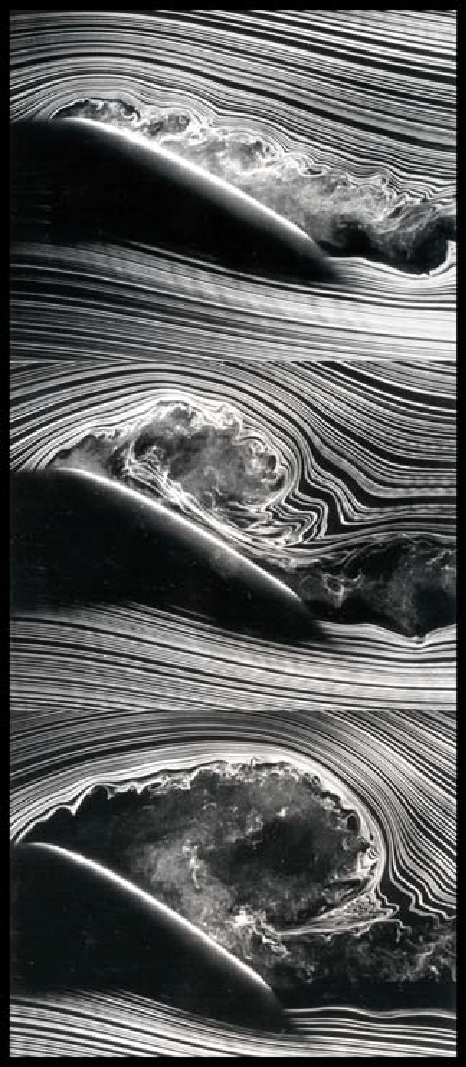
For a fixed-wing aircraft, stall – the point where airflow around the wing separates and lift is lost – is an enemy. It’s the precursor to a stomach-turning freefall for the airplane and its contents. But the story is rather different when the wing is actively pitching through these high angles of attack. In this case, you get what’s known as dynamic stall, illustrated in three consecutive snapshots above.
In the top image, the flow has clearly separated from the upper surface of the wing, but this isn’t a cause for panic. As the middle image shows, there’s a vortex that’s formed in that separated region and it’s moving backward along the wing as the angle of attack continues to increase. That vortex causes a strong low-pressure region on the upper surface of the wing, allowing it to maintain lift.
In the final image, the vortex is leaving the wing, taking its low-pressure zone with it. This is the point where the pitching wing loses its lift, but if the vortex’s departure is immediately followed by a pitch down to lower angles of attack, the aircraft will recover lift and carry on. (Image credit: S. Schreck and M. Robinson, source)
Phytoplankton Swirl
During the warm summer months, phytoplankton blooms pop up in waters around the world. This natural-color satellite image shows a bloom in the Gulf of Finland. The tiny phytoplankton serve as tracker particles for the flow, revealing large-scale features like the spectacular vortex in the center of this image. The presence of the phytoplankton here suggests that this vortex could be pumping nutrients up from the deep.
Researchers also use particles for flow visualization. This can be as simple as adding small, neutrally buoyant particles, illuminating smoke, or even using natural snowfall to see what’s happening in the flow. (Image credit: NASA/USGS/J. Stevens/L. Dauphin)

Oobleck Under Impact
Fluids like air and water are Newtonian, which means that the way they deform does not depend on how the force on them gets applied. Many other fluids, however, are non-Newtonian. How they behave depends on how force is applied to them. The Internet’s favorite non-Newtonian fluid is probably oobleck, a mixture of cornstarch and water with some fairly extreme properties. When deformed quickly, like when struck with a bat, oobleck doesn’t flow; it shatters.
What’s happening at the microscopic level is that the cornstarch particles in the oobleck are jamming together. They simply cannot move quickly and avoid one another. When they jam together, the friction between them goes way up and so does the apparent viscosity of the oobleck. Because it doesn’t have time to flow, all that energy goes into breaking off “solid” chunks instead. Once they hit the ground, the pieces of oobleck will puddle, just like any other liquid. (Image and video credit: Beyond the Press; via Nerdist)
Making Champagne for Space


Humanity’s ongoing quest to enjoy beloved beverages in space has a new entry: champagne. French champagne maker Mumm has announced a new line with specially designed bottles to dispense champagne in microgravity. The bottles feature an internal piston that allows users to release the contents from the bottle in a controlled manner. Rather than pouring the champagne, one dispenses a blob which can then be caught in the special cups that go with it. They’re shaped somewhat like a miniature coupe.
It certainly looks like a fun way to celebrate in microgravity, although it’s unclear to me that they’ve tested the after effects of consumption. Historically, astronauts have avoided carbonated beverages in orbit because the lack of gravity can cause unpleasant side effects with all those bubbles. (Image credits: Mumm Champagne, source; via Wired)

Supernumerary Bows
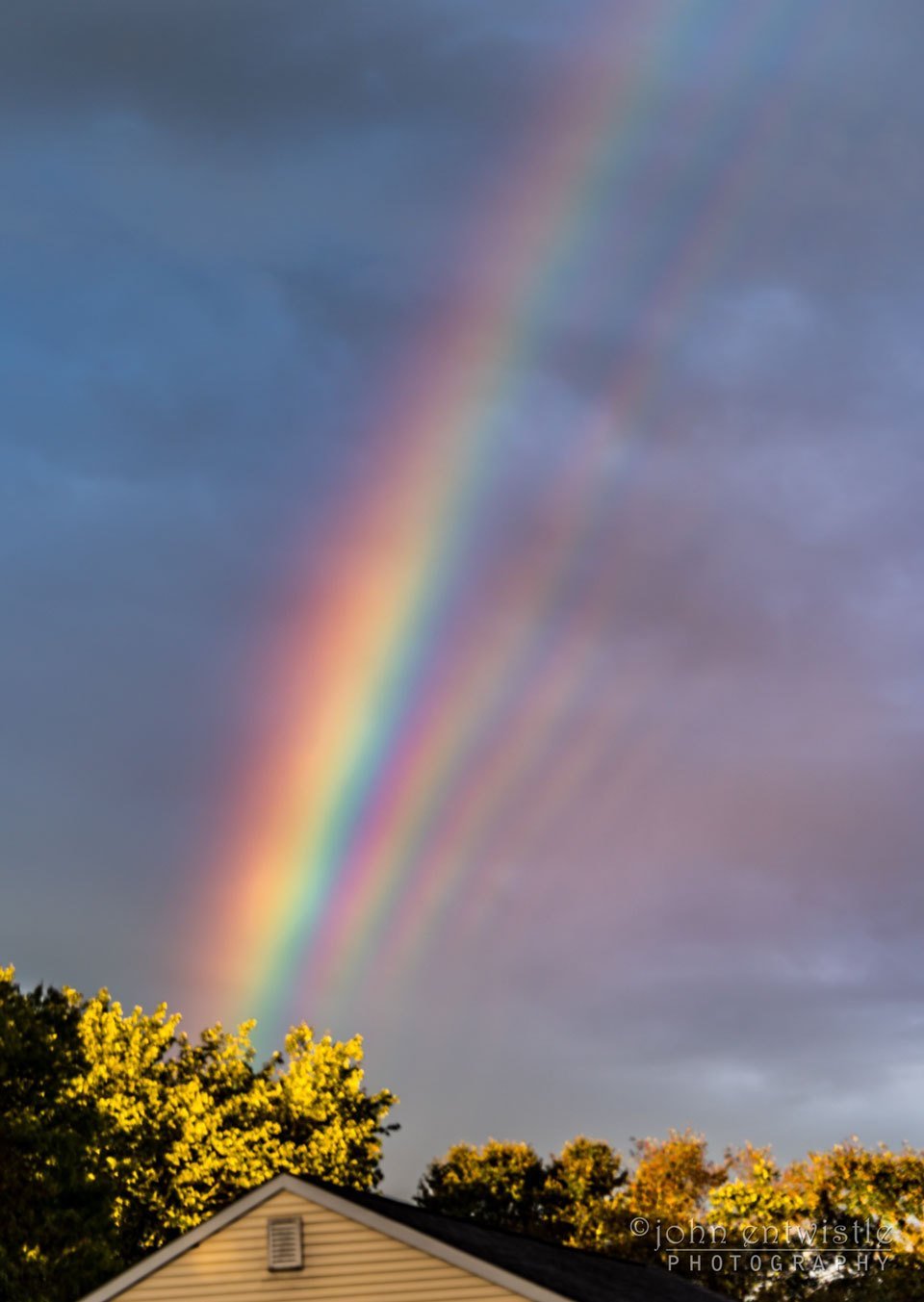
After the rain of Hurricane Florence came the rainbow, or rainbows, in this case. Photographer John Entwistle captured this image of a rainbow with several additional supernumerary bows. The inner fringes seen here form when light passes through water droplets that are all close to the same size; given the spread seen here, the droplets are likely smaller than a millimeter in diameter. Supernumerary rainbows cannot be explained with a purely geometric theory of optics; instead, they require acknowledging the wave nature of light. (Image credit: J. Entwistle; via APOD; submitted by Kam-Yung Soh)