Periodically, our sun releases plasma in a coronal mass ejection. Afterwards, the local magnetic field lines shift and reorganize. We can see that process in action here because charged particles spin along the magnetic lines, outlining them as bright loops in this imagery. This sequence – one of the best examples of this phenomenon to date – was captured by NASA’s Solar Dynamics Observatory in early 2017. To understand behaviors like these, scientists use magnetohydrodynamics, a marriage of the equations of fluid mechanics with Maxwell’s equations for electromagnetism. (Image credit: NASA SDO, source)
Category: Phenomena

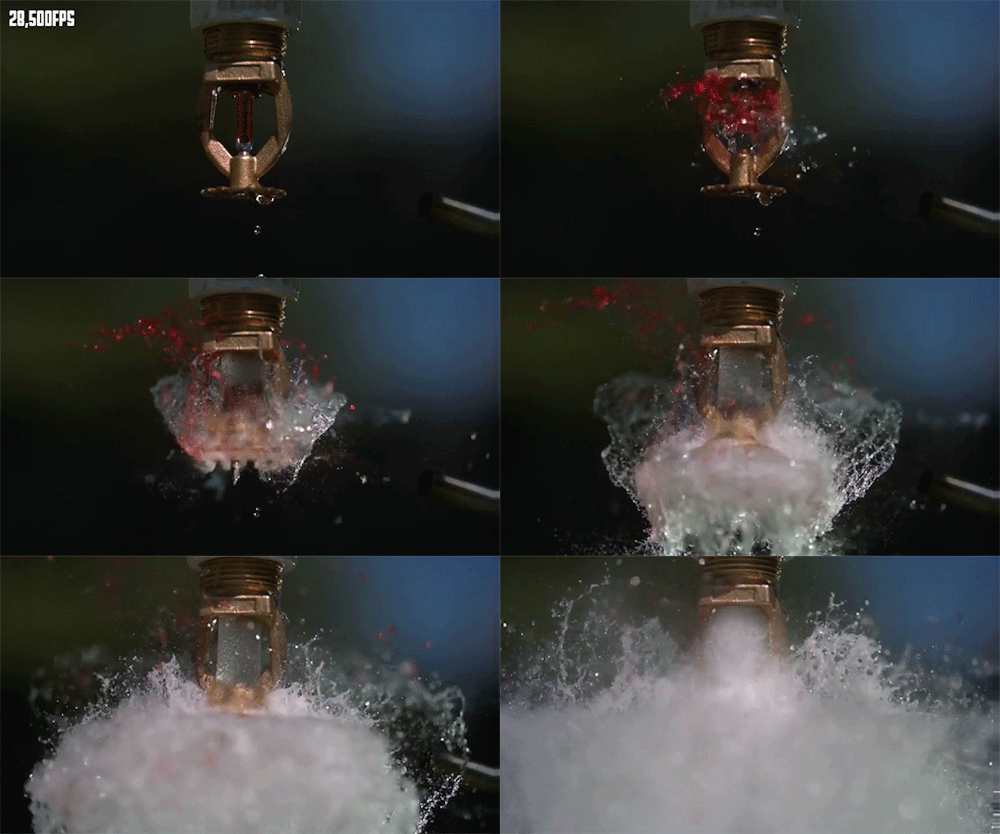
How Fire Sprinklers Work
Most of us have probably never given much thought to how a fire sprinkler works, but fortunately, the Slow Mo Guys have used their high-speed skills to answer that question anyway. Sprinkler systems of this variety are constantly pressurized by a full pipe line of water that’s held back by a thin metal disk and a colored glass ampule containing a fluid like alcohol. The color of ampule indicates the temperature at which the system is designed to activate. As the ampule heats up, the fluid inside expands, breaking the ampule at or near the critical temperature. That allows the metal disk to fall away and releases a torrent of water, which falls onto the gear-like disk at the bottom of the sprinkler and gets flung out over a wider area. Despite appearances, that bottom disk is stationary, not spinning; its shape alone is what distributes the water. (Image and video credit: The Slow Mo Guys)


Titan’s Dragonfly
Last week, NASA announced its next New Frontiers mission: a nuclear-powered drone named Dragonfly heading to Titan. This astrobiology mission is set to search our solar system’s second largest moon for signs of life. It’s exciting aerodynamically, as well, since Titan’s thick atmosphere makes it uniquely suited for heavier-than-air flight. Therefore, rather than using wheeled rovers like we have on Mars, Dragonfly is a rotorcraft. It will be capable of traveling up to 8km per flight, which will quickly surpass the fewer than 21km the Curiosity Rover has managed on Mars!
Like Earth, Titan has rainfall and open liquid bodies on its surface. I, for one, can’t wait to see the alien vistas Dragonfly sends back as it cruises over methane lakes. (Image and video credit: NASA)
Fingers of Clay
Take a mixture of a viscous liquid – like clay mud – and squeeze it between two glass plates and you’ll create a mostly-round layer of liquid. As you pry the two glass plates apart, air will push its way into that layer, forcing through the mud in a dendritic pattern. This is called the Saffman-Taylor instability or viscous fingering. It occurs because the interface between the air and mud is unstable. (Image and video credit: amàco et al.)

Experimenting with Speakers
In her ongoing quest to explore natural resonance, Dianna has enlisted some very nice, very expensive speakers to find out just what happens when the bass drops. If you ever wondered what the natural frequency of your eyeballs is, then this one’s for you.
If you’re more intrigued by the idea of putting out fires with sound (and/or explosions), I’ve got some posts on that including a sound-based fire extinguisher and a supersonic cannon capable of blowing out fires. (Video credit: Physics Girl)
How Spillways Work


Human infrastructure like dams have the challenge of standing up to whatever nature can throw at them. It’s expensive, if not outright impossible, to build to every single contingency, so engineers have developed methods of dealing with problems like excess flow caused by a storm. For dams, one of the ways of dealing with this are spillways, which allow a method of controlled release from a reservoir.
Spillways come in many shapes and sizes, as seen in the video, but there are two general types: those that are actively managed and those that are automatic. An automatic spillway is like the “morning glory” type seen in the middle animation. There’s no on or off for a spillway like this. Instead, once the water level is high enough, water naturally flows out. In that sense, it’s like the overflow holes found in many bathroom sinks.
Controlled spillways are usually managed with gates that can be opened or closed as operators need them. This technique gives more granular control and can even end up being cheaper in some situations because it requires less space to implement. (Video and image credit: Practical Engineering)
Engineering Droplets
A jet of falling liquid doesn’t remain a uniform cylinder; instead, it breaks into droplets. In this video, Bill Hammack explores why this is and what engineers have learned to do to control the size of the droplets formed.
The technical name for this phenomenon is the Plateau-Rayleigh instability. It begins (like many instabilities) with a tiny perturbation, a wobble in the falling jet. This begins a game of tug of war. One of the competitors, surface tension, is trying to minimize the surface area of the liquid, which means breaking it into spherical droplets. But doing so requires forcing some of the the liquid to flow upward, against both gravity and the liquid’s inertia. The battle takes some time, but eventually surface tension wins and the jet breaks up.
That’s not necessary a bad thing. It’s actually key to many engineering processes, like ink-jet printing and rocket combustion, as Bill explains in the full video. (Video and image credit: B. Hammack; submitted by @eclecticca)

Capillary Action and Sand Castles
Capillary action – or capillarity – is the ability of liquids to flow through narrow constrictions. It results from intermolecular forces between fluids and solids. It’s a combination of surface tension – which creates cohesion within the liquid – and adhesion, which allows the liquid and solid to hold to one another. Together, these forces propel the liquid to flow through narrow gaps.
In the video below, a saturated mixture of sand and water is poured into a mold on a bed of dry sand. When left to settle, much of the water flows from the mold into the dry sand bed through capillary action. When the mold is removed (top), the sand holds its shape, something it can’t do without a porous bed to soak in the excess liquid. (Image and video credit: amàco et al.)
Evaporative Convection
Since we spend so much of our lives around transparent fluids like air and water, we often miss seeing some of their coolest-looking flows. Here, we see a layer of water only 3 centimeters deep but a full meter wide. It’s seeded with tiny crystals that reflect light depending on their orientation, which allows us to see the flow. Initially, the tank is spun up, then left stationary for 2 hours while evaporation cools the water.
Normally, the resulting flow would be too slow to notice, but that’s where the magic of timelapse comes in. With it, we can see the wriggling dark lines marking areas where cool, dense water sinks and brighter regions where warm fluid rises. What begins as an array of polygonal convection cells quickly merges into a couple of large, rounded cells. Check out the full video below, where you can see the streaming patterns far better than in animation. (Image and video credit: UCLA Spinlab)
Drinking Coffee in Space


You probably don’t give much thought to the forces involved in drinking here on Earth. That’s because gravity’s effects dominate over everything else. Our cups are designed to hold a liquid until we use gravity to pour it into our mouths. But that technique doesn’t work in microgravity. There other forces govern how liquids flow: specifically surface tension and capillary action.
Both of these forces are the result of intermolecular attractions. In the case of surface tension, it’s the attraction that the molecules of a liquid feel for one another that keeps them in a cohesive bunch. Capillary action is similar, but it’s an attraction between the liquid molecules and those of the solid they’re wetting. When you combine them both, you get the ability for liquids to climb up a narrow gap and pull more liquid up behind them. That’s the key science behind every version of the “space cup” developed by astronaut Don Pettit and his collaborators.
To hear more about the development and engineering of the cup (and exactly why it makes drinking coffee so much more enjoyable in space than it would be otherwise) check out the full video. And, in case you’re wondering, there’s a special microgravity champagne flute, too! (Image and video credit: It’s Okay to Be Smart)