Category: Phenomena

  • Featured Video Play Icon

    Melting

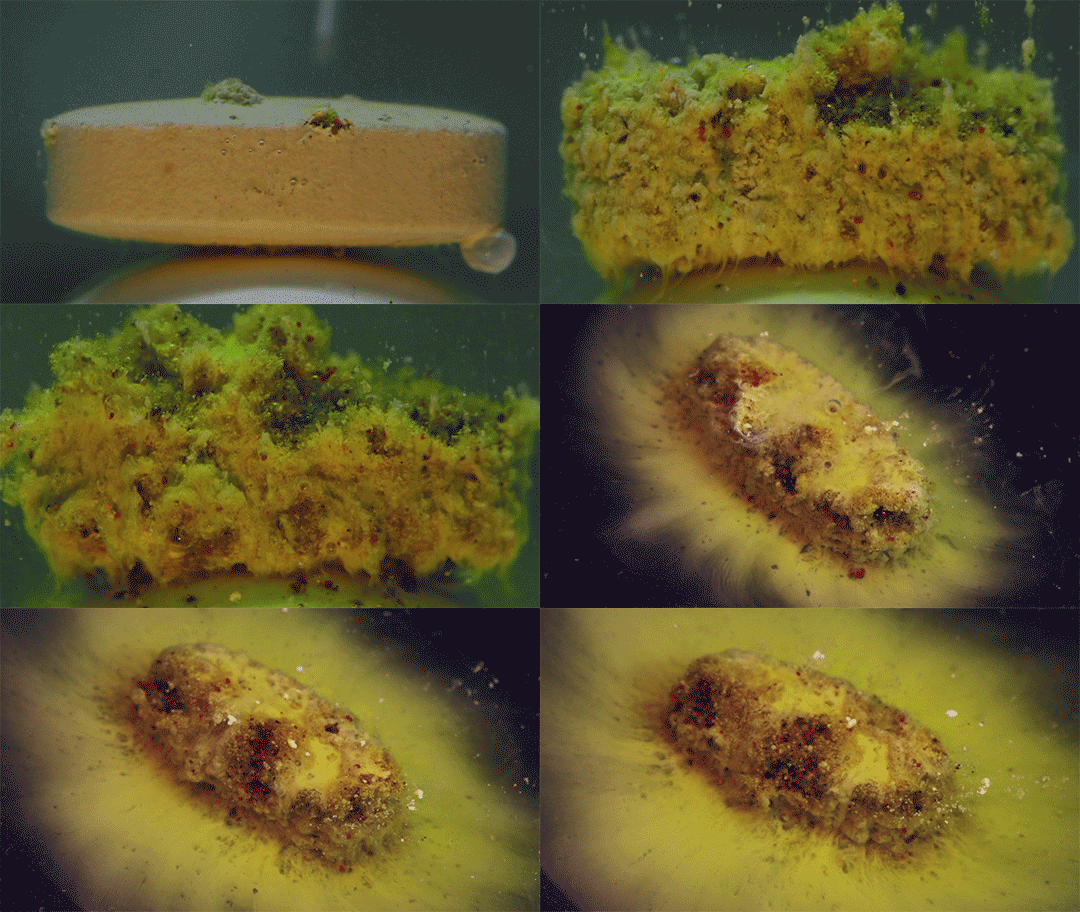
    File this one under “Oddly Satisfying” – this timelapse video shows the process of melting a jawbreaker candy using a blowtorch. Over a minute and a half, each colorful layer of candy melts away to reveal the strata beneath. There’s a definite connection here to some of the previous research we’ve discussed on erosion, dissolution, and melting. The blowtorch’s flame generates a hot boundary layer around the candy surface; it’s thickest and hottest at the central stagnation point, but judging by the melting layer we see running all the way to the candy’s shoulder, its size and effect are substantial even there. It’s hard to tell from the video whether the surface of candy is getting roughened (a la scalloping) or whether that’s just an uneven layer of melted candy flow. Regardless, it’s a fun watch. (Video and image credit: Let’s Melt This; via Colossal)

  • Inside a Wind Tunnel

    Inside a Wind Tunnel

    When I was in graduate school, I worked in a facility known as the High-Speed Wind Tunnel Lab. We were located next door to the Low-Speed Wind Tunnel, and every few months we’d receive a phone call asking whether we could film someone in the high-speed wind tunnel. This was impossible for several reasons – the size of human beings and the necessity of drawing the hypersonic tunnels down to vacuum-like pressures before initiating flow being only two of them – but what it really did was highlight the difference in definitions. 

    What these (usually) weather forecasters wanted was to simulate hurricane force winds on a human being. And to an aerodynamicist, that hundred mile-an-hour flow is still low-speed. Because we’re comparing it to the speed of sound, not the normal range of wind speeds a human experiences. That said, watching humans struggle inside a wind tunnel is always entertaining. 

    As you can see from the Slow Mo Guys here, counteracting the lift and drag forces from these wind speeds is tough. On the bottom left, Dan has managed to balance his weight and the drag forces to hold himself in a virtual chair. Meanwhile, Gav’s attempt to jump forward against the wind just pushes him backward as his lab coat parachutes behind him. (Image and video credit: The Slow Mo Guys)

  • Featured Video Play Icon

    Even Mountains Flow

    Over about 5 months of 2018, the summit of Mount Kilauea slowly collapsed as the volcano erupted. Seen in timelapse, it’s a remarkable reminder of the ancient Greek philosopher Heraclitus’s observation, “Everything flows.” All things change, so given enough time, just about everything can flow.

    Fluid dynamicists actually capture this concept in a dimensionless ratio known as the Deborah number. Named for a Biblical prophet who states, “The mountains flow before the Lord,” the Deborah number is defined as the ratio between the time needed for a material to respond applied stress and the time over which the process is observed. In practice, a lower Deborah number indicates a more fluid-like material while a higher one represents more solid-like behavior.

    Be sure to check out the full video. There’s some spectacular lava flow footage near the end – definitely a small Deborah number! (Video and image credit: USGS via Science; research credit: C. Neal et al.)

  • Featured Video Play Icon

    Massive Worthington Jet

    The FloWave facility in Scotland is one of the coolest ocean simulators out there. Equipped with 168 individual wave makers and 28 submerged flow-drive units, it’s capable of recreating almost any ocean conditions imaginable. So naturally the Slow Mo Guys used it to create a giant spike wave.

    Essentially, this is an oversized Worthington jet, the same as the ones you see after a droplet hits the surface. But with several thousand tonnes of crystalline clear water, the effect of that wave focusing is pretty spectacular. When you’re watching the high-speed footage, be sure to pay attention to the details, like the glassy surface of the collapsing jet, or the way holes open and expand as the splash curtain comes down around Dan’s head (above). Longtime readers will recognize many familiar features. (Image and video credit: The Slow Mo Guys)

  • Featured Video Play Icon

    Hydraulic Jumps

    Chances are that you’ve seen plenty of hydraulic jumps in your life, whether they were in your kitchen sink, the whitewater of a river, or at the bottom of a spillway. Practical Engineering has a great primer on this oddity of open channel flow. 

    When water (or other liquids) flow with a surface open to the air – think like a river rather than a pipe – the flow has three important regimes: subcritical, critical, and supercritical. Which state the flow is in depends on the speed of the flow compared to the speed of a wave traveling in that flow. If the waves are faster than the flow, we call it subcritical. If the flow is faster than the waves, it’s called supercritical. (This is equivalent to subsonic or supersonic flow, where the regime depends on the flow speed compared to the speed of sound.)

    Flows can transition naturally from one state to another, and where they transition from fast, supercritical flow to slower, subcritical flow, we find hydraulic jumps – places where the kinetic energy of the supercritical flow gets changed into turbulence and potential energy through a change in height. Check out the video above to learn how civil engineers use hydraulic jumps to control water and erosion. (Video and image credit: Practical Engineering)

  • Amber Waves

    Amber Waves

    When I was a teenager, I liked riding my bike along the river boardwalk near my house. There were fields there, like those in the image above and video below, with tall grass that would bend and sway in the wind. The long stalks undulated almost like a fluid, and they were mesmerizing. This video gives you a higher vantage point, where you can see the larger patterns of motion. What you’re seeing, I think, are some of the large-scale turbulent variations in the wind. Rather than being uniform and laminar, the wind contains pockets of turbulent gusts, which the sway of the long grass reveals to the naked eye. In terms of physical mechanism, I suspect it’s similar to how wind imprints its patterns on water. (Video and image credit: N. Moore)

  • Collective Motion: Intro

    Collective Motion: Intro

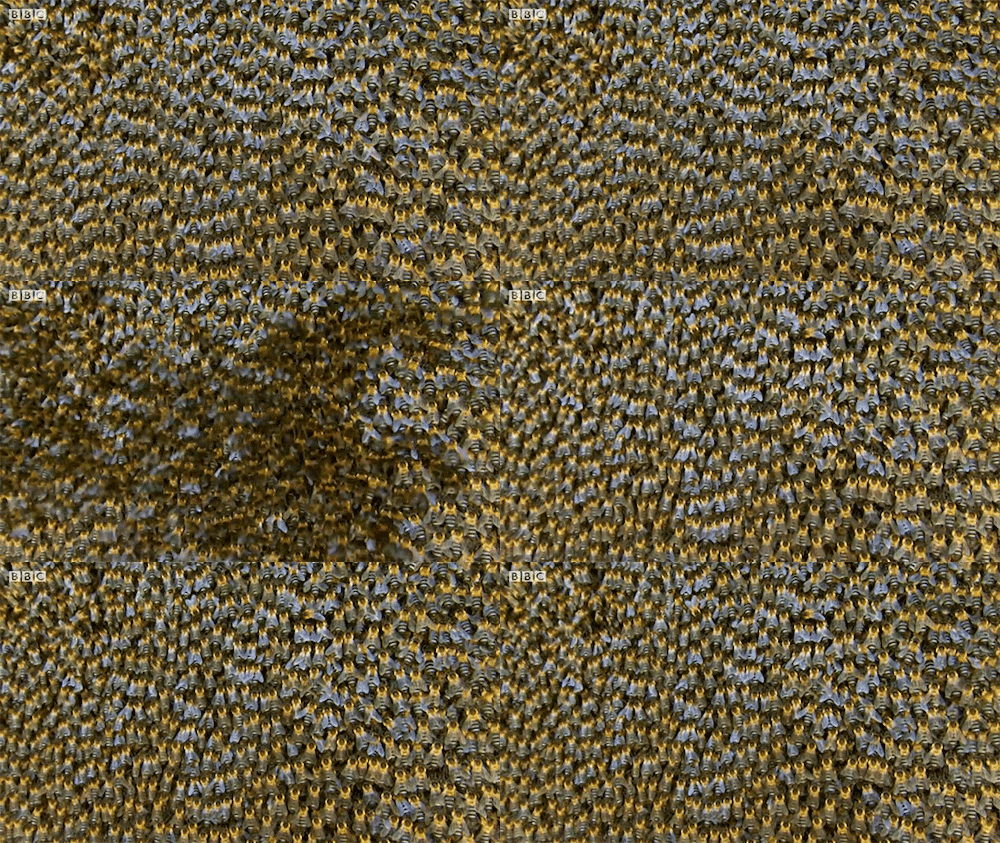
    Herds, flocks, schools, and even crowds can behave in fluid-like ways. On Science Friday, Stanford professor Nicholas Ouellette explains some of the physics behind these similarities. Fluids are, after all, made up of a many, many individual particles – typically molecules – just the way a crowd of people or a school of fish contains many individuals. What makes the collective behaviors of groups harder to model than a fluid, however, is a lack of randomness. In something like water, all the molecules move randomly, which allows scientists to make certain simplifications in how we describe that motion.

    In animal group behaviors, on the other hand, the motion of an individual is not completely random. It instead seems to be governed by relatively simple rules based on the observations that an individual can make. Combine those rules across a large number of individuals and you can get what’s called emergent behavior – exactly the sort of large-scale patterns we see in swarms of insects, flocks of birds, and schools of fish. (Image credits: fish – N. Sharp; starlings – N. Fielding, source; battle – New Line Cinema; podcast credit: Science Friday; submitted by Michelle D.)

    This week on FYFD, we’ll explore the world of collective motion and how it overlaps with fluid dynamics.

  • Featured Video Play Icon

    Worthington and His Jets

    If you’ve been around fluid mechanics for very long, you’ve probably noticed that we like to name things after people. (Mostly dead, white guys, but that’s another subject.) Whenever someone describes or explains a new phenomenon, it tends to get their name attached to it. Some of the common names in fluid dynamics – Reynolds, Rayleigh, Kelvin, Taylor, von Karman, Prandtl – read like a who’s-who of nineteenth and twentieth century physics. This video gives some historical insight into a couple of those figures – particularly Arthur Worthington, who is known for his contributions to the understanding of splashes. Be sure to check out some of his awesome illustrations and photos. Can you imagine being able to piece together splash physics like that without high-speed video?! (Video credit: Objectivity; submitted by Kam-Yung Soh)

  • Featured Video Play Icon

    The Polar Vortex

    Every year or two, the Northern Hemisphere gets treated to a bout of intensely cold temperatures thanks to the polar vortex. What you may not realize, though, is that it’s not the polar vortex that causes this cold weather – it’s the vortex breaking down. As Simon Clark explains in this video, the polar vortices (one at each pole) are intense and powerful regions of circulation in the stratosphere, or mid-atmosphere. They’re largely responsible for keeping cold air trapped in the Arctic and Antarctic. But occasionally, this region of the atmosphere will suddenly get warmer – to the tune of increasing by 80 degrees Celsius in less than a week! When this happens, a polar vortex will deform and potentially even split into smaller vortices, as seen below. When this happens, the vortex loses its hold on the cold air near the surface, allowing Arctic air to sneak as far south as Texas. After a couple of weeks of affecting our weather, the polar vortex will typically reform and we’ll return to normal. In the meantime, stay warm! (Video and image credit: S. Clark; submitted by Nikhilesh T.)

  • Vortices and Ground Effect

    Vortices and Ground Effect

    Though typically unseen, the vortices that swirl from the tips of aircraft wings are powerful. Here you see a Hawker Sea Fury equipped with a smoke system used to visualize the vortices that form at the wingtip as high-pressure air from the bottom of the wing and low-pressure air from the top swirl together. As you can see, the vortices persist in the wake long after the plane passes. The size and strength of the vortices depend on the size and speed of the aircraft; this is why air traffic control requires smaller planes to wait longer to take off or land if there was just a larger aircraft on the runway.

    The other cool thing to note here is how the wingtip vortices move apart from one another in the animation above. In flight, wingtip vortices usually stay roughly parallel to one another, but they drift downward in the aircraft’s wake. Near the ground, though, the vortices cannot move down, so instead ground effect forces them apart from one another, as seen here. (Image and video credit: E. Seguin; via Kelsey C.)