When you hear the term “ultrasound,” your brain likely jumps to grainy black and white images of unborn babies, but this technology has a lot more medical uses than just that! Ultrasound is used to image many parts of the body — earlier this year, I got to see my own heart in action through an echocardiogram, for example. But the technology has therapeutic uses as well. At higher energies, ultrasound is used to break up kidney stones (through cavitation), treat tremors, and alleviate some sources of pain. To learn more, check out Explore Sound’s page on biomedical acoustics. (Video and image credit: Acoustical Society of America)
Category: Phenomena

Speeding Sedimentation
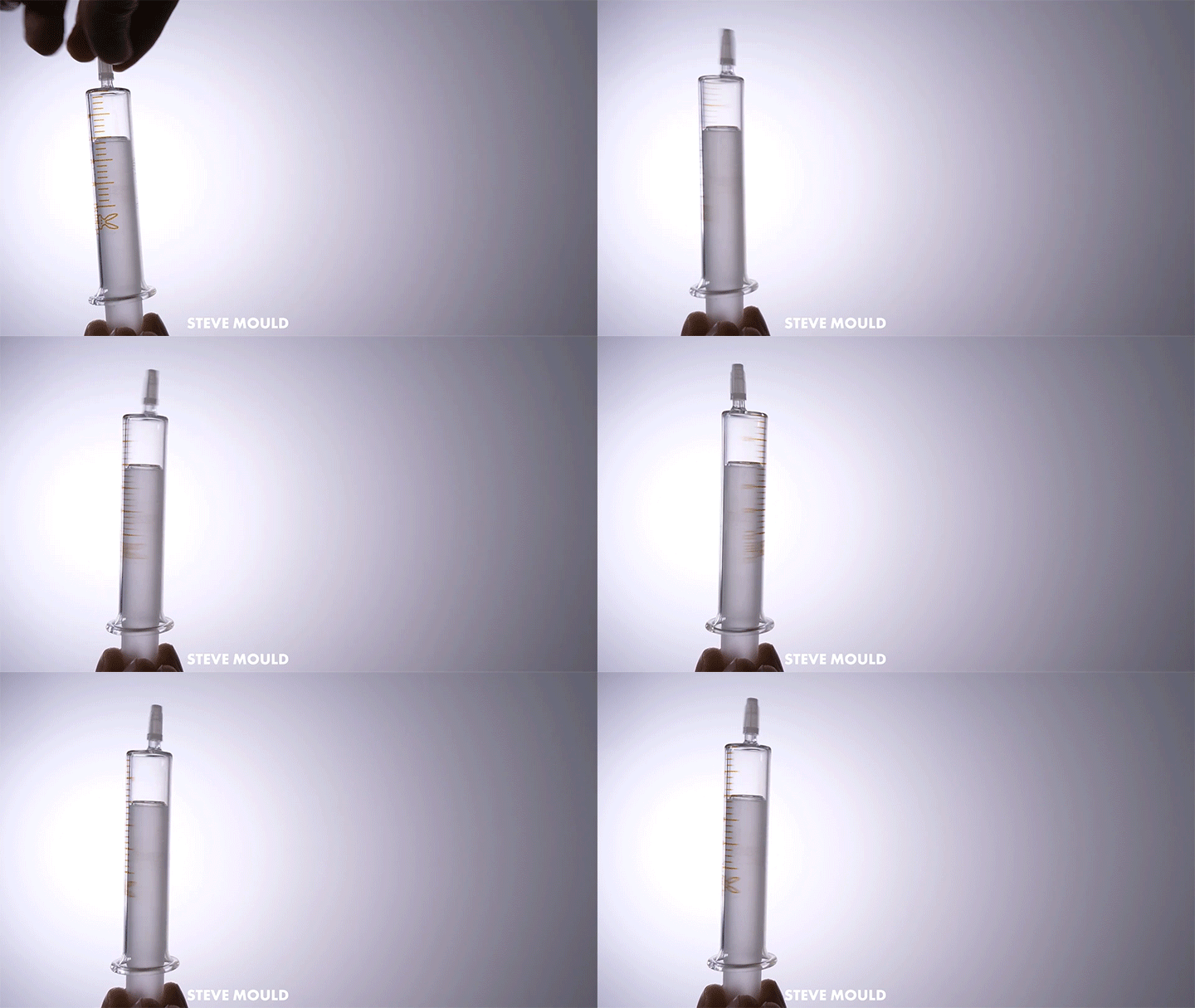
Did you know that particles settle faster in an inclined container instead of a vertical one? This sedimentation phenomenon is known as the Boycott effect, after the researcher who first described it. Boycott noticed that red blood cells settled out of samples faster when the test tubes were inclined.
The inclined walls give particles a much larger area to settle on. As the particles gather on the wall, it creates a buoyant, particle-free layer of fluid above. That fluid quickly rises to the top of the container, helping to push the sediment further toward the bottom. As you can see in the video below, the Boycott effect drastically reduces settling time. (Video and image credit: C. Kalelkar)

Sediment and Coral
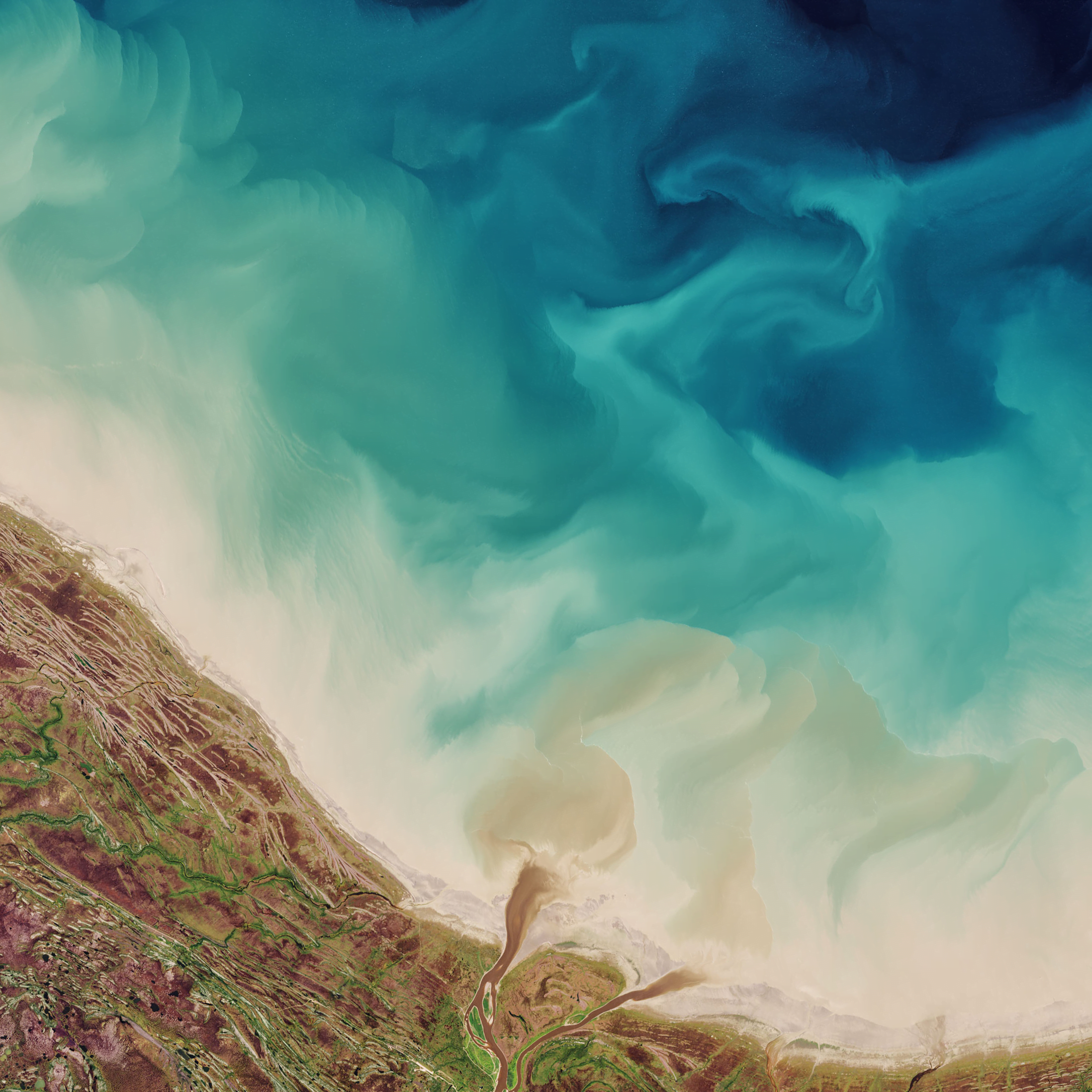
As rivers wash sediment toward the sea, they carve elaborate deltas like that of the Rio Cauto in Cuba. Over time these sediments build up marshes, swamps, lagoons, and other wetlands that provide critical habitat and flood control. Sediment also washes into the bay, where it interacts with the coral reefs (light green lines on the lower left) and the species that live there. (Image credit: L. Dauphin/USGS; via NASA Earth Observatory)


Molten Thermite
This glowing, molten liquid captured by the Slow Mo Guys is thermite. The chemical reaction behind thermite is highly exothermic, hence its intense glow. There’s some great fluid dynamics hiding in this video. First, there’s the dripping thermite (Image 1), which breaks up into droplets via the Plateau-Rayleigh instability before shattering when it hits the ground.
Then there are the sequences (Images 2 and 3) of thermite dripping into water. The heat of the reacting thermite vaporizes a layer of water around it, creating a bubble that completely envelops the thermite. In other words, the falling thermite is supercavitating! That layer of air significantly reduces drag on the thermite and it insulates the thermite from the cooler temperature of the water. (Video and image credit: The Slow Mo Guys)

The Explosive Vaporization Derby
When pressurized, liquids can be superheated to temperatures well above their normal boiling point. When the pressure is released, the liquid will start boiling, sometimes explosively. In this video, researchers explore that dynamic by “racing” a series of liquids against one another. Each racer has been heated to a different temperature beyond the expected boiling point.
The clear winner is the liquid with the highest overheat; as explained in the latter part of the video, beyond a critical overheat temperature, vaporization waves in the fluid enhance the boiling, helping vaporization take place faster. (Video and image credit: K. Jing et al.)

Popping an Oil Balloon
Oil and water don’t mix — or at least they won’t without a lot of effort! In this video, we get to admire just how immiscible these fluids are as oil-filled balloons get burst underwater.
Visually, the two bursts are quite spectacular. In the first image, the initial balloon has a sizeable air bubble at the top, which rises even more rapidly than the buoyant oil, creating a miniature, jelly-fish-like plume that reaches the surface first. The large oil plume follows, behaving similarly to the balloon burst without an added air bubble.
The last of the oil in both cases comes from a cloud of smaller droplets formed near the bottom of the balloon. Being smaller and less buoyant, these drops take a lot longer to rise to the surface and remain much closer to spherical as they do. I suspect these smaller droplets form due to the forces created by the fast-moving elastic as it tears away. (Video and image credit: Warped Perception)

Mimicking Insect Flight
There’s an oft-repeated tale that science cannot explain how a bumblebee flies. And while that may have been true 80 years ago, when engineers assumed they could apply their knowledge of fixed-wing aircraft to insects, it’s very far from the truth now.
Being small, insects use aerodynamic tricks that are very different from the physics used by aircraft or even birds. Insects like fruit flies use a forward-and-backward sweeping motion at a very high angle of attack as they flap. This motion creates a vortex at the leading edge of the wing that provides the lift keeping the insect aloft. It still requires fast reflexes — most insects flap their wings hundreds of times a second — but the mechanism is robust enough to keep insects aloft and maneuverable. (Image credits: Robobee – K. Ma and P. Chirarattananon, simulation – F. T. Muijres et al., illustration – G. Lauder; via APS Physics)

The Engineering of Culverts
Manmade infrastructure often interferes with natural waterways, which is one reason civil engineers turn to culverts, those pipes and concrete tunnels you often see beneath roadways. As simple as they may seem, there’s a lot of engineering that has to go into these artificial waterways to keep flows from backing up and flooding roads. In this video from Practical Engineering, you’ll learn about some of those factors and see through demos just how they impact the flow. (Image and video credit: Practical Engineering)

Tornadoes of the Sea
This dramatic image shows a waterspout formed off the coast of Florida. Waterspouts come in two varieties: tornadic and fair-weather. Both types can be dangerous to anyone caught up in them, though the tornadic variety, which are usually associated with severe thunderstorms, is generally worse. Tornadic waterspouts can form top-down from a thunderstorm or when a tornado moves from land to water. Fair-weather waterspouts, on the other hand, typically form from the bottom, in a similar fashion to dust devils and other fair-weather vortices. (Image credit: J. Mole; via APOD)

A Hand in Hot Oil
In this video, Dianna from Physics Girl demonstrates a feat no one should try at home: dipping her hand into boiling oil. To stay safe, she’s relying on the Leidenfrost effect, the tendency of liquids exposed to temperatures well above their boiling point to vaporize and create a layer of gas that insulates against further heat transfer.
We’ve seen a lot of cool behaviors from Leidenfrost droplets, like surfing on herringbone surfaces, digging through sand, vibrating like a star, and, well, violently exploding. We know a lot about what can happen in this Leidenfrost state, but there are also some major unknowns, like exactly what the Leidenfrost temperature is for many liquids. That’s part of what makes Dianna’s demo so dangerous; the temperature needed to see the Leidenfrost effect — even just for water — varies wildly depending on the experimental set-up. (Video and image credit: Physics Girl)