Category: Phenomena

  • Featured Video Play Icon

    Why Watering Globes Are Hard to Fill

    If you’re leaving home for a few days and want to keep your houseplants happy, you may have tried using a watering globe – those glass bulbs with long stems that slowly release water for your plant. And if you have used one, you’ve probably noticed what a pain it can be to fill. Pour water down the neck too quickly and you’ll get splashed by a sheet of water blown back at you.

    That splashback happens for the same reason that blowing across the top of a bottle plays an audible note: you’re compressing the air inside the container. When water tries to pour continuously down the watering globe’s neck, it can block the escape path needed by the air already in the globe. The increasing weight of water atop that volume of air compresses it, raising its pressure until it’s eventually high enough that it blows all the water back out the neck and into your face.

    The best method to ensure that doesn’t happen is to fill the globe slowly. Try tilting it at an angle and letting only a small stream of water fall into it such that there’s always an escape route for the air. (Image and video credit: E. Challita et al.)
  • Featured Video Play Icon

    Hot Ice, Buoyancy Tricks, and More DIY Fun

    Here’s a smorgasbord of DIY experiments from Dianna at Physics Girl. Some are fluidsy, some aren’t, but all of them give you a chance to stretch your science muscles at home. Personally, I think she saved the best for last with her laser-acoustics demo! (Video credit: Physics Girl)

  • Featured Video Play Icon

    Centrifugal Instability

    When it comes to geophysics, there are all kinds of phenomena that depend on rotation. In this short video, researchers demonstrate one such phenomena — the centrifugal instability — in a tank on a turn table. The experiment begins once the fluid in the tank is all rotating together, like a solid body would. Then, they reduce the rotation rate of the turn table. Almost immediately, we see rolls encircle the tank.

    The rolls form due to the difference in momentum between fluid in the interior and near the wall. Friction with the wall slows the fluid there down much faster than that in the middle of the tank. As the faster-moving fluid gets centrifuged outward, it forms rolls. As the video demonstrates, these rolls can be relatively uniform and laminar, or, with enough change in rotation rate, they can become turbulent. (Image and video credit: UCLA Spinlab)

  • Bright Volcanic Clouds

    Bright Volcanic Clouds

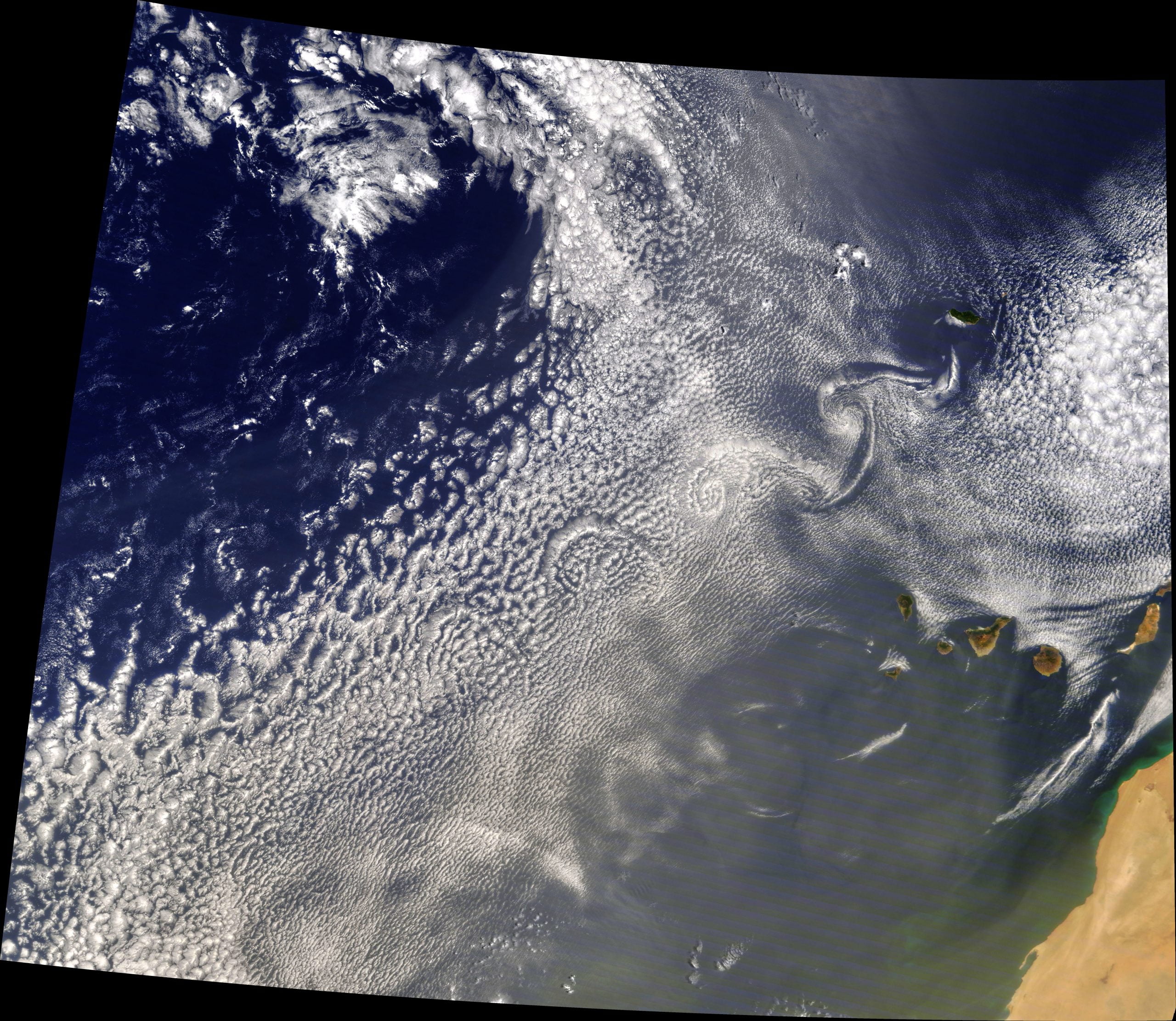
    Every day human activity pumps aerosol particles into the atmosphere, potentially altering our weather patterns. But tracking the effects of those emissions is difficult with so many variables changing at once. It’s easier to see how such particles affect weather patterns somewhere like the Sandwich Islands, where we can observe the effects of a single, known source like a volcano.

    That’s what we see in this false-color satellite image. Mount Michael has a permanent lava lake in its central crater, and so often releases sulfur dioxide and other gases. As those gases rise and mix with the passing atmosphere, they can create bright, persistent cloud trails like the one seen here. The brightening comes from the additional small cloud droplets that form around the extra particles emitted from the volcano.

    As a bonus, this image includes some extra fluid dynamical goodness. Check out the wave clouds and von Karman vortices in the wake of the neighboring islands! (Image credit: J. Stevens; via NASA Earth Observatory)

  • Featured Video Play Icon

    How Canal Locks Work

    For thousands of years, boats have been a critical component of trade, efficiently enabling transport of goods over large distances. But water’s self-leveling creates challenges when moving up and downstream through rivers and canals. To get around this, engineers use locks, which act as a sort of gravity-driven elevator to lift and lower boats to the appropriate water level. In this video from Practical Engineering, we learn about the basic physics behind locks as well as some of the methods engineers use to limit water loss through the lock. (Image and video credit: Practical Engineering)

  • Featured Video Play Icon

    Why Aren’t Trees Taller?

    Trees are incredible organisms, with some species capable of growing more than 100 meters in height. But how do trees get so big and why don’t they grow even taller? The limit, it turns out, is how far fluid forces can win over gravity.

    To live and grow, trees must be able to transport nutrients between their roots and their highest branches. As explained in the video, there are three forces that enable this transport inside trees: transpiration, capillary action, and root pressure. Of these, you are probably most familiar with capillary action, where intermolecular forces help liquids climb up the inside of narrow spaces, like the straw in your drink. Capillary action can’t lift liquids more than a few centimeters against gravity, though.

    Similarly, root pressure is limited in how far it can raise liquids. Functionally, it’s pretty similar to the way a column of water or mercury can be held up by atmospheric pressure acting at the base of a barometer. But atmospheric pressure can only hold up 10.3 meters of water, so what’s a tree to do?

    This is where transpiration — the most important force for sap transport in the tree — comes in. As water evaporates out of the tree’s leaves, it creates negative pressure that — along with water’s natural cohesion — literally drags sap up from the roots. It’s this massive pull that drives the flow and enables most of a tree’s height. (Image and video credit: TED-Ed)

  • Two Views of Ocean Eddies

    Two Views of Ocean Eddies

    Colorful, sediment-laden eddies swirl off the Italian coast in this satellite image. These small-scale eddies — less than 10 km in diameter — can be short-lived and are often difficult to capture in numerical models, but remote sensing can help scientists better understand their impact on oceanic mixing, especially when we capture more than one view of the same event.

    The image below shows the same eddies in an infrared (thermal) view. The resolution on this instrument is not as fine as the natural color one, but we can still make out some of the same swirling motions. It’s also worth comparing the features we don’t see in both images. For example, the Cornia River discharges in infrared as a bright, white plume of cooler water, but it’s barely visible in the color-image, suggesting that the river is not contributing much sediment to the bay. (Image credit: USGS; via NASA Earth Observatory)

    Infrared satellite image of waters off the coast of Italy.
  • Featured Video Play Icon

    Digging Droplets

    A droplet on a surface much hotter than its boiling point will skate on a layer of its own vapor, thanks to the Leidenfrost effect. But if that surface is, instead, a granular mixture like this glass powder, the droplet will dig itself a hole.

    As in the usual Leidenfrost situation, the heat of the powder causes part of the drop to vaporize. But as that vapor flows away, it carries powder with it. At the same time, the vaporization process causes the droplet to vibrate violently, which frees more powder and helps the drop dig deeper. Eventually, the drop will vaporize completely, leaving a volcano-like crater in the powder. (Image and video credit: C. Kalelkar and H. Sai)

    A water droplet falls on heated glass powder, which it then digs its way into.
  • Featured Video Play Icon

    Ventilation and Respiratory Disease

    In 1977, one passenger with the flu infected 38 people onboard a flight with malfunctioning ventilation. In this video, Dianna digs into the physics of respiratory disease transmission and just why ventilation is so key to preventing it.

    There are three primary modes of transmission for respiratory diseases like influence or SARS-CoV-2: 1) touching an infected surface and then oneself, i.e., self-inoculation; 2) inhaling virus-filled droplets larger than 5 nm; and 3) inhaling virus-filled droplets smaller than 5 nm. That size cut-off may seem a little arbitrary, but it’s how scientists distinguish between droplets that fall quickly to the ground and ones that can persist on buoyant air currents.

    That airborne persistence is one of the reasons ventilation — in other words, replacing the air — is so important. So many people on that 1977 flight got sick because there was no system removing the infected air and bringing in fresh air. For more on the fluid dynamics disease transmission, check out these posts. Curious about those bacterial bubble bursts? I’ve covered that, too. (Video and image credit: Physics Girl)

  • Featured Video Play Icon

    Sundews Weaponize Viscoelasticity

    In nutrient-poor soils, carnivorous plants like the cape sundew supplement their diets by eating insects. To entice their prey, the cape sundew secretes droplets of sugary water. But unwary insects who land to feed soon find themselves unable to pull away from this viscoelastic liquid. Complex molecules in the fluid grant it elasticity, so when insects pull against it, the liquid stretches and pulls back instead of breaking up. Other carnivorous plants, like the pitcher plant, use similar non-Newtonian tricks to trap insects. (Video and image credit: Deep Look)