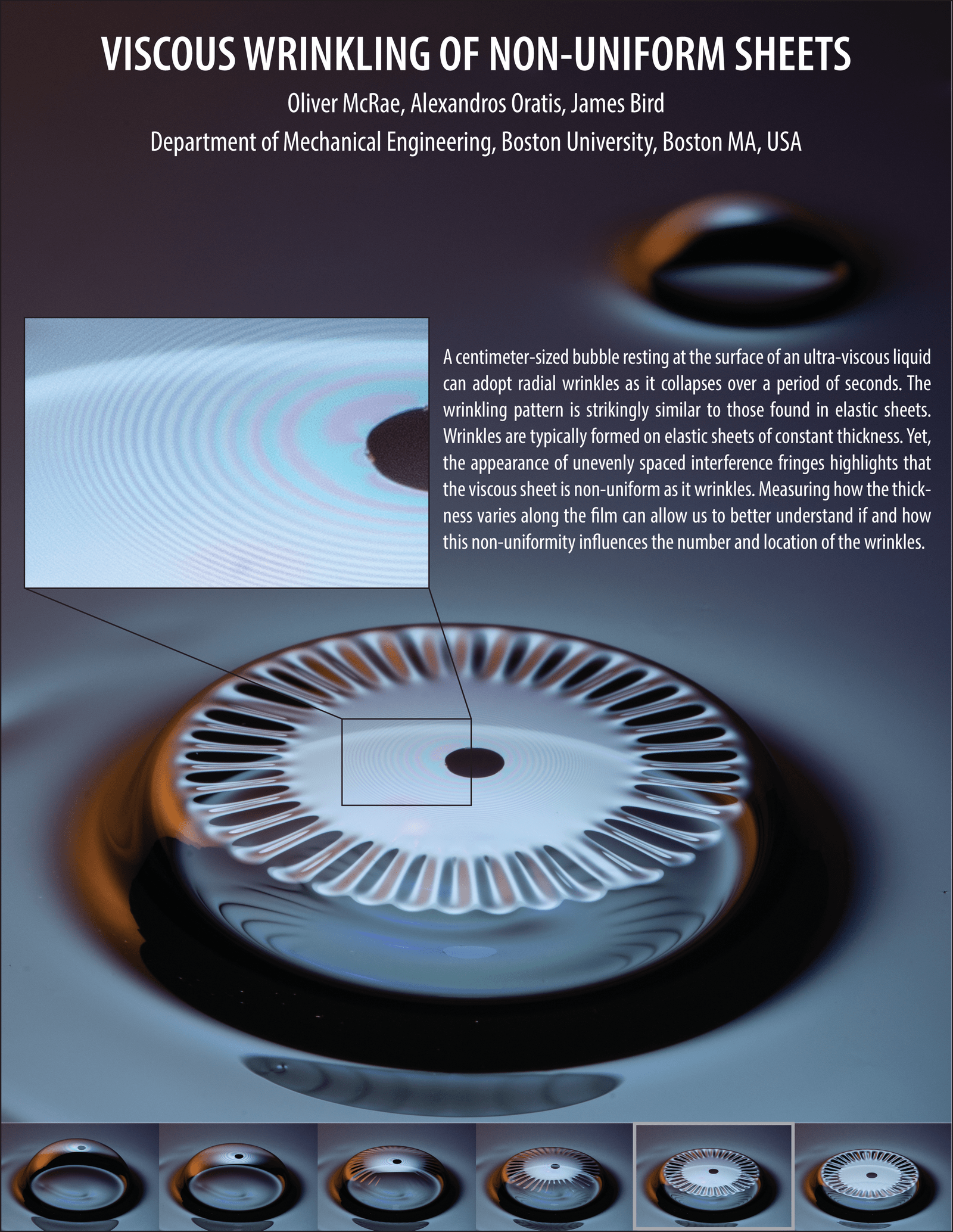
As a bubble sitting on a pool collapses, wrinkles form around its edges. Visually, the result is quite similar to the wrinkles one gets on an elastic sheet. Unlike the solid sheet, though, the bubble’s film varies in thickness; we know this because of the fringes shown in the enlarged inset of the poster. Researchers are studying this non-uniformity to see whether it affects the number and shape of wrinkles that form on the bubble. (Image and research credit: O. McRae et al.)
Category: Phenomena

Albedo Effect
Temperature isn’t the only factor that determines how ice will melt. In this photo, a dark oak leaf absorbed more solar radiation than the reflective ice around it, causing the ice beneath it to melt. Scientifically, this effect is described by albedo; darker, more absorptive surfaces like the leaf have a lower albedo, whereas light, reflective ice and snow have a high albedo and can better resist melting on sunny days. (Image credit: K. James; submitted by Kam-Yung Soh)

Fluid Chains


In this video, Steve Mould tackles a question many of us have likely wondered: just why does falling water make this chain-like shape? When pouring from a slit-like orifice, water jets take on this undulating pattern. While I have no issue with Steve’s explanation of surface tension oscillations driving the shape, I’ll quibble a little bit with the idea that this hasn’t been studied. Personally, I’d connect it to the fishbone instability, which classically occurs when two jets collide. At low flow rates, though, the colliding jets form a pattern very much like this one. And if you look just past the initial conditions at the container opening, all of these flows have thicker jet-like rims colliding. I think the flows in these videos are just a slightly messier version of the low-flow-rate fishbone. What do you think? (Video and image credit: S. Mould)

Superior Mirage
This photograph of a ship seemingly floating far above the water is not some Photoshop fakery; it’s physics creating the illusion. It’s an example of what’s known as a superior mirage — superior because the mirage appears above the object’s actual location, unlike the mirages you see above the road on a hot day.
In this case, the air layer near the water is cold — colder than the air above it, thanks to a temperature inversion. Cold air is denser and has a higher index of refraction, so light traveling through it gets bent downward. To a far off observer, this downward bend makes objects appear higher in altitude than they actually are. The effect is most common in polar regions, where the right conditions can actually allow images of objects completely below the horizon! (Image credit: D. Morris; via The Guardian; submitted by Alec)
Taylor Columns


When rotating, fluids often act very differently than we expect. For example, an obstacle in a rotating flow will deflect flow around it at all heights. This is known as a Taylor column.
In this video, we see the phenomenon recreated in a simple rotating tank (that’s easy to build yourself). Once all the water in the tank is rotating at the same rate, there is very little variation in flow with height. Food coloring dropped into the tank forms tight vertical columns. Even with a short obstacle in place and induced flow in the tank from a change in rotation rate, the dye continues to move uniformly in height. Because the dye cannot travel through the obstacle, it goes around and does so at every height, leaving the space above the obstacle dye-free.
The same phenomenon occurs in planetary atmospheres; this rotating tank is basically a mini-version of our own atmosphere. Where there are obstacles — like mountains — on our planet, air has an easier time flowing around the mountain instead of over it! (Image and video credit: DIYnamics)

Fallstreak Holes


Occasionally clouds appear to have a hole in them; these are known as fallstreak holes or hole-punch clouds. To form, the water droplets in the cloud must be supercooled; in other words, they must be colder than their freezing point but still in liquid form. When disturbed — say, by the temperature drop caused by flowing over an airplane wing — the supercooled water droplets will suddenly freeze. This typically kicks off a chain reaction in which many droplets freeze and the heavy ice crystals fall out of the sky, leaving behind a void in the cloud. Because airplanes are particularly good at creating these fallstreak holes, they’re often seen near busy airports. (Image credit: J. Stevens/NASA; via NASA Earth Observatory)
Wind Turbine Physics


Over the years, wind turbines have gotten tall with long, thin blades. This MinutePhysics video delves into the reasons for those changes. They’re all aimed at generating more wind power and doing so with greater efficiency.
I’ll add one caveat to the video, though, because you may wonder how modern wind turbines can be fast when they appear to rotate so slowly. That’s a trick of the reference frame. The power a turbine blade generates depends on the flow speed over it, and the relative air speed is greatest near the tip of the turbine blades.
Think of the circle the blade tip traces. For a given rotation rate – say once revolution a minute – the blade tip has a much larger distance to travel than the blade’s base does. Divide that large distance by the rotation time and you get a large velocity. So even though the wind turbine appears to be rotating slowly, the flow the blade sees is quite fast. And the longer the wind turbine’s blades, the larger this effect. (Image and video credit: H. Reich/MinutePhysics)
Blue Jets
Blue jets are a mysterious form of lightning that shoots upward from intense thunderstorms. The image above comes from one of the first color videos of blue jets, taken by an astronaut aboard the International Space Station. Scientist think blue jets form during an electric breakdown between the positively-charged upper region of a cloud and the negative charge at its boundary. Once the discharge starts, it can shoot to the stratopause in less than a second, forming a glowing, blue, nitrogen-based plasma. (Image credit: ESA/NASA/DTU Space; via NASA Earth Observatory)
The Unsinkable Pygmy Gecko


The Brazilian pygmy gecko is a tiny inhabitant of the Amazon rainforest, growing to no longer than 24 mm. But these tiny lizards have some incredible superpowers when it comes to surviving the rainforest’s deluges. The gecko’s surface is superhydrophobic — water repellent — thanks to millions of tiny hairs that create air pockets between water and the gecko’s skin. This superhydrophobic surface, combined with the gecko’s tiny stature, allow it to sit atop water, supported entirely by surface tension. (Image and video credit: BBC Earth)

Gathering Droplets
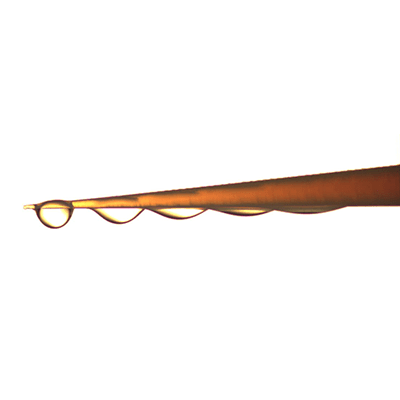

In deserts around the world, plants have adapted to collect as much moisture as they can. Geometry aids them in this endeavor because droplets on the tip of a cone will move toward its thicker base. The motion takes place due to a imbalance in surface tension forces on either end of the droplet.
As the droplet moves up a cone, it changes shape from a barrel-like drop that fully covers the conical surface to a clamshell-shaped droplet that hangs only from the bottom of the cone. (Image and research credit: J. Van Hulle et al.)


