Today we have some holiday-themed fluid dynamics: visualization of flow around Santa’s sleigh! This is a flowing soap film visualization at a low speed (author Nick Moore has some other speeds as well). Santa’s sleigh is what aerodynamicists call a bluff body–a shape that is not streamlined or aerodynamic–and sheds a complicated wake of vortices. Like any object moving through a fluid, Santa’s sleigh generates drag forces made up of several components. There is viscous drag, which comes from friction between the sleigh’s surface and the fluid, and form drag (or pressure drag), which comes from the shape of the sleigh. That wake full of complicated vortices significantly increases the sleigh’s pressure drag, requiring Rudolph and the other reindeer to provide more thrust to counter the sleigh’s drag. Speaking thereof, the visualization does not take into account the aerodynamics of the reindeer, who, in addition to providing the sleigh’s thrust, would also affect the flowfield upstream of the sleigh. This post is part of this week’s holiday-themed post series. (Video credit: N. Moore)
Category: Phenomena

Holiday Fluids
BYU Splash Lab–those breakers of bottles, skippers of rocks, spinners of eggs, students of soap films, masters of splashes, and all-around cool fluid dynamicists–have some fluids-themed, high-speed holiday greetings. Likewike, here at FYFD we’ll be spending the next week celebrating the physics and fluid dynamics of the winter holiday season! In the meantime, you can whet your appetite by brushing up on your cookie dunking techniques, watching how icicles form, and enjoying a good beverage. Stay tuned and happy holidays from FYFD! (Video credit: BYU Splash Lab/BYU News)

Shuttle Re-Entry
Complicated shock wave patterns envelope vehicles traveling at supersonic and hypersonic speeds. A shock wave is essentially a very tiny region–only a few mean free path lengths wide–over which flow conditions, including density, pressure, velocity, and temperature, change drastically. The image above shows a model of the Space Shuttle at a re-entry-like, high angle of attack at around Mach 20 in one of NASA Langley’s historic helium tunnels. The eerie glow outlining the shock structures around the model is a result of electron-beam fluorescence. In this flow visualization technique, a beam of high-energy electrons is swept over the model, causing the gas molecules to fluoresce according to temperature. (Photo credit: NASA Langley)

Bullet Through a Bubble
A bullet passes through a soap bubble in the schlieren photo above. The schlieren optical technique is sensitive to changes in the refractive index and, since a fluid’s refractive index changes with density, permits the visualization of shock waves. A strong curved bow shock is visible in front of the bullet as well as weaker lines marking additional shocks waves around the bullet. Impressively, the bullet’s passage is so fast (and the photo’s timing so perfect) that there are no imperfections or signs of bursting in the soap bubble. The photo’s caption suggests that the bubble may be filled with multiple gases. If they are unmixed and of differing densities, this may be the source of the speckling and plume-like structures inside the bubble. Incidentally, if anyone out there has high-speed schlieren video of a bullet passing through a soap bubble, I would love to see it. (Photo credit: H. Edgerton and K. Vandiver)
Fluctuating Ferrofluids
Ferrofluids–liquids seeded with magnetically sensitive ferrous nanoparticles–demonstrate some beautiful and bizarre behaviors when exposed to magnetic fields. This video shows the reaction of a pool of ferrofluid to the magnetic field generated by an alternating current through a simple wire coil. At 1 Hz, the fluid response is not unlike the normal-field instability–the characteristic spikes–the fluid develops when exposed to a permanent magnet. But because field is fluctuating, the spikes pop out and fade again. At 10 Hz, the behavior gets even more interesting. As the frequency of the magnetic field’s oscillation increases, the time the fluid has to respond to changes in the magnetic field decreases. Eventually, one can imagine a point where the magnetic field oscillates faster than the molecules in the fluid can rearrange themselves to respond. It’s unclear if such a mismatch in timescales is the cause of the increasing violence of the ferrofluid’s response in the later clips or whether this results from an unmentioned change to the current through the coil. For something even wilder, check out Nick’s video of the ferrofluid’s response to music. (Video credit: N. Moore)

Lenticular Clouds Over Ice

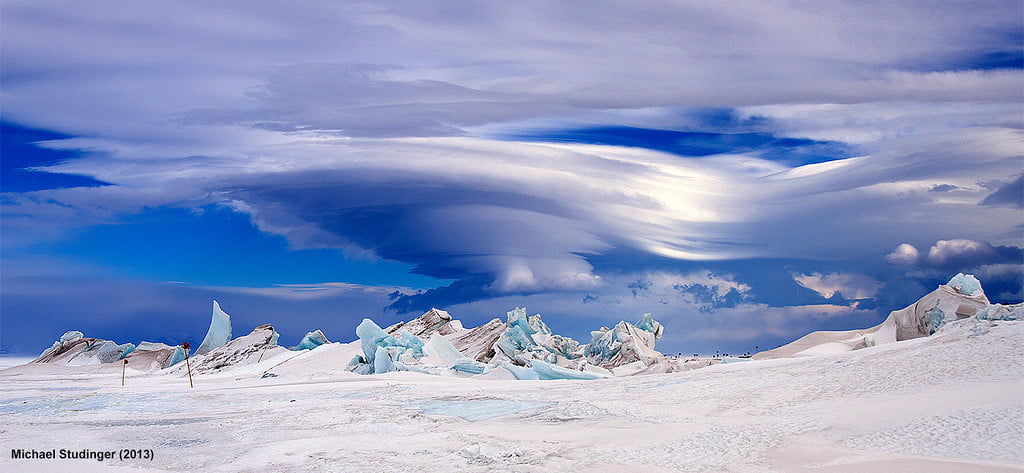
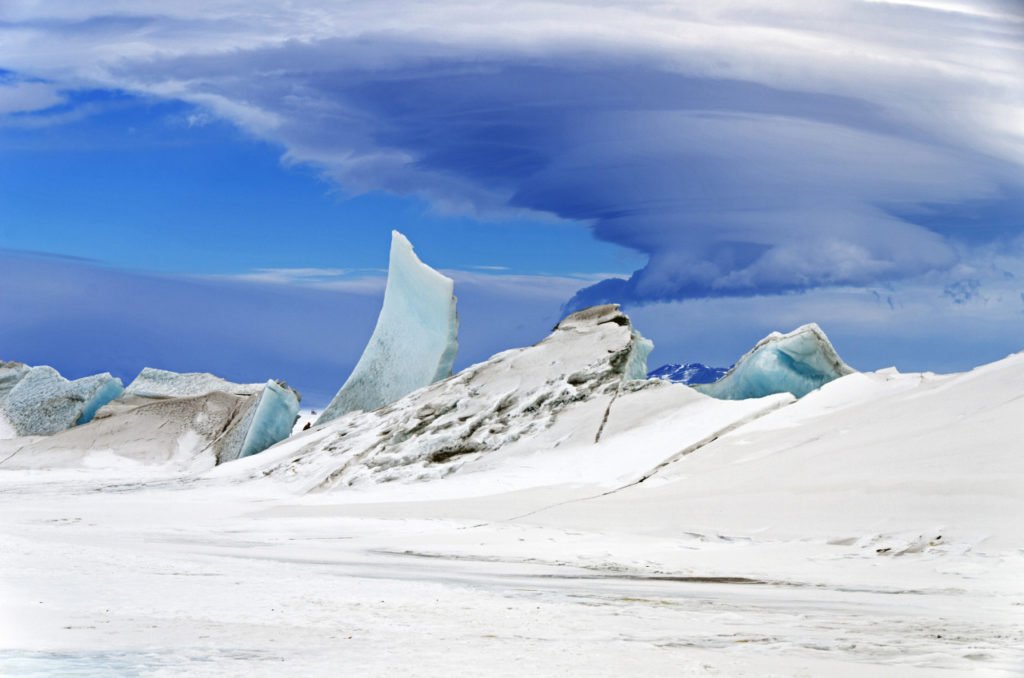
Lenticular clouds, like the one shown above, often attract attention due to their unusual shape. These stationary, lens-shaped clouds can form near mountains and other topography that force air to travel up and over an obstacle. This causes a series of atmospheric gravity waves, like ripples in the sky. If the temperature at the wave crest drops below the dew point, then moisture condenses into a cloud. As the air continues on into a warmer trough, the droplets can evaporate again, leaving a stationary lenticular cloud over the crest. This particular lenticular cloud was captured by Michael Studinger during Operation IceBridge in Antarctica. The line of ice in the foreground is a pressure ridge of sea ice formed when ice floes collided. (Photo credit: M. Studinger; via NASA Earth Observatory)
North Dakota Ice Disk
Cold weather can create some wild fluid dynamics, so pay attention to your local rivers and waterfalls during the next cold snap. The video above comes from North Dakota where a combination of cold dense air and a stable river eddy created a spinning ice disk, roughly 16 meters in diameter. The disk forms as a collection of ice chunks–not one solid, spinning piece–because the ice formed gradually. As ice pieces form, they get caught in the river eddy and begin to spin as part of the disk, rather like dust and ice do in the rings of Saturn. Such formations are rare but not unheard of; here’s a video showing a similar disk as it grows. (Video credit: G. Loegering; via Yahoo and io9; submitted by Simon H and John C)

Bouncing Off The Surface
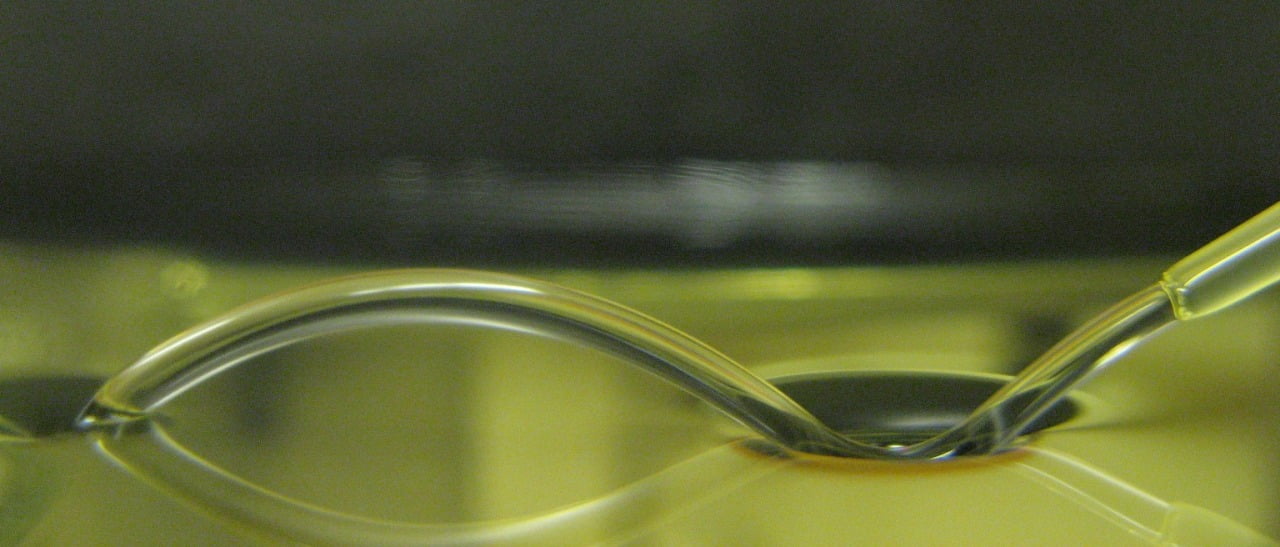
For the right angles and flow rates, it’s possible to bounce a fluid jet off a pool of the same fluid. As the jet flows, it pulls a thin layer of air with it, entraining the air. This air film is what keeps the jet separate from the pool when it initially hits. In the photo above, the jet is flowing right to left; notice how it maintains its integrity within the dimple during the bounce. The pool’s surface tension acts almost like a trampoline, redirecting the jet’s momentum into the bounce. It’s even possible to get a double bounce. In this video, the mechanism is the same, although the apparatus is different. In the photo above, the jet is introduced with a horizontal velocity to induce air entrainment and bouncing. In the video, the pool is spinning, which provides the necessary horizontal velocity between the jet and the liquid pool. (Photo credit: J. Bomber and T. Lockhart)

Start Your Rocket Engine
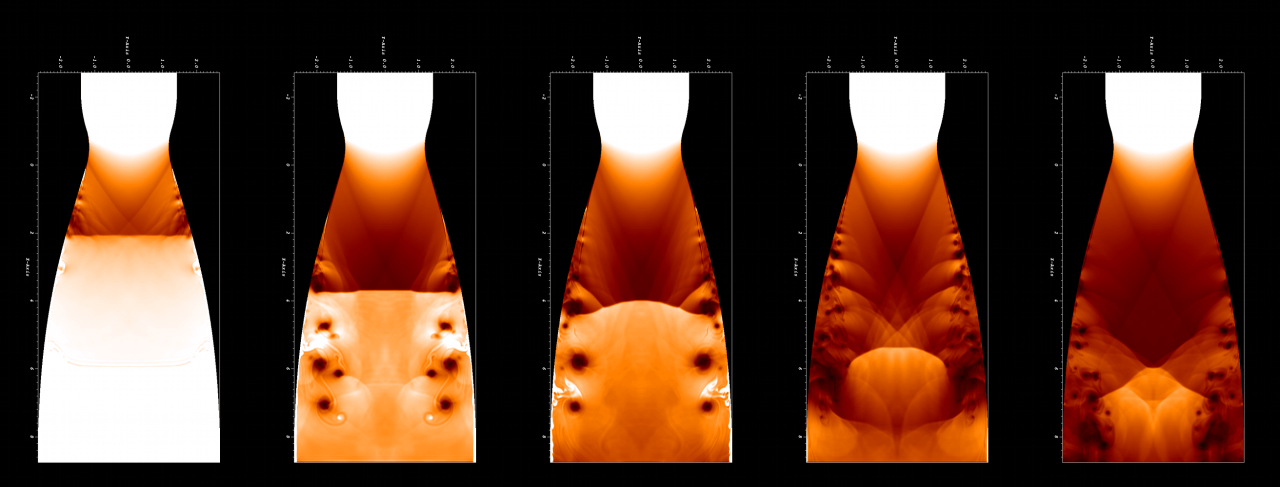
When supersonic flow is achieved through a wind tunnel or rocket nozzle, the flow is said to have “started”. For this to happen, a shock wave must pass through, leaving supersonic flow in its wake. The series of images above show a shock wave passing through an ideal rocket nozzle contour. Flow is from the top to bottom. As the shock wave passes through the nozzle expansion, its interaction with the walls causes flow separation at the wall. This flow separation artificially narrows the rocket nozzle (see images on right), which hampers the acceleration of the air to its designed Mach number. It also causes turbulence and pressure fluctuations that can impact performance. (Image credit: B. Olson et al.)
The Glory of a Roll Cloud
Roll clouds stretch like a long horizontal tube, spinning as they process across the sky. This class of arcus cloud is relatively rare but occasionally forms in areas where cool air is sinking, along the downdraft of an oncoming storm or in coastal regions as a result of sea breezes. The cooler, sinking air displaces warmer, moist air to higher altitudes where the moisture condenses into a cloud. Winds then roll the cloud parallel to the horizon. Roll clouds are a form of soliton, a solitary wave with a single crest that moves without changing its shape or velocity; this is why the cloud appears so regular as it moves across the sky. These clouds are sometimes also called Morning Glory clouds and form regularly off the coast of Queensland, Australia around October. (Video credit: T. and B. Mask)
A reminder, for those attending the APS DFD conference this weekend: my FYFD talk will be Sunday evening at 5:37pm in Rm 306/307. I will be discussing, among other things, the results of July’s reader survey and science communication.