Tag: equilibrium

  • Floating in Levitating Liquids

    Floating in Levitating Liquids

    When it comes to stability, nature can be amazingly counter-intuitive, as in this case of flotation on the underside of a levitating liquid. First things first: how is this liquid layer levitating? To answer that, consider a simpler system: a pendulum. There are two equilibrium positions for a pendulum: hanging straight down or pointing straight up. We don’t typically observe the latter position because it’s unstable; the slightest disturbance from that perfectly vertical situation will make it fall. But it’s possible to stabilize an inverted pendulum simply by shaking it up and down. The vibration creates a dynamic stability.

    The same physics, it turns out, holds for a layer of viscous fluid. With the right vibration, the denser fluid can levitate stably over a layer of air. Inside this vibrating layer, the rules of buoyancy are a little different because the vibration modifies the effects of gravity. As a result, bubbles deep in the liquid layer sink (Image 1). The researchers used this behavior to create their levitating layer (Image 2). The shaking also serves to stabilize objects floating on the underside of the liquid layer, allowing the boat in Image 3 to float upside down! (Image and research credit: B. Apffel et al.; via NYTimes; submitted by multiple sources)
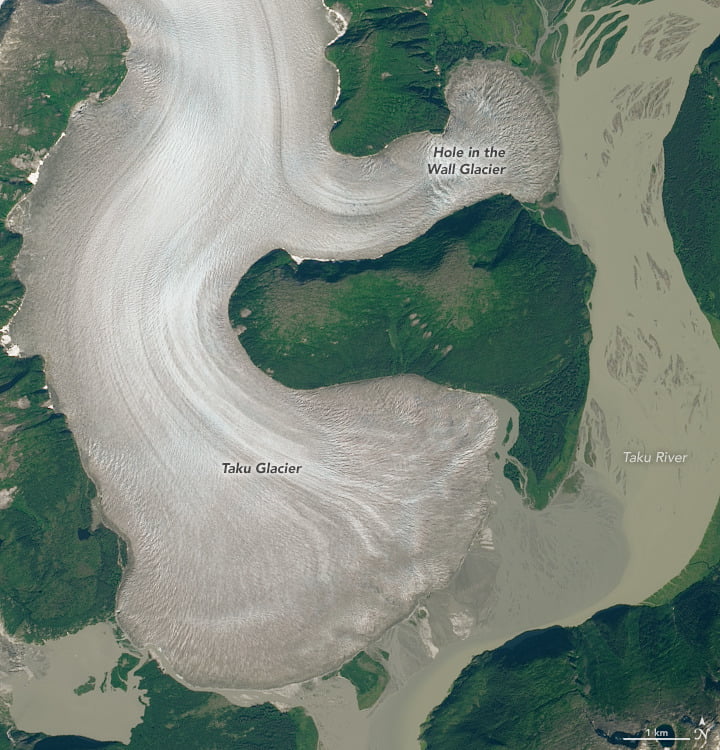
  • Recession at Taku Glacier

    Recession at Taku Glacier

    glacier’s snowline marks the location where the amount of summer melting and accumulated snowmass are equal. If, over the course of a season, a glacier experiences more snowfall than melting, its snowline will advance. If melting outweighs accumulation, then the snowline will retreat to higher altitudes. Tracking the snowline gives scientists important data about how the glacier is changing.

    And that change is typically slow. When glaciers stop advancing, their snowlines can remain unmoving for decades. Or, at least, they used to. In recent years, Alaska’s Taku Glacier was one of the only alpine glaciers holding out against the warming Arctic. Its slow advance stopped in 2013–the left image shows Taku in 2014–and researchers hoped the massive glacier would maintain its mass for a few decades at least. Instead, the glacier was retreating by 2018 and doing so with the highest mass loss ever recorded at the glacier. The 2019 image on the right shows the glacier’s visible losses.

    For such a massive glacier–the largest in Juneau Icefield at nearly 1.5 km thick–to reverse fortunes so quickly is disturbing and serves as yet more evidence of climate change overriding natural cycles of advance and retreat. (Image credit: L. Dauphin/USGS; via NASA Earth Observatory)

  • Featured Video Play Icon

    Magnetic Putty

    For a little Friday fun, enjoy this timelapse of magnetic putty consuming magnets. Really this is a bit of slow-motion magnetohydrodynamics. The magnet’s field exerts a force on the iron-containing putty, which, because it is a fluid, cannot resist deformation under a force. As a result, the putty will flow around the magnet, eventually coming to a stop once it reaches equilibrium, with its iron equally distributed around the magnet. Assuming the putty is homogeneously ferrous (i.e. the iron is mixed equally in the putty), that means the putty will stop moving when the magnet is at its center of mass.  (Video credit: J. Shanks; submitted by Neil K.)

  • Reader Question: Snow from Boiling Water?

    [original media no longer available]

    Reader kylewpppd asks:

    Have you seen the post of a man in Siberia throwing boiling water off of his balcony? Can you provide a better explanation of what’s going on?

    As you can see in the video (and in many similar examples on YouTube), tossing near boiling water into extremely cold air results in an instant snowstorm. Several effects are going on here. The first thing to understand is how heat is transferred between objects or fluids of differing temperatures. The rate at which heat is transferred depends on the temperature difference between the air and the water; the larger that temperature difference is the faster heat is transferred. However, as that temperature difference decreases, so does the rate of heat transfer. So even though hot water will initially lose heat very quickly to its surroundings, water that is initially cold will still reach equilibrium with the cold air faster. Therefore, all things being equal, hot water does not freeze faster than cold water, as one might suspect from the video.

    The key to the hot water’s fast-freeze here is not just the large temperature difference, though. It’s the fact that the water is being tossed. When the water leaves the pot, it tends to break up into droplets, which quickly increases the surface area exposed to the cold air, and the rate of heat transfer depends on surface area as well! A smaller droplet will also freeze much more quickly than a larger droplet.

    What would happen if room temperature water were used instead of boiling water? In all likelihood, a big cold bunch of water would hit the ground. Why? It turns out that both the viscosity and the surface tension of water decrease with increasing temperature. This means that a pot of hot water will tend to break into smaller droplets when tossed than the cold water would. Smaller droplets means less mass to freeze per droplet and a larger surface area (adding up all the surface area of all the droplets) exposed. Hence, faster freezing!

  • Featured Video Play Icon

    Liquid Settling

    Despite the strange shapes of the arms on this container, the fluid inside will always settle to a common height. This is because each interconnected section is open to the outside air. The fluid’s surface has to reach a static equilibrium with the atmosphere–i.e. the surface of the fluid must be at atmospheric pressure–and the pressure at the lowest level in each section must match because the arms are connected. When fluid is added, the height of the columns oscillates some because the momentum of the added fluid carries the column past its equilibrium position, much like a perturbed mass hanging from a spring will oscillate before settling.

  • Featured Video Play Icon

    Freezing Soap Bubbles

    This is what it looks like when a soap bubble freezes. Perhaps not strictly fluid mechanical in nature, but it’s a nice thermodynamics demonstration.