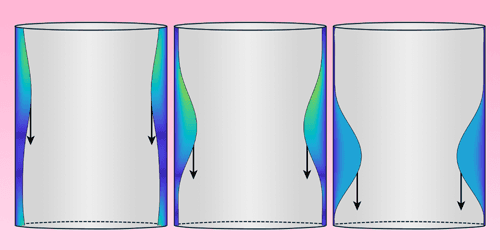
When a fluid coats the inner walls of a cylinder, it can move downward in what’s called a collar flow. In our airways, a sinking collar flow can thicken as it falls, eventually blocking the airway completely.
In a Newtonian fluid, this thickening during motion is essentially unavoidable; any small disturbance to the fluid will make its thickness change. But in a viscoplastic fluid–one more akin to the mucus in our airways–researchers found that, below a critical film thickness, the collar flow won’t thicken to form a blockage. (Image and research credit: J. Shemilt et al.; via APS)


Leave a Reply