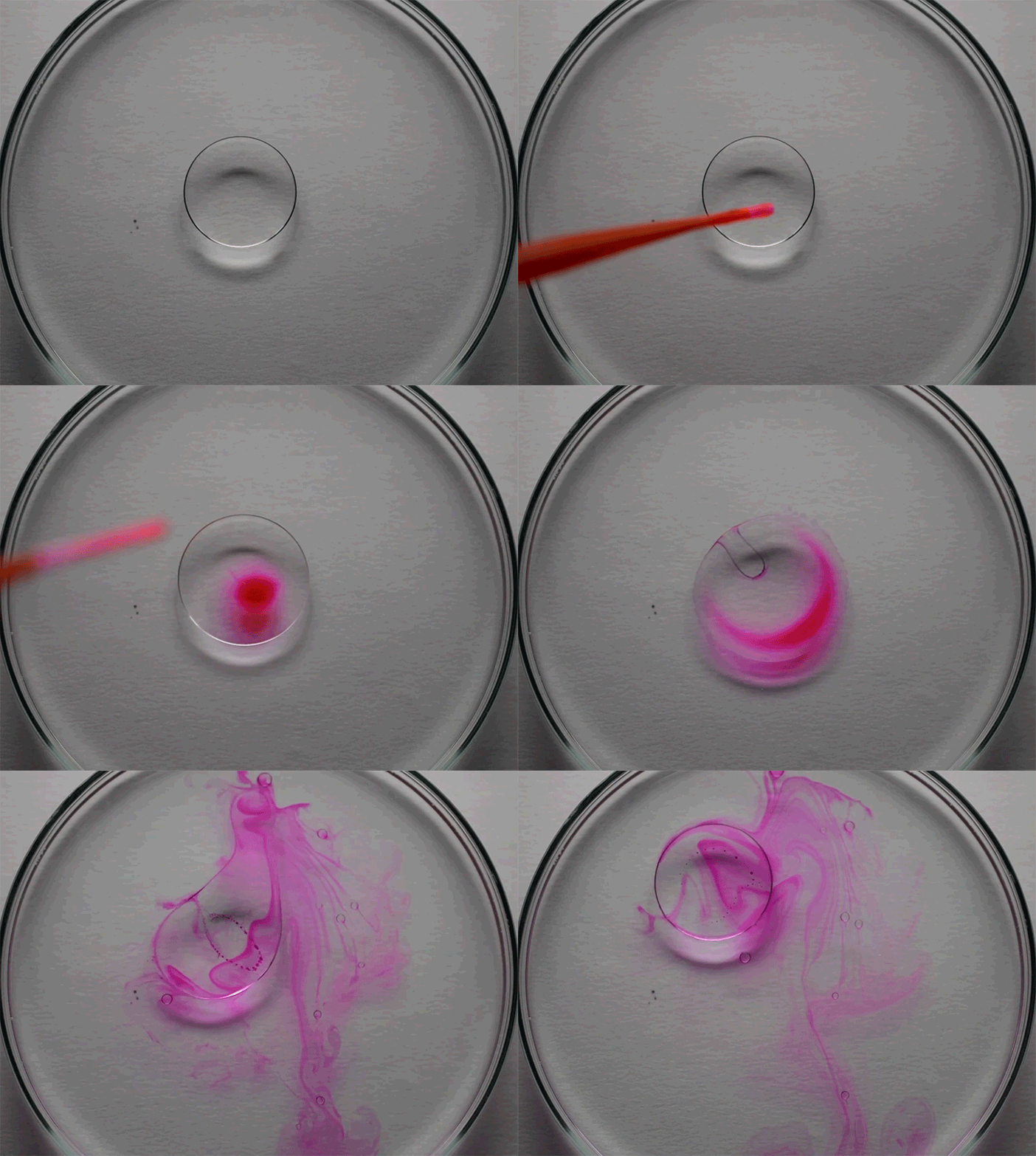
A blob of sunflower oil floating on soapy water forms a disk known as a liquid lens. But add some dyed ethanol and things take a turn. The lens rapidly expands and distorts as the ethanol and soapy water meet. These surface flows are driven by the imbalance of surface tension between the different liquids. The liquid lens deforms and abruptly ruptures, releasing dye and ethanol before rebounding into a stable lens again. Adding more ethanol to the lens will repeat the cycle. (Image credit: C. Kalelkar and P. Dey; research credit: D. Maity et al.)
Month: July 2023

Marshy Veins
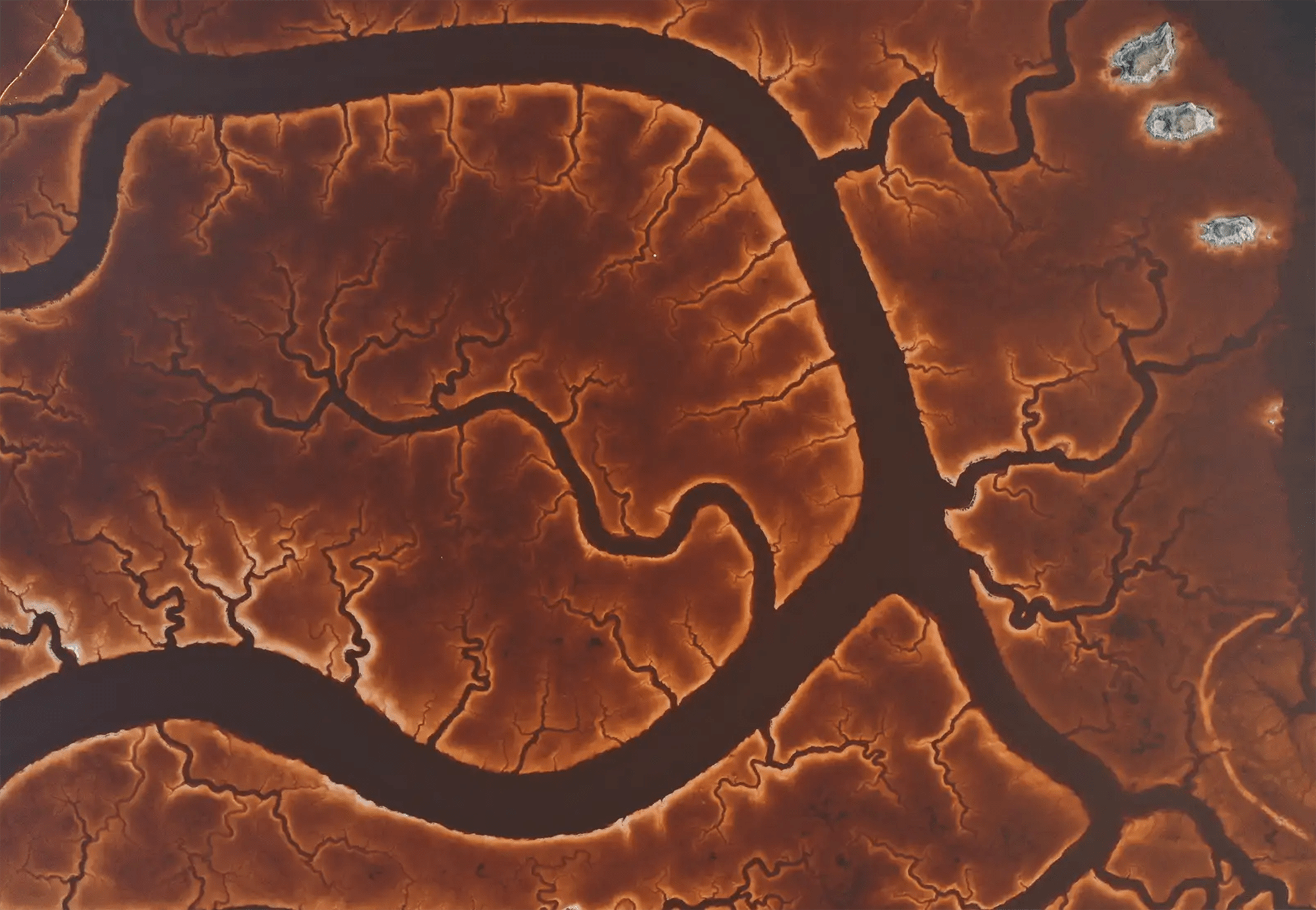
From above, the salt marshes of Alviso Marina County Park look like veins and capillaries in this photo from Tayfun Coskun. The waterways curve and branch, forming fractal patterns only apparent from the air. Although the mechanisms that form these dendritic patterns vary, they are very common in fluids, appearing over and over at many scales. (Image credit: T. Coskun; via Gizmodo)

Bubble Trails – Straight or Wonky?
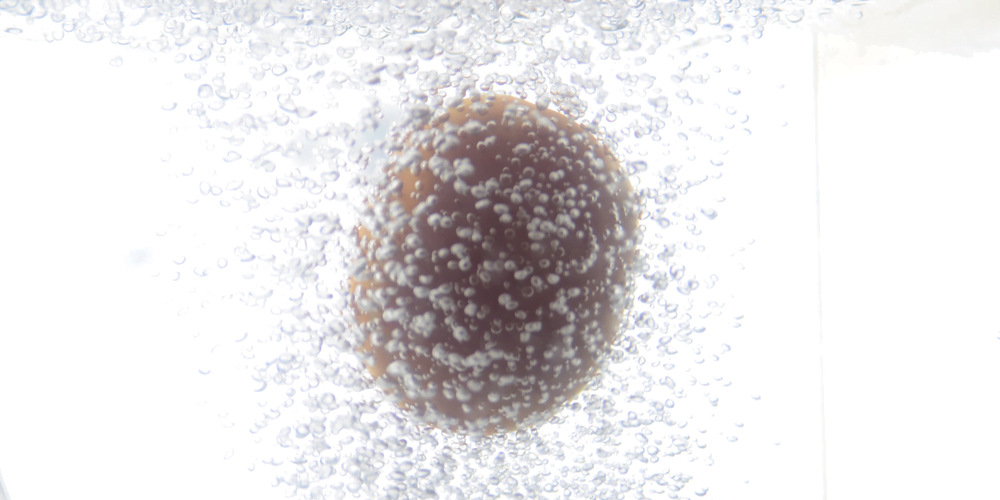
Watch the bubbles rising in a glass of champagne and you’ll see them form tiny straight lines, with each bubble following its predecessor. But in a carbonated soda, the bubbles rise all over the place, each following its own zig-zaggy line. Why the difference? A recent study points out the culprits: bubble size and surfactants.

As bubble size increases from left to right, the bubble trail straightens. Looking at a variety of beverage scenarios, researchers found that both a bubble’s size and its surfactant concentration affected what sort of path it followed. For clean (surfactant-free) bubbles, small bubbles take a winding path, but bigger ones move in a straight line. Simulations show that bubbles can only form a straight path if they produce enough vorticity on their surface. Small bubbles just can’t deform enough to do that.
For bubbles of the same size, increasing the surfactants on the bubbles straightens their path. When surfactants get added, though, the story changes. For bubbles of a set size, adding surfactants made their paths straighter. This was due, the team found, to a bump in vorticity provided by the stabilizing effect of the surfactants. Champagne, they concluded, has straight bubble paths despite its tiny bubbles because of the drink’s high number of flavorful surfactants. (Image credit: top – D. Cook, experiments – O. Atasi et al.; research credit: O. Atasi et al.; via APS Physics)

Wave Clouds From Space
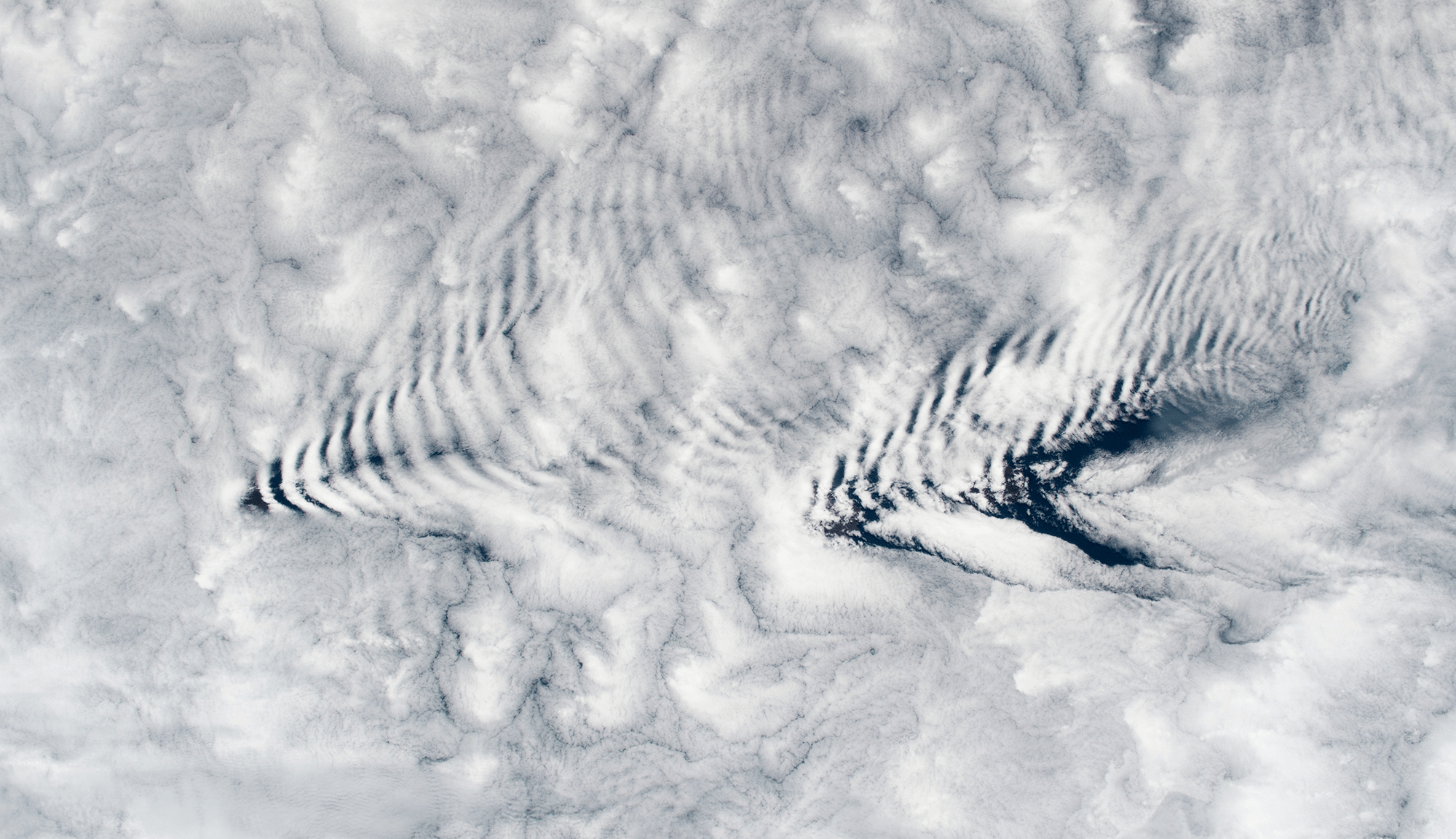
An astronaut snapped this image of wave clouds formed around the Crozet Islands, which lie between South Africa and Antarctica. Clouds like these form when warm, moist air gets pushed up and over a mountain. As it rises, the air cools and its pressure decreases, causing condensation. Pushed out of equilibrium, gravity then pulls the air back downward in the wake of the mountain. That warms the air, causing evaporation. Like a mass bouncing on a spring, the air continues to yo-yo up and down, forming cloudy stripes and clear ones until the energy from its mountain climb is spent. (Image credit: NASA; via NASA Earth Observatory)

Lanes in Crowds
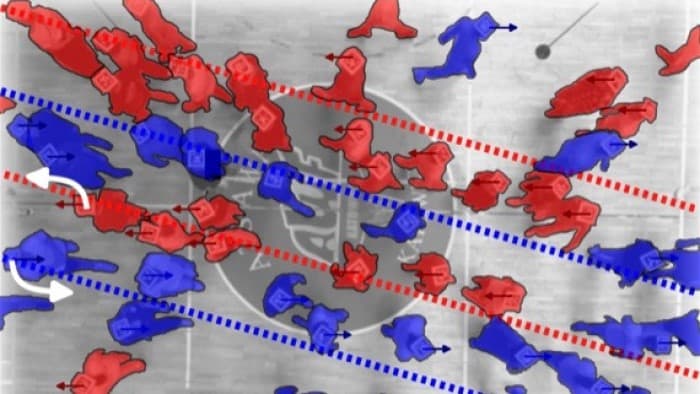
In nature — from atoms to human crowds — two groups moving in opposite directions often spontaneously organize into interwoven lanes flowing in their respective directions. Now researchers have built a mathematical model for this behavior, building on Einstein’s observations of Brownian motion.
To test their model, the researchers performed numerical simulations and experiments with pedestrians. Intriguingly, they found that introducing rules like “always pass on the right” created unexpected results, such as tilted lanes. With their model verified — at least for low-density crowds — the group hope to uncover other hidden patterns within crowds. (Image and research credit: K. Bacik et al.; via Physics World)

In their validation experiments, the researchers filmed groups of pedestrians walking past one another under different conditions. Note the lanes that form as the two groups interleave. 
How Squall Lines Form
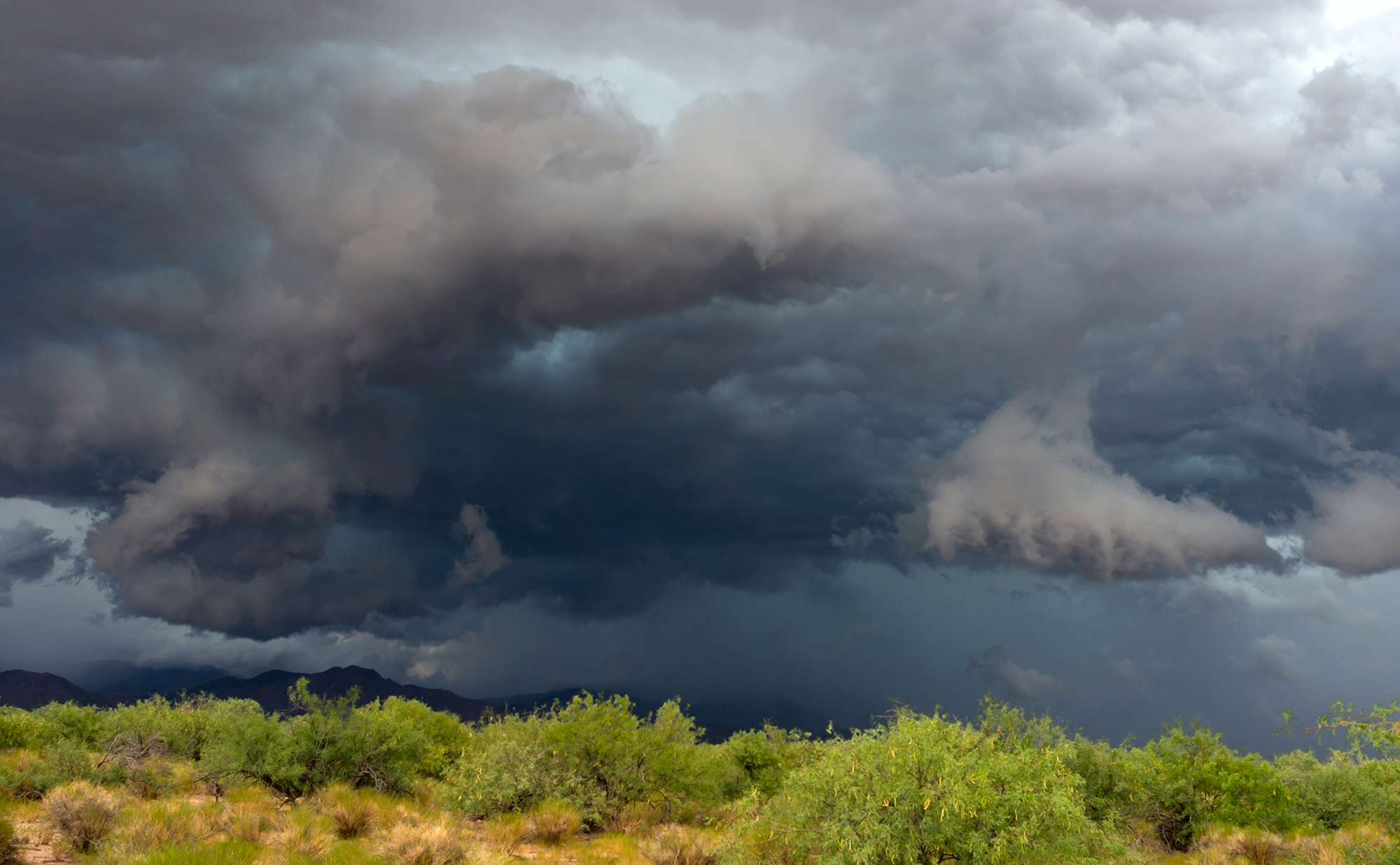
Summertime in the middle U.S. means thunderstorms, many of which can form long lines of storms known as squall lines. Complex convective dynamics feed such storms. Here is an illustration of one part of a squall’s lifecycle:

As rain falls and evaporates, it fuels the formation of a cold pool of air below the cloud. Incoming wind (gray arrows) blocks the cold pool from spreading. In turn, the cold pool acts as a ramp that redirects this warm, moist air upward. The vertical variation in wind speed (wind shear, shown with pink arrows) creates a positive vorticity. Together with the negative vorticity in the cold pool, this induces a vorticity dipole that lifts air and moisture, feeding the growing line of storms. As it falls, rain evaporates, cooling air near the ground and forming a cold pool. If incoming winds block the cold pool from spreading, the pool will act instead as a ramp that redirects the wind upward, carrying any warmth and moisture up into the storm cloud. Wind shear — a vertical variation in wind strength with altitude — creates positve vorticity that opposes the negative vorticity inherent to the cold pool. Together these two regions of opposing vorticity lift more air and moisture into the squall, generating more clouds and more rainfall. (Image credit: top – J. Witkowski, illustration – C. Muller and S. Abramian; see also C. Muller and S. Abramian)

Glowing Skies
Not every experiment turns out as expected. Photographer Julien Looten expected to capture the Milky Way arching across the sky above this French chateau. But the photo’s most striking feature is instead the airglow suffusing the sky. The psychedelic colors result from air high in Earth’s atmosphere getting excited by sunlight and producing a faint glow of its own. Such airglow is common, though not always easily seen. If you watch videos from the ISS, you may notice the orange arc of airglow over the atmosphere. (Image credit: J. Looten; via APOD)

Bubble Cleaning
Removing dirt and bacteria from fruits and vegetables is a delicate job; too much force can bruise the produce and hasten spoiling. That’s why fluid mechanicians want to give the job to bubbles. Placing objects in a stream of air bubbles inside a bath is a surprisingly effective method for gently cleaning surfaces. A recent study finds that 22.5 degrees is the optimal angle for sliding bubbles to scrape a surface clean.
As the bubbles slide past the surface, they exert a shear force that scrapes away debris, just as you might use a loofah in the shower. The angle the bubble makes with the surface determines how long it’s in contact and how much force the bubble exerts. Increasing the angle makes the bubble slide faster, increasing its shear force. But above 22.5 degrees, the bubble’s buoyancy means that it spends less time pressed against the surface, which decreases its cleaning ability.
The team hopes to use their results to build a “fruit Jacuzzi” device that will direct bubble streams to gently and effectively clean fruits and vegetables in a matter of minutes. (Image and research credit: A. Hooshanginejad et al.; via APS Physics)

EpiPen in Action


Researchers are hard at work developing needle-free alternatives to injection, but devices like the EpiPen — used in anaphylactic emergencies for food and insect allergies — aren’t going anywhere yet. In this Slow Mo Guys video, they show what happens when an EpiPen fires into ballistic gel.
An EpiPen’s needle is extremely narrow and about 15 millimeters long. It enters the gel (and presumably the human body) at a modest speed of ~6 m/s, releases the medication, and retracts. Despite its relatively slow speed, the needle is visibly blunted after use (and, no, the EpiPen is not reusable, for this and other reasons).
Injections like this may be tough for some people to see, but as Dan’s mother attests, they’re absolutely life-saving for the patients that need them. (Video and image credit: The Slow Mo Guys)

Draining By Vortex
Unstop your bathtub and the draining water will form a tiny tornado-shaped vortex over the outlet. Four centuries ago Torricelli developed a mathematical equation to describe how long it would take to empty the container, based on the height of the fluid in the tank. Now researchers have made a more generalized version of Torricelli’s law, based on experiments with a rotating tank. They found that measuring the water level above the outlet (i.e., taking into account the surface level dip caused by the vortex) gave better agreement. The stronger the vortex, the lower the surface dips and the slower the container drains. (Image and research credit: A. Caquas et al.)