Year: 2021

  • Sea Swirls by the Shore

    Sea Swirls by the Shore

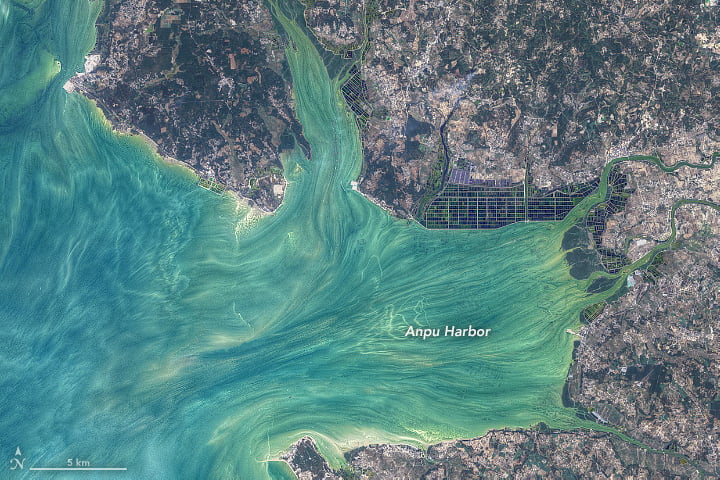
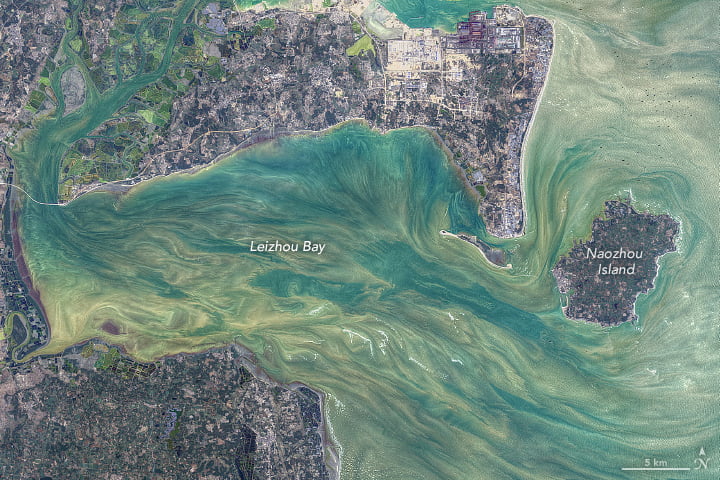
    Water and sediments swirl in these enhanced satellite photos of China’s Leizhou Peninsula. Color-filtering algorithms have drawn out the details of the flows, but the patterns themselves are real. Tides, currents, sediment, and human activity combine to form these complex flows along the peninsula’s shores. The straight parallel lines seen off Liusha Bay, for example, are likely the result of a traditional fishing method using nets suspended off poles anchored into the seabed. (Image credit: N. Kuring; via NASA Earth Observatory)
  • Iceberg Melting Depends on Shape

    Iceberg Melting Depends on Shape

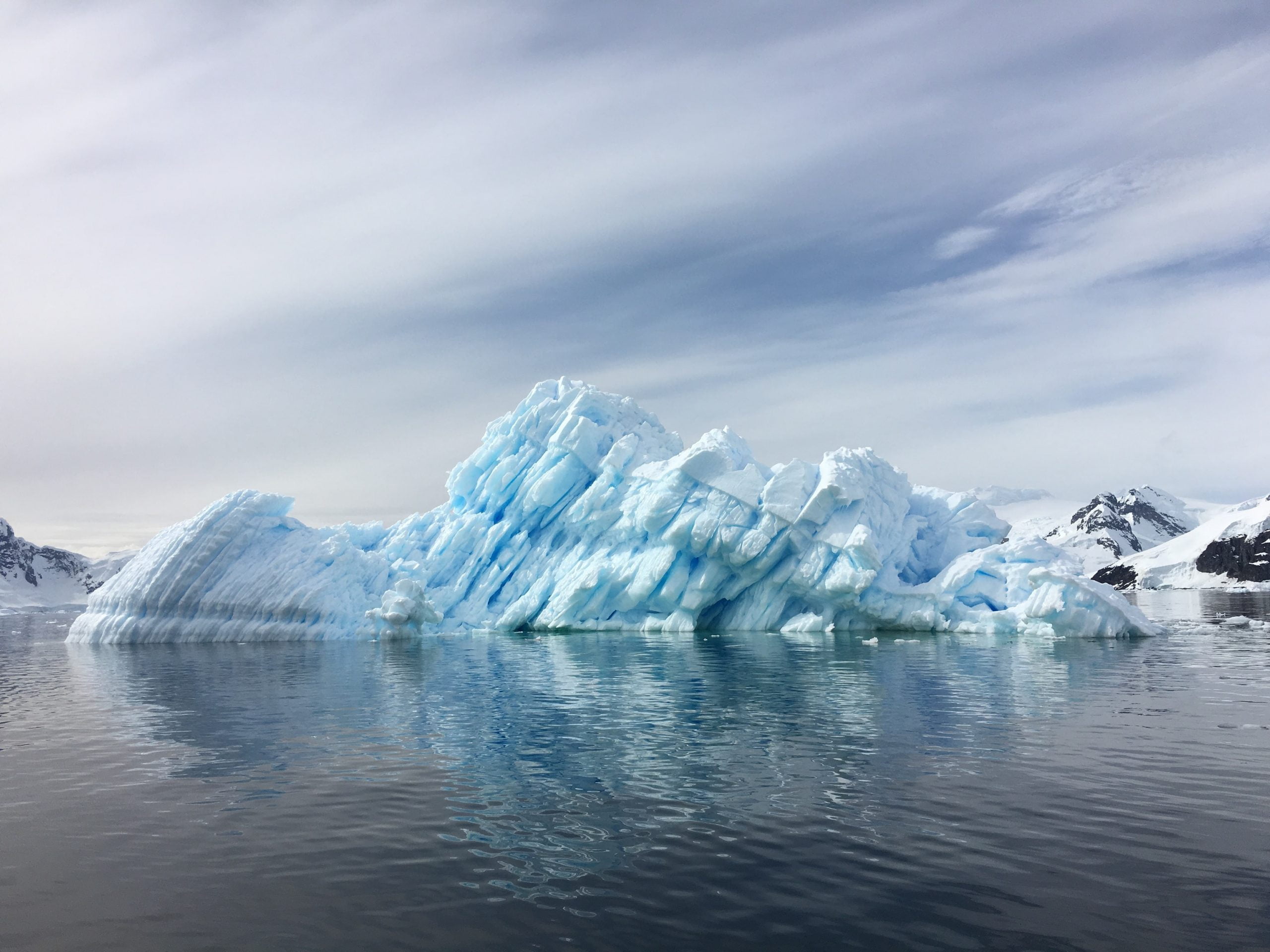
    Not all icebergs melt equally. Through a combination of experiment and numerical simulation, researchers have shown that an iceberg’s shape underwater strongly affects how it melts. Specifically, icebergs in a flow melt more quickly on the front and side surfaces and slower on the underside. This means that narrow icebergs that project deep into the water will melt faster than wider, shallow ones. Currently, climate models don’t account for this variation, but the researchers hope their work will help build more accurate models for future studies. (Image credit: iceberg – C. Matias, experiment – E. Hester et al.; research credit: E. Hester et al.; see also APS Physics)

    Snapshots of a model iceberg as it melts.
  • Featured Video Play Icon

    Lava and Life

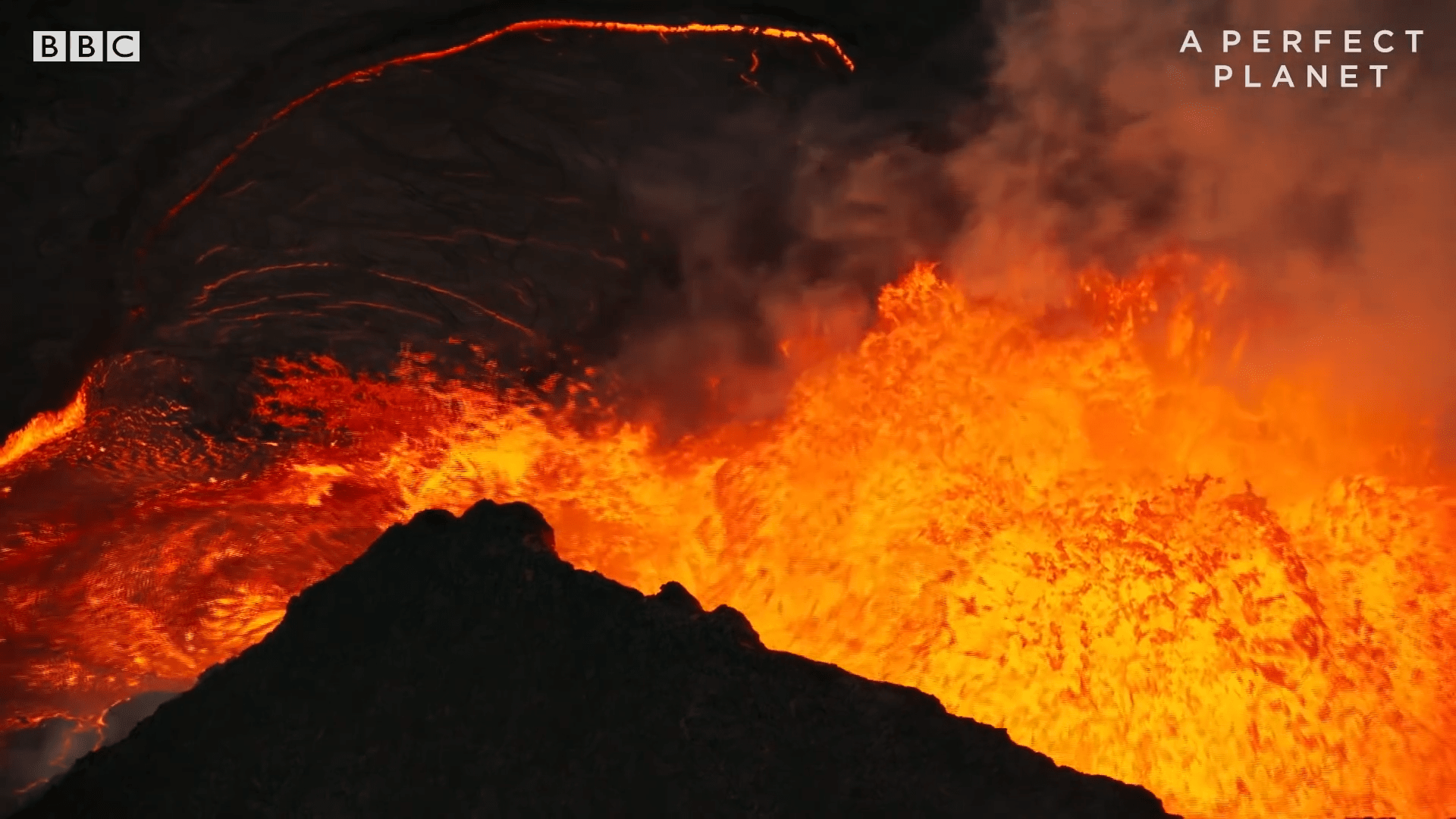
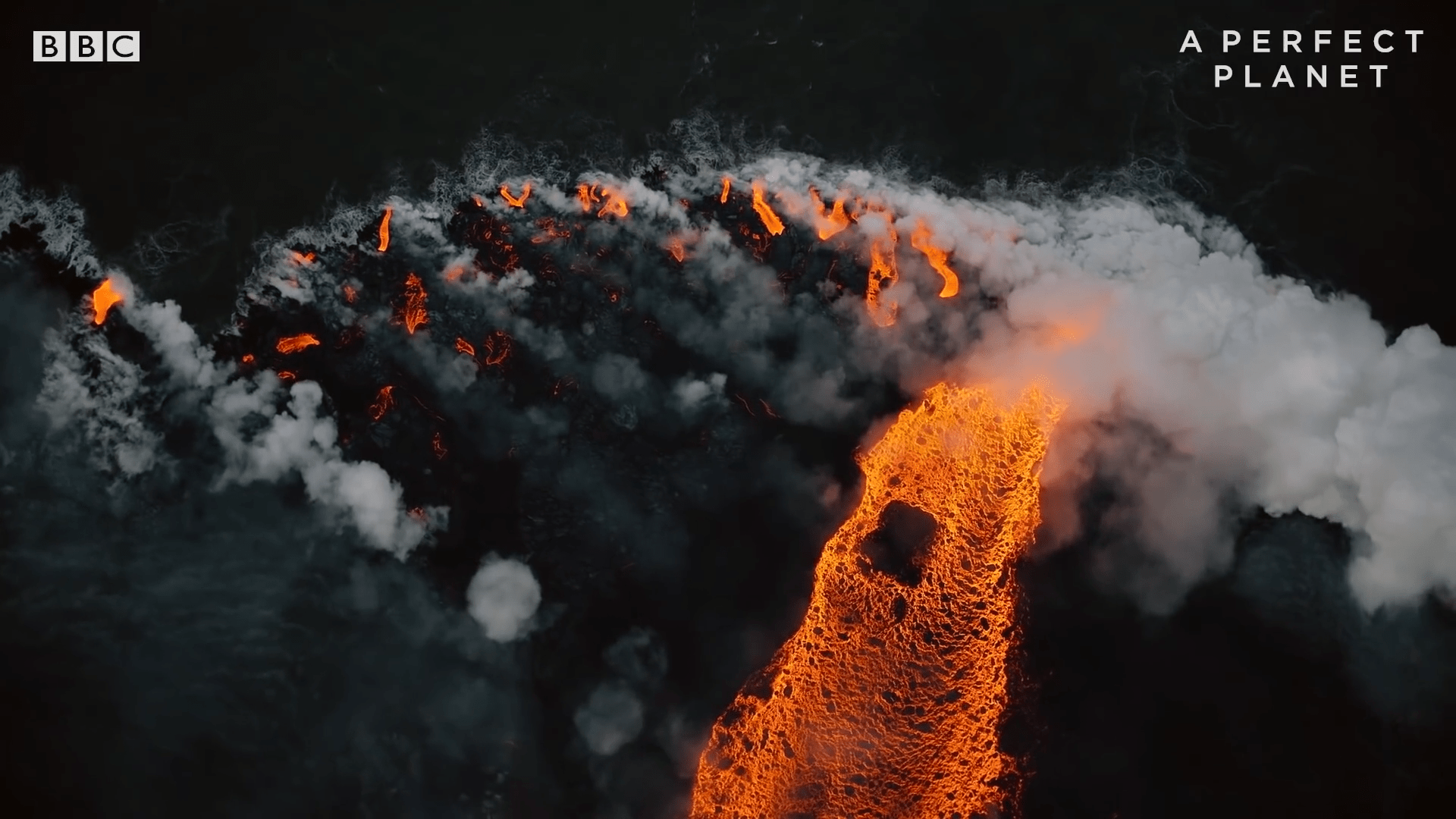
    Kilauea’s 2018 eruption gave us some of the most stunning volcanic footage ever seen, a tradition carried on in this BBC footage. As powerful and destructive as lava is, it’s also critical to life as we know it here on Earth. Volcanoes are a piece of the tectonic activity on our planet that drives the carbon cycle, without which we’d have no oceans or breathable atmosphere. It’s tough to imagine the geological scales over which these cycles act, but fortunately, there are numerical simulations to help! (Image and video credit: BBC Earth)

  • Inside Hydroplaning

    Inside Hydroplaning

    When a tire spins over a wet roadway, pressure at the front of the tire generates a lifting force; if that lift exceeds the weight of the car, it will start hydroplaning. To prevent this, the grooves of a tire’s tread are designed to redirect the water. Now researchers have visualized flow inside these grooves for the first time, using a version of particle image velocimetry (PIV). PIV techniques use fluorescent particles to track the flow.

    The results reveal a complicated, two-phase flow inside the tire grooves. As seen in the images above, bubble columns form inside the tire grooves. The team’s results suggest that the bubble columns depended on groove width, spacing, and intersections with other grooves. They also saw evidence of vortices inside some grooves. (Image credit: tires – S. Warid, others – D. Cabut et al.; research credit: D. Cabut et al.; via Physics World; submitted by Kam-Yung Soh)

  • Featured Video Play Icon

    Planes Lift

    Need a little refresher on how airplanes fly? The middle school students of The Nueva School have you covered with their latest science rap parody. They take a look at the four main forces on a flying airplane and even dig a little bit into the principles behind lift generation. Check it out! (Video and image credit: Science With Tom/Science Rap Academy)

  • Featured Video Play Icon

    “Geodaehan”

    In “Geodaehan” Roman De Giuli’s macro fluid art mimics massive landscapes. The film takes us over deltas, rivers, glaciers, and landslides. Some look like earthbound locations, others look like something from Mars or Titan. All are, in fact, paint, ink, and glitter on paper! It’s truly incredible how artists capture large-scale fluid physics on such a tiny canvas. (Image and video credit: R. De Giuli)

  • A Macro View of Weathering

    A Macro View of Weathering

    Water constantly weathers sedimentary rock, both physically — through abrasion — and chemically — through dissolution and recrystallization. Now researchers have gotten their first view of this weathering at the Ångstrom level by observing porous rocks with environmental transmission electron microscopy as they interact with both water vapor and liquid water.

    As expected, the experiments with liquid water showed that water dissolved the rocks and substantially changed the geometry of the rock’s pores. But the experiments also showed significant weathering from water vapor alone. The researchers found that water vapor formed a film on the surface of the rock’s pores in a process known as adsorption. This film substantially decreased the size of each pore and created strain in the rock. Once the water vapor was removed, the rock’s pores were notably altered, supporting the idea that this adsorption was, itself, a form of weathering. (Image credit: M. Kosloski; research credit: E. Barsotti et al.; via AGU EOS; submitted by Kam-Yung Soh)

  • An Oasis Among Dunes

    An Oasis Among Dunes

    The Saudi Arabian oasis of Jubbah sits in the bed of an ancient lake. It’s protected from the westerly winds that sculpt the surrounding dunes by the wind shadow of the mountain Jabel Umm Sinman. The long, skinny shape of the settlement reveals the shape of the mountain’s wake! (Image credit: NASA; via NASA Earth Observatory)

  • Swapping Emulsions

    Swapping Emulsions

    Chemically speaking, oil and water don’t mix. But with a little fluid mechanical effort, it’s possible to make them an emulsion — a mixture of oil droplets in water or water droplets in oil. Researchers in the Netherlands discovered that the viscosity of these emulsions depends critically on which of those mixtures you have.

    To create their emulsions, the team used a tank consisting of two concentric cylinders. When the inner cylinder spins, it creates a well-understood flow field between the inner and outer cylinder. By varying the ratio of oil to water in the tank, they could explore a wide range of emulsions. They found that the emulsion’s viscosity changed dramatically when the emulsion shifted from oil droplets in water to water droplets in oil, something known as a catastrophic phase inversion. During this switch the viscosity dropped from 3 times higher than pure water to 2 times lower! (Image credit: A_Different_Perspective; research credit: D. Bakhuis et al.; via APS Physics; submitted by Kam-Yung Soh)

  • Featured Video Play Icon

    Protecting From Storm Surge

    The most dangerous and destructive part of a tropical cyclone isn’t the wind or rain; it’s the storm surge of water moving inland. This landward shift of ocean takes place because of a cyclone’s strong winds, which drive the water via shear. The depth storm surges reach depends on the wind speed and direction, shape of the shoreline, and many other factors, making exact predictions difficult.

    Fortunately, engineers can — with enough foresight and investment — build structures and networks to help protect developed land from storm surge flooding. (Image and video credit: Practical Engineering)