Year: 2021

  • Featured Video Play Icon

    Lava at Night

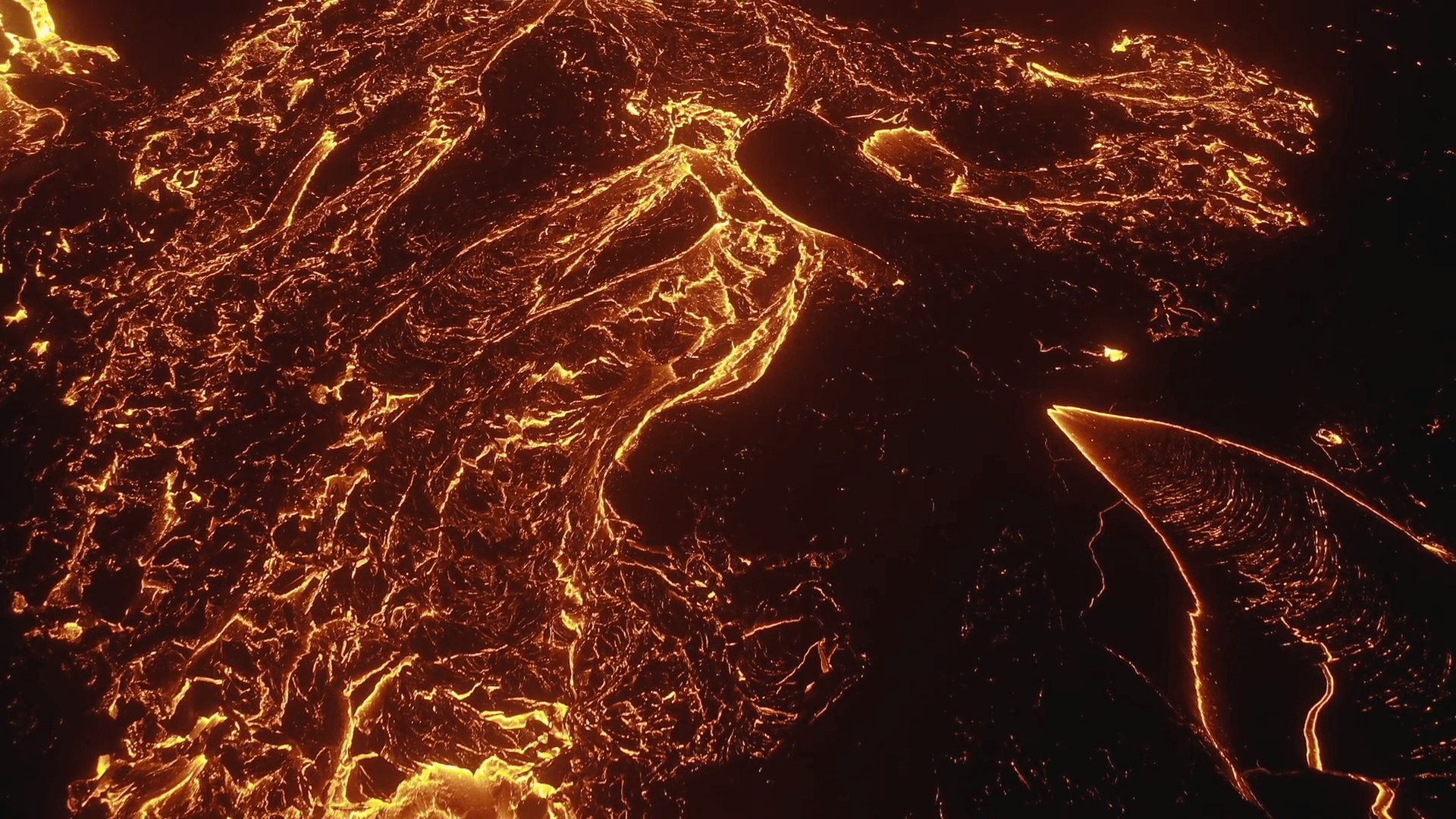
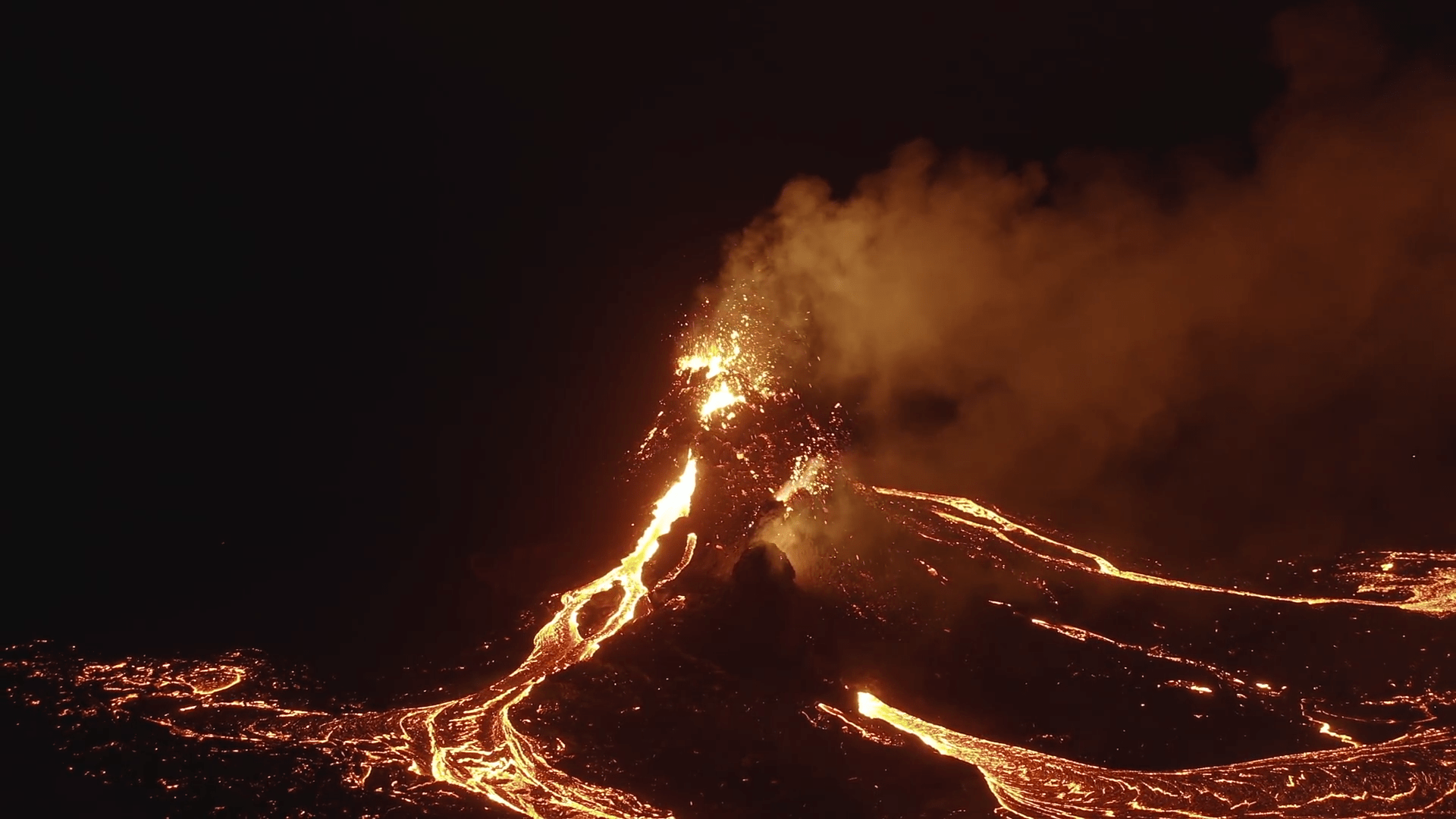
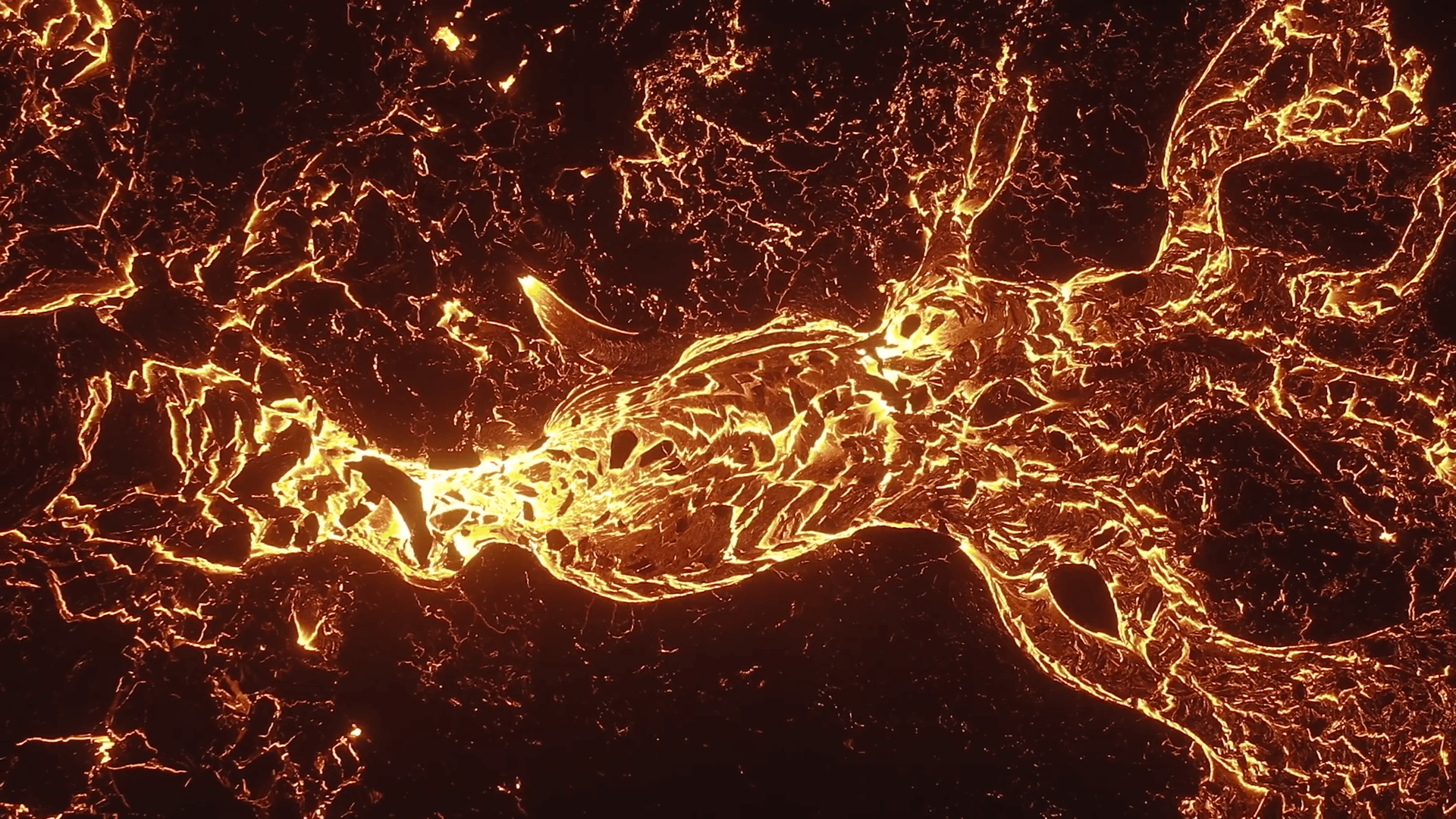
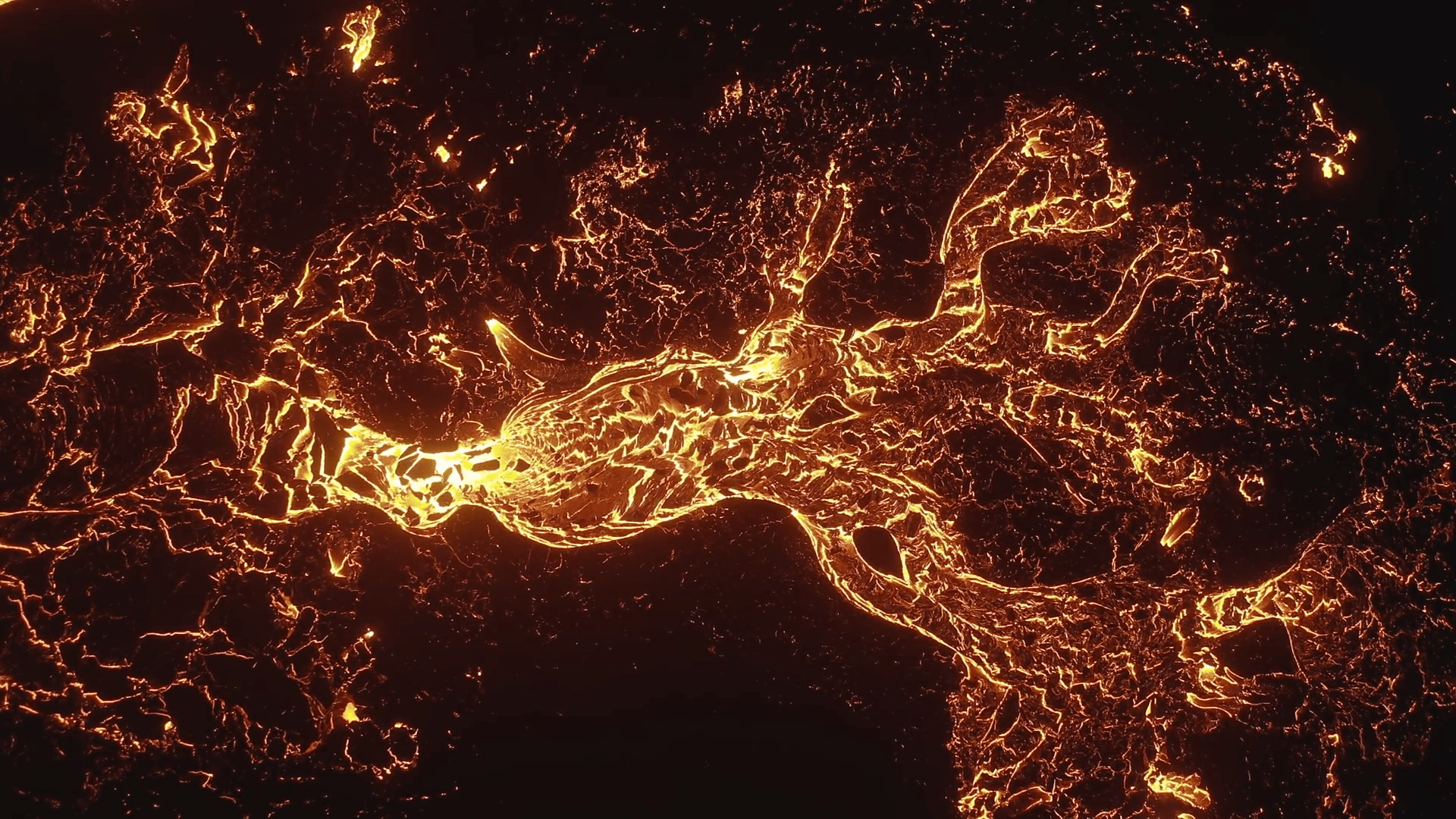
    Today’s cameras and drones capture volcanic eruptions in ways that were unthinkable in years past. This incredible footage shows the recent eruption in Iceland as it glows in the night. I love the crisp details of the flow. You can clearly see how the hotter, molten lava moves compared to the cooling crust. There’s some great footage of spurting fountains and blocks of lava getting swept along by the river. Enjoy! (Image and video credit: B. Steinbekk; submitted by jpshoer)

  • Decelerating Jets

    Decelerating Jets

    For more than a century, scientists have been fascinated by the jet that forms after a drop impacts a liquid. In this study, researchers tracked fluorescent particles in the fluid to understand the velocity and acceleration of flow inside the jet. They found that, within the first 10ms after the jet appears, it decelerates at up to 20 times the gravitational acceleration. That’s much too fast for gravity to cause, pointing instead to the critical importance of surface tension in dictating the behavior of these fast-moving jets. (Image and research credit: C. van Rijn et al.; via APS Physics; submitted by Kam-Yung Soh)

  • Wrinkles on Collapsing Bubbles

    Wrinkles on Collapsing Bubbles

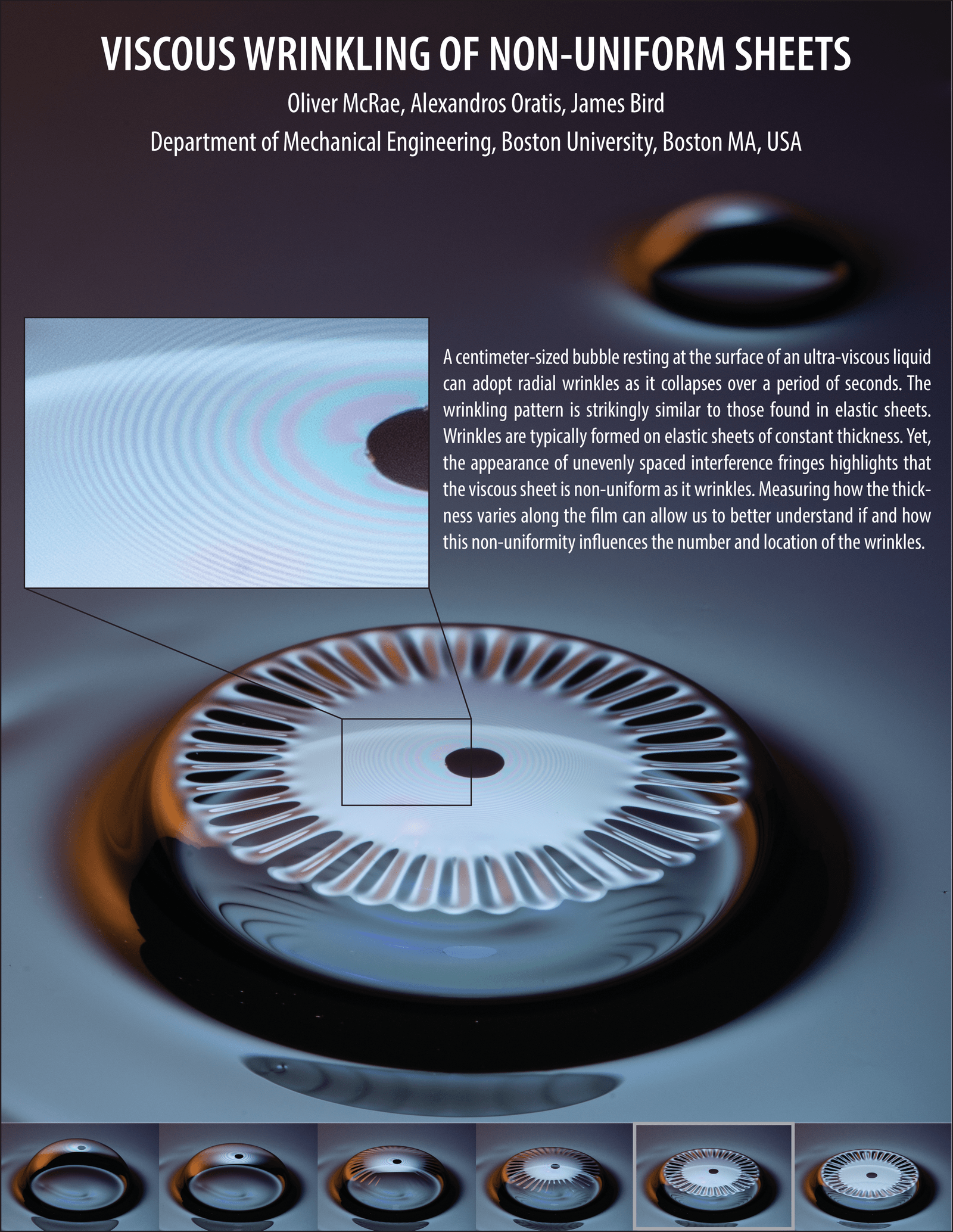
    As a bubble sitting on a pool collapses, wrinkles form around its edges. Visually, the result is quite similar to the wrinkles one gets on an elastic sheet. Unlike the solid sheet, though, the bubble’s film varies in thickness; we know this because of the fringes shown in the enlarged inset of the poster. Researchers are studying this non-uniformity to see whether it affects the number and shape of wrinkles that form on the bubble. (Image and research credit: O. McRae et al.)

  • Whiskey Webs

    Whiskey Webs

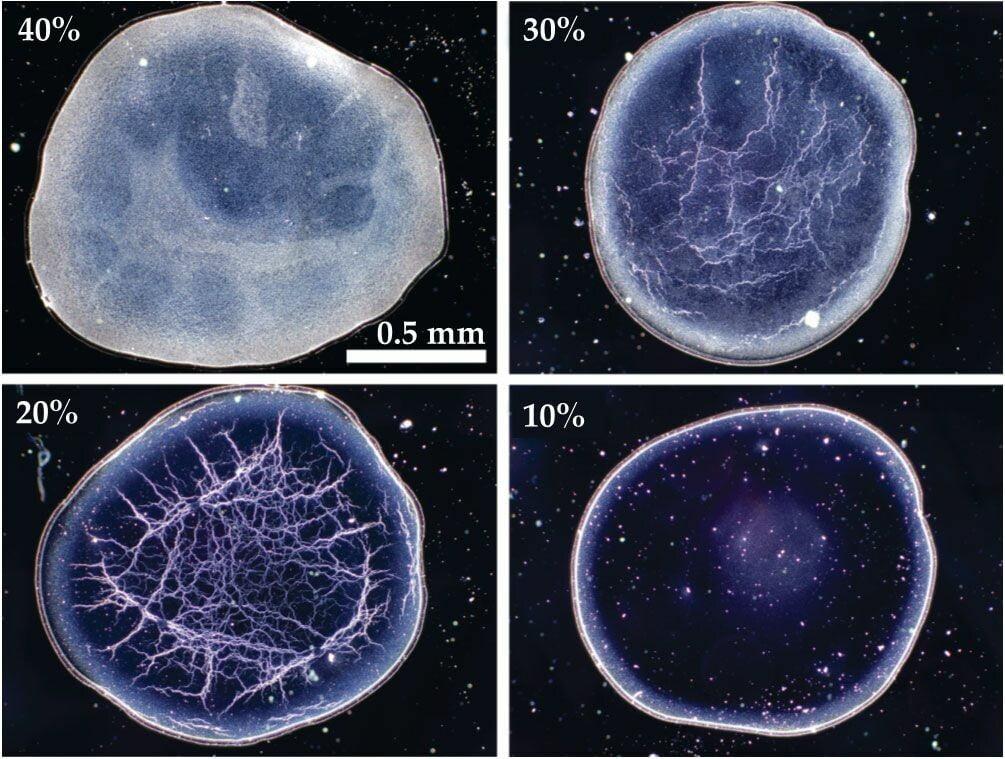
    Unlike scotch whisky, when American bourbon whiskeys are diluted, they form unique web-like evaporation patterns. These differences arise in part from the way the liquors are aged: scotch is aged in re-used barrels, whereas bourbons require aging in a new, charred American white oak barrel*.

    During aging, the whiskey picks up water-insoluble chemicals from the barrel. When water is added to the bourbon, it helps transport those insoluble components to the surface of a droplet, where they form a monolayer of fatty acid chains (Image 2; in green). As evaporation continues and the droplet gets smaller, the molecules at the shrinking surface collapse inward, forming the rigid web structure we see left behind. The patterns that form act as a kind of fingerprint for the bourbon. Check out some of the brand-to-brand variations over at the researchers’ Whiskey Webs site. (Image and research credit: S. Williams et al.; via Physics Today)

    * In case you were wondering, this is actually a legal requirement in order to be considered bourbon. Bourbons must also be made from a grain mixture that is >50% corn.

  • Albedo Effect

    Albedo Effect

    Temperature isn’t the only factor that determines how ice will melt. In this photo, a dark oak leaf absorbed more solar radiation than the reflective ice around it, causing the ice beneath it to melt. Scientifically, this effect is described by albedo; darker, more absorptive surfaces like the leaf have a lower albedo, whereas light, reflective ice and snow have a high albedo and can better resist melting on sunny days. (Image credit: K. James; submitted by Kam-Yung Soh)

  • Featured Video Play Icon

    Visualizing Radiation

    Radiation is invisible, but it’s not too difficult to build an apparatus that lets you see it. This video shows the ghostly aftermath of passing radiation in a cloud chamber, one of the first set-ups used to study radiation. The chamber contains a radioactive source and chilled isopropyl alcohol. The alcohol forms a supersaturated vapor — essentially a cloud in waiting — inside the chamber.

    When a radioactive particle gets emitted from the source, it streaks through the chamber, colliding with atoms and ionizing them. Those ions then serve as nucleation sites where alcohol condenses into droplets. It’s these condensation trails that we see bloom and decay in the particle’s wake. (Image and video credit: L. Gledhill)

  • Featured Video Play Icon

    Insect-Inspired Flight

    Insects are incredibly agile and resilient fliers, capable of colliding and recovering without damage. Engineers are only beginning to capture these characteristics in their robots. Here, engineers use a soft actuator — a rubber cylinder coated in carbon nanotubes — to drive their robot’s flight. When voltage is applied across the carbon nanotubes, the rubber squeezes and stretches, causing the robot’s wings to flap. These soft actuators are far less fragile than hard ones, allowing the robots to take hits and keep flapping, much like the real insects. (Image and video credit: MIT News; research credit: K. Chen et al.)

  • Featured Video Play Icon

    Fluid Chains

    In this video, Steve Mould tackles a question many of us have likely wondered: just why does falling water make this chain-like shape? When pouring from a slit-like orifice, water jets take on this undulating pattern. While I have no issue with Steve’s explanation of surface tension oscillations driving the shape, I’ll quibble a little bit with the idea that this hasn’t been studied. Personally, I’d connect it to the fishbone instability, which classically occurs when two jets collide. At low flow rates, though, the colliding jets form a pattern very much like this one. And if you look just past the initial conditions at the container opening, all of these flows have thicker jet-like rims colliding. I think the flows in these videos are just a slightly messier version of the low-flow-rate fishbone. What do you think? (Video and image credit: S. Mould)

  • Meltwater Tracking Via Seal

    Meltwater Tracking Via Seal

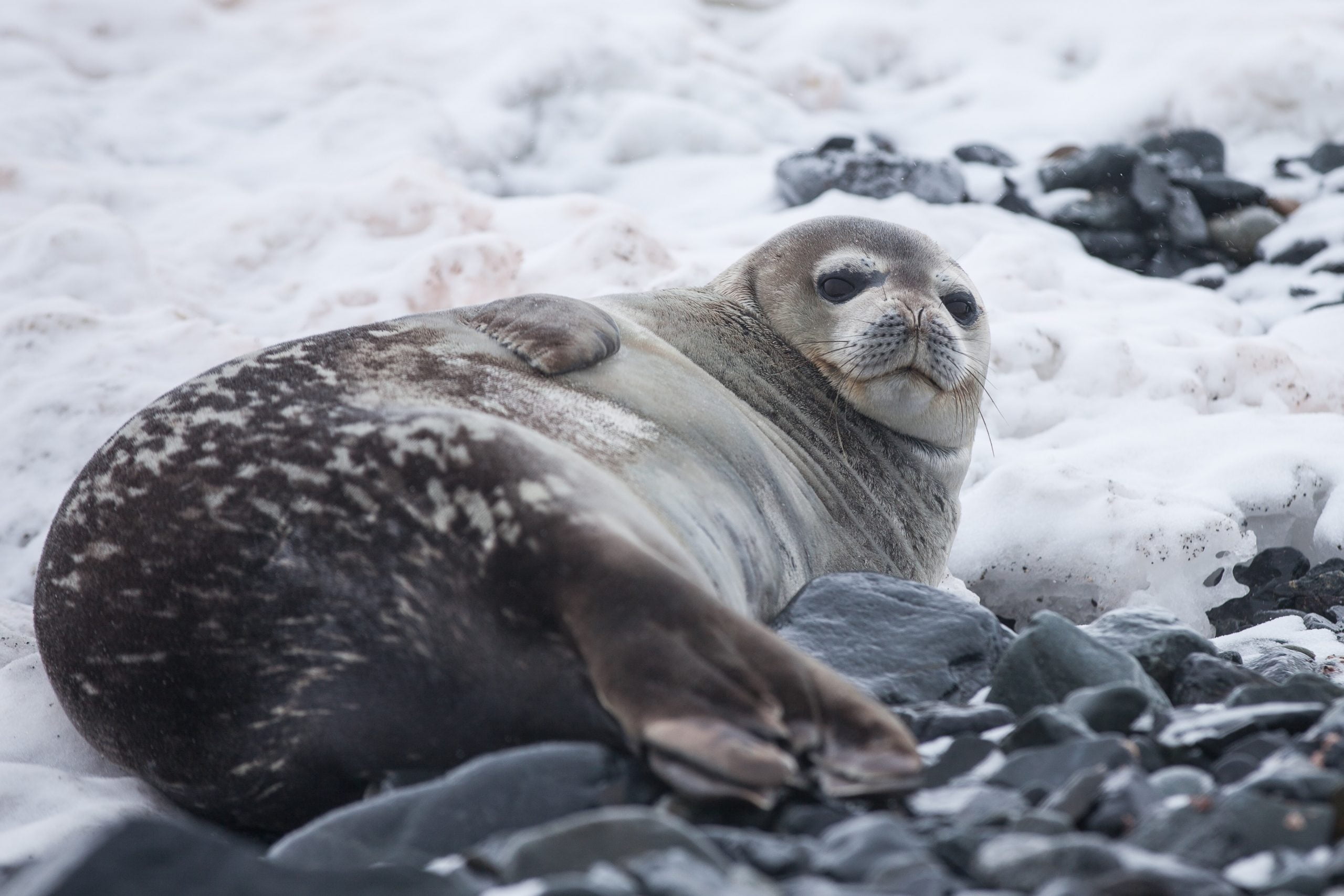
    Monitoring meltwater from Antarctic glaciers is critical for understanding our changing climate, but such remote and inaccessible regions are tough to collect data in. So researchers are turning to local workers to help them gather data. By collecting and analyzing data from seal tags, researchers have mapped new seasonal variations in meltwater flows around Pine Island Glacier. Although the seals are somewhat tough collaborators — they rarely swim exactly where the researchers would like them to — their winter activities are revealing data researchers could never have collected on their own. (Image credit: Y. Rzhemovskiy; research credit: Y. Zheng et al.; via Gizmodo)

  • Superior Mirage

    Superior Mirage

    This photograph of a ship seemingly floating far above the water is not some Photoshop fakery; it’s physics creating the illusion. It’s an example of what’s known as a superior mirage — superior because the mirage appears above the object’s actual location, unlike the mirages you see above the road on a hot day.

    In this case, the air layer near the water is cold — colder than the air above it, thanks to a temperature inversion. Cold air is denser and has a higher index of refraction, so light traveling through it gets bent downward. To a far off observer, this downward bend makes objects appear higher in altitude than they actually are. The effect is most common in polar regions, where the right conditions can actually allow images of objects completely below the horizon! (Image credit: D. Morris; via The Guardian; submitted by Alec)