Year: 2020

  • Branching Sparks from Senko-hanabi

    Branching Sparks from Senko-hanabi

    Senko-hanabi are a Japanese firework, somewhat similar to a sparkler. But instead of being driven by burning powder, the senko-hanabi’s sparks come from bursting liquid droplets undergoing an exothermic reaction with air.

    Chemistry aside, the effect is similar to what goes on in soda water. As bubbles within the liquid nucleate and move to the surface, they burst, generating smaller droplets. As the researchers explain, the same cascade carries on in the smaller drops, creating the branching sparks the firework is known for.

    For more slow motion views of the fireworks and sparks, check out the video below or those produced by the researchers. (Image and research credit: C. Inoue et al. and C. Inoue et al.; video credit: NightHawkInLight; submitted by Jason C.)
  • Internal Waves in the Andaman Sea

    Internal Waves in the Andaman Sea

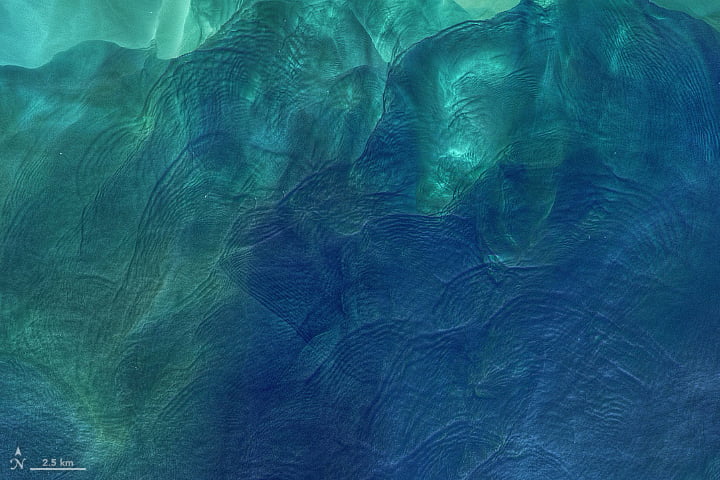
    Differences in temperature and salinity create distinct layers within the ocean. When combined with flow over submerged topography — underwater canyons, mountains, and reefs — it makes waves. But those waves aren’t always apparent when sitting at the surface. Instead, they travel along those ocean layers as internal waves that can be as tall as hundreds of meters in height.

    When the sun glints just right off the ocean, these massive internal waves can be caught by satellite imagery, as shown in the above image of the Andaman Sea near Thailand and Myanmar. Even seemingly calm waters can roil in the deep. (Image credit: USGS; via NASA Earth Observatory)

  • The Vortex Beneath a Drop

    The Vortex Beneath a Drop

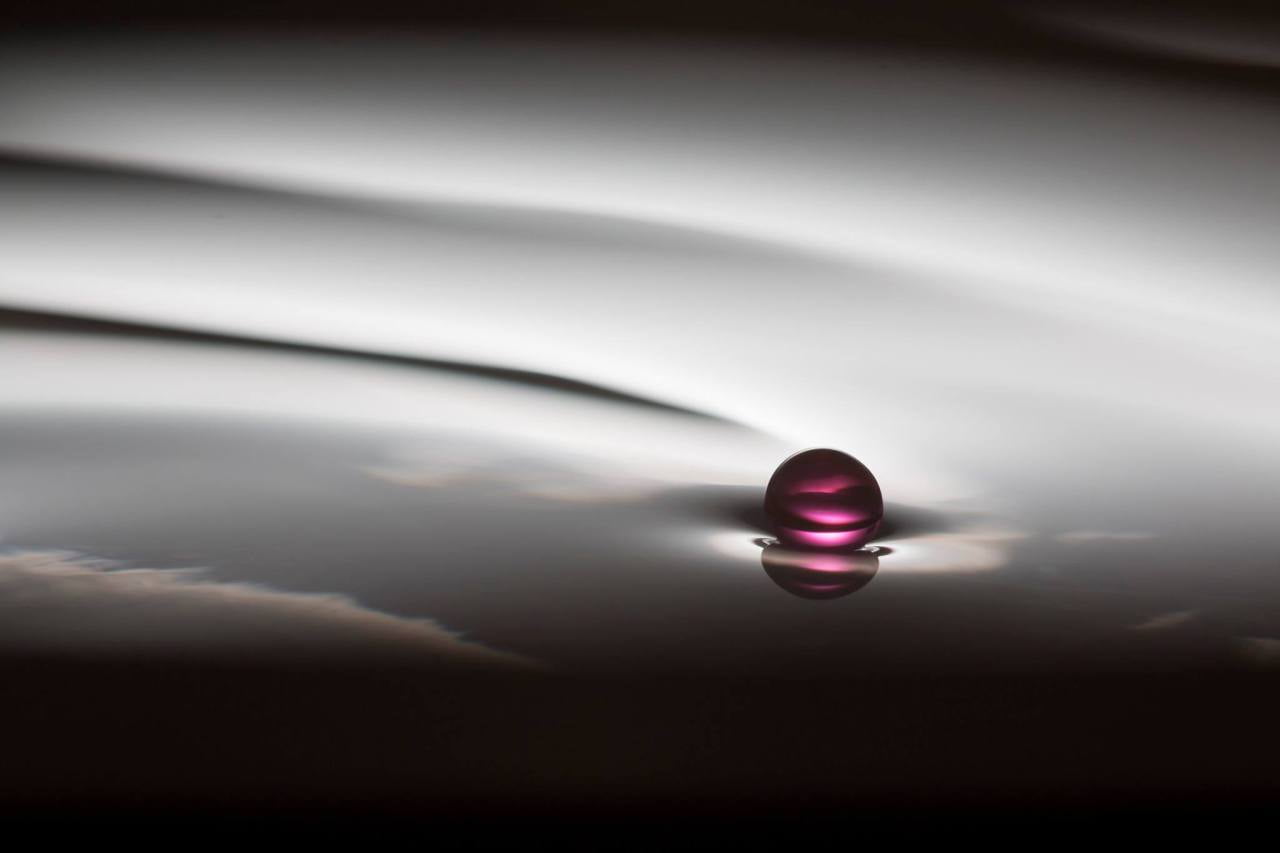
    While we’re most used to seeing levitating Leidenfrost droplets on a solid surface, such drops can also form above a liquid bath. In fact, the smoothness of the bath’s surface, combined with mechanisms discussed in a new study, means that drops will levitate at a cooler temperature over a liquid than they will over a solid surface.

    Researchers found that a donut-shaped vortex forms in the bath beneath a levitating droplet, but the direction of the vortex’s circulation is not always the same. For some liquids, the flow moves radially outward from beneath the drop. In this case, researchers found that the dominant force was shear stress caused by the vapor escaping from under the droplet.

    With other droplet liquids, the flow direction instead moved inward, forming a sinking plume beneath the center of the drop. In this situation, researchers found that evaporative cooling dominated. As the liquid beneath the droplet cooled, it became denser and sank. At the same time, the lower temperature changed the bath’s local surface tension, creating the inward surface flow through the Marangoni effect. (Image credit: F. Cavagnon; research credit: B. Sobac et al.)

  • Featured Video Play Icon

    Making Waves

    The Seoul Aquarium is now home to an enormous crashing wave, courtesy of design company d’strict. Check out several different views of the anamorphic illusion in their video above. There’s no word on the techniques used to generate the animation, but it’s certainly a cool visual! (Image and video credit: d’strict; via Colossal)

  • Featured Video Play Icon

    How Animals Stay Dry in the Rain

    Getting wet can be a problem for many animals. A wet insect could quickly become too heavy to fly, and a wet bird can struggle to stay warm. But these animals have a secret weapon: tiny, multi-scale roughness on their wings, scales, and feathers that helps them shed water. Watch the latest FYFD video to learn how! (Image and video credit: N. Sharp; research credit: S. Kim et al.)

  • Featured Video Play Icon

    Traffic Flow and Phantom Jams

    We’ve all experienced the frustration of traffic jams that seem to come from nowhere — standstills that occur with no accident, construction, or obstacle in sight. Traffic shares a lot of similarities with fluid flows, including its waves and instabilities.

    These disturbances propagate and grow when traffic surpasses a critical density. Once that happens, any small speed adjustment made by a lead driver gets amplified by the larger and larger braking of each driver downstream. Effectively, this creates a wave of slower speed and higher density that travels downstream through the traffic.

    Each driver brakes more than the last largely because they can’t tell what the conditions upstream of them are. But that lack of knowledge may be less of an issue for driverless cars, which have the potential to communicate with cars and traffic sensors ahead of them. With enough automated vehicles on the highway, phantom traffic jams may become a thing of the past. (Video and image credit: TED-Ed)

  • New Details on the Sun’s Surface

    New Details on the Sun’s Surface

    As part of its shakedown, the new Inouye Solar Telescope has captured the surface of the sun in stunning new detail. Seen here are some of the sun’s turbulent convection cells, each about the size of the state of Texas. Hot plasma rises in the center of each cell, cools, and then sinks near the dark edges. Also visible within these dark borders are bright spots thought to mark magnetic fields capable of channeling energy out into the corona. Researchers hope the new telescope will help them uncover the physics behind these processes. (Image and video credit: Inouye Solar Telescope)

    Convection cells on the sun.

    Editor’s note: Like several other telescopes located in Hawai’i, the Inouye Solar Telescope was built against the wishes of many native Hawaiians. Although FYFD supports scientific progress, it is my personal belief that scientific advances should not come at the expense of indigenous populations. I strongly urge my scientific colleagues to listen to and work alongside those with concerns about future facilities.

  • Featured Video Play Icon

    Mimicking Supernovas

    The Hubble archives are full of incredible swirls of cosmic gas and dust, many of which were born in supernovas. Predicting the forms these massive explosions will generate is extremely difficult, thanks in large part to the complicated fluid dynamics generated by their blast waves. But new lab-scale experiments may help shed light on those underlying processes.

    Researchers mimic supernovas in the lab by launching blast waves through an interface between a dense gas (shown in white) and a lighter one (which appears black). As the blast wave passes, it drives the dense fluid into the lighter one, triggering a series of instabilities. Notice how any initial perturbations in the interface quickly grow into mushroom-like spikes that rapidly become turbulent. This behavior is exactly what’s seen in supernovas (and in inertial confinement fusion)! (Video credit: Georgia Tech; research credit: B. Musci et al.; submitted by D. Ranjan)

  • Mossy Vortex Rings

    Mossy Vortex Rings

    Many plants have evolved an ability to move remarkably quickly. Often, this capability is driven by water. Here we see the moss Sphagnumaffine, which disperses its spores explosively. The process is triggered by the spore capsule gradually drying out; its shape changes from round to cylindrical, pressurizing the capsule. Once the internal pressure is high enough to overcome the strength of the capsule’s upper membrane, the capsule bursts, sending a plume of spores aloft. The sudden release of spore-laden air forms a vortex ring, which lifts the spores higher far more efficiently than they would be otherwise. (Image credit: capsule dry-out – J. Edwards et al., spore dispersal – J. Edwards et al. 2010; research credit: J. Edwards et al.)

  • Featured Video Play Icon

    Mammatus Clouds

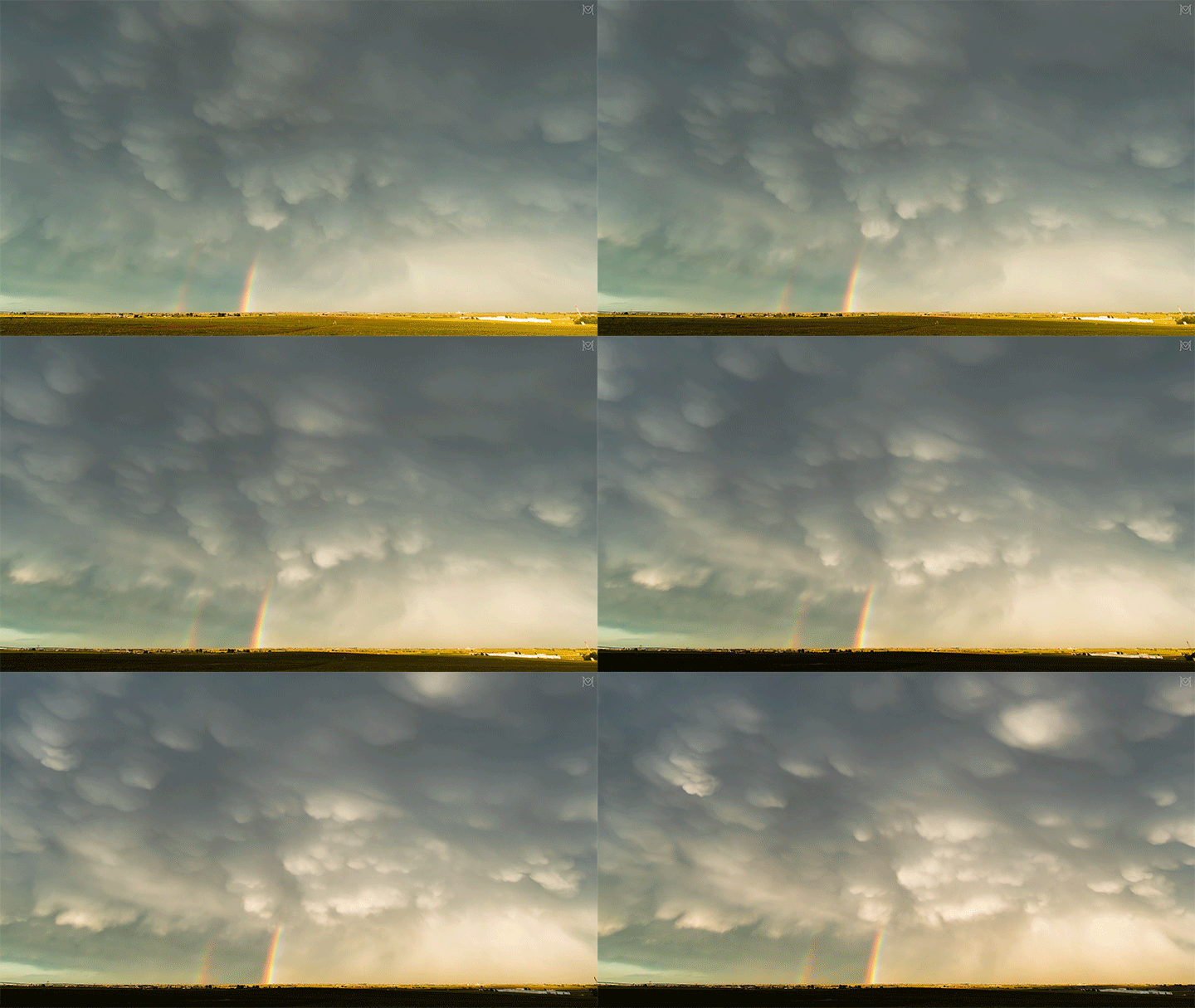
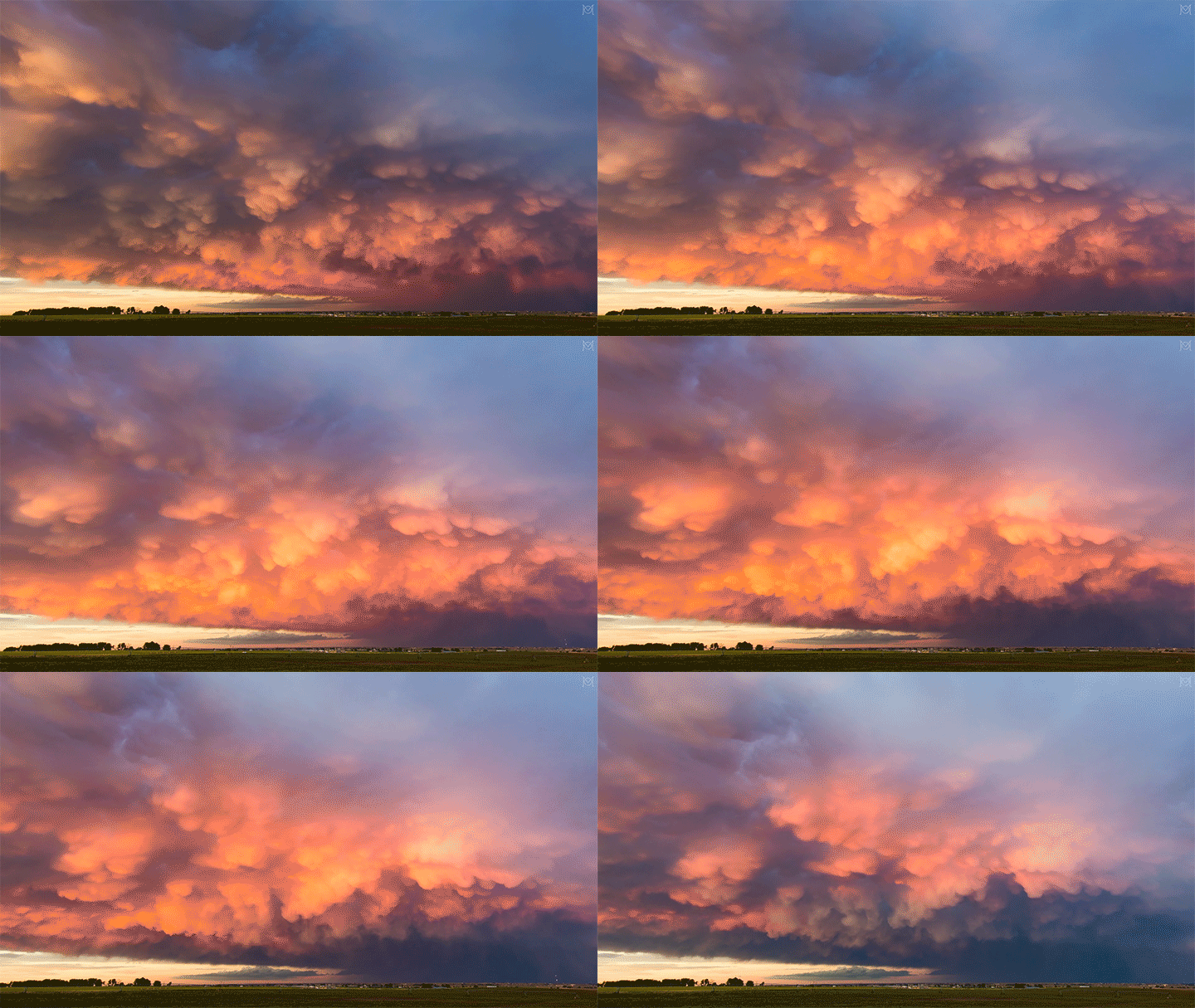
    Mammatus clouds are a relatively rare and dramatic variety. One advantage of living in Colorado is that I see them somewhat often, especially during our stormy springs and summers. This video by Mike Olbinski features a dramatic skyscape of mammatus clouds (here in Colorado, natch) at sunset.

    Although they’re often associated with stormy weather, there’s no widely accepted theory as to how mammatus clouds form. Their lobe-like protrusions form from cold, sinking air, but this is about as far as theories agree. It’s even unclear what their relation to extreme weather may be since these short-lived cloud formations can appear around, before, or even after such weather. (Image and video credit: M. Olbinski)