Year: 2020

  • Marangoni Bursting

    Marangoni Bursting

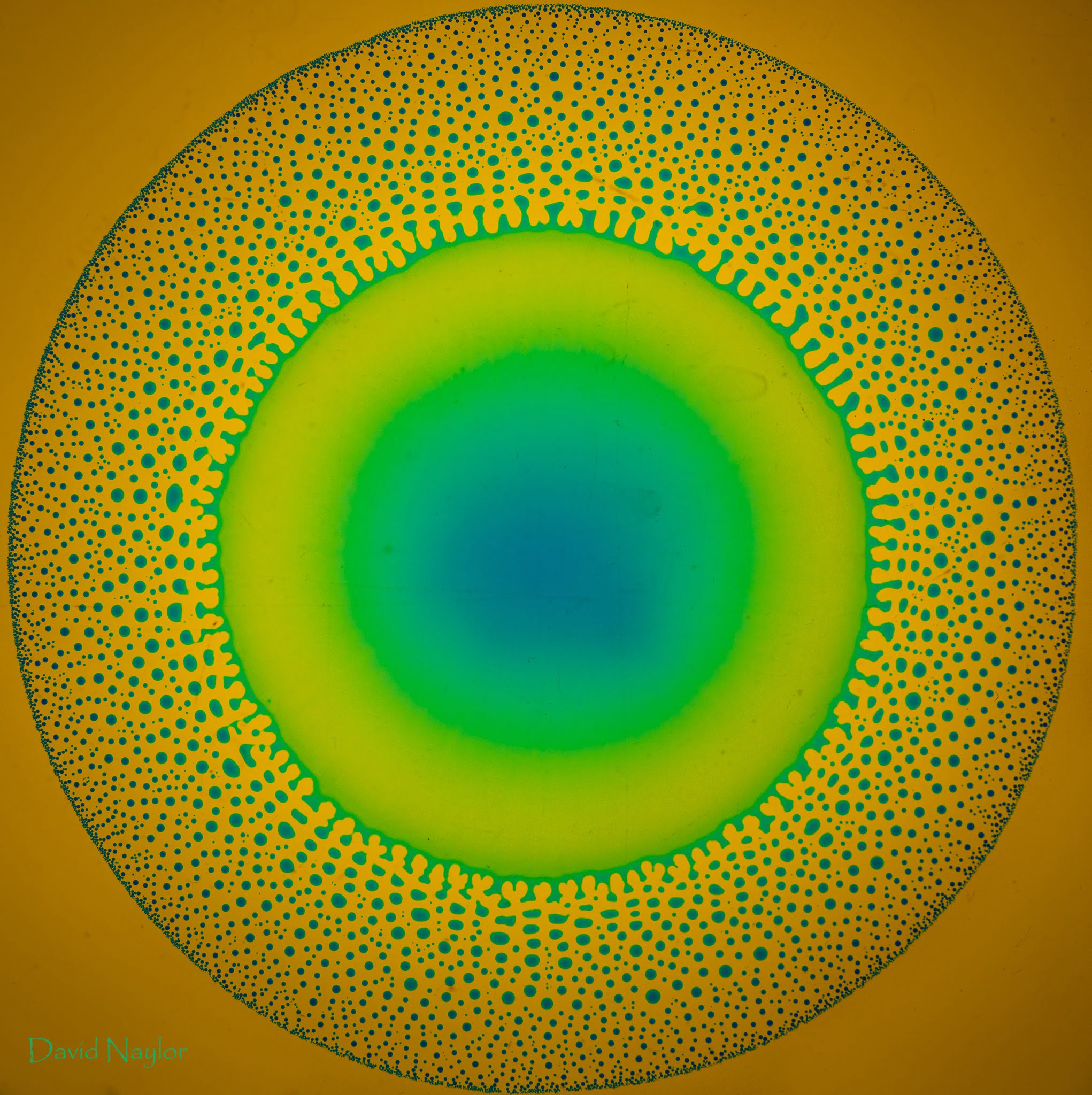
    Placing a mixture of alcohol and water atop a pool of oil creates a stunning effect that pulls droplets apart. The action is driven by the Marangoni effect, where variations in surface tension (caused in this case by the relative evaporation rates of alcohol and water) create flow. David Naylor captures some great stills of the flow, including the only example of a double burst I’ve seen so far. For more on the science behind the effect, check out this previous post or the original research paper. (Image credit: D. Naylor; see also this previous post)

  • A Lenticular Cloud With a Curl

    A Lenticular Cloud With a Curl

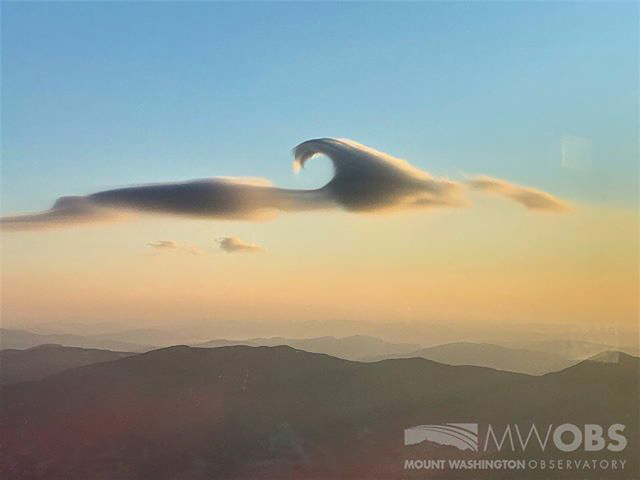
    Lens-shaped lenticular clouds are not terribly rare in mountainous areas, but observers at Mount Washington caught a very unusual cloud near sunrise in late February. This lenticular cloud had an added curl on top thanks to the Kelvin-Helmholtz instability!

    Lenticular clouds form when air is forced to flow up over a mountain in such a way that its temperature and pressure drop and water vapor in the air condenses. The resulting water droplets form a cloud that appears stationary over the mountain, even though the air continues to flow.

    To get that added wave-like curl, there needs to be another, faster-moving layer of air just above the cloud. As that air flows past, it shears the cloud layer, causing the interface to curl. Neither of these cloud types is long-lived — Kelvin-Helmholtz formations often last only a few minutes — so catching such a great dual example is lucky, indeed! (Image credit: Mount Washington Observatory; via Smithsonian Magazine; submitted by Kam-Yung Soh)

  • Featured Video Play Icon

    Renewing the Colorado River

    The Glen Canyon Dam lies on the Colorado River, upstream of the Grand Canyon. Because the dam blocks sediment from upstream, the region’s only sediment sources are two tributary rivers downstream of the dam. Periodically, the Bureau of Reclamation releases high flows from the dam in order to mimic the seasonal floods that existed on the river before the dam was built. These surge flows pick up hundreds of thousands of tonnes of sediment from the tributary rivers and push it downstream, creating and renewing sand bars and beaches along the Colorado. (Video and image credits: Bureau of Reclamation, 1, 2)

  • Featured Video Play Icon

    Exploring Martian Mud Flows

    When looking at Mars and other parts of our solar system, planetary scientists are faced with a critical question: if what I’m looking at is similar to something on Earth, did it form the same way it does here? In other words, if something on Mars looks like a terrestrial lava flow, is it actually made of igneous rock or something else?

    To tackle this question, a team of researchers explored mud flows in a pressure chamber under both Earth-like and Martian conditions. They found that mud flowed quite freely on Earth, but with Martian temperatures and pressures, the flows resembled lava flows like those found in Hawaii or the Galapagos Islands.

    On Mars, mud begins boiling once it reaches the low pressure of the surface. This boiling cools it, causing the outer layer of the mud to freeze into an increasingly viscous crust, which changes how the mud flows. In this regard, it’s very similar to cooling lava, even though the heat loss mechanisms are different. (Video and research credit: P. Brož et al.; image credit: N. Sharp; see also P. Brož; submitted by Kam-Yung Soh)

  • New Signs of Turbulence in Blood Flow

    New Signs of Turbulence in Blood Flow

    Our bodies are filled with a network of blood vessels responsible for keeping our cells oxygenated and carrying away waste products. In many ways, our blood vessels are tiny pipes, but there’s a crucial difference in the flow they carry: it’s pulsatile. Because the flow is driven by our hearts, rather than a continuous pump, every heartbeat creates a distinct cycle of acceleration and deceleration in the flow. And new research has found that this cycle, when combined with curvature or flow restrictions like plaque build-up, can create turbulence in unexpected places.

    Specifically, the researchers found that decelerating pipe flows can develop a helical instability that breaks down into turbulence, even in vessels where purely laminar flow would be expected. In the animations above, you can see the flow slow, develop swirls and then break into turbulence. The flow becomes laminar again as it accelerates, but during that brief bout of turbulence there’s much higher forces on the walls of a blood vessel. Over time, that extra force could contribute to inflammation or even hardening of the arteries. (Image and research credit: D. Xu et al.; via phys.org)

  • Seeping Sculptures

    Seeping Sculptures

    Drips, blobs, and squishes – that’s how artist Dan Lam describes her recent series of sculptures. The pieces are a mix of polyurethane foam, resin, and acrylic, decorated in bold gradients of neon color. I love the fluidity of each piece, as well as the decorative piping of spikes on many of them. (As a matter of fact, they remind me of this work.) Check out more of Lam’s work on her website and Instagram feed. (Image credit: D. Lam; via Colossal)

  • Aerodynamic Flight Testing

    Aerodynamic Flight Testing

    Flight testing models has a long history in aerodynamics. Above you see a Curtiss JN-4 biplane in flight with a model wing suspended below the fuselage. This test was conducted circa 1921 by NASA’s predecessor, NACA. At the time, of course, computational simulations were non-existent, and, although wind tunnels existed, presumably they could not recreate the exact circumstances needed for the test. Available wind tunnels might have lacked the power to reach the speeds engineers wanted, or they could have been too small for the model or had too many disturbances compared to the pristine flight environment. Any or all of these concerns can drive decisions to use flight testing instead of ground tests.

    Flight testing in aerodynamics is still used today, albeit sparingly. The second image shows a crew of Texas A&M graduate students (including yours truly) with a swept wing model we were about to test with a Cessna O-2 aircraft. By this point (roughly 10 years ago), we had wind tunnels capable of overlapping the conditions we could achieve in flight, but flight testing still gave us a larger range of conditions than working solely in the wind tunnel. (Image credits: JN-4 – NASA, O-2 – M. Woodruff; via Rainmaker1973; submitted by Marc A.)

  • Featured Video Play Icon

    Michigan Dam Failure

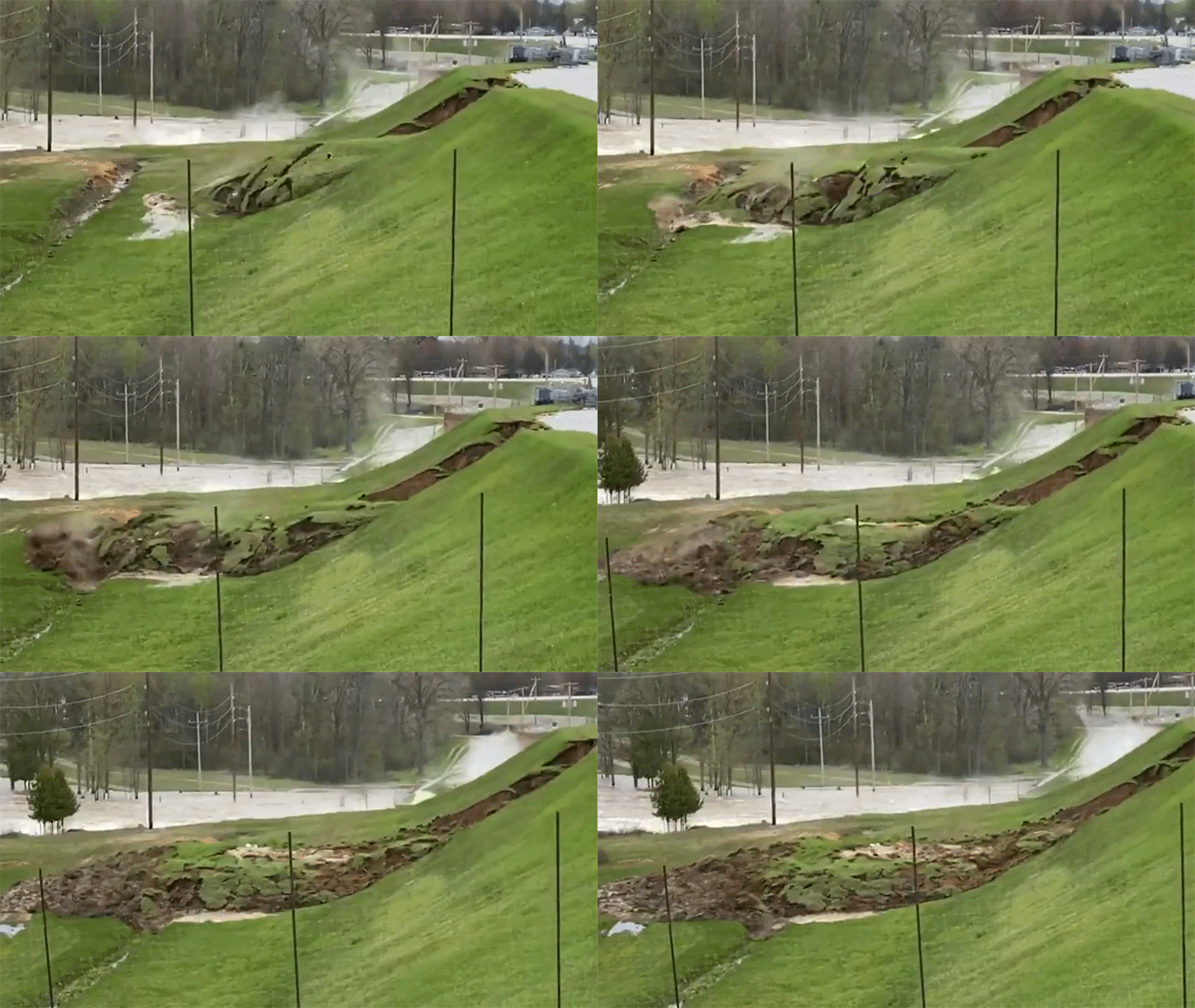
    Last week Michigan’s Edenville Dam failed, triggering catastrophic flooding. While the exact causes of dam’s failure are not yet clear, this video of the collapse provides some interesting hints.

    As the video begins, we see water that’s already trickled down the slope, potentially a sign that the top of the dam has already degraded. Then a noticeable bulge forms near the bottom of the earthwork slope, followed quickly by a landslide. Water doesn’t pour out immediately, though. That delay suggests that only part of the dam’s thickest section failed in the landslide. During the delay, the remaining interior of the dam is failing from the sudden lack of support. Then, the floodwaters come pouring out.

    From the sequence of events, it seems likely that the dam was suffering from soil liquefaction prior to the collapse. With high water levels behind the dam, pressure can drive water into the soil beneath the dam, reducing its strength. You can see this effect in action in this video and this one. For more on the Edenville dam specifically, check out the great analysis over at AGU from Dave Petley (1, 2).

    Sadly, failures like these are quite avoidable, provided dams are properly maintained. Climate change is drastically altering precipitation patterns across the world, and without updating and reworking our infrastructure to account for that, we’ll see more failures like this in the future. (Video and image credit: L. Coleman/MLive; via Earther; see also D. Petley 1, 2)

  • Particle-filled Splashes

    Particle-filled Splashes

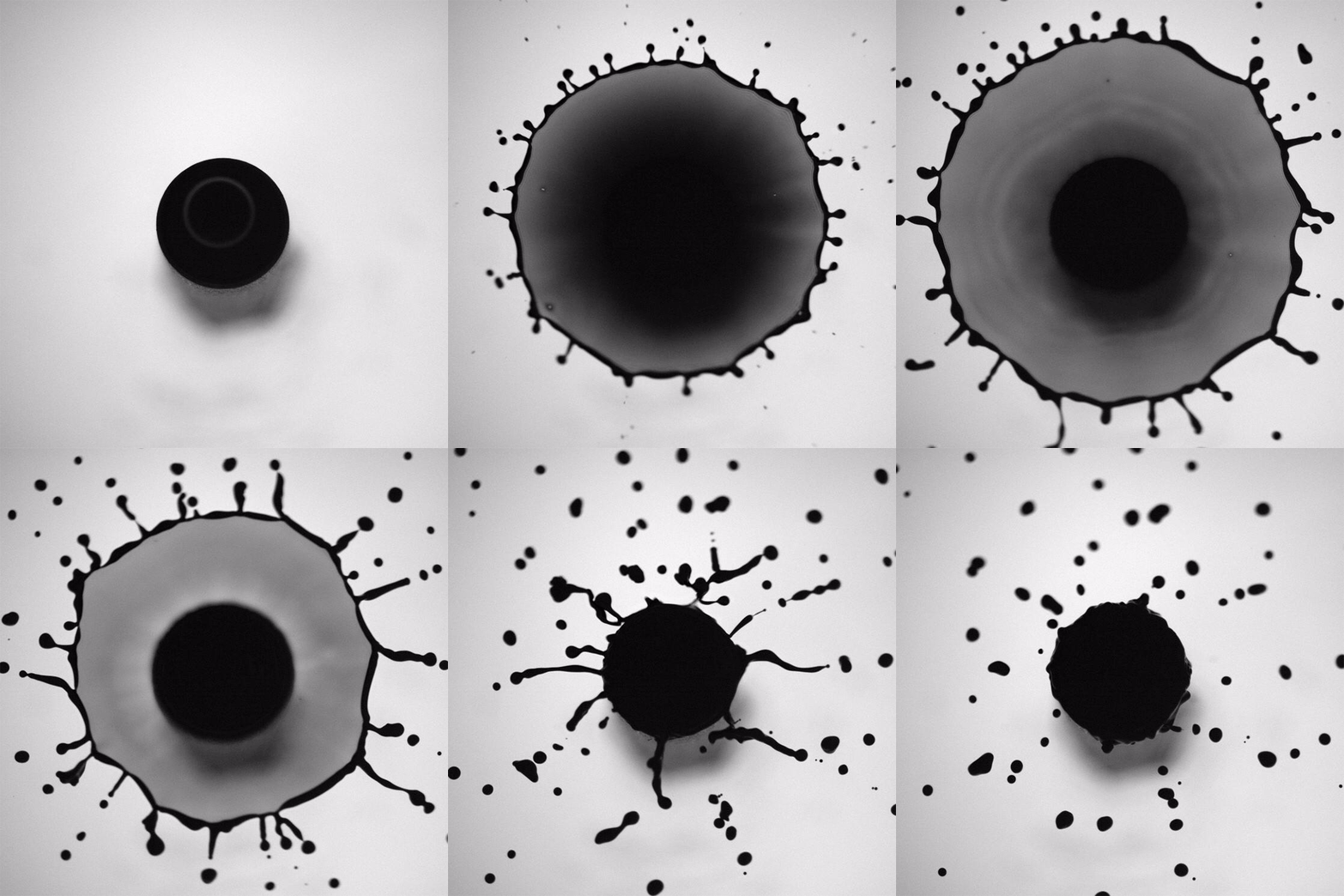
    Adding particles to a liquid can significantly alter its splash dynamics, as shown in this new study. In the first image, a purely-liquid droplet spreads on impact into a thin liquid sheet that destabilizes from the rim inward, ripping itself into a spray of droplets. At first glance, the particle-filled droplet in the second image behaves similarly; it, too, spreads and then disintegrates. But there are distinctive differences.

    During expansion, the particles increase the drop’s effective viscosity, meaning that the splash sheet does not expand as far. That apparent viscosity increase is also part of why the drops the splash sheds are bigger than those without particles. The other part of that story comes from the retraction, where the variations in thickness caused by the particles and their menisci create preferential paths for the flow. As a result, the particle-filled splash breaks up faster and into larger droplets compared to its purely-liquid counterpart. (Image and research credit: P. Raux et al.)

  • Updating Undergraduate Heat Transfer

    Updating Undergraduate Heat Transfer

    For many engineering students, their first exposure to fluid dynamics comes in a heat transfer class. The typical focus in these classes is not on the underlying physics but on learning to use empirical formulas and correlations that are used in engineering heat exchangers, computer fans, and other applications.

    As part of this, students are presented with an extremely simplified view of classical flows like flow over a flat wall, known as a flat-plate boundary layer. Students are told that there are two main features of this and other flows: a laminar region where flow is smooth and orderly, and a turbulent region where flow is chaotic and better at mixing. The transition between these two, according to the undergraduate picture, takes place at a particular point that can be calculated as part of the correlation.

    The problem with this picture is that it grossly oversimplifies the actual physics, and for students who may not take dedicated, graduate-level fluid dynamics courses, leaves future engineers with a false understanding that may impact their designs. The truth of transition is far more complicated and nuanced. Transition from laminar to turbulent flow rarely takes place at a single, predictable point; instead it takes place over an extended region and where it begins depends on factors like geometry, vibration, and the level of turbulence already present in the flow.

    In an effort to bring undergraduate heat transfer correlations more in line with actual physics — as well as with real, experimental data — a new study revamps the mathematical models. Personally, I applaud any effort to add some nuance to the introduction of this important topic. (Image and research credit: J. Lienhard; via phys.org)