Month: August 2020

  • Featured Video Play Icon

    Sundews Weaponize Viscoelasticity

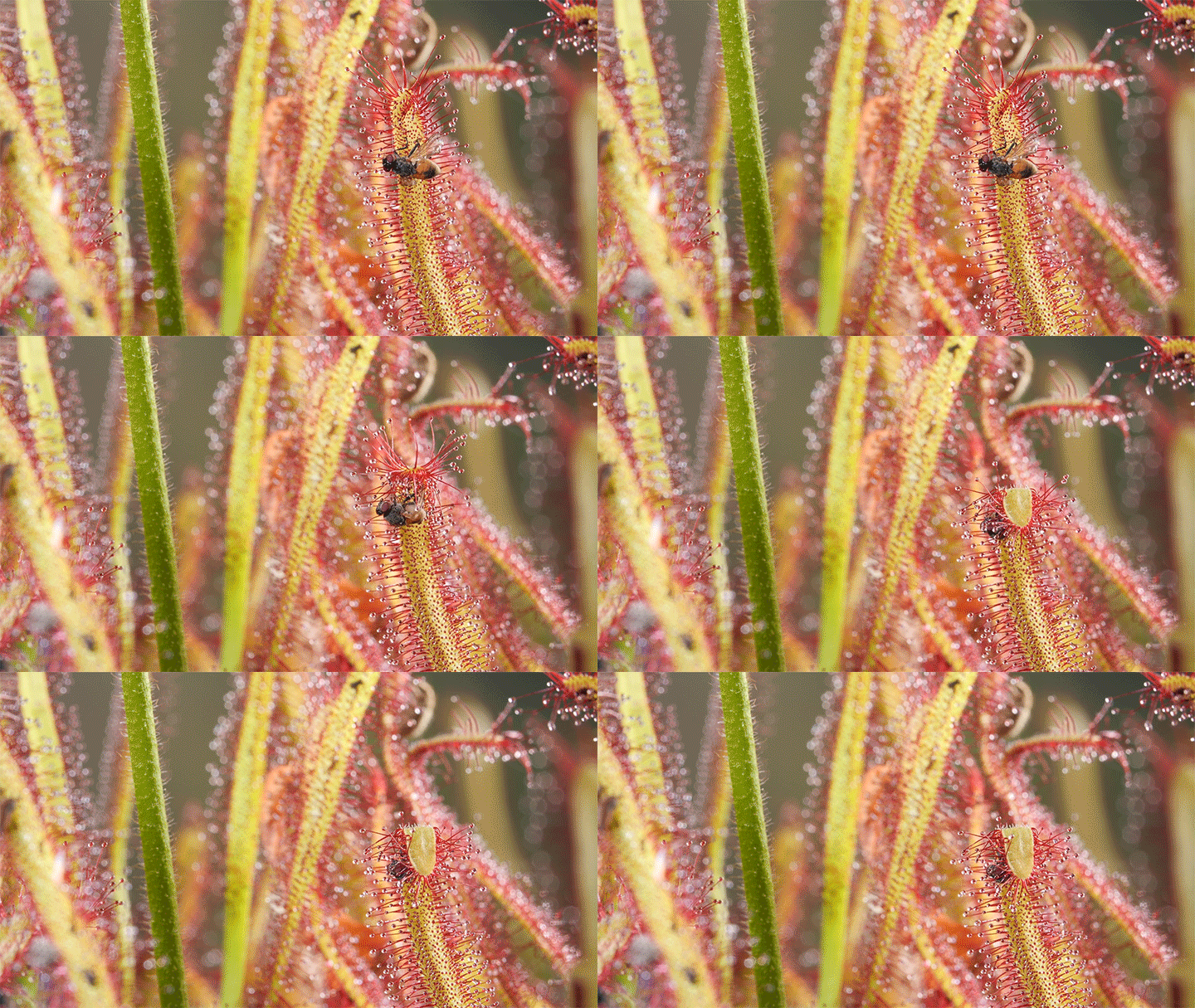
    In nutrient-poor soils, carnivorous plants like the cape sundew supplement their diets by eating insects. To entice their prey, the cape sundew secretes droplets of sugary water. But unwary insects who land to feed soon find themselves unable to pull away from this viscoelastic liquid. Complex molecules in the fluid grant it elasticity, so when insects pull against it, the liquid stretches and pulls back instead of breaking up. Other carnivorous plants, like the pitcher plant, use similar non-Newtonian tricks to trap insects. (Video and image credit: Deep Look)
  • Ferrofluid Snakes

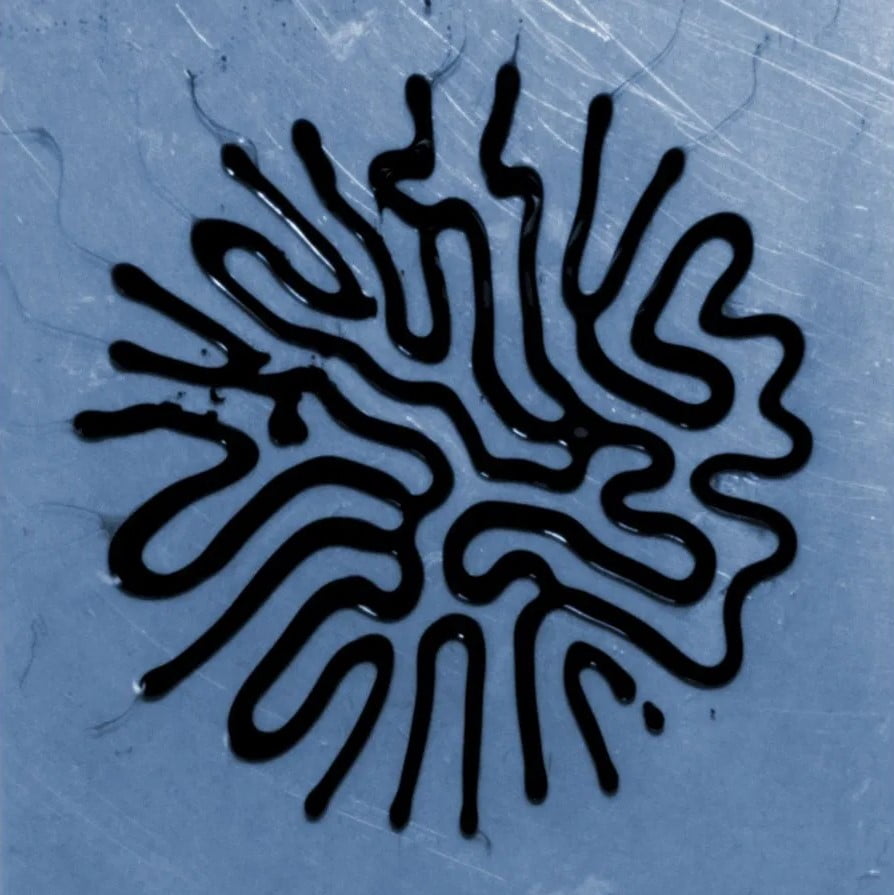
    Ferrofluid Snakes

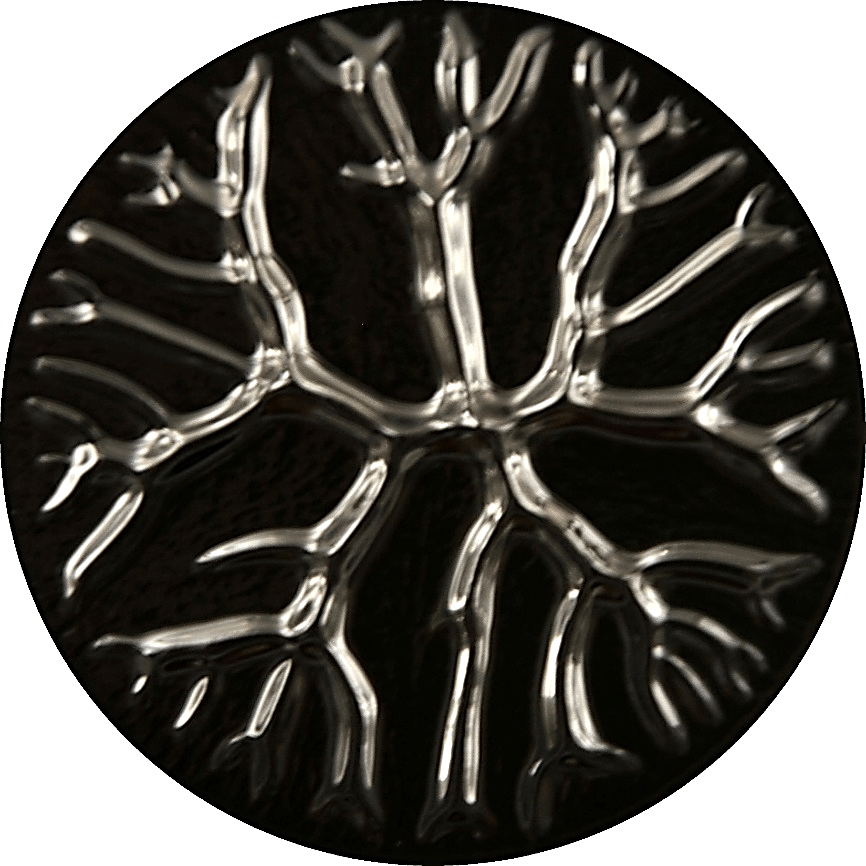
    We’re used to seeing ferrofluids — with their suspended iron nanoparticles — as spiky fluids when exposed to a magnetic field. But this is not always the case. Here, the ferrofluid is immersed in a thin liquid layer — window cleaner, in this case — and when a magnet is brought near, it forms snake-like, labyrinthine lines. (Image credit: M. Carter et al.)

  • Featured Video Play Icon

    Ultrasound in Medicine

    When you hear the term “ultrasound,” your brain likely jumps to grainy black and white images of unborn babies, but this technology has a lot more medical uses than just that! Ultrasound is used to image many parts of the body — earlier this year, I got to see my own heart in action through an echocardiogram, for example. But the technology has therapeutic uses as well. At higher energies, ultrasound is used to break up kidney stones (through cavitation), treat tremors, and alleviate some sources of pain. To learn more, check out Explore Sound’s page on biomedical acoustics. (Video and image credit: Acoustical Society of America)

  • Branching Gels

    Branching Gels

    If you sandwich a viscous fluid between two plates, then pull the plates apart, you’ll often get a complex branching pattern that forms as air pushes its way into the fluid. But the exact results depend strongly on what kind of viscous fluid you used. A new study looks specifically at what happens when that fluid is a yield-stress gel.

    Yield-stress fluids behave like a solid until a critical amount of force causes them to flow. Think about your toothpaste. When you take the cap off, the toothpaste stays put until you squeeze the tube enough to make it flow. The gels used in this experiment behave similarly.

    The researchers found that their gels required a critical energy input in order to branch and flow. If the energy applied in pulling the plates apart was too low, no branching occurred (Image 1). But beyond that critical energy, separating the plates created intricate branching patterns consistent with those seen in simpler, Newtonian fluids. (Image, research, and submission credit: T. Divoux et al.; via APS)

  • Event: Machine Learning in Mechanics

    Event: Machine Learning in Mechanics

    This Thursday, August 27th, the U.S. National Committee on Theoretical and Applied Mechanics is holding a special free webinar series on Machine Learning in Mechanics. Details for each talk and a link to register are available here. Note that the event is free but registration is necessary if you want to receive the Zoom link.

    Full disclosure: I am a member-at-large of the U.S. National Committee on Theoretical and Applied Mechanics.

  • Speeding Sedimentation

    Speeding Sedimentation

    Did you know that particles settle faster in an inclined container instead of a vertical one? This sedimentation phenomenon is known as the Boycott effect, after the researcher who first described it. Boycott noticed that red blood cells settled out of samples faster when the test tubes were inclined.

    The inclined walls give particles a much larger area to settle on. As the particles gather on the wall, it creates a buoyant, particle-free layer of fluid above. That fluid quickly rises to the top of the container, helping to push the sediment further toward the bottom. As you can see in the video below, the Boycott effect drastically reduces settling time. (Video and image credit: C. Kalelkar)

  • Featured Video Play Icon

    Crystalline Critters

    In 5th grade, I grew crystals by evaporating solutions of salt water from miniature pie tins. The results were white, boxy crystals whose size depended on how much salt I’d managed to dissolve into the water. But it turns out I could have gotten much cooler results if I’d evaporated my salt water a drop at a time on a hot superhydrophobic surface. That’s how these researchers formed the “crystal critters” shown in the video above.

    Initially, the evaporating salt water drop is what we would expect, but once enough water is gone to leave a shell of salt, the drop grows legs and lifts off the surface. From that point, all growth occurs from the surface up. Because the surface is heated, evaporation happens quickest at that point of contact, and the water that remains is drawn down the legs, providing more fluid for evaporation as well as additional salt to grow the crystal. (Video, image, and research credit: S. McBride et al.)

  • Featured Video Play Icon

    Slow Mo Espresso

    High-speed photography gives us an alternate glimpse of reality. Here it provides an all-new perspective on making espresso. Surface tension plays a starring role, first in pulling together the film that forms over the exit, then in creating the drips and drops that follow. The break-up of espresso into individual droplets is an example of the Plateau-Rayleigh instability, where surface tension drives any wobble in the falling jet to pinch off. For more slow-motion espresso, you can also check out this behind-the-scenes video. (Video and image credit: J. Hoffmann; submitted by Jerrod H.)

  • Fungal Fluid Dynamics

    Fungal Fluid Dynamics

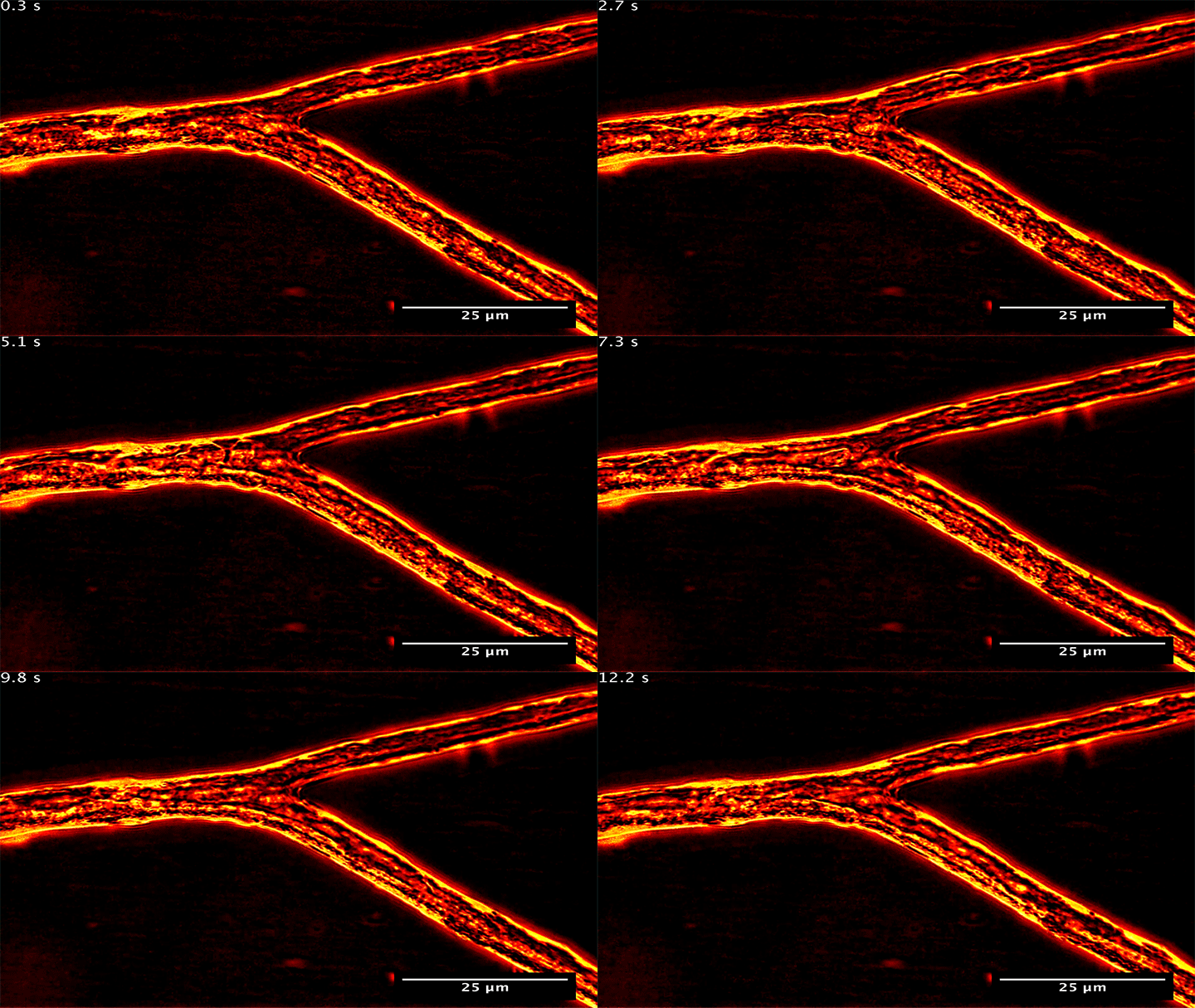
    Many plants gain the soil-bound nutrients they need by trading with symbiotic fungi. Underground, these fungi spread networks that gather and store phosphorus, which they then trade with host plants to get the carbon they need. Research shows that the fungi can be shrewd traders, moving phosphorus from nutrient-rich areas to poorer ones in order to maximize their trade gains.

    What you see above are snapshots of some of this transport within the fungal network. Notice how flow within the branching network changes direction. The fungus can force these flow reversals in a matter of seconds, allowing it to move nutrients to wherever the best returns are found. (Image and research credit: M. Whiteside et al.)

  • Sediment and Coral

    Sediment and Coral

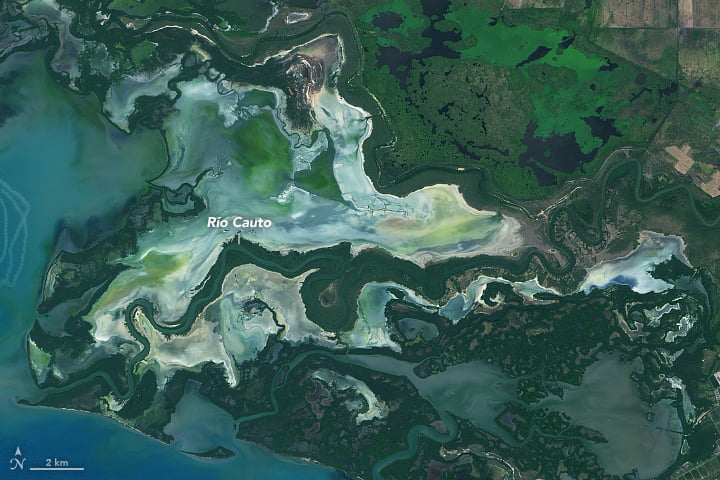
    As rivers wash sediment toward the sea, they carve elaborate deltas like that of the Rio Cauto in Cuba. Over time these sediments build up marshes, swamps, lagoons, and other wetlands that provide critical habitat and flood control. Sediment also washes into the bay, where it interacts with the coral reefs (light green lines on the lower left) and the species that live there. (Image credit: L. Dauphin/USGS; via NASA Earth Observatory)

    Satellite image of Cuba's Gulf of Guacanayabo. The green curves in the lower left are the upper portions of coral reefs in the bay.