Month: March 2020

  • Replacing Injections With Pills

    Replacing Injections With Pills

    In medicine, many medications contain molecules too large to be easily absorbed through the intestinal wall, so these so-called biologics — like the insulin administered to diabetics — are injected into the body. Researchers are studying ways that such injections could eventually be replaced with pills, but there are plenty of challenges involved.

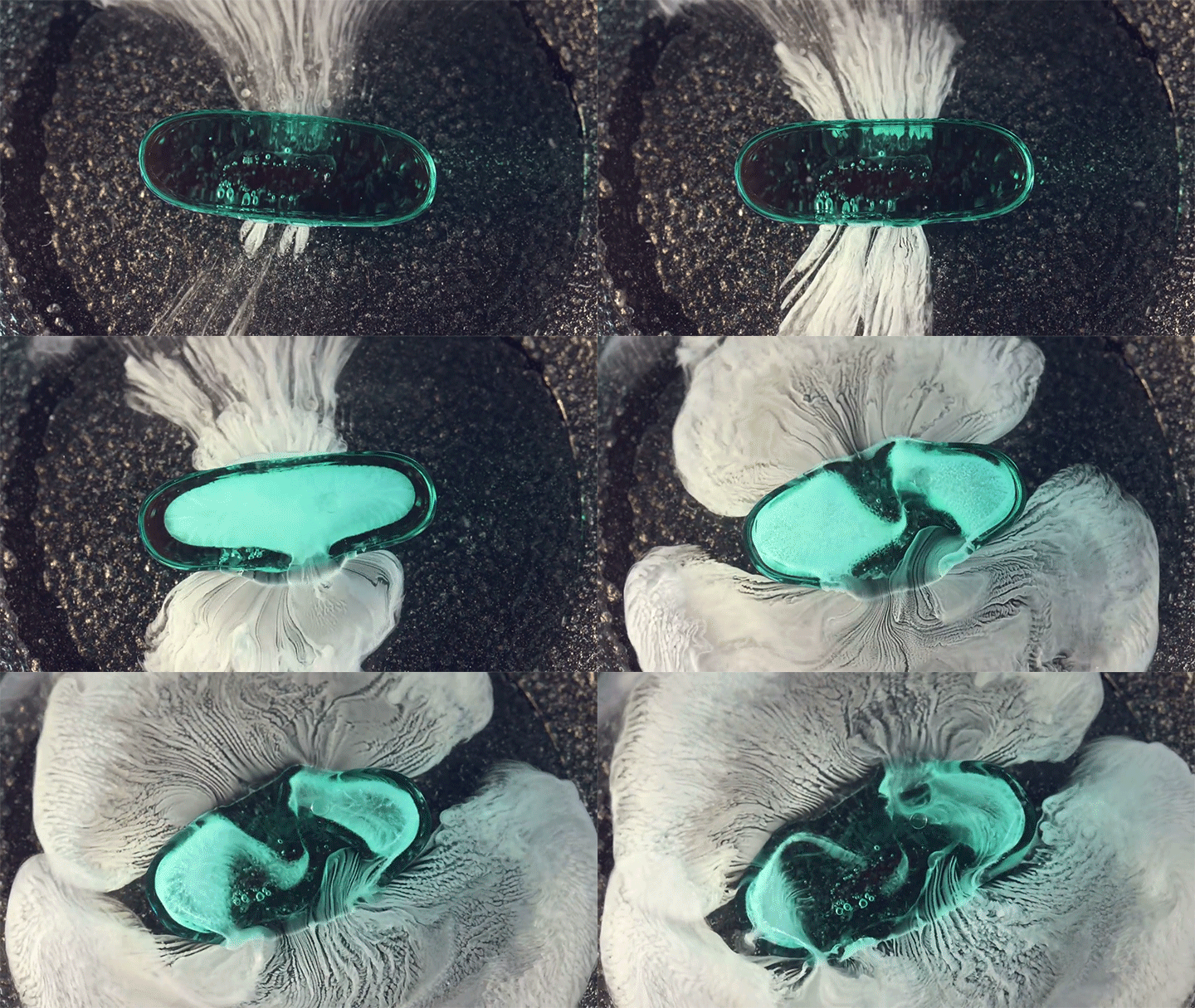
    Some substances, known as transient permeability enhancers, allow the intestines to absorb larger molecules, but they work for only tens of minutes, which means researchers must understand how and when to administer them relative to the medication they help patients absorb. To do so, researchers are building computational fluid dynamics models of the human digestive system so that they can better understand how and when different kinds of pills break down in the body. (Image credit: Macro Room, source; via CU Engineering; submitted by Jenny B.)

  • Featured Video Play Icon

    “Dendrite Fractals”

    In this short film from the Chemical Bouillon team, dark ink drops spread in dendritic fractal patterns after being deposited on an unknown transparent liquid. Although the patterns look similar to those of the Saffman-Taylor instability, I suspect what we see here is actually driven by surface tension and not viscosity.

    The authors describe the ink they used as a “special old” “tree ink,” which — putting on my fountain pen aficionado hat — probably means some variety of iron gall ink. These inks draw on chemicals extracted from trees and other plants to create a permanent, waterproof ink. They tend to be highly acidic, which could play a role in the pattern formation seen here. (Video and image credit: Chemical Bouillon)

  • Dunes Avoid Collisions

    Dunes Avoid Collisions

    The speed at which a dune migrates depends on its size; smaller dunes move faster than larger ones. That speed differential implies that small dunes should frequently collide into and merge with larger dunes, eventually forming one giant dune rather than a field of smaller separate ones. But that’s not what we observe in nature.

    To figure out why dunes aren’t colliding that often, researchers built a dune field of their own in the form of a rotating water tank. Inside the tank, their two artificial dunes can chase one another indefinitely while the researchers observe their interactions. What they found is that the dunes “communicate” with one another through the flow.

    As flow moves over the upstream dune, it generates turbulence in its wake, which the downstream dune then encounters. All that extra turbulence affects how sediment is picked up and transported for the downstream dune, ultimately changing its migration speed. For two dunes of initially equal size and close spacing, these interactions push the downstream dune further away until the separation between the dunes is large enough that they both migrate at the same speed. Even between dunes of unequal sizes, the researchers found that these repulsive interactions force the dunes away from collision and into migration at the same speed. (Image credit: dune field – G. Montani, others – K. Bacik et al.; research credit: K. Bacik et al.; via Cosmos; submitted by Kam-Yung Soh)

  • Featured Video Play Icon

    Sunlight Is Older Than You Think

    Joe Hanson over at “It’s Okay to Be Smart” has a great video on the random walk photons have to make to escape the core of the sun and other stars. Because the high-energy photons born in the star’s core have to bounce their way out rather than flying in a straight line, those photons can spend thousands of years escaping the sun. After that, the eight-and-a-half minute trip to Earth is nothing.

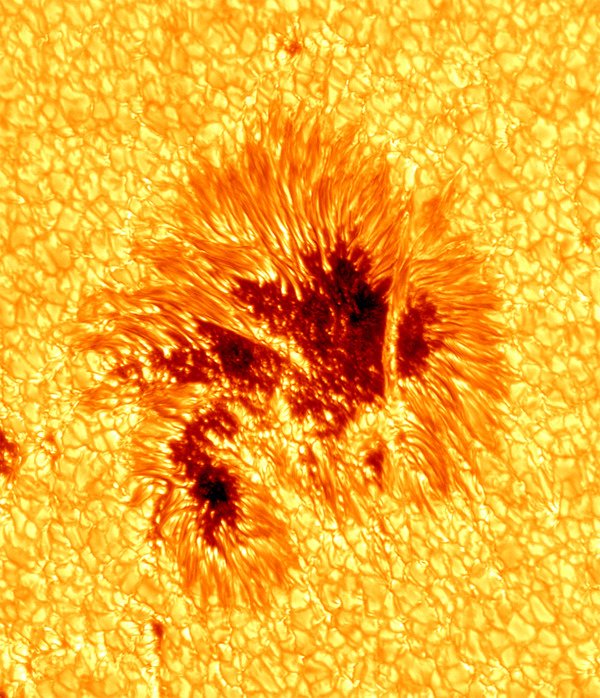
    But there’s a key element missing in this explanation: convection! That radiative random walk photons do doesn’t last all the way from the core of the sun to its surface. From a depth of about 200,000 km onward, the dominant mode of transport in the sun is convection, actual fluid motion that carries heat and light much faster than simple molecular diffusion, or Brownian motion, does. That’s why the surface of the sun shines with convection cells similar to the ones you’ll see in your skillet when heating a layer of oil.

    Fluid motion beyond molecular diffusion is also a big part of the other flows Joe describes in the video. If you had to wait on Brownian motion in order to smell your morning coffee, it would be cold long before you knew it was there! (Video and image credit: It’s Okay to Be Smart; sun surface image credit: Big Bear Solar Observatory/NJIT)

  • Kicking Droplets

    Kicking Droplets

    Moving the surface a droplet sits on creates some interesting dynamics, especially if the surface is hydrophobic. That’s what we see here with these droplets launched off an impulsively-moved plate.

    On the left, the drop has some limited contact with the plate and it takes time for the droplet to completely detach. When accelerated, the droplet first flattens into a pancake, the rim of which quickly leaves the plate. The center of the droplet is slower to detach, stretching the drop into a vase-like shape. When the drop does finally lose contact, it creates a fast-moving jet that shoots upward at several meters per second!

    In contrast the image on the left shows a levitating Leidenfrost droplet. Since this drop has no physical contact with the plate, the kick makes it leave the surface all at once, launching a pancake-like drop that quickly forms unstable lobes. (Image and research credit: M. Coux et al.)

  • Listening to a Bubble’s Pop

    Listening to a Bubble’s Pop

    Sound is an important aspect of many flows, from the scream of a rocket engine to the hum of electrical wires vibrating in the wind. Critically, those sounds carry important information about the flow. A new study extends these acoustic diagnostics to the popping of soap bubbles.

    When a hole opens in a soap bubble, it throws the surface-tension-driven capillary forces of the bubble into disarray. The rim around the hole retracts, pushing fluid away from the expanding hole. At the same time, air is pushed out of the collapsing bubble. Using microphone arrays, the researchers found they could measure and distinguish sound from both sources — the escaping air and the expanding hole.

    From the sound, they developed a model that predicts the rupture location, bubble thickness profile, and other properties of the bubble. They confirmed the model’s results by comparing with high-speed photography. The authors hope their new acoustic technique will shed light on bubble bursting events that are hard to observe visually, like the bubbling of magma. (Image and research credit: A. Bussonnière et al.; via Science News; submitted by Kam-Yung Soh)

  • Featured Video Play Icon

    The Cricket’s Chirp

    Growing up, my summer nights often featured a chorus of crickets and bull frogs. Even now, the sound of those chirps reminds me of home. So how do crickets make their calls? As this video shows, it’s a matter of scraping the hard edge of one wing along a tiny series of spines, similar to the teeth of a comb, that sit on the other wing.

    How fast the cricket’s wings move affects how frequently the chirps are heard. Being cold-blooded, the insects’ speed is affected by the external temperature, which is why you can count cricket chirps to estimate the temperature. Essentially, the chemical reactions necessary to regulate wing movement are temperature-dependent, so colder crickets produce slower chirps. (Video and image credit: Deep Look)

  • Frozen Wavelets

    Frozen Wavelets

    Photographer Eric Gross captured these surreal alpine landscapes in Colorado’s Rocky Mountains. Although the lake’s surface appears to have frozen waves, the prevailing theory is that these mounds and divots occur when snowdrifts form atop the lake, melt and refreeze. Over multiple melting and freezing cycles, the lake builds up with what appear to be wind-driven waves frozen in time. (Image credit: E. Gross; via Colossal)

  • Spin Cycle

    Spin Cycle

    Rotational motion is a great way to break up liquids, as anyone who’s watched a dog shake itself dry can attest. That same centrifugal force is what allows this rotary atomizer to break liquids into droplets. Relative to the photos above, the atomizer spins in a counter-clockwise direction. This motion stretches the fluid flowing off it into skinny, equally-spaced ligaments, which eventually break down into droplets.

    Just how and when that break-up occurs depends on the fluid, as well as the characteristics of the spin. For Newtonian fluids like silicone oil — shown in the first two pictures — the break-up is driven by surface tension and happens relatively quickly. But with a viscoelastic fluid — shown in the last image — the elasticity of polymers in the fluid allow it to resist break-up for much longer. Instead, the ligaments form the beads-on-a-string instability. See more flows in action in the video below. (Video, image, and research credit: B. Keshavarz et al., video)

  • Featured Video Play Icon

    Colorful Dissipation

    Colorful eddies swirl in this short video from photographer Karl Gaff. Formed near the boundary at the bottom of the frame, these eddies act to dissipate some of the energy in the flow. Structures like these are key in turbulent flows, where energy must pass from large eddies to smaller and smaller ones until they reach a size where viscosity can extinguish them. (Video, image, and submission credit: K. Gaff)

    P.S. – Today’s post is FYFD’s 2,500th! Crazy, right? That means we have a pretty enormous archive. Want to explore? Click here for a random post.