Year: 2019

  • Finding New States of Matter

    Finding New States of Matter

    As children we’re taught that there are three basic states of matter: solids, liquids, and gases. The latter two are known scientifically as fluids. But the world doesn’t divide quite so simply into those three categories, and scientists have since named several other states of matter, including plasmassuperfluids, and Bose-Einstein condensates.  Many of these types of matter only exist under extreme temperatures and/or pressures, which makes them difficult to observe. Scientists have instead turned to numerical simulation to discover and study these exotic materials.

    One of the latest discoveries among these bizarre materials is a form of potassium that simultaneously displays properties of a solid and a liquid. Inside this so-called chain-melted potassium, there’s a complex crystalline lattice containing smaller chains of atoms. One author described the material thus: “ It would be like holding a sponge filled with water that starts dripping out, except the sponge is also made of water.” That certainly boggles my mind! (Image credit: Turtle Rock Scientific; research credit: V. Robinson et al.; via NatGeo; submitted by Emily R.)

  • Featured Video Play Icon

    Coke and Butane Rockets

    Rocket science has a reputation for being an incredibly difficult subject. But while there’s complexity in the execution, the concept behind rockets is pretty simple: throw mass out the back really fast and you’ll move forward. Whether you’re talking about a Saturn V or these Coke-and-butane-powered bottles, the basic principle is the same.

    These rockets get their kick mostly from the added butane, which has a very low boiling point. When the bottle is flipped, the lighter butane is forced to rise through the Coke. With a large surface area of liquid butane exposed to the warmer Coke, the butane becomes gaseous. That sudden increase in volume forces a liquid-Coke-and-gaseous-butane mixture out of the bottle, which has a helpful nozzle shape to further increase the propellant’s speed. Once the phase change is underway, the rocket quickly takes off! (Image and video credit: The Slow Mo Guys)

  • Making Drops Stick

    Making Drops Stick

    As you may have noticed when washing vegetables, many plants have superhydrophobic leaves. Water just beads up on their surface and slides right off. This is a useful feature for plants that want to direct that water toward their roots, but it’s a frustration in agriculture, where that superhydrophobicity means extra spraying of pesticides in order to get enough to stick to the plant.

    But that may not be the case for much longer. Researchers have found that adding a little polymer to water droplets (right) can suppress their ability to rebound (left) from superhydrophobic surfaces. Above a critical concentration, the high shear rate of the droplet as it tries to detach activates the viscoelastic properties of the polymer. That viscoelasticity suppresses the rebound, keeping the droplet attached. That’s good news for everyone, since it means less spraying is needed to protect crops. (Image and research credit: P. Dhar et al.)

  • Whiskey Stains

    Whiskey Stains

    Complex fluids leave behind fascinating stains after they evaporate. We’ve seen previously how coffee forms rings and whisky forms more complicated stains as surface tension changes during evaporation drive particles throughout the droplet. Now researchers are considering the differences between traditional Scottish whisky, which ages in re-used, uncharred barrels, and American whiskeys like bourbon, which are required to age in new, charred white oak barrels.

    When diluted, the American whiskeys form web-like patterns – seen above – that vary from brand to brand, like a fingerprint. The charring of the barrels allows American whiskeys to pick up more water-insoluble molecules compared to whisky aged in uncharred barrels. Since the webbed patterns form in American whiskey but not Scotch whisky, it’s likely those molecules play an important role in the evaporation dynamics and subsequent staining. (Image credit: S. Williams et al.; research credit: S. Williams et al.; via APS Physics; submitted by Kam-Yung Soh)

  • Featured Video Play Icon

    “Mocean”

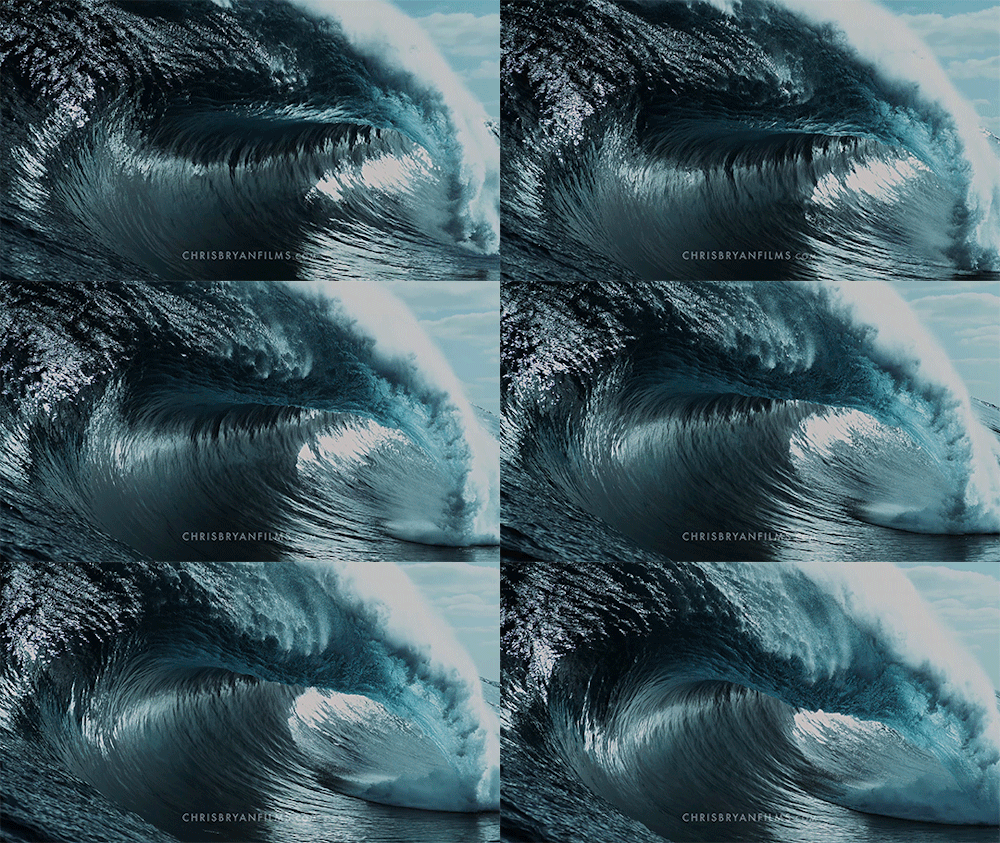
    Ocean waves are endlessly fascinating to watch. In “Mocean,” cinematographer Chris Bryan captures them in ways few ever see, thanks to his high-speed camera. Honestly, this film is so gorgeous that I don’t want to distract you with the science, so just go watch!

    All done? Pretty wonderful, right? There’s nothing quite like seeing those holes break and expand through sheets of water, tearing what looked solid into a spray of droplets that bleed salt into the atmosphere. Or how about those rib vortices underneath the waves? Or the cloud-like turbulence of the waves breaking overhead? How fortunate we are to see and capture and share such beauty! (Video and image credit: C. Bryan; via RedShark; submitted by Michael F.)

  • Leidenfrost Stars

    Leidenfrost Stars

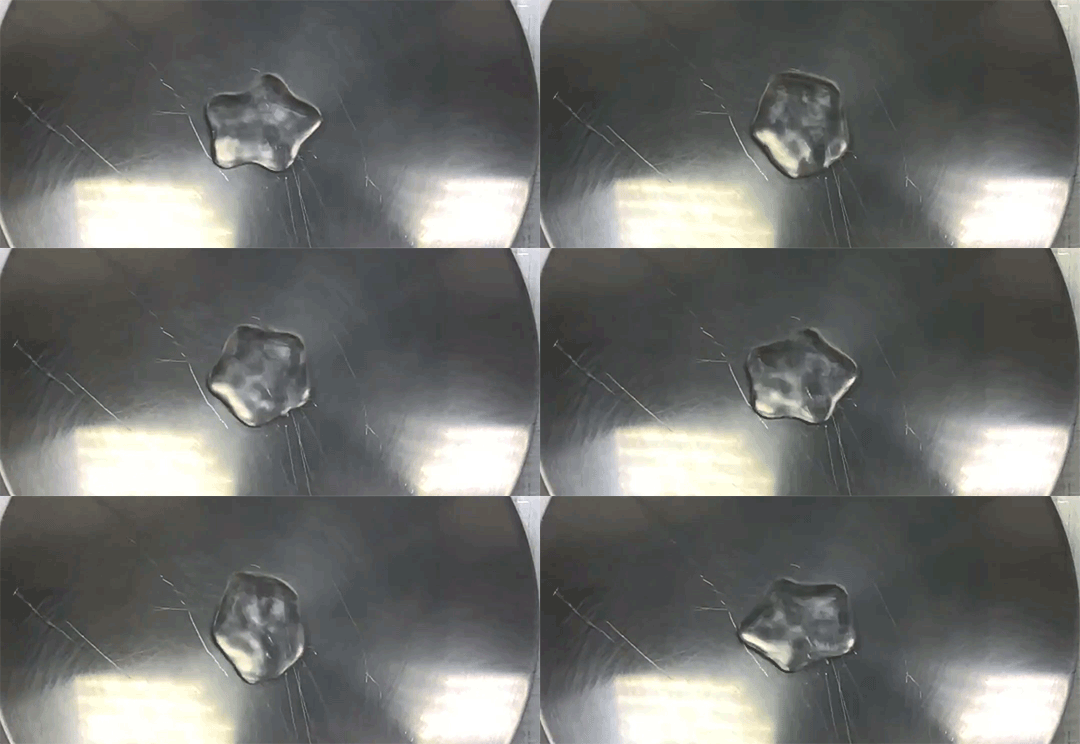
    Atop a very hot surface, liquids can instantly vaporize, leaving a drop levitating on a layer of its own vapor. These Leidenfrost droplets demonstrate all kinds of interesting behaviors, including self-propulsionexplosion, and star-shaped oscillations, like those above. The oscillation is driven by feedback between the drop and its vapor layer

    Interestingly, the drops are capable of sustaining more than one mode of oscillation at once, as seen above. The obvious mode (m=5) corresponds to the 5 star-like points pushing out on the drop. But notice that the drop is also stretching into an oval shape that moves up and down, back and forth. This is the second mode (m=2) present. It moves slower than the m=5 mode, completing a cycle only once for every four cycles the other has. (Image and research credit: J. Bergen et al.)

  • Featured Video Play Icon

    Driving Instabilities with a Twist

    Imagine that you want to study how two fluids mix when a lighter fluid is pushed into a denser one. Conceptually, it’s a straightforward situation. It would be like having a layer of oil under a layer of water and watching what happens. But how do you do that experimentally? Oil won’t naturally stay under water. If you flip the container over to start the experiment, you’ve added a bunch of extra motion from the rotation. And if you use a barrier to separate the two layers and then pull it out, you’ve added extra shear where they meet.

    To deal with challenges like these, researchers at Lehigh University spent five years designing and building the rotating wheel apparatus you see in the video above. Instead of relying on gravity to force the lighter fluid into a denser one, this set-up uses centrifugal force. The test fluids start out on the loading wheel, spinning in their naturally stable configuration. Then once both sides are rotating at the desired speed, the track flips, transferring the experiment onto the other wheel, which rotates in the opposite sense. This gives the fluids a sudden change in the direction of the centrifugal force and, once the apparatus completes shake-down, should give us new insight into the sort of mixing seen in fusion. (Video credit: Lehigh University; see also Turbulent Flow Design Group)

  • Featured Video Play Icon

    Modeling Oobleck

    Oobleck – that peculiarly behaved mixture of cornstarch and water – continues to be a favorite of children and researchers both. Oobleck flows like a liquid when deformed slowly, but try to move it quickly and it will seize up like a solid. This sudden change depends on the tiny particles of cornstarch suspended in the liquid. When they’re given time, electrostatic forces between the particles help them repel one another and keep the liquid flowing. But under sudden impacts, the particles get jammed together and the friction between neighboring grains makes the viscosity of the fluid increase by orders of magnitude. 

    Researchers are now able to model these particle interactions numerically, which will help them predict how oobleck and similar substances will behave in applications like body armor or pothole repair. (Video credit: MIT; via MIT News; research credit: A. Baumgarten and K. Kamrin)

  • Featured Video Play Icon

    Drops That Dig

    On extremely hot surfaces, droplets will skitter on a layer of their own vapor, thanks to the Leidenfrost effect. This keeps the liquid insulated from contact with the hot surface. But what if the surface isn’t solid?

    That situation is what we see above. Instead of soaking into a granular material like a room temperature droplet (left), a drop falling onto a very hot bed of grains digs a hole! As with a typical drop on a super hot surface, the heat vaporizes part of the droplet. As the vapor escapes, it carries sand with it, allowing the boiling drop to burrow its way into the material. As the temperature difference between the sand and droplet changes, the digging slows. Eventually, the drop comes to a rest and boils away. (Video and image credit: J. Zou et al.)

  • Pollock Avoided Coiling

    Pollock Avoided Coiling

    Streaks of black and gray in the Jackson Pollack painting the researchers studied.

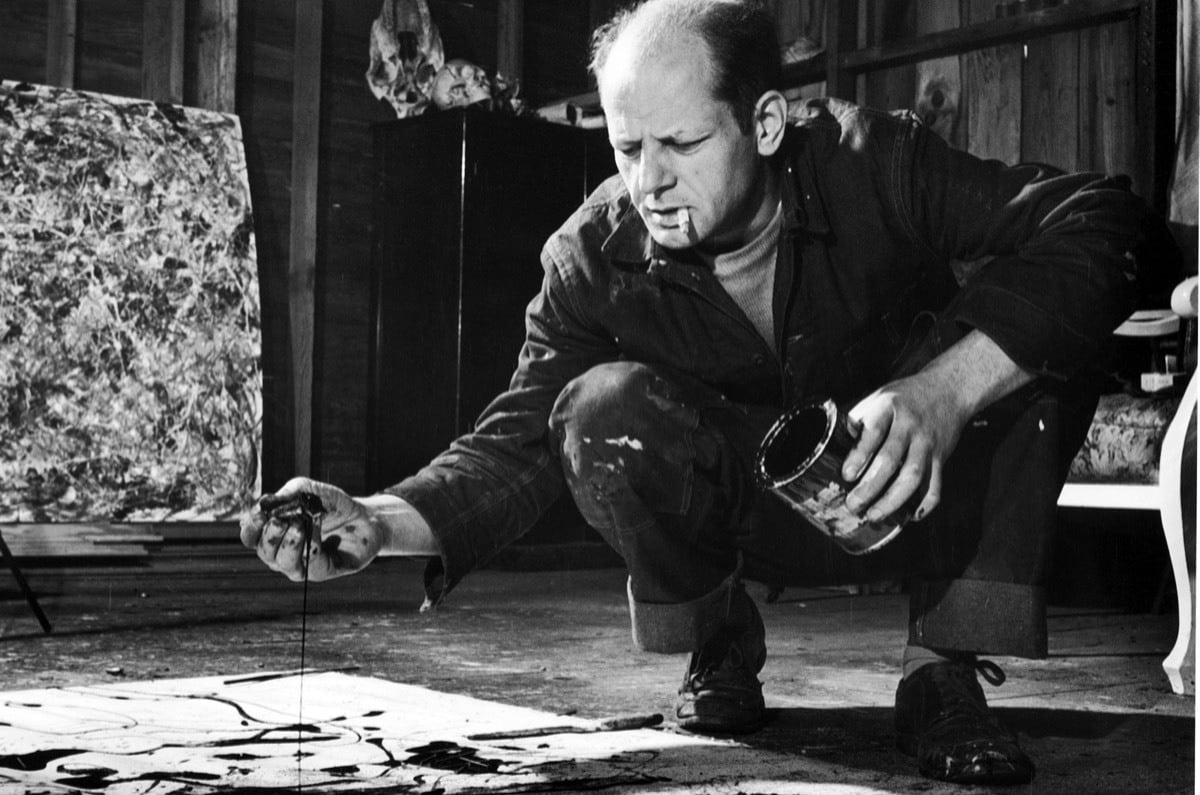
    Artists are often empirical masters of fluid dynamics, as they must be to achieve the effects they want. Jackson Pollock was particularly known for his so-called dripping technique, in which he dropped filaments of paint from brushes, cans, and even syringes as he moved around a horizontal canvas. (Scientifically speaking, this wasn’t really dripping since the paint wasn’t breaking up into droplets for the most part, but that’s another story.)

    What Pollock was doing, fluid dynamically speaking, is the subject of a new study. Researchers analyzed historical footage of Pollock painting to measure the typical heights from which he dropped paint and the speed at which he moved. Then they built their own apparatus to mimic the painting style with modern paints and study the flow regime Pollock’s technique falls into. 

    Since much of the paint falls in a steady stream, like syrup falling onto pancakes, the researchers wondered whether the paint was likely to coil the way other viscous fluids do. What they found, however, is that Pollock’s choice of height and speed when applying paint seems deliberately designed to avoid the coiling instability. That fact suggests that art historians might identify forged paintings in part from the presence of too much coiling among the paint filaments. (Image credits: photo – M. Holmes/LIFE, painting – J. Pollock; research credit: B. Palacios et al; via Ars Technica; submitted by Kam-Yung Soh)