Year: 2019

  • Featured Video Play Icon

    Streaming Fire

    I’m just going to start this one with a blanket statement: DO NOT TRY THIS. Instead, enjoy the fact that the Internet enables us to enjoy the sight of burning gasoline in slow mo without any danger to ourselves.

    In this video, Gav and Dan capture a burning bucket of gasoline as it’s thrown against glass. One thing this stunt really highlights is that it’s not the liquid gasoline that burns, it’s the vapor. However, since gasoline is volatile – in other words, it evaporates easily – the fire is quick to spread, especially as the toss atomizes droplets near the edge of the fluid. That’s why you see distinct streaks near the edge of the spreading flame and a non-burning liquid in the center. (Image and video credit: The Slow Mo Guys)

    Flaming gasoline flies toward the viewer and spreads against glass in slow motion
  • Trails from a Delta Wing

    Trails from a Delta Wing

    Top-down view of green and red dyes streaming off a delta wing

    Rhodamine (red) and fluorescein (green) dyes highlight the complex flows around a delta wing. To visualize the flow, researchers painted the apex of the delta wing with rhodamine, which gets drawn into the core of the wing’s leading edge vortex. The green fluorescein dye was added to the wing’s trailing edge, where it gets pulled into the secondary structure of the vortices. A laser illuminates the flow, making even the most delicate wisps of dye shine. As the wake behind the wing develops, the dyes reveal growing instabilities along the vortices. Given time and space, these instabilities will grow large enough to destroy any order in the wake, leaving behind turbulence. (Image and research credit: S. Morris and C. Williamson; see also poster)

  • Featured Video Play Icon

    Inside Tears of Wine

    Pour wine or liquor into a glass, give it swirl, and you can watch as droplets form and dance on the walls. This well-known phenomena, often called “tears” or “legs” in wine, results from an interplay of surface tension and evaporation. Despite its common occurrence, researchers are still discovering interesting subtleties in the physics, as seen in new research on the subject.  

    Dianna walks you through the phenomenon step-by-step in this video. The key piece of physics is the Marangoni effect, the tendency of regions with high surface tension to pull flow from areas with lower surface tension. In the wine glass, evaporation creates this surface tension gradient by removing alcohol more quickly from the meniscus than the bulk. That sets up the gradient that lets the wine climb the glass. By preventing or delaying that evaporation, we can see other neat effects, too, like shock fronts that travel through the film. (Video credit: Physics Girl; research credit: Y. Dukler et al.)

  • Shearing Grains

    Shearing Grains

    Granular materials, like beads and sand, demonstrate both solid and fluid-like behaviors, which makes them difficult to study. Traditionally, one method for studying how fluids respond to deformation places the fluid in a ring-shaped cell with a rotating outer wall. That creates a uniform shear, as indicated by the red arrows above. For granular materials, though, this classic set-up usually breaks the grains up into two separate regions, one that behaves solidly and the other that behaves fluidly.

    To get past that issue and study grains under truly uniform shear, researchers built a new version of the classic apparatus. In this new ring-shaped cell, the outer wall moves but so do independent concentric rings beneath the grains. This allows researchers to see how grains move under uniform shear (left) and what kinds of forces develop between jammed grains in the system (right). (Image and research credit: Y. Zhao et al.; via APS Physics; submitted by Kam-Yung Soh)

  • Featured Video Play Icon

    “Silk”

    With the right lighting and eye, billowing streaks of dye and paint can become the ethereal wisps of silk. Artist Susi Sie explores this dichotomy in “Silk,” a short, fluidic film made entirely in macro. Sometimes there’s astounding beauty in the complexity of a fluid filmed up close. (Video and image credit: S. Sie)

  • Seeing Past the Surface

    Seeing Past the Surface

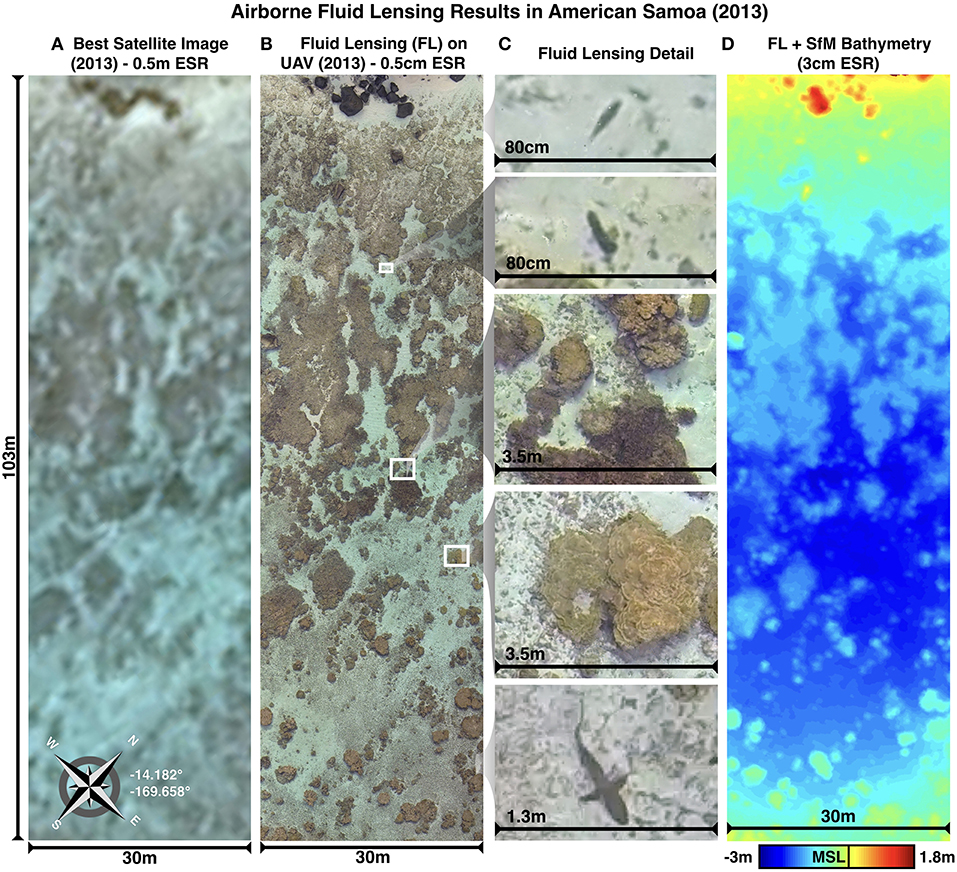
    Satellite imagery has revolutionized remote sensing and our ability to observe the world around us. But peering past the surface of water has always been next to impossible. We might be able to see the extent of a coral reef from a photo, but thanks to the interplay of light and water, the details are too blurry to identify what species we’re looking at.

    To solve this issue, researchers decided to work backwards, taking everything we understand about the physics of light – refraction, reflections, and so on – and using it to remove the distortions. The result is NASA’s FluidCam, an instrument capable of of taking a video of shallow waters less than 10 m deep, processing it, and producing images with sub-centimeter accuracy showing what lies beneath. Tests in American Samoa revealed details fine enough that scientists were able to identify multiple coral species as well as many of the species of fish inhabiting the reef. 

    With coral reefs changing quickly, this technology may be invaluable for monitoring coral health without actively disrupting these delicate systems. (Image credit: N. Usry; research credit: V. Chirayath and A. Li; via OceanBites; submitted by Kam-Yung Soh

  • Whale Feeding

    Whale Feeding

    Whether in groups or as individuals, humpback whales are canny hunters. They herd prey together by encircling them and releasing bubbles that form a “net” that bars escape. Then, the whales lunge through the center with open mouths, gathering prey. Scientists have long wondered whether humpbacks’ unusually long pectoral fins played any role in their hunting. New drone observations of whales feeding (see video below) are beginning to provide some hints.

    The scientific teams observed multiple individual whales feeding under the same circumstances and found that the whales used their fins quite differently. Both used them as additional barriers to prevent prey from escaping, but one whale favored a horizontal fin position that created currents that helped sweep prey into its mouth. The other whale used a more vertical fin position that, while hydrodynamically unfavorable, exposed its bright underside, which seemed to startle prey into fleeing into its darker, more inviting mouth. (Image credit: K. Kosma; video credit: M. Kosma; research credit: M. Kosma et al.; via Science)

  • Fiery Streaklines

    Fiery Streaklines

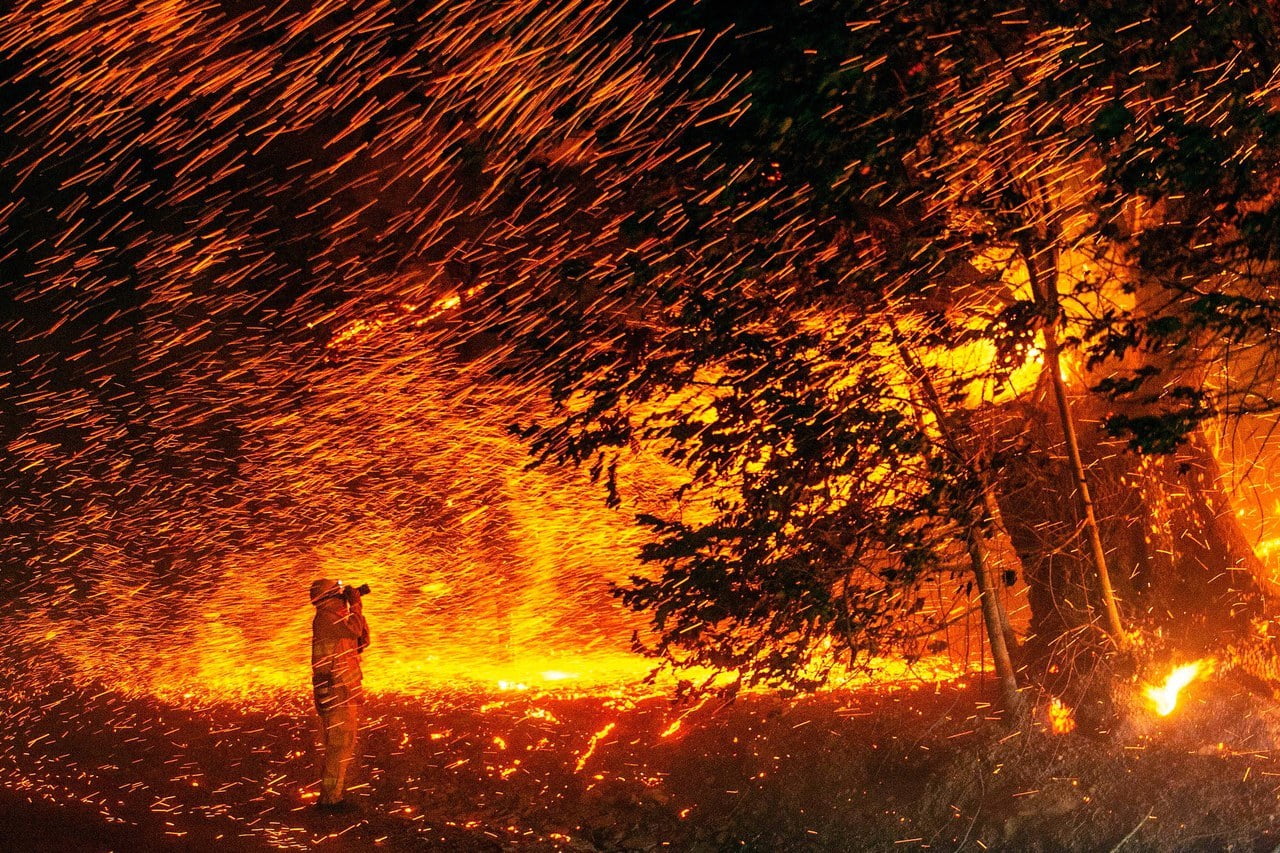
    Embers fly through the Kincade wildfire leaving streaks of light that reveal the strong winds helping drive the fire. This unintentional flow visualization mirrors techniques used by researchers to understand how flows are moving. The shutter of the camera remains open for a fixed time, so the length of each streak tells us about the speed of the flow. Longer streaks occur where embers moved faster. 

    Here we see the longest streaks in the upper left side of the image, which tells us that the wind was moving faster there than it did at lower heights, like near the photographer in the picture. That’s in keeping with what we would expect. In general, winds move faster above the ground than they do near the surface. That speed difference is one of the reasons wildfires are so difficult to contain; a single ember caught by high winds is easily carried to unburnt areas, allowing the fire to spread more quickly than if it had to burn along the ground. (Image credit: J. Edelson/Getty Images; via Wired)

  • Freezing Bubbles

    Freezing Bubbles

    Scientists have observed distinctive differences in the way soap bubbles freeze depending on their environment. If a bubble is surrounded by room temperature air but placed on a cold surface (top), it freezes from the bottom up, with a clear freeze front that slowly creeps upward.

    In contrast, bubbles in an isothermal environment – one where it’s equally cold everywhere – freeze with a snow-globe-like effect of ice crystals (bottom). This freezing mode is actually triggered by a Marangoni flow. As the thin bottom layer of the soap bubble begins to freeze, it releases latent heat. That local heating changes the surface tension enough to generate an upward flow. You can see the plumes form right as the bubble touches the surface. Those plumes lift up tiny ice crystals, which continue to grow, ultimately forming the snowy crystals we see take over the surface. (Image and research credit: S. Ahmadi et al.; submitted by Kam-Yung Soh)

  • Turning a Corner in Microfluidics

    Turning a Corner in Microfluidics

    Over the past couple decades, microfluidic devices have become a staple of medical and biological diagnostics and analysis. Tests that once required large and specialized equipment can now be completed closer to a patient, using only a few drops of sample fluid. Running multiple tests on a single chip can become difficult, though, since flow through the device tends to dissolve and mix the dried reagents used for tests. But a new method cleverly uses fluidic forces to keep reagents separated without the need for complicated microfluidic structures.

    The basic concept is outlined in the illustration above. You’re looking down on a microfluidic channel that’s long and very thin. A shallow groove down the middle serves as a barrier by pinning the contact line of the incoming fluid. So when the sample fluid flows in through the inlet on the left, it will only fill the top half of the cell. When it reaches the far right side, it turns the corner and flows to the left, encountering the first of the dried reagents it must dissolve for the device’s tests. The fluid will fill the lower channel quickly and then come to rest while the reagents dissolve. 

    With both sides of the channel full of liquid, the shallow barrier can no longer hold, and the fluid will take up the full width of the channel, with two well-dispersed – but separated – regions of reagents. Once that’s happened, a valve – represented by the pale blue line near the right side of the illustration – releases the fluid into the next section of the chip, allowing the analysis to proceed. (Image credit: Nature; research credit: O. Gökçe et al.; submitted by Kam-Yung Soh)