Year: 2019

  • Capillary Action and Sand Castles

    Capillary Action and Sand Castles

    Capillary action – or capillarity – is the ability of liquids to flow through narrow constrictions. It results from intermolecular forces between fluids and solids. It’s a combination of surface tension – which creates cohesion within the liquid – and adhesion, which allows the liquid and solid to hold to one another. Together, these forces propel the liquid to flow through narrow gaps.

    In the video below, a saturated mixture of sand and water is poured into a mold on a bed of dry sand. When left to settle, much of the water flows from the mold into the dry sand bed through capillary action. When the mold is removed (top), the sand holds its shape, something it can’t do without a porous bed to soak in the excess liquid. (Image and video credit: amàco et al.)

  • Featured Video Play Icon

    Active Foam

    Geometrically, biological tissues and two-dimensional layers of foam share a lot of similarities. To try and understand how active changes in one cell affect neighbors, researchers are studying how foams shift when air is injected (below) at one or more sites. When a foam cell expands, it forces topological changes in neighboring cells, which researchers built an algorithm to track in real-time. 

    With some processing, they can actually visualize the radially-expanding waves of strain that pass through the foam (bottom image). This allows them to visualize the effects and interaction of multiple injection sites at once, hopefully helping unlock the mechanics behind both the foam’s shifts and those that occur in tissues. (Image and video credit: L. Kroo and M. Prakash)

  • Bubble Break-Up

    Bubble Break-Up

    When bubbles burst, they spray a myriad of tiny droplets into the air. In general, the older a bubble gets, the thinner it is, thanks to gravity draining its liquid away. When older bubbles burst, they create tinier and more numerous droplets (upper right) compared to a younger bubble (upper left). But there are more forces than just gravity at play.

    Bubbles also undergo evaporation – most effectively at the apex. Evaporation cools the cap of the bubble, increasing its surface tension and triggering a Marangoni flow that helps restore fluid to the bubble film. This stabilizes an aging bubble. 

    Contamination plays a role as well. The bright spots in the bottom image reveal bacteria in the bubble’s cap. Compared to a clean bubble, these contaminated ones can survive far longer and, when burst, produce 10 times as many droplets as a clean bubble of the same age. That has major implications for disease transmission, especially for bacteria that spend a significant portion of their life cycle in liquids. (Image and research credit: S. Poulain and L. Bourouiba; see also Physics Today)

  • Evaporative Convection

    Evaporative Convection

    Since we spend so much of our lives around transparent fluids like air and water, we often miss seeing some of their coolest-looking flows. Here, we see a layer of water only 3 centimeters deep but a full meter wide. It’s seeded with tiny crystals that reflect light depending on their orientation, which allows us to see the flow. Initially, the tank is spun up, then left stationary for 2 hours while evaporation cools the water.

    Normally, the resulting flow would be too slow to notice, but that’s where the magic of timelapse comes in. With it, we can see the wriggling dark lines marking areas where cool, dense water sinks and brighter regions where warm fluid rises. What begins as an array of polygonal convection cells quickly merges into a couple of large, rounded cells. Check out the full video below, where you can see the streaming patterns far better than in animation. (Image and video credit: UCLA Spinlab)

  • Pluto’s Subsurface Ocean

    Pluto’s Subsurface Ocean

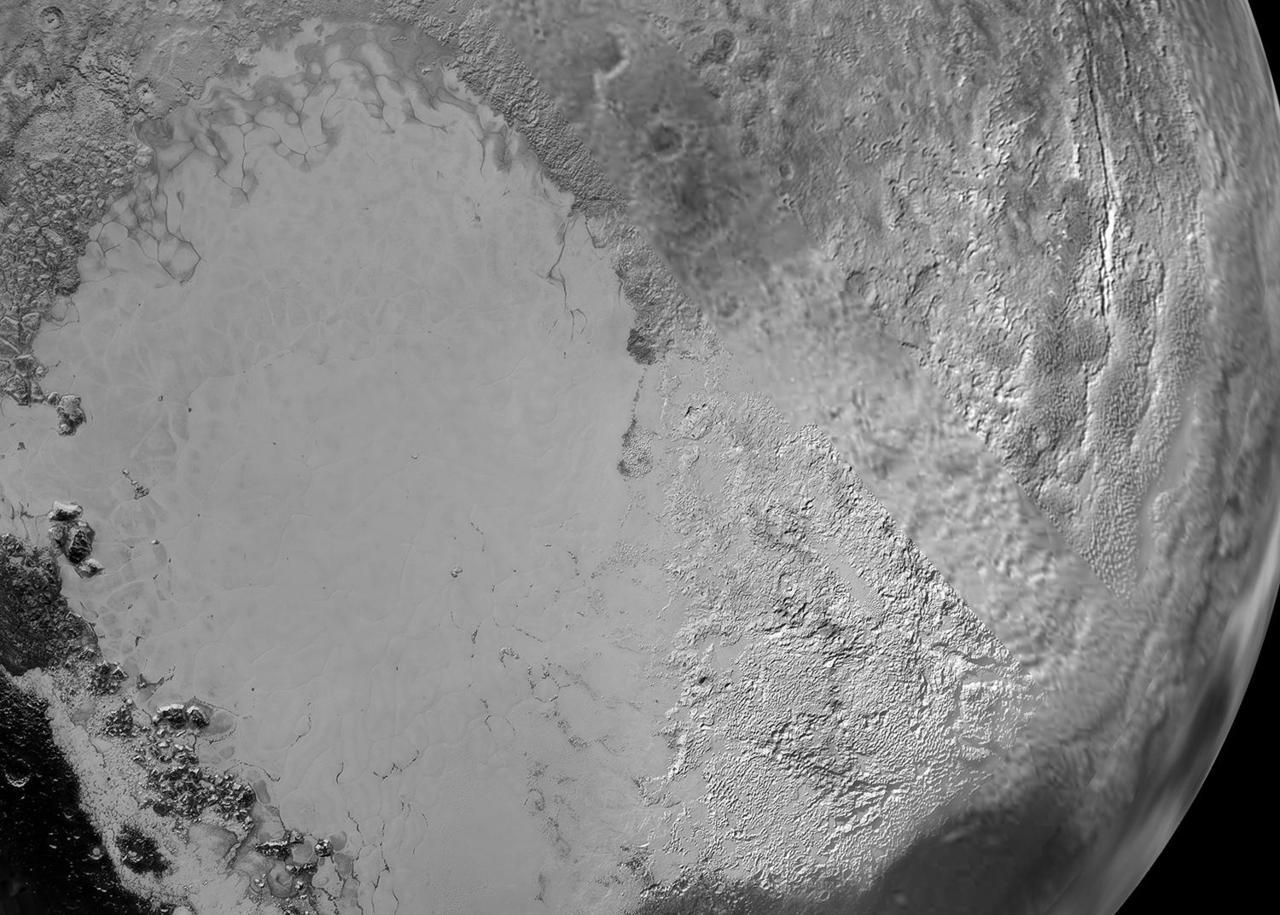
    Since the New Horizons probe visited Pluto in 2015, scientists have suspected that Sputnik Planitia (a.k.a. Pluto’s Heart), shown above, may hide a subsurface ocean. But it’s tough to explain how that ocean could stay warm enough to be liquid while the surface ice remains cold and viscous enough to support the variations in thickness we see. One theory cites the possibility of ammonia in the ocean, essentially serving as anti-freeze, but that would require much higher concentrations of ammonia than have been observed in comets – which, like Pluto, spend most of their time in the icy, frigid regions of the Kuiper Belt.

    A new study suggests another theory: a layer of gas-trapping hydrates between the liquid ocean and its icy cap. A thin layer of clathrate hydrates, as proposed by the authors, would trap gases like methane and create a thermally-insulating layer between a warm ocean and much colder ice cap. Because heat would struggle to cross the insulation layer, the water beneath would stay above the freezing point without the cold ice above leeching all of its warmth away.

    It would likely require future missions to Pluto or other potential ocean worlds to confirm the presence of such a hydrate layer, but, for now, the theory provides a possible new explanation for how icy objects like Pluto maintain liquids. (Image credit: NASA/JHU Applied Physics Laboratory/SwRI; research credit: S. Kamata et al.; via Gizmodo)

  • Guiding Particles with Chladni Patterns

    Guiding Particles with Chladni Patterns

    During the 19th century, Ernst Chladni and Michael Faraday independently explored the patterns formed by particles of different sizes placed on a vibrating plate. Faraday found that large particles accumulated at nodes of the plate, where there was no vertical vibration, whereas smaller particles moved toward anti-nodes, where air currents caused by the large vibration amplitude lifted them up.

    The situation becomes a little different if you submerge the vibrating plate in water. Then large, heavy particles gather at the anti-nodes. Drag keeps the particles on the plate, while acoustic forces and gravity conspire to move the particles horizontally toward the anti-nodes (top). Because anti-node patterns change with frequency, this actually provides a way to manipulate particle’s trajectories. The researchers demonstrated this by steering a particle through a maze (bottom) as well as by manipulating an entire swarm of beads. (Image and research credit: K. Latifi et al.; via Physics World; submitted by Kam-Yung Soh)

  • Giving Chocolate that Smooth Finish

    Giving Chocolate that Smooth Finish

    Anyone who’s tried to make chocolate confections at home can tell you that achieving that perfect smooth consistency isn’t easy. It was only after Rodolphe Lindt invented the process of conching in 1879 that anyone enjoyed smooth chocolate. Conching is what allows granular solids like sugar, milk and cocoa powders to mix with liquid cocoa butter into a smooth, homogeneous liquid. Although the process has been known for more than a century, it’s only recently that researchers have unraveled the underlying physics that enables it.

    One of the key parameters to conching is the a mixture’s jamming volume fraction; in other words, the point where the fraction of solid particles in the mixture is too high for it to flow freely. In the first stage of conching, the solid particulates and a small amount of liquid are stirred and slowly heated. The mechanical action of stirring breaks up aggregates and raises the jamming volume fraction. By the end of the dry conche, the mixture could flow, in theory, except that it fractures at a lower stress than what’s necessary to flow.

    At this point, chocolatiers add the remainder of the liquid ingredients. That infusion of moisture decreases the friction between solid particles and further raises the jamming volume fraction. With the system now far below that jamming point, the mixture transforms into a freely-flowing, smooth fluid. By understanding the intricacies of the process, scientists hope to reduce the energy necessary in chocolate production and similar industrial processes.  (Image credit: A. Stein; research credit: E. Blanco et al.; via Physics World; submitted by Kam-Yung Soh)

  • Featured Video Play Icon

    Reader Question: Inside a Vortex

    Reader embersofkymillo asks:

    Hey FYFD, could you do some analysis/explanations behind the physics of this vortex stuff? I love when you do spots on Slow Mo Guys vids and figured I’d share a recent one w you 

    I enjoy doing that, too! So let’s talk a little about vortices. What Dan’s tea stirrer is doing is creating a low-pressure core for a vortex. We can see just how strong that low pressure region is by the way it sucks the air-water interface down toward the spinning arms. Eventually the interface and stirrer meet, and what was once a single, smooth(ish) surface gets torn into a myriad of bubbles. (As an aside, those bubbles get loud.) 

    I also like the sequence of sugar cube drops because they make for some very cool splashes. Notice how the orientation of the cube’s edges as it hits determines the shape of the inital splash curtain. The asymmetry borne out of that impact actually follows through all the way through the seal of the cavity behind the cube. It reminds me of this oldie-but-goodie video on drops hitting different shapes. (Video and image credit: The Slow Mo Guys; submitted by embersofkymillo)

  • The Leidenfrost Crack

    The Leidenfrost Crack

    In 1756, Leidenfrost reported on the peculiar behaviors of droplets on surface much hotter than the liquid’s boiling point. Such droplets were highly mobile, surfing on a thin layer of their own vapor and were prone to loud cracking noises.

    More recently, scientists have observed that drops with an initially small radius eventually rocket off the hot surface whereas larger drops end their lives in an explosion (above) – the source of Leidenfrost’s crack. Now researchers have explained why drops of different sizes have such different fates. The key is their level of contamination.

    To reach the take-off radius, the drop has to evaporate a significant portion of its volume. For an initially-large drop, that’s tough because any solid contaminants in the drop will build up along the surface of the drop as it shrinks. Eventually, they restrict the liquid from evaporating, which thins the vapor layer the drop sits on. It sinks until a part of it touches the surface. The sudden influx of heat from the surface explosively destroys whatever remains of the drop. (Image and research credit: S. Lyu et al.; via Brown University; submitted by gdurey)

  • Featured Video Play Icon

    Drinking Coffee in Space

    You probably don’t give much thought to the forces involved in drinking here on Earth. That’s because gravity’s effects dominate over everything else. Our cups are designed to hold a liquid until we use gravity to pour it into our mouths. But that technique doesn’t work in microgravity. There other forces govern how liquids flow: specifically surface tension and capillary action.

    Both of these forces are the result of intermolecular attractions. In the case of surface tension, it’s the attraction that the molecules of a liquid feel for one another that keeps them in a cohesive bunch. Capillary action is similar, but it’s an attraction between the liquid molecules and those of the solid they’re wetting. When you combine them both, you get the ability for liquids to climb up a narrow gap and pull more liquid up behind them. That’s the key science behind every version of the “space cup” developed by astronaut Don Pettit and his collaborators. 

    To hear more about the development and engineering of the cup (and exactly why it makes drinking coffee so much more enjoyable in space than it would be otherwise) check out the full video. And, in case you’re wondering, there’s a special microgravity champagne flute, too! (Image and video credit: It’s Okay to Be Smart)