Year: 2019

  • Featured Video Play Icon

    Experimenting with Speakers

    In her ongoing quest to explore natural resonance, Dianna has enlisted some very nice, very expensive speakers to find out just what happens when the bass drops. If you ever wondered what the natural frequency of your eyeballs is, then this one’s for you.

    If you’re more intrigued by the idea of putting out fires with sound (and/or explosions), I’ve got some posts on that including a sound-based fire extinguisher and a supersonic cannon capable of blowing out fires. (Video credit: Physics Girl)

  • Floccing Particles

    Floccing Particles

    Adding particles to a viscous fluid can create unexpected complications, thanks to the interplay of fluid and solid interactions. Here we see a dilute mixture of dark spherical particles suspended in a layer of fluid cushioned between the walls of an inner and outer cylinder. Initially, the particles are evenly distributed, but when the inner cylinder begins to rotate, it shears the fluid layer. Hydrodynamic forces assemble the particles together into loose conglomerates known as flocs. Once the particles form these log-like shapes, they remain stable thanks to the balance between viscous drag on particles and the attractive forces that pull particles toward one another. (Image and research credit: Z. Varga et al.; submitted by Thibaut D.)

  • Crepe-Making Physics

    Crepe-Making Physics

    If you buy a crêpe from a vendor, chances are that they’ll use a blade like the one above to spread the batter evenly across an immobile griddle. But for those of us making our own crêpes at home, this method is impractical. (After all, who wants to purchase a special griddle and utensil just for making one meal?) Instead most of us make our crêpes or pancakes in a standard pan and we use gravity to help us spread the batter.

    Now researchers have described this crêpe-making process mathematically and calculated the optimal method for getting a perfect, uniformly-thin crêpe. Their model even accounts for the fact that the viscosity of the batter changes as the crêpe cooks.

    For optimal crêpe-making, add the batter to the center of the pan. Then immediately tilt the pan to one side to spread the batter all the way to the edge. Keeping the pan inclined, rotate once to fill in the full circumference. Then continue the rotation at a slighter incline to fill in any holes until the pan is horizontal and the crêpe is cooked through. This is what’s shown in the lower animation, where the colormap indicates the crêpe thickness and the arrows show the effective direction of gravity. (Image credit: crêpe-making – taleitan, simulated crêpe – E. Boujo and M. Sellier; research credit: E. Boujo and M. Sellier; via APS Physics; submitted by Kam-Yung Soh)

  • Using Bubbles to Keep Clean

    Using Bubbles to Keep Clean

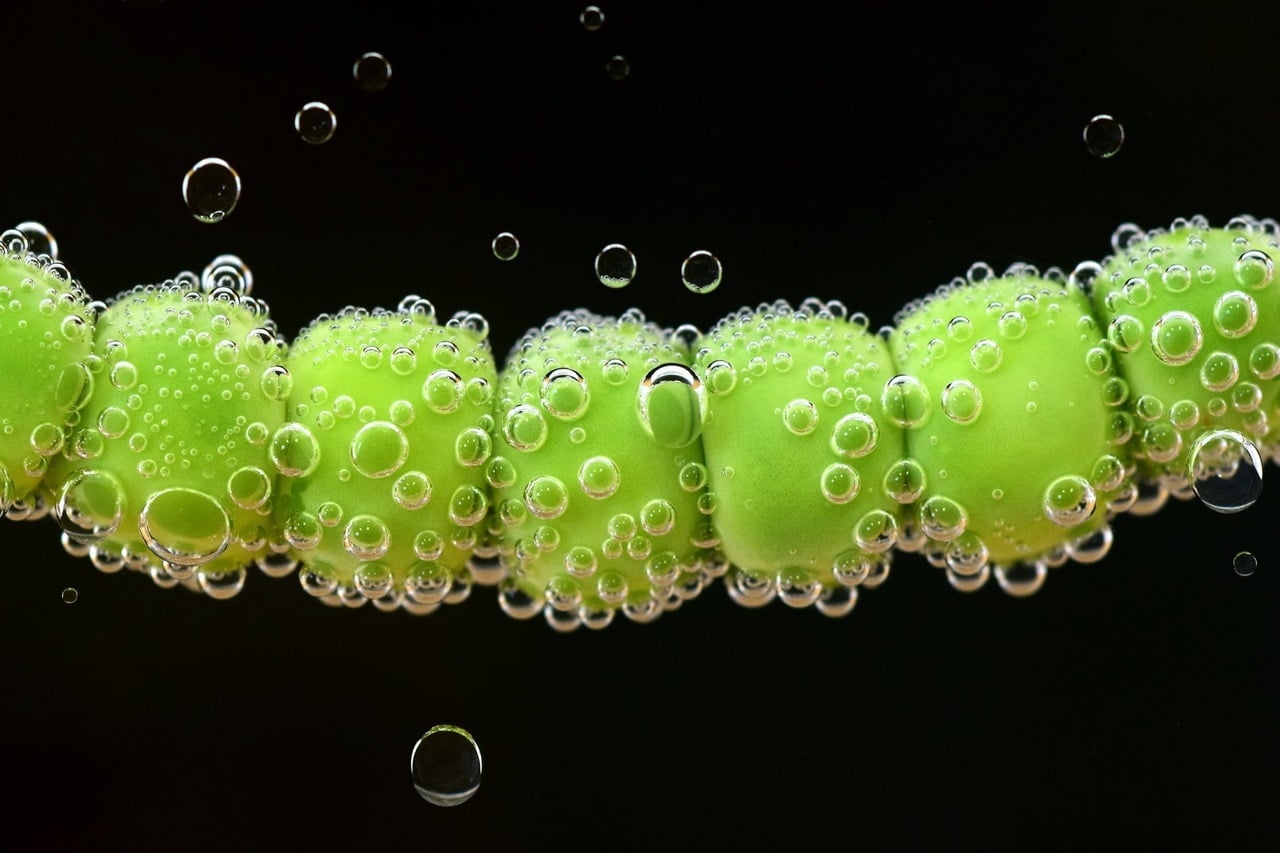
    Keeping produce clean of foodborne pathogens is a serious issue, and delicate fruits and vegetables like tomatoes cannot withstand intense procedures like cavitation-based cleaning. But a new study suggests that simple air bubbles may have the power to keep our produce free of germs.

    In particular, researchers studied air bubbles injected into water as they bounced and slid along an inclined solid surface. They found that as a bubble approaches a tilted surface, it squeezes a thin film of liquid between itself and the surface. That flow creates a shear stress that pushes contaminants like E. coli away from the point of impact. When the bubble bounces away, fluid gets sucked back into the void left behind, creating more shear stress. In their experiments and simulations, the team measured shear stresses greater than 300 Pa, more than double what’s needed to remove foodborne bacteria like Listeria. (Image credit: Pixabay; research credit: E. Esmaili et al.)

  • Featured Video Play Icon

    How Spillways Work

    Human infrastructure like dams have the challenge of standing up to whatever nature can throw at them. It’s expensive, if not outright impossible, to build to every single contingency, so engineers have developed methods of dealing with problems like excess flow caused by a storm. For dams, one of the ways of dealing with this are spillways, which allow a method of controlled release from a reservoir. 

    Spillways come in many shapes and sizes, as seen in the video, but there are two general types: those that are actively managed and those that are automatic. An automatic spillway is like the “morning glory” type seen in the middle animation. There’s no on or off for a spillway like this. Instead, once the water level is high enough, water naturally flows out. In that sense, it’s like the overflow holes found in many bathroom sinks.

    Controlled spillways are usually managed with gates that can be opened or closed as operators need them. This technique gives more granular control and can even end up being cheaper in some situations because it requires less space to implement. (Video and image credit: Practical Engineering)

  • Salty Comets

    Salty Comets

    Many of the products we use every day in our homes behave like solids until the right force is applied. These yield-stress fluids are like hand sanitizer – strong enough to suspend millimeter-sized particles when still but capable of flowing easily when pumped. In hand sanitizer, this is because the fluid is made up of swollen microgel particles that are jammed together. To rearrange, they need a certain amount of force applied. The weight of the sugars, capsules, and particulates added to the product aren’t heavy enough to move the jammed microgels, so they stay suspended.

    But researchers found that if they add a salt crystal of the same size and weight (bottom image), it sinks steadily through the gel. The salt’s velocity is constant; it doesn’t change with size as we might expect. That’s because it’s not falling by forcing the microgel particles to move. Instead, its salinity forces the microgel to release its absorbed liquid; basically, it’s collapsing the jammed particles. It falls steadily because it takes a given amount of time to collapse each gel particle.  (Image credits: microgel – N. Sharp; salt comet – A. Nowbahar et al.; research credit: A. Nowbahar et al.)

  • Polygonal Droplets

    Polygonal Droplets

    Spheres are a special shape; they provide the smallest possible surface area necessary to contain a given volume. And since surface tension tries to minimize surface energy by reducing the surface area, drops and soap bubbles are, generally, spherical. There’s subtlety here, though: namely, what if reducing the surface area doesn’t minimize the surface energy?

    That’s the issue at the heart of this study. It looks at microscale oil droplets, like the ones above, that are floating in water and stabilized by surfactants. We’d expect droplets like these to be round, and above a critical temperature, they are. But as the temperature drops, the surfactant molecules along the droplet’s interface crystallize. The drop itself is still liquid, but interface is not.

    This changes the rules of the game. There’s no way for the surfactant molecules to form a sphere when solidified; they simply can’t fit together that way. So instead defects form along the interface and the drop becomes faceted. As the temperature drops further, the energy relationship between the water, oil, and surfactants continues shifting, causing the droplet to change shape – even to increase its surface area – all to minimize the overall energy. The effect is reversible, too. Raise the temperature back up above the critical point, and the interface “thaws” so that the drop becomes round again. (Image and research credit: S. Guttman et al.; via Forbes; submitted by Kam-Yung Soh)

  • Order in Chaos

    Order in Chaos

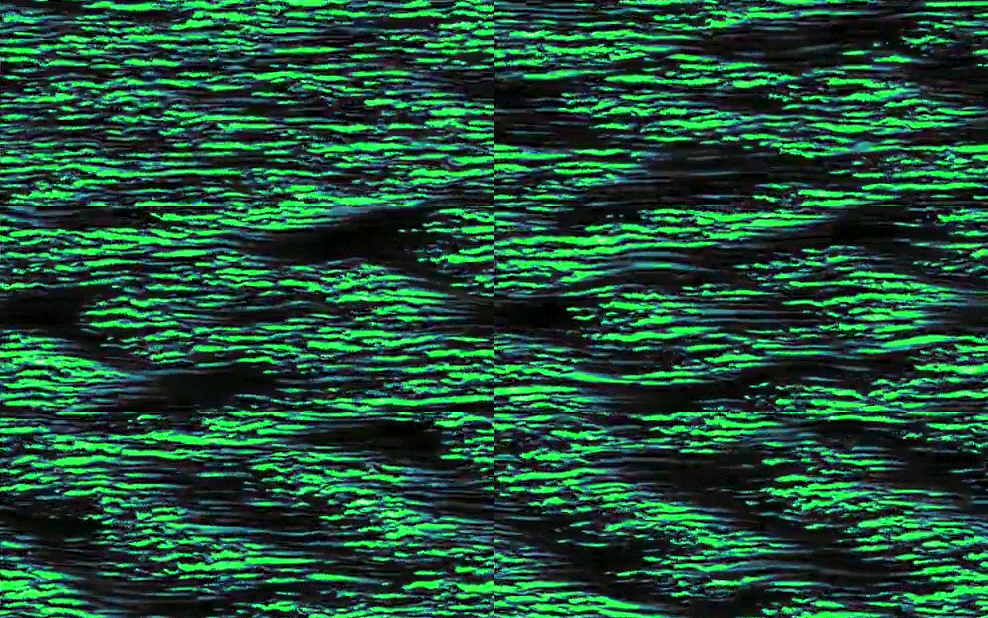
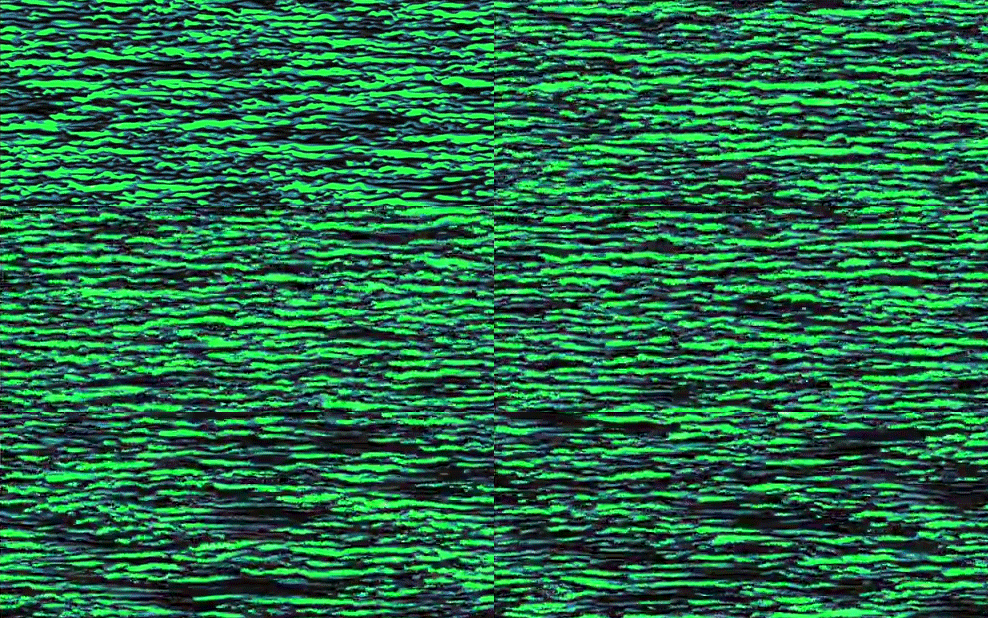
    Although turbulent flow is chaotic, it’s not completely disordered. In fact, order can emerge from turbulence, though exactly how this happens has been a long-enduring mystery. Take the animations above. They show the flow that develops between two plates moving in opposite direction that are separated by a small gap. (The formal name for this is planar Couette flow.) The visualization is taken in a plane at a fixed height between the plates.

    Initially (top), the flow shows narrow bands of turbulence, shown in green, separated by calmer, laminar zones in black. As time passes, these areas of laminar and turbulent flow self-organize, eventually forming diagonal stripes that are much longer than the gap between plates (bottom), the natural length-scale we would expect to see in the flow. Researchers have wondered for years why these distinctive stripes form. What sets their spacing, and why are they along diagonals?

    To answer those questions, researchers explored the full Navier-Stokes equations, searching for equilibrium solutions that resemble the striped patterns seen in experiments and simulation. And for the first time, they’ve found a mathematical solution that matches. What the work shows is that the pattern emerges naturally from the equations; in fact, given the characteristics of the solution, the researchers found that many disturbances should lead to this result, which explains why the pattern appears so frequently. (Image and research credit: F. Reetz et al., source; via phys.org; submitted by Kam-Yung Soh)
  • Featured Video Play Icon

    Engineering Droplets

    A jet of falling liquid doesn’t remain a uniform cylinder; instead, it breaks into droplets. In this video, Bill Hammack explores why this is and what engineers have learned to do to control the size of the droplets formed.

    The technical name for this phenomenon is the Plateau-Rayleigh instability. It begins (like many instabilities) with a tiny perturbation, a wobble in the falling jet. This begins a game of tug of war. One of the competitors, surface tension, is trying to minimize the surface area of the liquid, which means breaking it into spherical droplets. But doing so requires forcing some of the the liquid to flow upward, against both gravity and the liquid’s inertia. The battle takes some time, but eventually surface tension wins and the jet breaks up.

    That’s not necessary a bad thing. It’s actually key to many engineering processes, like ink-jet printing and rocket combustion, as Bill explains in the full video. (Video and image credit: B. Hammack; submitted by @eclecticca)

  • The Shape of Splashes

    The Shape of Splashes

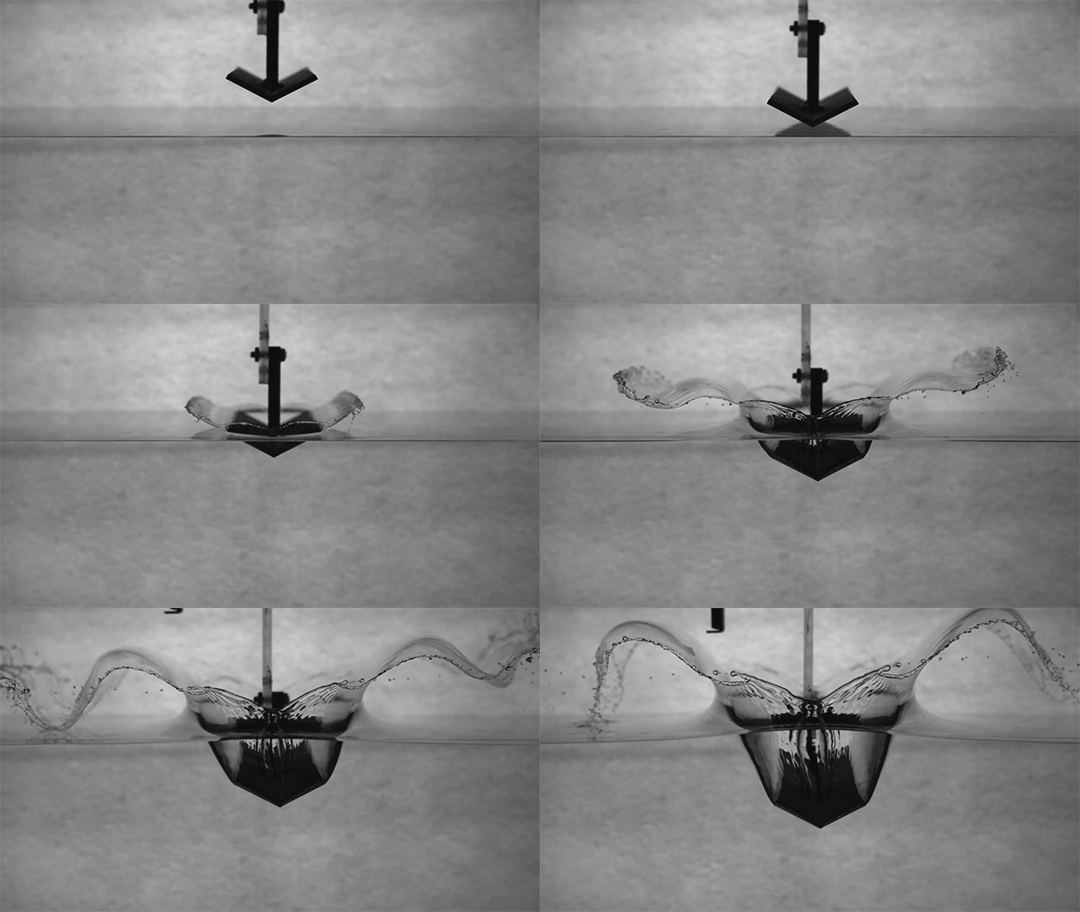
    When a wedge falls into a pool, it creates a distinctive, doubly-curved splash. Here’s how it works. When the front of the wedge first enters the water, it creates a thin sheet of fluid that gets ejected diagonally upward. As the wedge sinks further, the sheet thickens and ejects at a more vertical angle. That creates a low pressure zone in the air beside the splash, which causes outside air to flow inward, generating a sort of Venturi effect under the splash. Because the outer part of the splash sheet is thinner, it’s more strongly affected by the air flow beneath it, and it gets pulled downward, enhancing the splash’s curvature.

    This doubly-curved splash is particular to wedges of the right angle. To see what kind of splashes other shapes make, check out the video below. (Image and video credit: Z. Sakr et al.; for more, see L. Vincent et al.)