Month: November 2019

  • Jovian Vortices

    Jovian Vortices

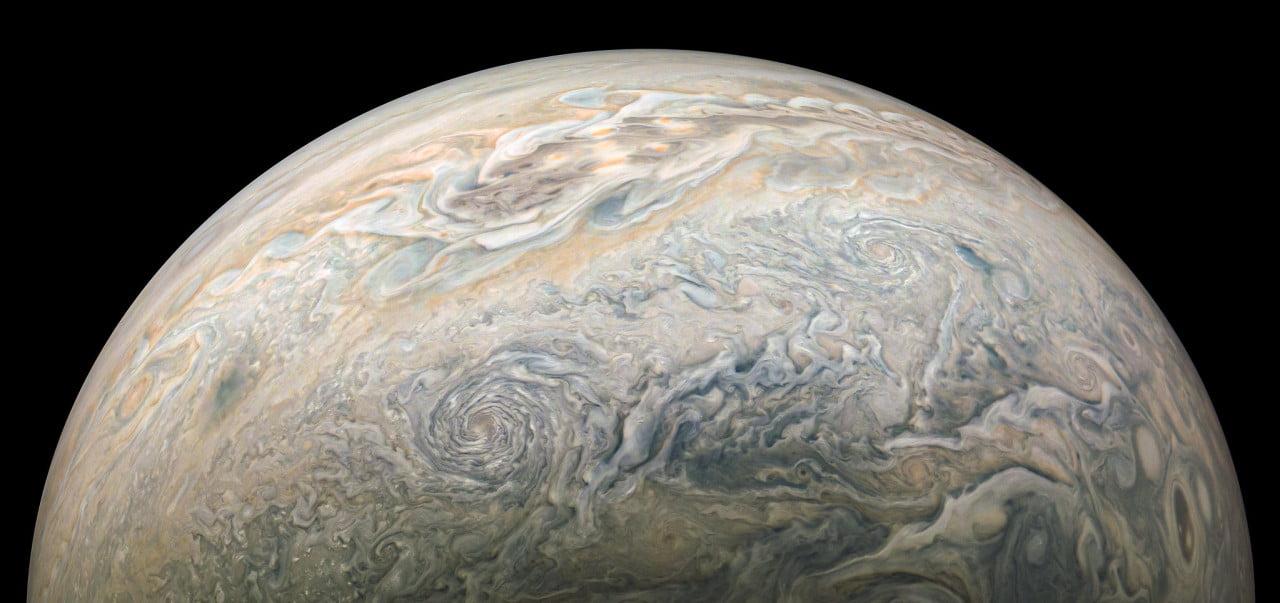
    Jupiter continues to mesmerize in the images from JunoCam. With enhanced contrast, the planet’s eddies look like swirls you could just lean forward and fall into. The complexity of the Jovian atmosphere’s mixing is just astounding. It’s like an ever-changing Impressionist painting brought to life. Check out full-size versions of these stunning images here and here. (Image credit: NASA/JPL-Caltech/SwRI/MSSS/Kevin M. Gill, 12; via Planetary Society; submitted by jpshoer)

  • Featured Video Play Icon

    “Stormscapes 4”

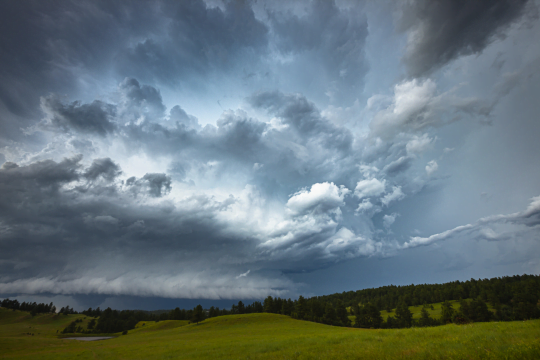
    Frightening as they can be in the moment, storms have a power and majesty all their own. I’ve never seen a better way to capture that than through timelapse, and photographer Nicolaus Wegner offers a great one in “Stormscapes 4″. I particularly like how his frame captures the motion of storms and how they shear, rotate, and billow as they evolve. With a quick glance upward, it’s easy to miss that motion, even if it is fundamental to these storms. Sit back and enjoy.  (Video and image credit: N. Wegner)

  • Featured Video Play Icon

    Creating Biofuel

    One production technique for biofuel converts agricultural waste through pyrolysis. These systems heat biomass particles in a mixture of sand and nitrogen gas until the biomass particles release tar and syngas, a key ingredient of biofuel. All this heating and mixing takes place in a fluidized bed, where the injected nitrogen gas helps the particle mixture move like a fluid.

    Building prototypes of these systems can be costly, so industry has largely relied on computational studies to predict performance. But capturing the complicated physics behind turbulent gas and particle interactions is tough, and some models discard key information in favor of faster and cheaper simulations. In this study, the authors found that clustering between particles has a major effect on syngas production, something that industrial studies must account for. 

    This is one of the challenges of computational fluid dynamics; although the codes have become more and more accessible over time, getting reliable results still requires a solid understanding of the strengths and limitations of each model used. (Image, video, and research credit: S. Beetham and J. Capecelatrosource; submitted by Jesse C.)

  • Swirling Vortex

    Swirling Vortex

    So much of fluid dynamics comes down to finding the right way to observe a flow. This image of a swirling tropical system was captured by an astronaut aboard the International Space Station in April 2019. The low sun angle at the time makes the shadows stretch long across the cloud tops, giving them greater definition as well as a tint of sunset color. As drastic as the system looks from this angle, it was a short-lived vortex that never made landfall, so it was never officially named. (Image credit: Expedition 59 Crew; via NASA Earth Observatory)

  • The Microscopic Ocean

    The Microscopic Ocean

    When you’re the size of plankton, water may as well be molasses. Viscosity rules at these scales, and swimming plankton leave distinctive wakes that are slow to dissipate. Fish that feed on plankton use these trails to find their prey. But this microscopic world is changing as the ocean warms.

    At higher temperatures, water is less viscous, and plankton wakes don’t last as long. To make matters worse for hungry fish, warmer waters have led to an explosion in a species of faster plankton, capable of moving hundreds of body lengths a second. This species is far more difficult to catch, which may explain some of the collapses we’re observing in populations of fish like cod and haddock. (Video and image credit: BBC Earth Lab)

  • Fast-Switching Multi-Material 3D Printer

    Fast-Switching Multi-Material 3D Printer

    For 3D printers to reach their potential, they need to handle more than one material and be able to swap quickly and seamlessly between them. That’s a tall order given how different materials like silicone and wax are. But a new 3D printer tackles that challenge using microfluidic nozzles designed extrude multiple fluids in quick succession. 

    The nozzle controls which fluid it ejects by pressurizing individual fluids, allowing it to switch from one to another up to 50 times a second (first image). Multiple nozzles, each containing multiple fluids, can be used to print periodically-patterned designed more quickly than previously possible (second image). The system can even directly print air-powered robots with both soft and hard components (third image). (Image and video credit: Nature, with M. Skylar-Scott et al.; research credit: M. Skylar-Scott et al.; via Nature; submitted by Kam-Yung Soh

  • 2019 APS DFD Schedule

    2019 APS DFD Schedule

    It’s time for the annual American Physical Society Division of Fluid Dynamics meeting, and once again, I’ll be attending. If you’ve been scanning the program wondering where I am, wonder no more! Here’s a run-down of the talks and events I’ll be appearing at:

    Yes, in very exciting news, the DFD has offered me an invited talk this year, and I hope to see many of you in the audience come Monday! Maybe for those who can’t attend in person, we can get a volunteer or two to live-tweet it?

    As usual, I’ll be hanging around throughout the conference, so if you see me, feel free to come say hi.

  • Wave Clouds in the Front Range

    Wave Clouds in the Front Range

    Last Sunday night metro Denver was treated to a rare sight: clouds resembling breaking waves formed near sunset. These are Kelvin-Helmholtz clouds, and the comparison to ocean waves is apt, since the same physics is behind both. Winds were unusually calm near the ground Sunday night, but strong winds blew at the altitude just above the lower cloud layer. That velocity difference created strong shear where the two air layers met. With the cloud layer in place to differentiate the slower-moving air from the faster, we can what’s normally invisible: how the two air layers mix.

    The Denver Post has several more views of the wave clouds from around the area, and you can learn lots more about the Kelvin-Helmholtz instability here. (Image credit: R. Fields; via the Denver Post)

  • Finding New States of Matter

    Finding New States of Matter

    As children we’re taught that there are three basic states of matter: solids, liquids, and gases. The latter two are known scientifically as fluids. But the world doesn’t divide quite so simply into those three categories, and scientists have since named several other states of matter, including plasmassuperfluids, and Bose-Einstein condensates.  Many of these types of matter only exist under extreme temperatures and/or pressures, which makes them difficult to observe. Scientists have instead turned to numerical simulation to discover and study these exotic materials.

    One of the latest discoveries among these bizarre materials is a form of potassium that simultaneously displays properties of a solid and a liquid. Inside this so-called chain-melted potassium, there’s a complex crystalline lattice containing smaller chains of atoms. One author described the material thus: “ It would be like holding a sponge filled with water that starts dripping out, except the sponge is also made of water.” That certainly boggles my mind! (Image credit: Turtle Rock Scientific; research credit: V. Robinson et al.; via NatGeo; submitted by Emily R.)

  • Featured Video Play Icon

    Coke and Butane Rockets

    Rocket science has a reputation for being an incredibly difficult subject. But while there’s complexity in the execution, the concept behind rockets is pretty simple: throw mass out the back really fast and you’ll move forward. Whether you’re talking about a Saturn V or these Coke-and-butane-powered bottles, the basic principle is the same.

    These rockets get their kick mostly from the added butane, which has a very low boiling point. When the bottle is flipped, the lighter butane is forced to rise through the Coke. With a large surface area of liquid butane exposed to the warmer Coke, the butane becomes gaseous. That sudden increase in volume forces a liquid-Coke-and-gaseous-butane mixture out of the bottle, which has a helpful nozzle shape to further increase the propellant’s speed. Once the phase change is underway, the rocket quickly takes off! (Image and video credit: The Slow Mo Guys)