Month: June 2019

  • Featured Video Play Icon

    How Spillways Work

    Human infrastructure like dams have the challenge of standing up to whatever nature can throw at them. It’s expensive, if not outright impossible, to build to every single contingency, so engineers have developed methods of dealing with problems like excess flow caused by a storm. For dams, one of the ways of dealing with this are spillways, which allow a method of controlled release from a reservoir. 

    Spillways come in many shapes and sizes, as seen in the video, but there are two general types: those that are actively managed and those that are automatic. An automatic spillway is like the “morning glory” type seen in the middle animation. There’s no on or off for a spillway like this. Instead, once the water level is high enough, water naturally flows out. In that sense, it’s like the overflow holes found in many bathroom sinks.

    Controlled spillways are usually managed with gates that can be opened or closed as operators need them. This technique gives more granular control and can even end up being cheaper in some situations because it requires less space to implement. (Video and image credit: Practical Engineering)

  • Salty Comets

    Salty Comets

    Many of the products we use every day in our homes behave like solids until the right force is applied. These yield-stress fluids are like hand sanitizer – strong enough to suspend millimeter-sized particles when still but capable of flowing easily when pumped. In hand sanitizer, this is because the fluid is made up of swollen microgel particles that are jammed together. To rearrange, they need a certain amount of force applied. The weight of the sugars, capsules, and particulates added to the product aren’t heavy enough to move the jammed microgels, so they stay suspended.

    But researchers found that if they add a salt crystal of the same size and weight (bottom image), it sinks steadily through the gel. The salt’s velocity is constant; it doesn’t change with size as we might expect. That’s because it’s not falling by forcing the microgel particles to move. Instead, its salinity forces the microgel to release its absorbed liquid; basically, it’s collapsing the jammed particles. It falls steadily because it takes a given amount of time to collapse each gel particle.  (Image credits: microgel – N. Sharp; salt comet – A. Nowbahar et al.; research credit: A. Nowbahar et al.)

  • Polygonal Droplets

    Polygonal Droplets

    Spheres are a special shape; they provide the smallest possible surface area necessary to contain a given volume. And since surface tension tries to minimize surface energy by reducing the surface area, drops and soap bubbles are, generally, spherical. There’s subtlety here, though: namely, what if reducing the surface area doesn’t minimize the surface energy?

    That’s the issue at the heart of this study. It looks at microscale oil droplets, like the ones above, that are floating in water and stabilized by surfactants. We’d expect droplets like these to be round, and above a critical temperature, they are. But as the temperature drops, the surfactant molecules along the droplet’s interface crystallize. The drop itself is still liquid, but interface is not.

    This changes the rules of the game. There’s no way for the surfactant molecules to form a sphere when solidified; they simply can’t fit together that way. So instead defects form along the interface and the drop becomes faceted. As the temperature drops further, the energy relationship between the water, oil, and surfactants continues shifting, causing the droplet to change shape – even to increase its surface area – all to minimize the overall energy. The effect is reversible, too. Raise the temperature back up above the critical point, and the interface “thaws” so that the drop becomes round again. (Image and research credit: S. Guttman et al.; via Forbes; submitted by Kam-Yung Soh)

  • Order in Chaos

    Order in Chaos

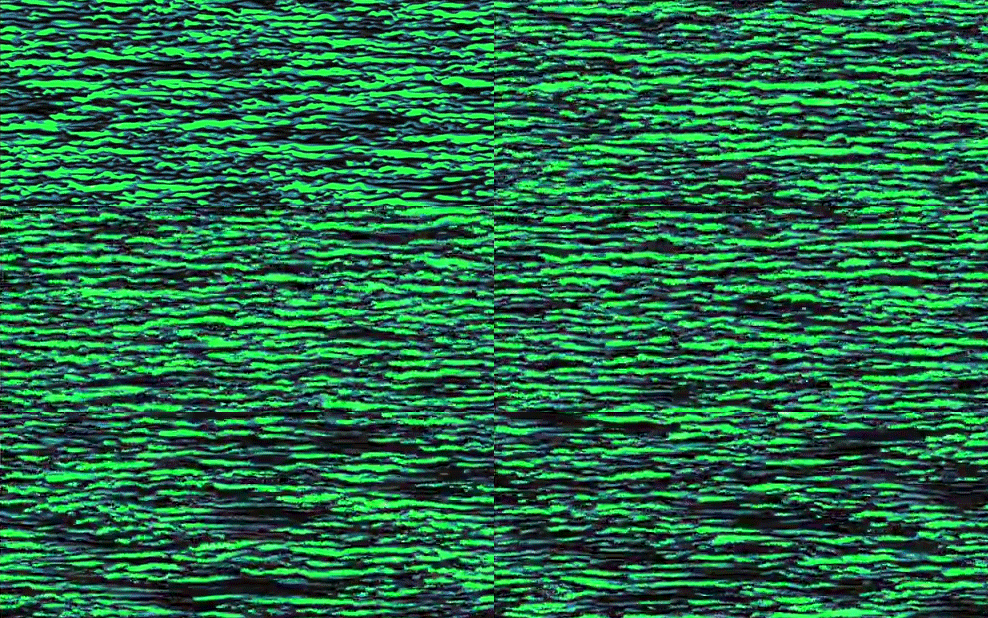
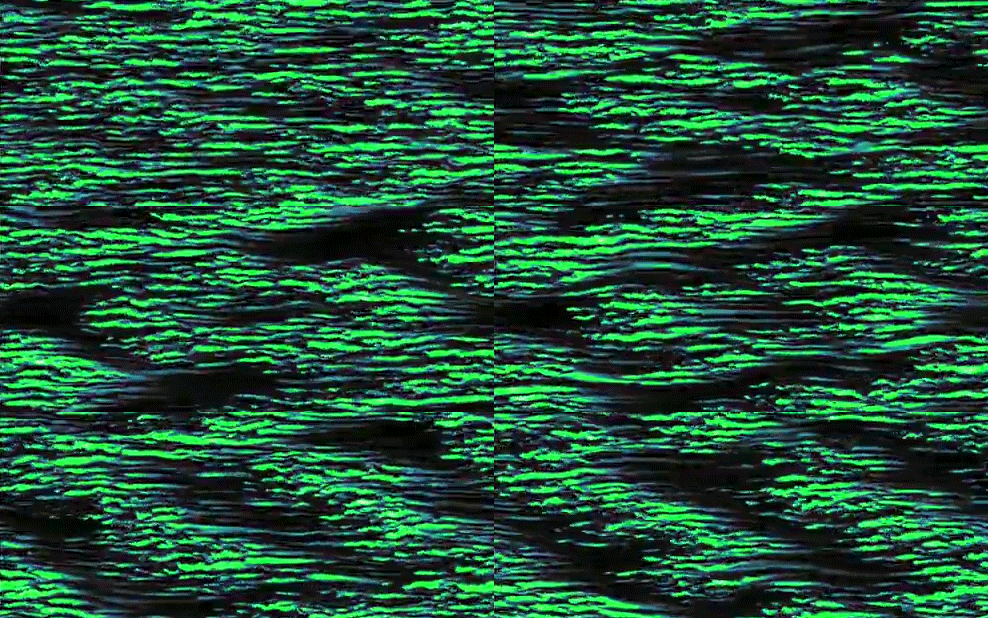
    Although turbulent flow is chaotic, it’s not completely disordered. In fact, order can emerge from turbulence, though exactly how this happens has been a long-enduring mystery. Take the animations above. They show the flow that develops between two plates moving in opposite direction that are separated by a small gap. (The formal name for this is planar Couette flow.) The visualization is taken in a plane at a fixed height between the plates.

    Initially (top), the flow shows narrow bands of turbulence, shown in green, separated by calmer, laminar zones in black. As time passes, these areas of laminar and turbulent flow self-organize, eventually forming diagonal stripes that are much longer than the gap between plates (bottom), the natural length-scale we would expect to see in the flow. Researchers have wondered for years why these distinctive stripes form. What sets their spacing, and why are they along diagonals?

    To answer those questions, researchers explored the full Navier-Stokes equations, searching for equilibrium solutions that resemble the striped patterns seen in experiments and simulation. And for the first time, they’ve found a mathematical solution that matches. What the work shows is that the pattern emerges naturally from the equations; in fact, given the characteristics of the solution, the researchers found that many disturbances should lead to this result, which explains why the pattern appears so frequently. (Image and research credit: F. Reetz et al., source; via phys.org; submitted by Kam-Yung Soh)

  • Featured Video Play Icon

    Engineering Droplets

    A jet of falling liquid doesn’t remain a uniform cylinder; instead, it breaks into droplets. In this video, Bill Hammack explores why this is and what engineers have learned to do to control the size of the droplets formed.

    The technical name for this phenomenon is the Plateau-Rayleigh instability. It begins (like many instabilities) with a tiny perturbation, a wobble in the falling jet. This begins a game of tug of war. One of the competitors, surface tension, is trying to minimize the surface area of the liquid, which means breaking it into spherical droplets. But doing so requires forcing some of the the liquid to flow upward, against both gravity and the liquid’s inertia. The battle takes some time, but eventually surface tension wins and the jet breaks up.

    That’s not necessary a bad thing. It’s actually key to many engineering processes, like ink-jet printing and rocket combustion, as Bill explains in the full video. (Video and image credit: B. Hammack; submitted by @eclecticca)

  • The Shape of Splashes

    The Shape of Splashes

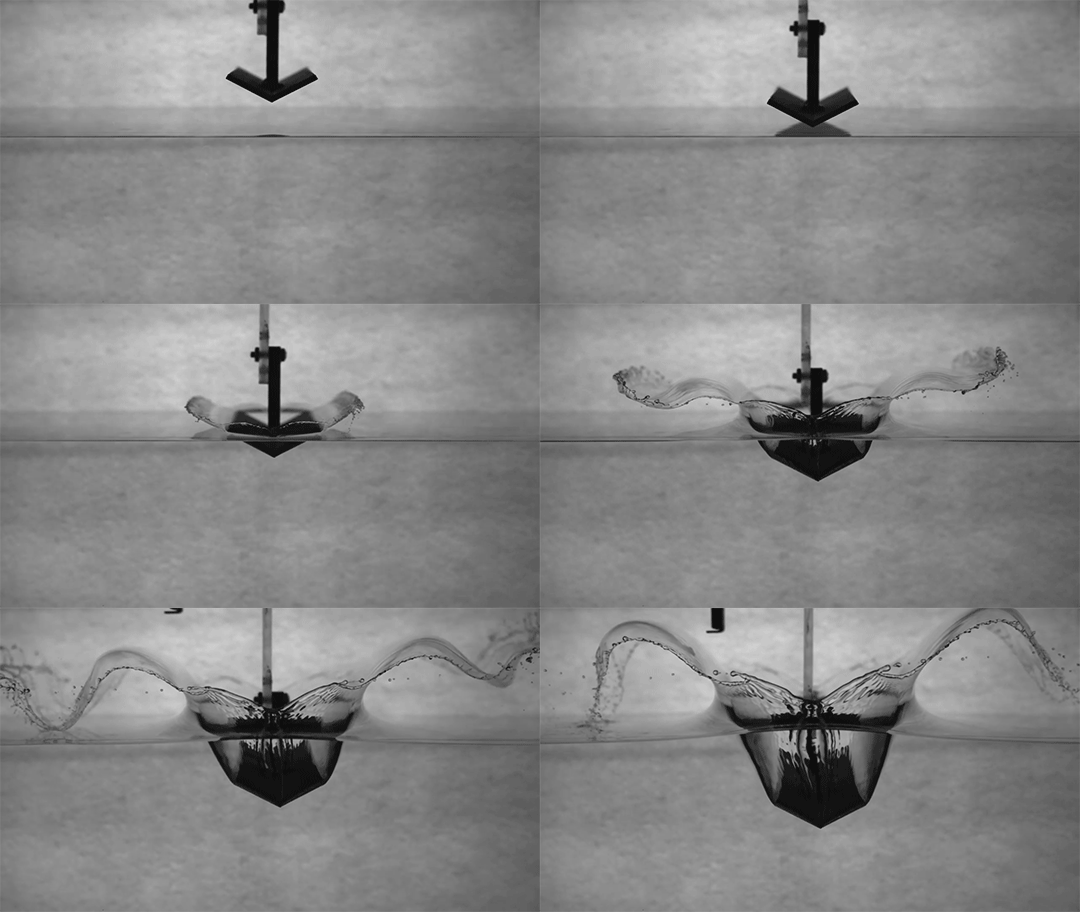
    When a wedge falls into a pool, it creates a distinctive, doubly-curved splash. Here’s how it works. When the front of the wedge first enters the water, it creates a thin sheet of fluid that gets ejected diagonally upward. As the wedge sinks further, the sheet thickens and ejects at a more vertical angle. That creates a low pressure zone in the air beside the splash, which causes outside air to flow inward, generating a sort of Venturi effect under the splash. Because the outer part of the splash sheet is thinner, it’s more strongly affected by the air flow beneath it, and it gets pulled downward, enhancing the splash’s curvature.

    This doubly-curved splash is particular to wedges of the right angle. To see what kind of splashes other shapes make, check out the video below. (Image and video credit: Z. Sakr et al.; for more, see L. Vincent et al.)

  • Capillary Action and Sand Castles

    Capillary Action and Sand Castles

    Capillary action – or capillarity – is the ability of liquids to flow through narrow constrictions. It results from intermolecular forces between fluids and solids. It’s a combination of surface tension – which creates cohesion within the liquid – and adhesion, which allows the liquid and solid to hold to one another. Together, these forces propel the liquid to flow through narrow gaps.

    In the video below, a saturated mixture of sand and water is poured into a mold on a bed of dry sand. When left to settle, much of the water flows from the mold into the dry sand bed through capillary action. When the mold is removed (top), the sand holds its shape, something it can’t do without a porous bed to soak in the excess liquid. (Image and video credit: amàco et al.)

  • Featured Video Play Icon

    Active Foam

    Geometrically, biological tissues and two-dimensional layers of foam share a lot of similarities. To try and understand how active changes in one cell affect neighbors, researchers are studying how foams shift when air is injected (below) at one or more sites. When a foam cell expands, it forces topological changes in neighboring cells, which researchers built an algorithm to track in real-time. 

    With some processing, they can actually visualize the radially-expanding waves of strain that pass through the foam (bottom image). This allows them to visualize the effects and interaction of multiple injection sites at once, hopefully helping unlock the mechanics behind both the foam’s shifts and those that occur in tissues. (Image and video credit: L. Kroo and M. Prakash)

  • Bubble Break-Up

    Bubble Break-Up

    When bubbles burst, they spray a myriad of tiny droplets into the air. In general, the older a bubble gets, the thinner it is, thanks to gravity draining its liquid away. When older bubbles burst, they create tinier and more numerous droplets (upper right) compared to a younger bubble (upper left). But there are more forces than just gravity at play.

    Bubbles also undergo evaporation – most effectively at the apex. Evaporation cools the cap of the bubble, increasing its surface tension and triggering a Marangoni flow that helps restore fluid to the bubble film. This stabilizes an aging bubble. 

    Contamination plays a role as well. The bright spots in the bottom image reveal bacteria in the bubble’s cap. Compared to a clean bubble, these contaminated ones can survive far longer and, when burst, produce 10 times as many droplets as a clean bubble of the same age. That has major implications for disease transmission, especially for bacteria that spend a significant portion of their life cycle in liquids. (Image and research credit: S. Poulain and L. Bourouiba; see also Physics Today)

  • Evaporative Convection

    Evaporative Convection

    Since we spend so much of our lives around transparent fluids like air and water, we often miss seeing some of their coolest-looking flows. Here, we see a layer of water only 3 centimeters deep but a full meter wide. It’s seeded with tiny crystals that reflect light depending on their orientation, which allows us to see the flow. Initially, the tank is spun up, then left stationary for 2 hours while evaporation cools the water.

    Normally, the resulting flow would be too slow to notice, but that’s where the magic of timelapse comes in. With it, we can see the wriggling dark lines marking areas where cool, dense water sinks and brighter regions where warm fluid rises. What begins as an array of polygonal convection cells quickly merges into a couple of large, rounded cells. Check out the full video below, where you can see the streaming patterns far better than in animation. (Image and video credit: UCLA Spinlab)