
Jupiter’s distinctive bands of colored clouds, known as belts and zones, have been an iconic part of the planet since they were first observed by Galileo. (The scientist, not the space mission!) They are considered part of Jupiter’s weather layer, the region of its atmosphere where storms reign. Thanks to gravitational measurements by the Juno spacecraft, we now know how deep these bands persist; they stretch about 3,000 kilometers into Jupiter! That means that Jupiter’s weather layer accounts for about one percent of the planet’s total mass. By comparison, Earth’s entire atmosphere makes up less than one millionth of its mass. What lies beneath Jupiter’s colorful clouds is also intriguing. The same gravitational measurements that indicate the weather layer’s depth also suggest that, beneath these storms, the rest of Jupiter rotates like a solid body. (Image credit: NASA, source; research credit: Y. Kaspi et al., submitted by Kam-Yung Soh)
Year: 2018

Fissures in Africa


Pictures of an enormous fissure in Kenya’s East African Rift Valley have gone viral in recent weeks along with breathless reports about how part of the African continent is splitting away. And while Africa is splitting – very, very slowly – this crack, impressive as it is, may not have anything to do with it. Geologists familiar with the area are confident that the fissure is the result of recent torrential rains and flooding – not fresh seismic activity. For one, there have been no earthquakes in this area stretching back for several years. One theory is that the crack had actually been present for quite some time but was filled with softer volcanic ash that’s been swept away by the rains. Geologists will need to study it more closely to be certain.
One thing geologists agree on, though, is that the tectonic plates that make up Africa are slowly pulling apart, or rifting. (That’s why the area is known as a rift valley in the first place.) This happens as mantle convection causes two land masses to move away from one another. That’s happening right now along a fault running through Ethiopia, Kenya, and Tanzania, and it’s happened before. A similar rift caused the South American and African continents to separate. This doesn’t mean that the countries in East Africa are in danger of being parted by ocean any time soon, though. Geologists predict it will take on the order of 50 million years for the break to happen. (Image credit: Getty Images; Reuters/T. Mukoya; DailyNation)

How Trees Pull Water
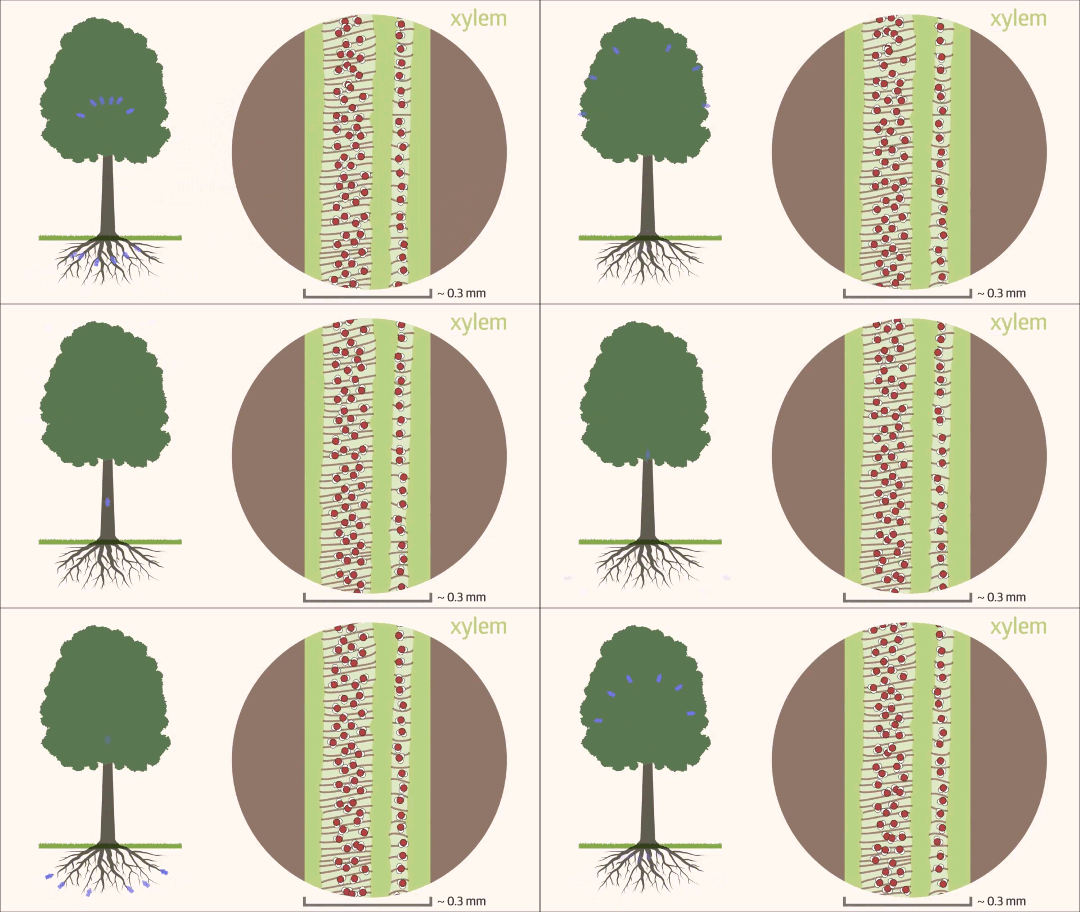


Trees are incredible organisms, and the physics behind them baffled scientists until relatively recently. Inside trees, there is a constant flow of water up from the roots, through the xylem and out the leaves. We often think of atmospheric pressure and capillary action as the mechanisms for pushing water up against the force of gravity, but this is not how trees work. Instead, the evaporation of water from the tree’s leaves actually pulls the entire water column up the tree. Water molecules really like sticking to one another, which actually allows them to hold together under this tension.
The result of all this pulling is a negative pressure inside the tree, and, with some clever manipulation, it’s possible to measure just how negative the pressure inside a tree is using a device called a pressure bomb. You can see the whole process in action in the Science IRL video below. The magnitude of a tree’s negative pressure fluctuates over a day, depending on how quickly it’s losing water, but typical values can range from 2-3 atmospheres of negative pressure to 17 or more! To get the equivalent (positive) pressure, you’d have to be nearly 2.7 kilometers under water. (Image and video credit: Science IRL)
Fly Away!
Spiders are often among the first colonists on newly formed volcanic islands. Thanks to their aerial skills, they are able to travel nearly anywhere by ballooning on strands of their own silk. Exactly how spiders as large as 20 milligrams manage this is still relatively known. A new study shows that crab spiders, like any careful aviator, use a foreleg to monitor wind conditions for 5 or more seconds before attempting take-off. The spiders will only spool out ballooning threads if the wind is warm and gentle. Wind speeds higher than 3 meters per second are an automatic no-go. When the spider decides conditions are favorable, they release as many as 60 nanoscale fibers that are several meters in length. The wind catches the silks and lifts them away to their next adventure. (Image credit: Science Magazine, source; research credit: M. Cho et al.)
Surfaces That Scrape Off Ice
Ice can be a terrible pest, freezing to surfaces like roads and airplane wings and causing all sorts of havoc. Some surfaces, though, can actually prompt a freezing drop to scrape itself off. There are a couple key effects in play here. The first is that the surface is nanotextured – in other words, it has extremely small structures on its surface. This makes it hydrophobic, or water-repellent. The second key ingredient is that the drop is cooling evaporatively; that means heat is escaping along the air-water interface instead of conducting through the solid surface. As a result, the freezing front forms at the interface and pushes inward. Water expands as it freezes, which tries to force the interior liquid out, toward the bottom of the drop. On a normal surface, this would force the contact line – where air, water, and surface meet – to push outward. But the nanotexture of the hydrophobic surface pins that line in place. So the expanding ice pushes the frozen drop upward, scraping it off the surface! (Video and image credit: G. Graeber et al., source)

Dune Networks
In sandy deserts, winds can build a vast network of dunes whose shapes depend on the winds that built them. This photograph, taken by an astronaut aboard the International Space Station, shows part of a Saharan dune field known as the Grand Erg Oriental. Of the five basic types of sand dunes, this field features all but one. The predominant winds of the region build most of the dunes into long, straight chains separated by interdune flats some 150 meters lower in elevation. Within the chains, there are linear dunes, created by winds blowing nearly parallel to the dune’s long axis. In places where winds tend to change directions, several linear dunes may merge to form star dunes, like the one just below and right of center in the image. Transverse dunes form perpendicular to the predominant wind direction. The one shown in the upper left of this image may have formed when multiple crescant-shaped barchan dunes merged. (Image credit: NASA, via NASA Earth Observatory)

Bouncing, Floating, and Jetting


Get inside some of the latest fluid dynamics research with the newest FYFD/JFM video. Here researchers discuss oil jets from citrus fruits, balls that can bounce off water, and self-propelled levitating plates. This is our third entry in an ongoing series featuring interviews from researchers at the 2017 APS DFD conference. Missed one of the previous ones? Not to worry – we’ve got you covered. (Video and image credit: N. Sharp and T. Crawford)

Auroras


Beautiful auroras are the result of ions in the solar wind exciting atoms in our atmosphere. This example of magnetohydrodynamics is typically only visible in the far northern and southern reaches of the globe. But in recent years, citizen scientists noticed a new aurora outside the polar regions. It looked like a narrow purple streak with occasional fingers of green. It got nicknamed Steve. Recent satellite measurements show that the aurora seems to be a visible emission from a known phenomenon, subauroral ion drift, which features a rapid flow of charged ions. In Steve’s case, this flow moves nearly 6 km/s and is around 6000 degrees Celsius. Scientists have dubbed the aurora S.T.E.V.E., Strong Thermal Emission Velocity Enhancement, to honor the original nickname. Learn more from NASA and Science magazine. (Image credit: K. Trinder; NASA GSFC/CIL/K. Kim, source)

Wrapping Droplets
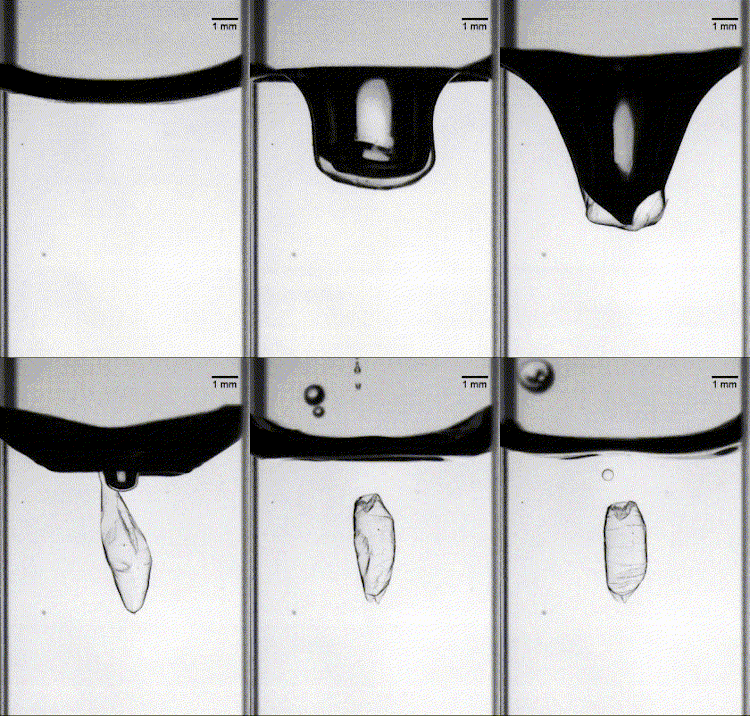


Future efforts for targeted drug delivery may require encapsulating droplets before transporting them to their final location. One method for encapsulation is wrapping a drop in a thin, solid sheet. Previously, we saw that drops can wrap themselves with a little outside assistance, but here the drops achieve that same feat on their own, using the energy of droplet impact to wrap liquids.
Here’s how it works: float a thin sheet on a bath of a liquid like water, then let an oil drop fall into the bath. Its impact deforms the air-water interface and, with a sufficiently energetic impact, causes the oil droplet to pinch off. The flexible sheet wraps around the droplet, and the encapsulated droplet sinks due to gravity. The shape of the final drop depends on the sheet’s initial geometry. The researchers have successfully used circular, triangular, and cross-shaped sheets to wrap droplets. Check out the original paper or the video below for more. (Image and research credit: D. Kumar et al.; video credit: Science)

Sunset Flow
Day and night mix in this flow visualization of watercolor pigments and ferrofluid. The former, as suggested by their name, are water-based, whereas ferrofluids typically contain an oil base. This means the two fluids are immiscible. Like oil and vinegar in salad dressing, the only way to mix them is to break one into tiny droplets floating in the other. This is what happens near their boundary, where brightly-colored paint droplets float in a network of dark channels. To the right, the paint and ferrofluid have been swirled around to create viscous mixing patterns among the paint colors with occasional intrusions of thin ferrofluid fingers. (Image credit: G. Elbert)


