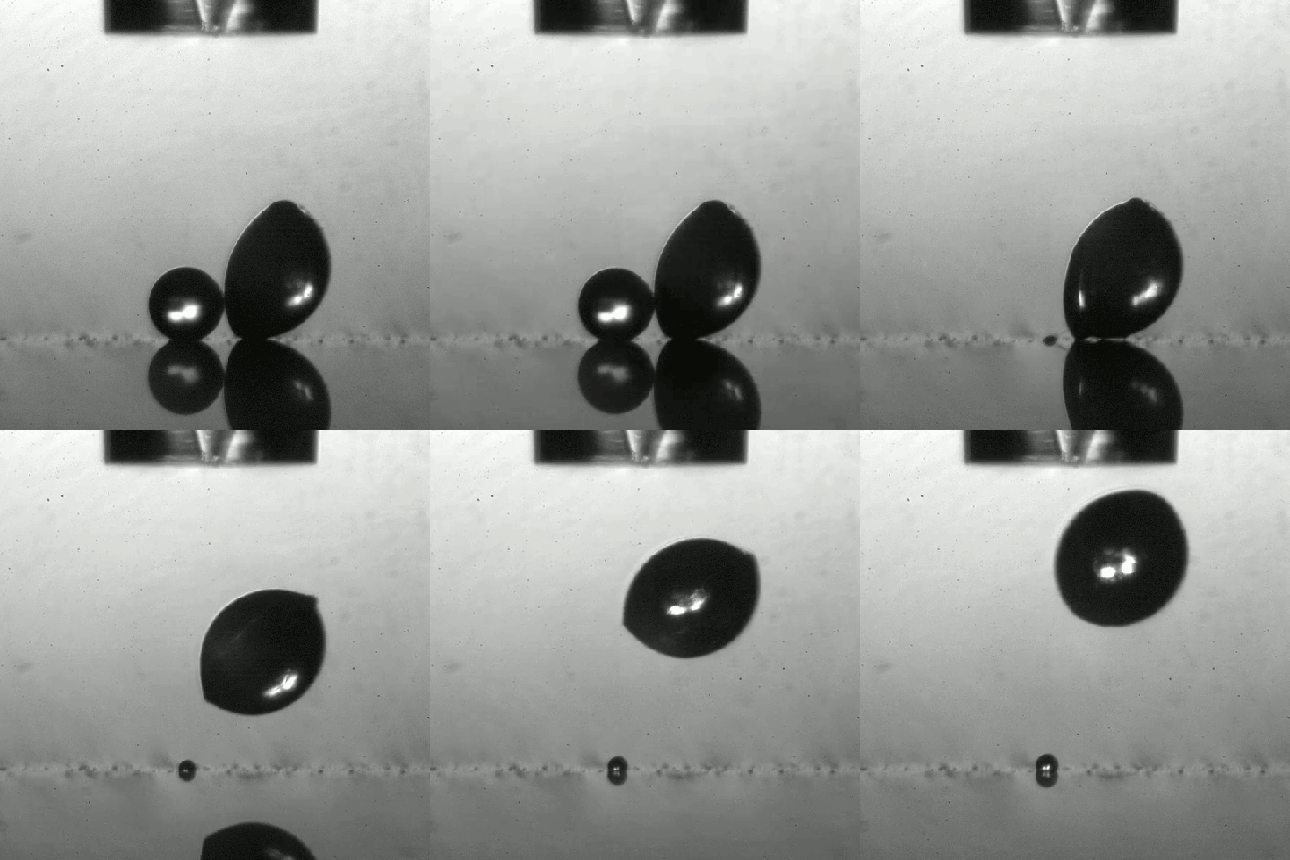
Many fungi use coalescing water droplets to launch and spread their spores. The process is recreated in the laboratory in the animation above. Initially, there is a small spherical drop and a second, flattened drop stuck to the backside of the spore. In the animation, the large object on the right is actually both spore and droplet. The spore is spherical on one side and flattened on the other and starts out tipped up on its edge. When the spherical drop gets large enough to reach the flattened drop, they merge. This reduces the total surface area of the drop and thus releases some surface energy. It’s that surface energy that drives the spore’s jump. Even launching just a centimeter away from the host fungus is enough for a breeze to carry the spore further, allowing the fungus to reproduce. (Image and research credit: F. Liu et al., source; submitted by Kam-Yung Soh)
Month: July 2017

The Hydraulics Behind a Tuna’s Turns
Tuna are remarkably agile for their size. Many species reach lengths exceeding the height of a human adult, yet they can still make tight turns, especially when hunting. A recent study described one mechanism that aids the fish – a built-in hydraulic system for raising its second dorsal and anal fins. The tuna use fluid from their lymphatic system – which produces and transports white blood cells in both humans and tuna – to pressurize chambers at the base of some fins, causing the fin to rise. The extra support puts the fin in a hydrodynamically advantageous position and helps stabilize the fish when turning quickly, allowing them to change direction without slowing. (Video credit: Science; research credit: V. Pavlov et al.)

Watching Flow Inside Rock
Flow through porous substances has been a major interest in fluid dynamics for the last hundred years because rocks are porous. For most of that period, we’ve used Darcy’s law to calculate how a fluid flows through pores in a rock. (Incidentally, it can also be used for determining the perfect length of time for dunking a cookie in milk.) Often, however, there is more than one fluid in a pore – for example, both a liquid and a gas could be trapped there. In that case, researchers made a few assumptions that allowed them to extend Darcy’s law for these multiphase situations. For a long time, that was the best anyone could do because it was impossible to observe what’s actually happening in the pores inside an actual rock.
Recently, however, scientists have begun observing these multiphase flows inside sandstone pores using x-ray imaging. They’re only able to take an image every 45 seconds or so, but even that is frequent enough to show that the flow is surprisingly unsteady. An example image is shown above. The colored areas show pores filled with nitrogen inside the rock. Brine is also being injected into the rock but not being shown. The colors indicate how connected the nitrogen-filled pores are to other pores nearby. Red areas are highly connected; blue have moderate connections; and green areas are smaller and have fewer connections. The network connections inside the rock change relatively rapidly, even with steady-state injection conditions. That varying connectivity implies that some of the injection energy is going into shifting interfaces around rather than actually moving the fluids through the pores. More work will be needed to unravel what’s really happening inside the porous network, but the results have far-reaching implications for understanding groundwater filtration, fossil fuel extraction, and, in the future, the possibility of carbon sequestration. (Image credit: C. Reynolds et al., source; submitted by Simon D.)

Flow Around a Cylinder
A cylinder standing upright in a flow creates a complicated system of vortices and recirculation. In the photo above, the flow is left to right. The cylinder itself is somewhat hard to see but is located in the center of the image; we see it from above. The colored streaks of dye show the flow path around the cylinder. In yellow, we see a spiraling vortex that forms just ahead of the cylinder and stretches downstream on either side. Because of its shape, this is called a horseshoe vortex. Its sense of rotation is such that it tends to pick up loose material in front of the cylinder; in other words, it can erode that area. This is often seen around the pilings of bridge supports and must be accounted for in designs. You also see the effects of this horseshoe vortex digging out material at the base of trees after snowfalls in areas with a dominant wind direction, and here’s an example with a snow roller. (Image credit: H. Werlé; via eFluids)
Burning a Rocket Underwater
In a recent video, Warped Perception filmed a model rocket engine firing underwater. Firstly, it’s no surprise that the engine would still operate underwater (after its wax waterproofing). The solid propellant inside the engine is a mixture of fuel and oxidizer, so it has all the oxygen it needs. Fluid dynamically speaking, though, this high-speed footage is just gorgeous.
Ignition starts at about 3:22 with some cavitation as the exhaust gases start flowing. Notice how that initial bubble dimples the surface when it rises (3:48). At the same time, the expanding exhaust on the right side of the tank is forcing the water level higher on that side, triggering an overflow starting at about 3:55. At this point, the splashes start to obscure the engine somewhat, but that’s okay. Watch that sheet of liquid; it develops a thicker rim edge and starts forming ligaments around 4:10. Thanks to surface tension and the Plateau-Rayleigh instability, those ligaments start breaking into droplets (4:20). A couple seconds later, holes form in the liquid sheet, triggering a larger breakdown. By 4:45, you can see smoke-filled bubbles getting swept along by the splash, and larger holes are nucleating in that sheet.

The second set of fireworks comes around 5:42, when the parachute ejection charge triggers. That second explosive triggers a big cavitation bubble and shock wave that utterly destroys the tank. If you look closely, you can see the cavitation bubble collapse and rebound as the pressure tries to adjust, but by that point, the tank is already falling. Really spectacular stuff! (Video and image credit: Warped Perception)
The Elastic Leidenfrost Effect


Drop some hydrogel beads in a hot frying pan and they’ll bounce, hiss, and screech. Normally, if you drop a ball, it bounces to ever smaller heights until it comes to rest. In contrast, on a hot surface the hydrogel can bounce to a steady height for minutes at a time, raising a question: where does it get the energy for its incessant bounce?
Upon close examination of the impact, researchers found the hydrogel beads are actually slapping the surface over and over on each bounce. The frequency of the slapping exactly matches that of the audible screech, so what you’re actually hearing is this bounce-slap. Now what causes the slapping?
Contact with the hot surface vaporizes some of the water inside the hydrogel. If it were a droplet, this vapor would form a thin, almost frictionless layer the droplet could glide on; that’s the classic Leidenfrost effect. Here the shell of the bead prevents that until the pressure really builds up. When the pressure gets high enough, the vapor finally escapes, opening up a gap. As the gap reaches its largest point, the bead rebounds elastically, bringing it back in contact with the surface and starting the process again. Each of these cycles acts like a tiny engine, harvesting energy that drives the larger bounce. This elastic Leidenfrost effect may be particularly helpful in soft robotics, providing robots with a new mechanism for movement. (Image and video credit: S. Waitukaitis et al.,arXiv)

Impressionist Gibraltar
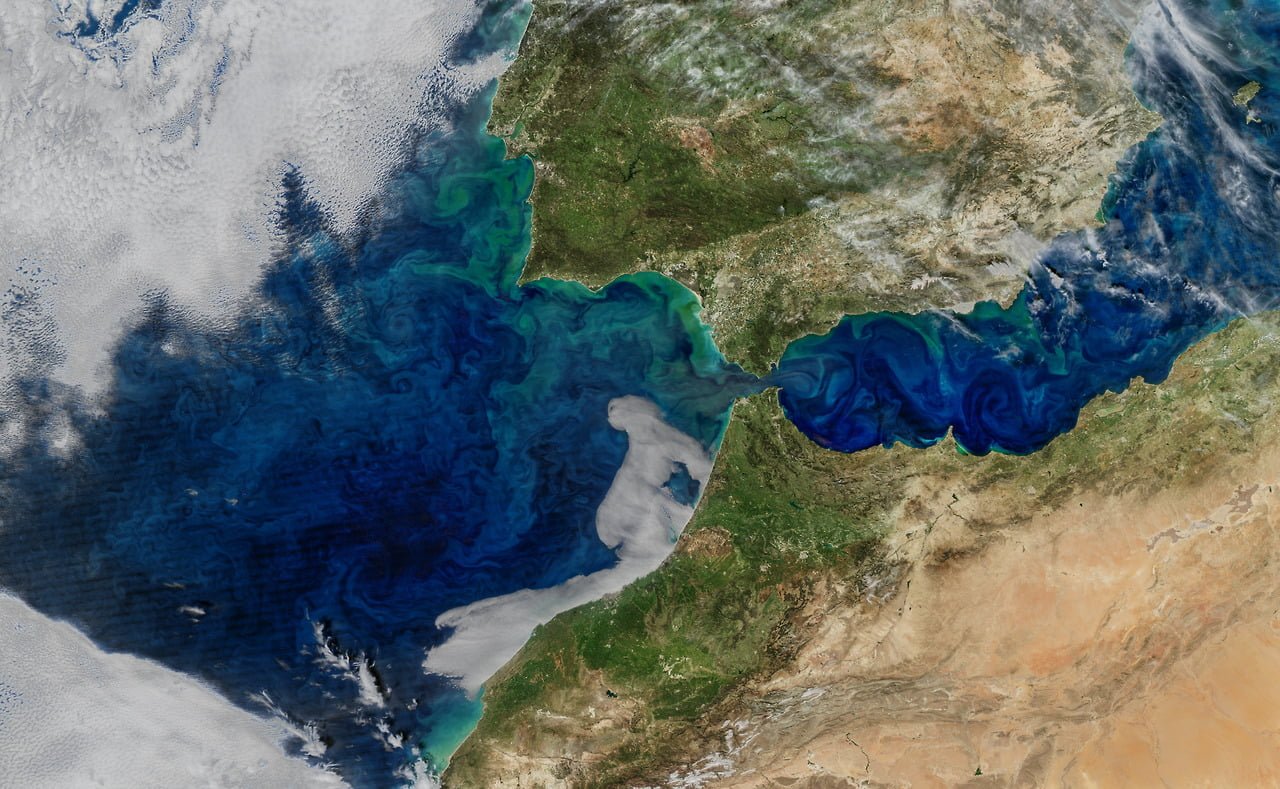
Swirls of phytoplankton make this satellite image of Gibraltar look like an Impressionist painting. The photo is a composite of data from several instruments, with colors enhanced to highlight features of the phytoplankton blooms. The tiny plankton act as tracer particles that reveal some of the complex flow between the North Atlantic and the Mediterranean. Although narrow, the Strait at Gibraltar has deep and complex terrain that was formed during a breach flood event millions of years ago. Water flowing through that terrain sets up enormous and complicated waves well beneath the ocean surface. These drive some of the turbulence that we see here as the blue swirls east of the Strait. (Image credit: NASA/N. Kurig; via NASA Earth Observatory)
Kelvin-Helmholtz Instability
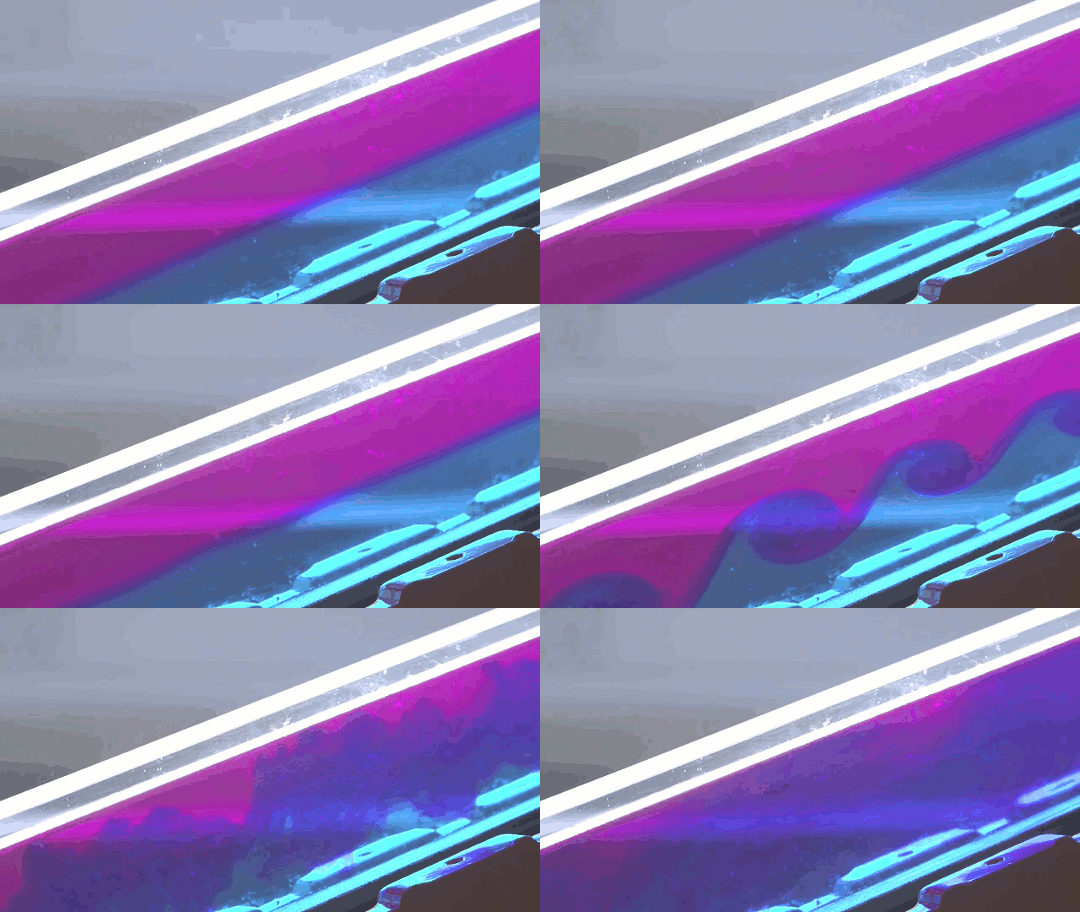
Sixty Symbols has a great new video explaining the laboratory set-up for demoing a Kelvin-Helmholtz instability. You can see a close-up from the demo above. Here the pink liquid is fresh water and the blue is slightly denser salt water. When the tank holding them is tipped, the lighter fresh water flows upward while the salt water flows down. This creates a big velocity gradient and lots of shear at the interface between them. The situation is unstable, meaning that any slight waviness that forms between the two layers will grow (exponentially, in this case). Note that for several long seconds, it seems like nothing is happening. That’s when any perturbations in the system are too small for us to see. But because the instability causes those perturbations to grow at an exponential rate, we see the interface go from a slight waviness to a complete mess in only a couple of seconds. The Kelvin-Helmholtz instability is incredibly common in nature, appearing in clouds, ocean waves, other planets’ atmospheres, and even in galaxy clusters! (Image and video credit: Sixty Symbols)

How Smoke Rings Work
Vortices are a ubiquitous part of life, whether they’re draining down your bathtub or propelling underwater robots. In the latest video from the Lib Lab project, you can learn about how vortex rings form, what makes them last so long, and even make a vortex generator of your own. I can personally attest that vortex cannons are good for hours of entertainment, no matter your age. They’re even more fun with friends, as the Oregon State drumline demonstrates in the video. Want even more vortex fun? Check out leapfrogging vortices, vortex rings colliding head-on, and a giant 3 meter wide vortex cannon in action. (Video and image credit: Lib Lab)

Hagfish Crash
Last week a flatbed truck in Oregon overturned and released 3400 kilograms of live hagfish on the highway and nearby cars. Hagfish are eel-like fish known for their impressive slime production. When threatened, the hagfish produce mucins that, when combined with water, form an extremely viscoelastic mucus. As it’s stretched, the mucus thickens and becomes more viscous. Normally, hagfish use this property to clog the gills of fish trying to eat them. The slime is weak, however, to shearing; hagfish actually tie themselves in knots to slide the slime off when there’s too much of it. The Oregon Department of Transportation managed to clear the road of mucus (and hagfish) using bulldozers and fire hoses, but it did take them several hours. For more photos and videos from the incident, check out Gizmodo and the Oregon State Police Twitter feed. (Image credit: Oregon State Police; via Gizmodo)