Month: October 2016

  • Featured Video Play Icon

    Fluorescein Ghosts

    Fluorescein is a popular chemical for flow visualization, and, as this video from Shanks FX demonstrates, it’s not hard to extract from highlighters if you’d like to experiment with it yourself. Fluorescein can also be purchased in powder form, but it’s typically rendered into a dye before use. When dripped into water, it can leave behind ghostly glowing wakes. Happy Halloween! (Video credit: Shanks FX)

    In other news, I am back from my vacation! Thanks again to Claire from Brilliant Botany for looking out for everything while I was gone. – Nicole

  • Featured Video Play Icon

    Non-Newtonian Splashes

    What happens when a stream of liquid falls through a screen? As the above video shows, water creates a beautiful flower-like burst of fluid when it hits a screen. Adding a little polymer to the water makes it non-Newtonian and more viscous. When hitting the screen, this slows it down but doesn’t prevent the fluid from flowing.

    Add enough polymer, though, and the fluid becomes what’s known as a yield-stress fluid. These fluids behave much like a solid–they don’t flow–until you apply a certain amount of stress. Then they’ll flow. If you’ve ever tried to get ketchup out of a glass bottle, then you’re familiar with how these yield-stress fluids act. When dropped onto a screen, the yield-stress fluid just forms a pile–unless the impact speed is high enough to create the necessary force to get the fluid to flow! (Video credit: B. Blackwell et al.)

  • Reflecting in a Stream

    Reflecting in a Stream

    Total internal reflection traps three lasers in a stream of falling water. When light tries to pass from the water – a material with a high refractive index – to the air – which has a lower index of fraction – it can only do so if its angle of incidence is smaller than the critical angle. Here, the light impacts the water-air boundary at a large angle and rather than refracting across the interface – like the distorted view of a straw in a glass of water – the laser light is completely reflected. Instead of escaping, the laser light is trapped, becoming a ribbon of light that swirls inside the water stream until the light is diffused. (Image credits: L. Yarnell et al.; F. Batrack et al.)

  • Featured Video Play Icon

    The Pythagorean Cup

    According to legend, Pythagoras invented a cup to prevent his students from drinking too greedily. If they overfilled the cup, it would immediately drain out all the fluid. The trick works thanks to a U-shaped tube in the center of the cup. As long as the liquid level is below the highest point in the U-tube, only the entrance side of the tube will be filled. As soon as the liquid level in the cup is higher, the weight of all that fluid forces liquid up and around the bend. This kicks off a siphoning effect that pulls all the fluid out. Coincidentally, this is the same way that toilet flushing works! Pulling the handle releases extra water into the bowl that raises the fluid level higher than the highest point in a U-bend. That establishes a siphon, which (provided nothing has clogged the pipe), empties the toilet bowl. (Video credit: Periodic Videos)

  • Shaking in the Wind

    Shaking in the Wind

    Sitting at a traffic stop on a windy day, you may have noticed the beam holding the traffic lights shaking steadily up and down. This phenomenon is called vortex-induced vibration. When the wind flows over the beam, it looks something like the flow animation shown above. Airflow follows the shape of the beam until near the backside, where the air separates from the surface and creates a vortex that sloughs off into the beam’s wake. These vortices form asymmetrically on the beam – first on one side, then the other. This creates unequal pressures on either side of the beam, and those pressure differences create a force that moves the beam. Because vortices are being steadily shed off the beam, it will keep moving back and forth as long as the wind is strong enough. (Image credits: traffic light – L. Sennick, source; cylinder – Aphex82/Wikimedia)

  • Fluid Fingers

    Fluid Fingers

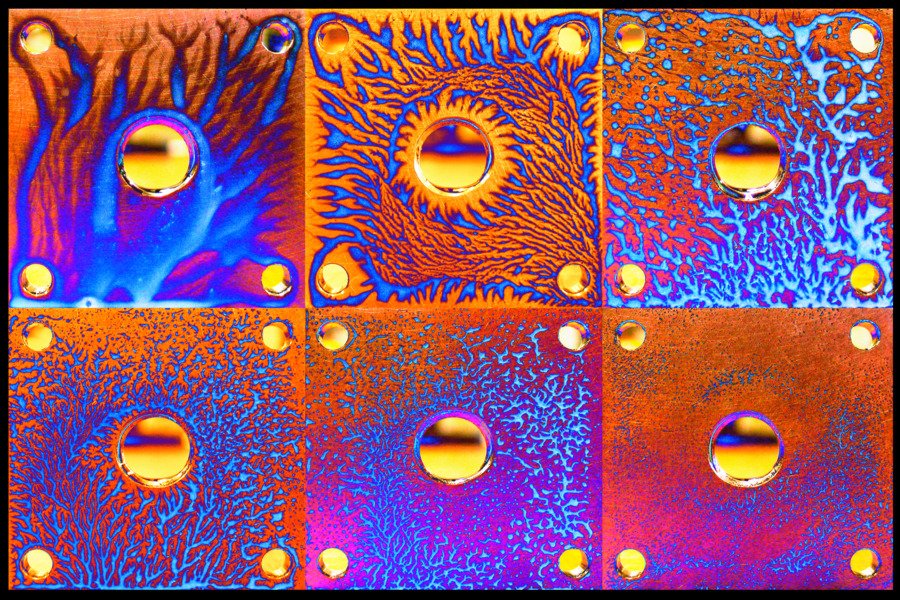
    Fluid phenomena can show up in unexpected places. The collage above shows patterns formed when an aluminum block is lifted during wet sanding, a polishing technique. The dendritic fingers are formed from oil and the slurry of sanded particles being polished away. They are an example of the Saffman-Taylor instability, which forms when less viscous fluids (oil) protrude into a more viscous one (the slurry). Each image contains a different concentration of oil, resulting in very different fingering patterns. (Image credit: D. Lopez)

  • Plesiosaur Swimming

    Plesiosaur Swimming

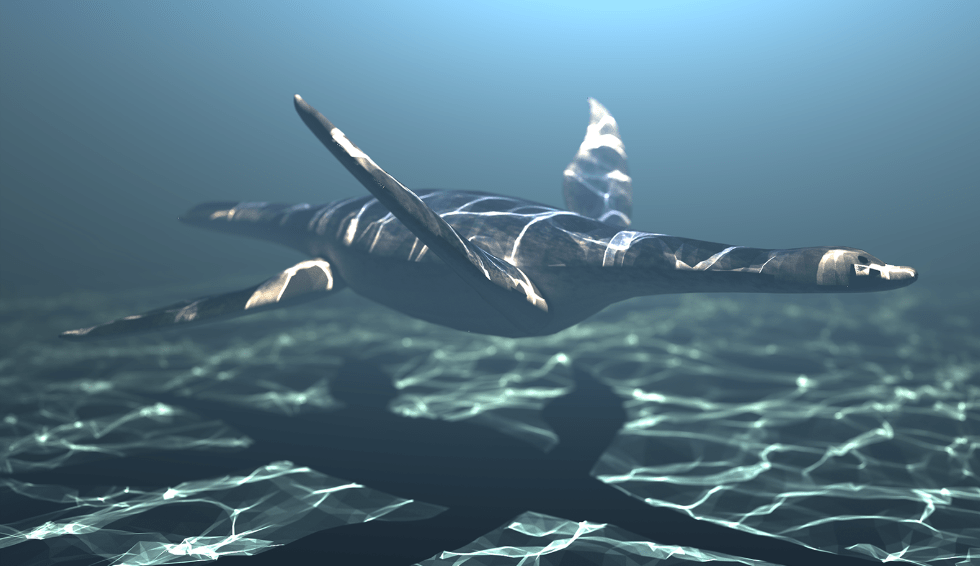
    Plesiosaurs are marine reptiles that thrived during the Jurassic period and went extinct some 66 million years ago. Since the first discoveries of plesiosaur fossils centuries ago, scientists have debated how the four-limbed creature would have swam. One approach to answering this question is to examine the efficiency of different strokes. Researchers have done this computationally by building a digital plesiosaur with biologically realistic joint motions. They then couple the model plesiosaur’s body motions with the movement of fluid around the body. With this computational model, they then simulate many different methods for moving the plesiosaur’s limbs and search for the most efficient one.

    What they found is that the plesiosaur’s propulsion is dominated by its forelimbs, which likely moved with a flight stroke similar to that of a penguin or sea turtle. Despite their size, the hindlimbs were able to produce very little thrust, suggesting that they were primarily used for stability and maneuverability. (Image credits: S. Liu et al., GIF source)

  • Dripping, Frozen

    Dripping, Frozen

    The simple drip of a faucet is more complicated when frozen in time. Any elongated strand of water tends to break up into droplets due to surface tension and the Plateau-Rayleigh instability. Whenever the radius of the water column shrinks, surface tension tends to drive water away from the narrow region and toward a wider point. This exaggerates the profile, making narrow regions skinnier and wider regions fatter. Eventually, the neck connecting the droplets becomes so thin that it pinches off completely, leaving a string of falling droplets.  (Image credit: N. Sharp)

  • Featured Video Play Icon

    Clogging, In Hourglasses and Crowds

    Hourglasses are pretty common, but you’ve probably never given much thought to the way they flow. An hourglass designer has to carefully select the sizing of the neck and the grains. Choosing a neck that’s too small relative to the grain size will result in frequent clogs but choosing too large a neck will make setting the timing difficult. Interestingly, it doesn’t matter whether the hourglass is filled with air or with water–the same principle holds.

    Where this knowledge becomes especially useful, though, is when dealing with crowds. We’ve all experienced the frustration of being in a large crowd trying to fit through a small exit. Paradoxically, the fastest way to get a large number of particles (or sheep or people) through a narrow opening is to slow each individual down. This can either be done by instructing everyone to slow down or by forcing that same result by placing an obstacle immediately before the exit. The reduction in speed reduces clogging, which means everyone gets through faster! (Video credit: A. Marin et al.)

  • Frost Spreading

    Frost Spreading

    Frost typically forms when supercooled droplets of water scattered across a surface freeze together. The freezing spreads via tiny ice bridges that link droplets together into a frozen network. The animation above shows this process in action. Freezing starts in a droplet off-screen on the right and quickly spreads. Watch carefully, and you can see the ice bridges growing toward the unfrozen droplets. This is because the ice bridges are fed by water vapor evaporating from the droplets. If one can spread the droplets far enough from one another, it’s possible for a droplet to evaporate completely before the ice bridge reaches it, thereby disrupting the spread of frost.  (Video credit: J. Boreyko et al.; research paper)