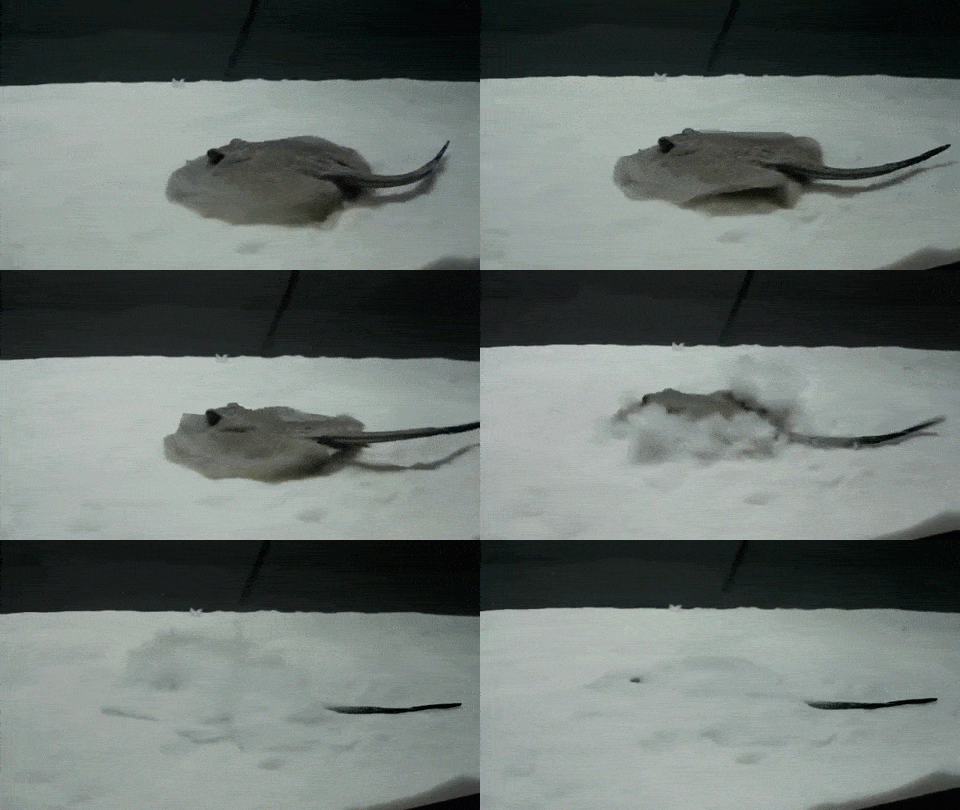
Flounders, stingrays, and other flat, bottom-dwelling fish often hide under sand for protection. These fish move by oscillating their fins or the edge of their bodies. They use a similar mechanism to bury themselves–quickly flapping to resuspend a cloud of particles, then hitting the ground so that the sand settles down to cover them. Researchers have been investigating this process by oscillating rigid and flexible plates and observing the resulting flow. When the flapping motion exceeds a critical velocity, the vortex that forms at the plate’s edge is strong enough to pick up sand particles. Understanding and controlling how and when these vortex motions kick up particles is useful beyond the ocean floor, too. Helicopters are often unable to land safely in sandy environments because of the particles their rotors lift up, and this work could help mitigate that problem. (Image credits: TylersAquariums, source; Richmondreefer, source; A. Sauret, source; research credit: A. Sauret et al.)
Year: 2015

Icebergs and Caramel
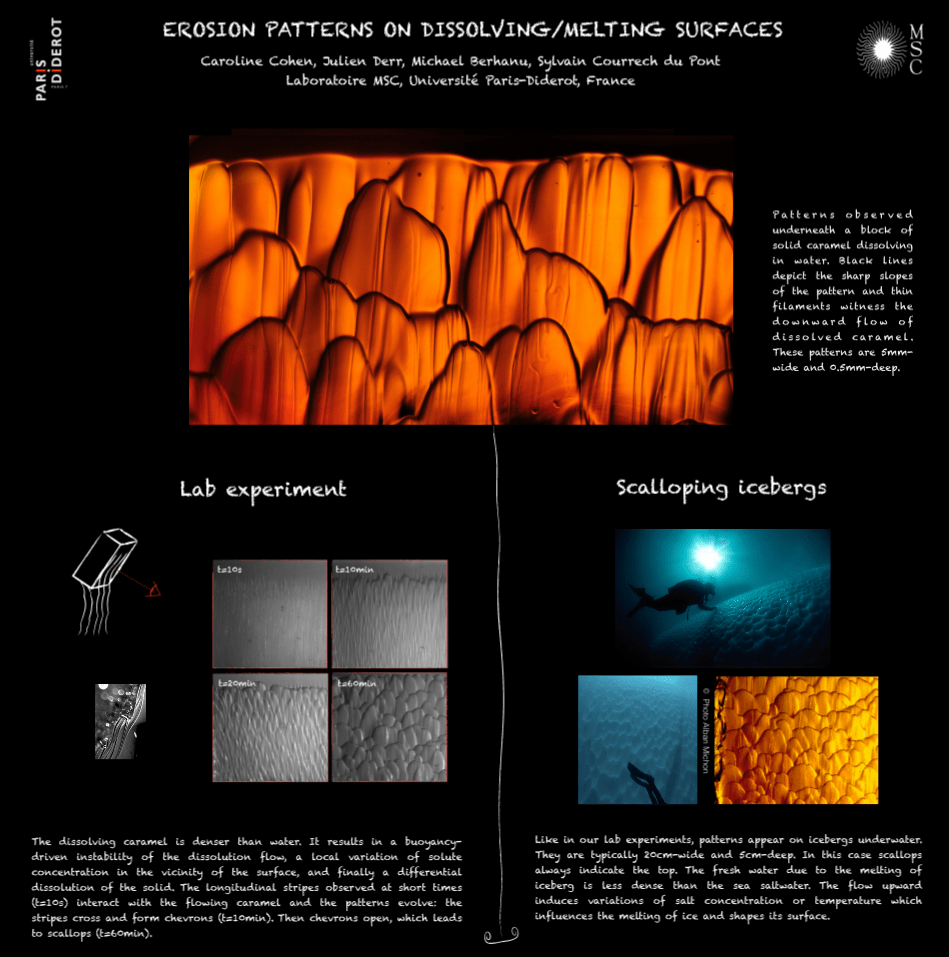
What do icebergs and caramel have in common? Both have similar scalloped erosion patterns as they dissolve. When caramel dissolves in water, the denser caramel sinks in the buoyant water. An initially smooth surface will first form lines, then the flowing caramel and the uneven surface interact, forming chevrons, followed by larger scallops. A similar process happens with melting icebergs. The meltwater from an iceberg is less dense than the surrounding seawater, so it will rise as it melts. This causes variations in the salt concentration and temperature near the iceberg, which cause it to melt differently in different spots, ultimately leading to the same scallop shapes observed in the caramel. Check out the full-size PDF of the poster here. (Image credit: C. Cohen et al.)

Drinking in Space
Earlier this year, the Capillary Beverage experiment launched to the International Space Station with new open-topped “Space Cups” for astronauts to test. Now those of us back on Earth are getting a glimpse of the cups in microgravity action. The geometry of the cups is wide on the back-end with a tightening v-shape near the mouth. This shape guides the liquid by using capillary action to wick it toward the spout.
One of the key goals of the experiment was to observe how the liquid drained–what shape it assumed in the cup and where and how much liquid was left behind. The researchers want to compare the real-life performance of the cups with their numerical models and simulations, which will help design future microgravity liquid transport systems for fuel, waste management, and other applications.
Although the experiments have a wider purpose, the space cups also do a great job allowing astronauts to drink from more than just pouches. Check out the gallery demo above to see how they hold up against astronaut silliness! (Video and image credits: NASA/IRPI LLC, GIF source)

The Fluidic Oscillator
A fluidic oscillator is a device with no moving parts that sprays a fluid from side to side. The animations above illustrate how they work. A nozzle funnels a fluid jet through a chamber with two feedback channels. When the jet sweeps close to one side of the chamber, part of the fluid is directed along the feedback channel and back toward the inlet. That flow feeds into a recirculating separation bubble in the middle of the chamber. As that bubble grows, it pushes the jet back toward the other feedback channel, continuing the cycle. Many automobiles use fluidic oscillators in their windshield washer sprays. Check out the award-winning full video from the Gallery of Fluid Motion. (Image credit: M. Sieber et al., source)

Fire Tornado
Fire tornadoes, despite their name, are more like dust devils than your typical tornado. In nature, they’ll often form in wildfires, but here the Slow Mo Guys simulate one for the high-speed cameras using a ring of box fans set up to provide rotational flow, or vorticity, around a kerosene fire. As the fire burns, the warm air over the flame moves upward due to buoyancy. This creates a low-pressure area around the fire that draws in the spinning air from further out. Like an ice skater who pulls her arms in when spinning, the rotating air spins faster as it moves in toward the fire, resulting in a swirling turbulent vortex of flame. Hopefully it goes without saying, but, seriously, don’t try this at home. (Video credit: Slow Mo Guys; submitted by Chris S.)

Draining Soap Film
The brilliant colors of a soap film are directly related to the film’s thickness. Black regions, like the one in the upper right of this image, are the thinnest regions and may be less than 100 nanometers thick. (That’s smaller than the shortest wavelength of visible light!) The colors of the peacock-feather-like blooms along the bottom of the image demonstrate significant variations in film thickness. This is caused by uneven concentrations of surfactants in the film. The variations in concentration causes differences in local surface tension, which in turn moves fluid around within the film. This is known as a Marangoni effect. (Image credit: S. Berg and S. Troian)

APS DFD 2015
Heads-up for those coming to Boston for APS DFD 2015. I’m giving a talk about FYFD and outreach Sunday evening at 5:16pm in Room 102. I’ll also be around the conference all weekend, so hopefully I’ll see you around. Also, I have FYFD stickers, but you have to come talk to me to get one! (Image credit: APS DFD 2015)

Oil Film on Water
This award-winning short film features a thin layer of volatile oil on water. The oil evaporates quickest from shallow pools only microns deep, which appear bluish in the video. Surface instabilities along the edge of the pool create flow that draws oil in, generating the iridescent droplets seen floating among the evaporation pools. The droplets combine and coalesce as they come in contact with one another. Since droplets have a larger volume per surface area than the shallow pools, they evaporate more slowly. The behaviors observed here are important to applications like oil and fuel spills, which can persist longer if the floating fluid layer tends to form droplets. (Video credit: J. Hart; via txchnologist)

Jovian Belts and Zones
Jupiter’s colorful cloud bands alternate between dark belts and light zones. The bands mark convection cells in Jupiter’s atmosphere, and, like on Earth, powerful jet streams form due to this atmospheric heating and the planet’s rotation. The jet winds can even move in opposite directions, creating strong shear forces between neighboring cloud bands. The shear helps drive Kelvin-Helmholtz instabilities in the clouds, resulting in the regularly spaced waves and vortices seen along the edges of some bands. (Image credit: NASA/ESA; via APOD)