When working at the microscale, engineering structures like those used for drug delivery systems requires ingenuity. Since it isn’t possible to manipulate particles manually, researchers harness physical effects to do the work for them. Here a droplet filled with millions of polystyrene microparticles sits on a hydrophobic surface, which helps keep the drop’s spherical shape. As the drop evaporates, surface tension and internal flow in the drop help the microparticles self-assemble into a microscopic soccer-ball-like shape. (Video credit: A. Marin et al.; submission by A. Marin)
Month: May 2013

Magnetic Putty
For a little Friday fun, enjoy this timelapse of magnetic putty consuming magnets. Really this is a bit of slow-motion magnetohydrodynamics. The magnet’s field exerts a force on the iron-containing putty, which, because it is a fluid, cannot resist deformation under a force. As a result, the putty will flow around the magnet, eventually coming to a stop once it reaches equilibrium, with its iron equally distributed around the magnet. Assuming the putty is homogeneously ferrous (i.e. the iron is mixed equally in the putty), that means the putty will stop moving when the magnet is at its center of mass. (Video credit: J. Shanks; submitted by Neil K.)

Reader Question: Energy from Whirlpools?
shiftymctwizz asks:
So I just read your post about vortices, and now I’m wondering if we could build structures similar to the Corryvreckan and put turbines in them for energy production? Would it be any more efficient than hydroelectric dams? Are you the right person to ask?
I can’t give you numbers off the top of my head, but I suspect that your typical hydroelectric dam will be more reliable if not more efficient. The trouble with things like the Corryvreckan, aside from the randomness of where the vortices pop up, is that they aren’t there every single day the way, say, Niagara Falls is.
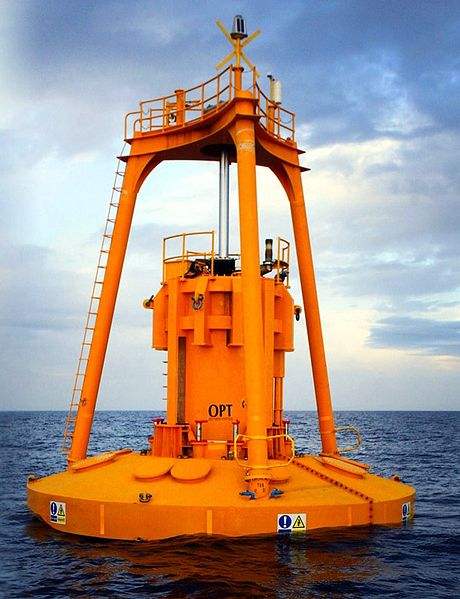
That said, there is on-going work to effectively harness ocean waves for power, with ideas like buoy generators or sea snake generators. As with most concepts one of the difficulties in implementation is determining a safe and efficient manner to transmit the electricity generated from these offshore sites (we’re generally talking miles from shore) to where it’s needed. This problem is often similarly faced by solar and wind energy producers. There are already wave farms in place around the world, though, and it’s a promising field of renewable energy. (Photo credit: Wikimedia)

Real-Life Whirlpools

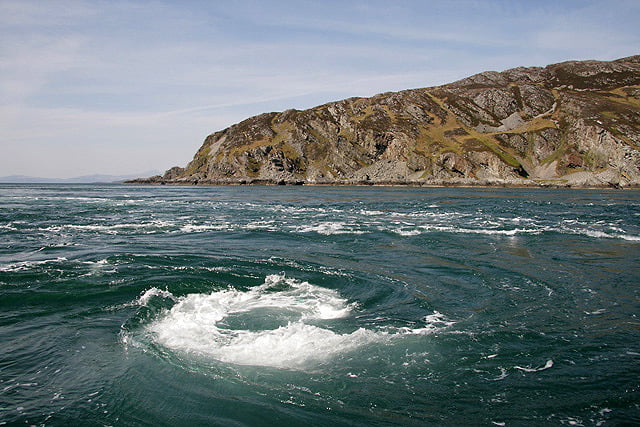
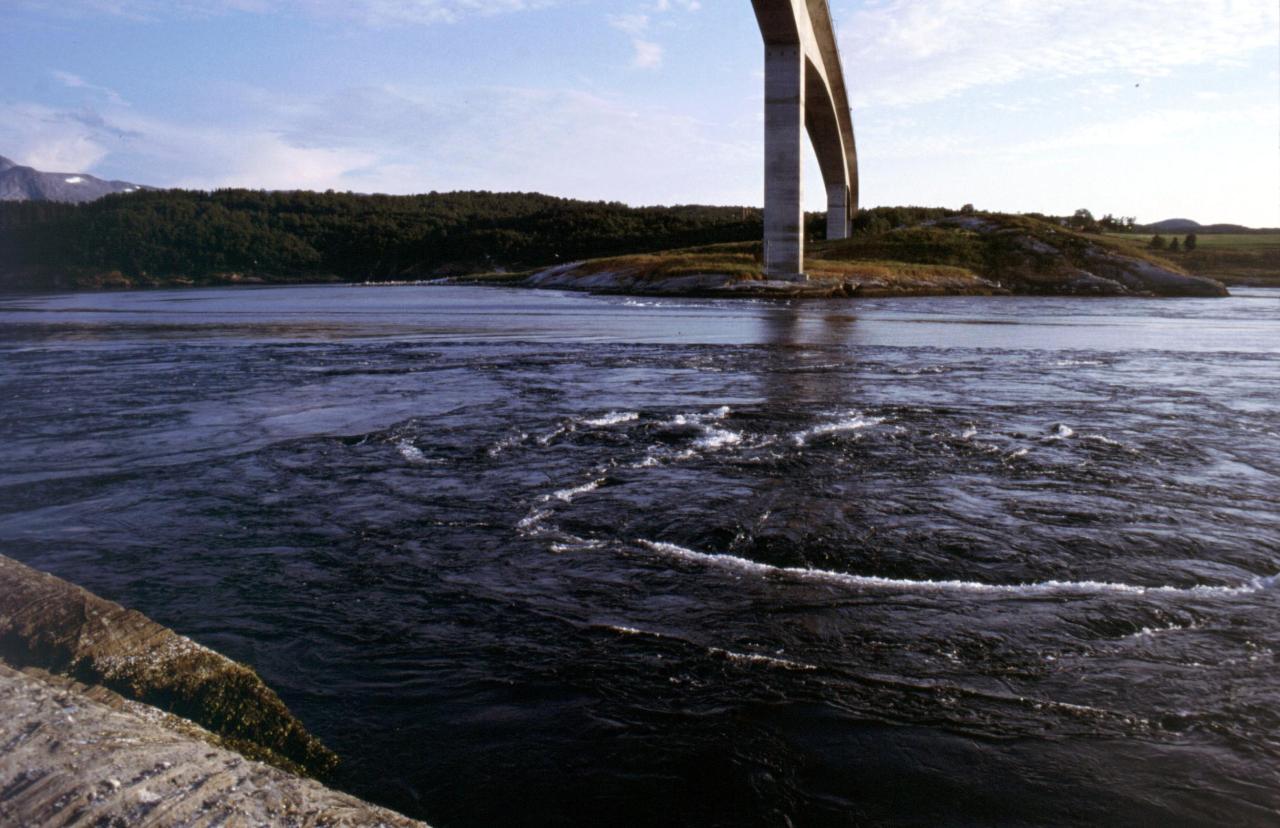
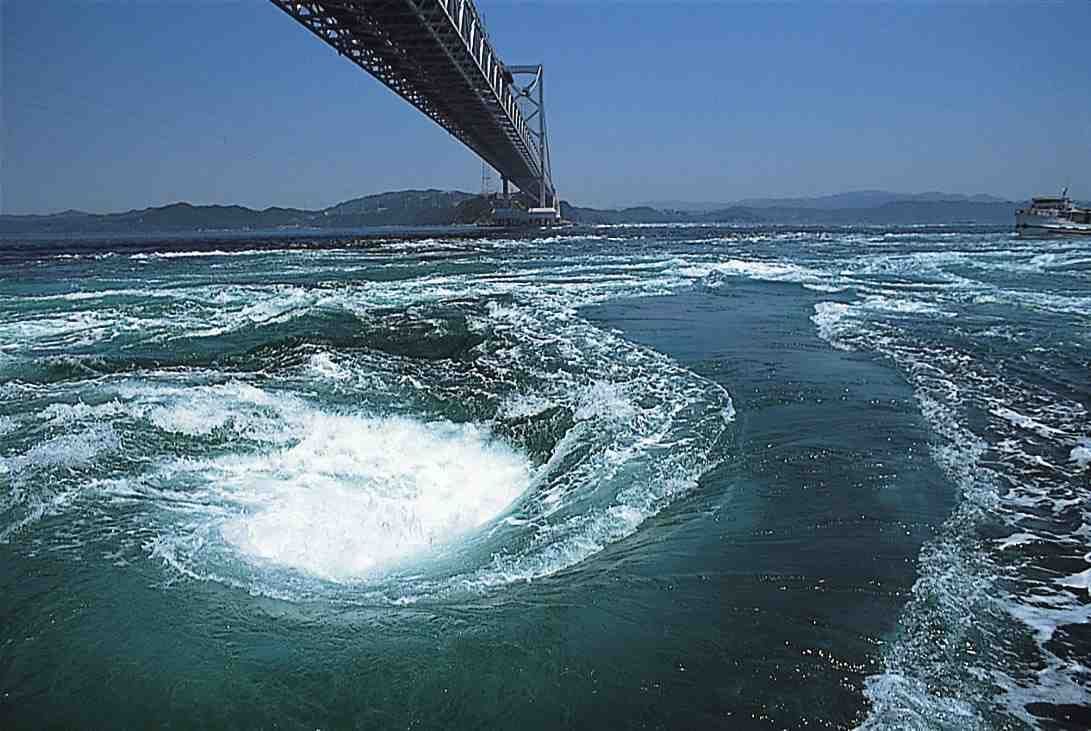
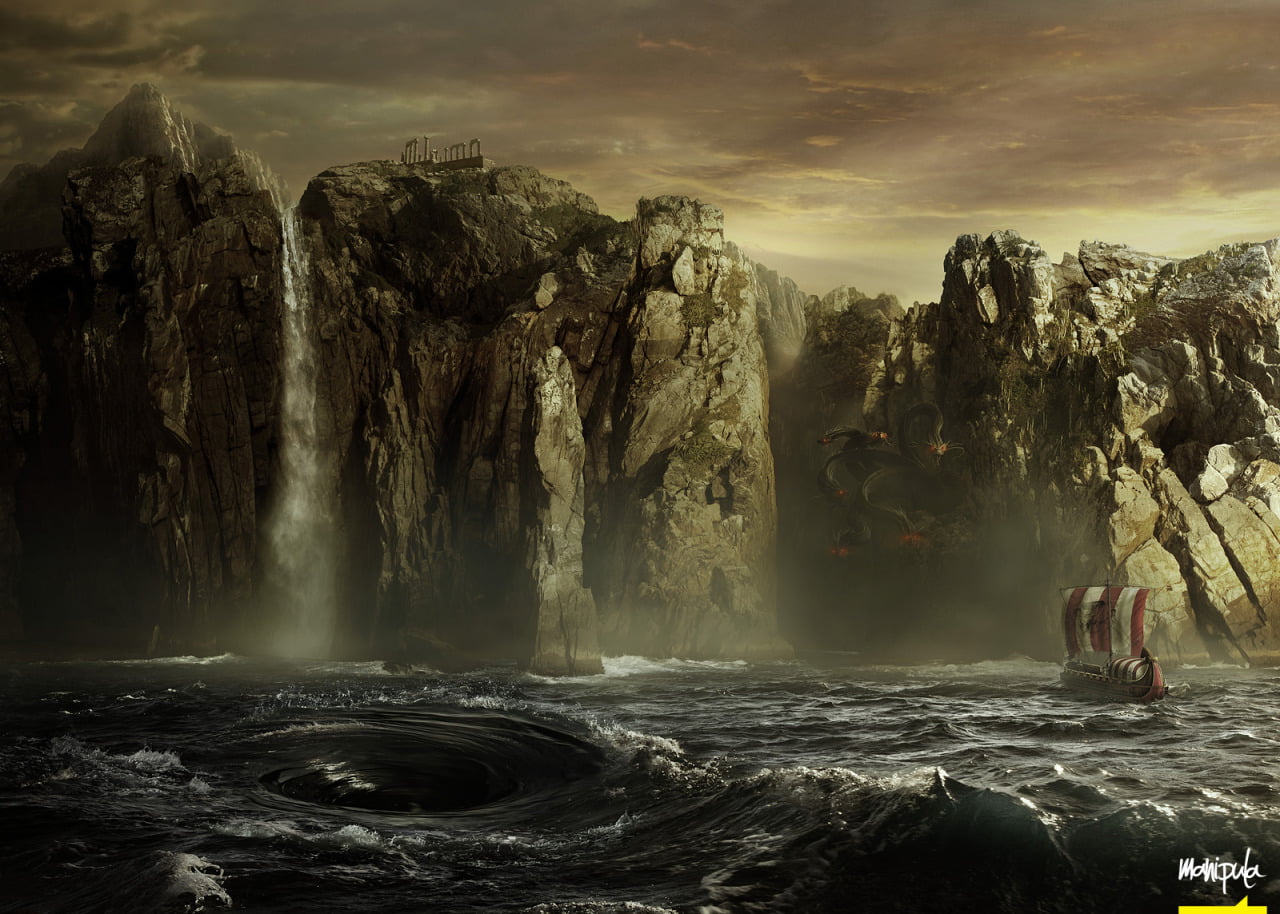
Literature is full of descriptions of monstrous whirlpools like Charybdis, which threatens Homer’s Odysseus. While it’s not unusual to see a small free vortex in bodies of water, most people would chalk boat-swallowing maelstroms up to literary device. But it turns out that, while there may not be permanent Hollywood-style whirlpools, there are several places in the world where the local tides, currents, and topology combine to produce turbulence, dangerously vortical waters, and even standing vortices on a regular basis.
One example is the Corryvreckan, between the islands of Jura and Scarba off Scotland. In this narrow strait, Atlantic currents are funneled down a deep hole and then thrust upward by a pinnacle of rock that rises some 170 m to only 30 m below the surface. The swift waters and unusual topology produce strong turbulence near the surface and whirlpools pop up throughout the strait. Other “permanent” maelstroms, such as those in Norway and Japan, arise from tidal interactions with similar structures rising from the sea floor.
For more, check out this Smithsonian article, Gjevik et al., Moe et al., and the videos linked above! (Photo credits: Manipula, Tokushima Gov’t, Wikimedia, and W. Baxter; requested by @kb8s)
Watching the Boundary Layer Go By
In experiments, it can be difficult to track individual fluid structures as they flow downstream. Here researchers capture this spatial development by towing a 5-meter flat plate past a stationary camera while visualizing the boundary layer – the area close to the plate. The result is that we see turbulent eddies evolving as they advect downstream. Despite the complicated and seemingly chaotic flow field, the eye is able to pick out patterns and structure, like the merging of vortices that lifts eddies up into turbulent bulges and the entrainment of freestream fluid into the boundary layer as the eddies turn over or collapse. It is also a great demonstration of how the Reynolds number relates to the separation of scales in a turbulent flow. Notice how much richer the variety of length-scale is for the higher Reynolds number case and how thoroughly this mixes the boundary layer. (Video credit: J. H. Lee et al.)