
Ethanol droplets on a hot copper plate bounce under the influence of electrostatic forces from a charged rod. The temperature of the plate is high enough that the droplet is supported by a thin vapor film, which is what keeps it from wetting the plate. Ethanol does not have the strong polarity that water does, but the hydroxyl group on one end does make it susceptible to the electrostatic charge built up on the teflon rod. As a result, the droplets oscillate under electrostatic and gravitational forces, resulting in a dribbling effect. (Video credit: S. Wildeman et al.)
Month: October 2012

Polygonal Jumps

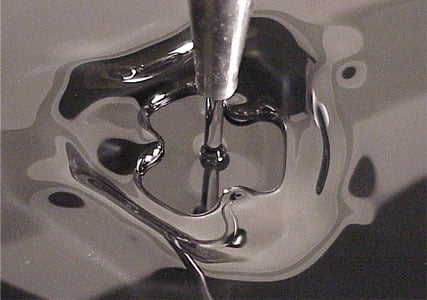
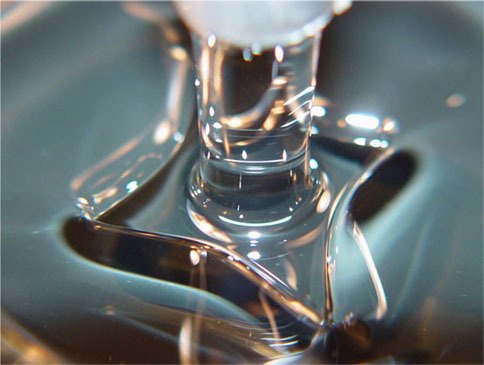
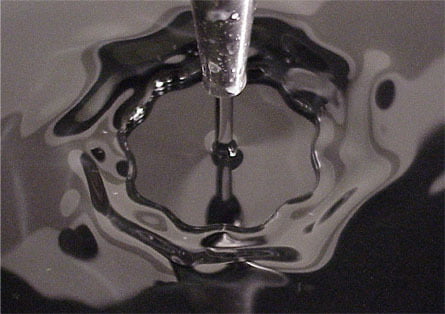
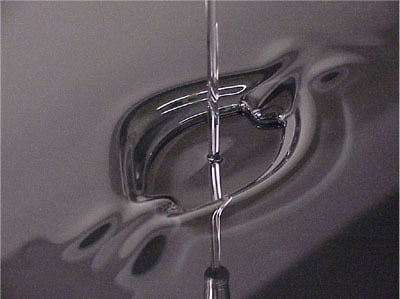
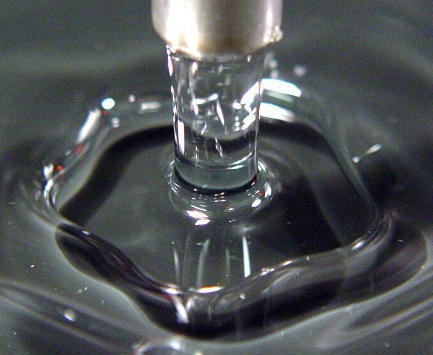
Hydraulic jumps occur when a fast-moving fluid enters a region of slow-moving fluid and transfers its kinetic energy into potential energy by increasing its elevation. For a steady falling jet, this usually causes the formation of a circular hydraulic jump–that distinctive ring you see in the bottom of your kitchen sink. But circles aren’t the only shape a hydraulic jump can take, particularly in more viscous fluids than water. In these fluids, surface tension instabilities can break the symmetry of the hydraulic jump, leading to an array of polygonal and clover-like shapes. (Photo credits: J. W. M. Bush et al.)

Spray Starch
High speed video of of spray starch from a can. Once the initial transients die down, a cone-shaped annular sheet forms. Disturbances propagate in the sheet, tearing it into filaments that break down into droplets. Beautiful complexity hidden in a simple everyday device. (Video credit: John Savage)
Dynamic Leidenfrost Impact
The Leidenfrost effect occurs when a liquid encounters a solid object much hotter than the liquid’s boiling point, like when water skitters on a hot griddle or someone plunges a hand in liquid nitrogen. A thin layer of vapor forms between the liquid and the solid, thereby (briefly) insulating the remaining liquid. The Leidenfrost effect can be static–like a droplet sitting on a pan–or dynamic, like the video above in which a droplet impacts the hot object. The video shows both a top and a side view of a droplet striking a plate that is over five times hotter than the liquid’s boiling point. On impact, the droplet spreads and flattens, and a spray of even tinier droplets is ejected before rebound. (Video credit: T. Tran and D. Lohse, from a review by D. Quere)

The Archer Fish’s Arrows

The archer fish hunts by shooting a jet of water at insects in the leaves above and knocking them into the water. How the fish achieve this feat has been a matter of contention. A study of high-speed video of the archer’s shot shows that fluid dynamics are key. The fish releases a pulsed liquid jet, imparting greater velocity to the tail of the jet than the head. As a result, the tail tends to catch up to the head and increase the jet’s mass on impact while decreasing the duration of impact. Simultaneously, the jet tends to break down into droplets via the Rayleigh-Plateau instability caused by surface tension. Surface tension’s power to hold the water in droplets combined with the inertial effects of the pulsed jet create a ball of fluid that strikes the archer’s prey with more than five times the power than vertebrate muscles alone can impart. For more on archer fish, check out this video and the original research paper by A. Vailati et a. (Photo credits: Scott Linstead and BBC; submitted by Stuart R)

Rebounding
A ping pong ball bounces off a puddle, drawing a liquid column upward behind it. This photo shows the instant after the fluid has disconnected from the ball, allowing it to rebound without further loss of momentum to the fluid. The fluid column begins to fall under gravity, the tiny undulations in its radius growing via the Rayleigh-Plateau instability and eventually causing the column to separate from the puddle. You can see the whole process in action in this high-speed video. (Photo credit: BYU Splash Lab)
Following a Breaking Wave
It’s fascinating to sit on the beach and watch the waves roll in and break, but rarely do we get a view like the one in this video. Here researchers have created a breaking wave in a wave tank and recorded the wave as it travels the length of the tank with a high-speed camera moving at the same speed as the wave crest. This perspective, moving alongside the fluid, is a Lagrangian coordinate system; if one instead stood still and watched the wave roll past, it would be an Eulerian measurement. Traveling with the wave, we can see how a lip forms on the wave crest, then rolls down, capturing a tube of air. As water begins to flow over the lip, perturbations grow, causing ripples in the laminar curtain. Then the water strikes the main wave and rebounds turbulently, creating a familiar white cap. In the second half of the video, the process is shown from above, highlighting the entrainment of air and the creation of the bubbles that form the white cap of a breaking wave. (Video credit: R. Liu et al)
Peering Inside the Kettle
Here natural convection is explored experimentally in a quasi-2D environment. The researchers demonstrate how this phenomenon, which is much like that seen in a boiling pot, can be investigated by measuring the refractive distortions caused by the thin heated fluid layer. They also demonstrate types of boiling that can occur. Typically, bubbles nucleate at the heated surface and then rise to pull hot fluid with them. At high enough temperatures above the liquid’s boiling point, however, an unstable layer of vapor can form over the heated surface. This “boiling crisis” or critical heat flux produces a marked reduction in heat transfer due to the insulation provided by the vapor layer. (Video credit: S. Wildeman et al.)

“Surface Tension”

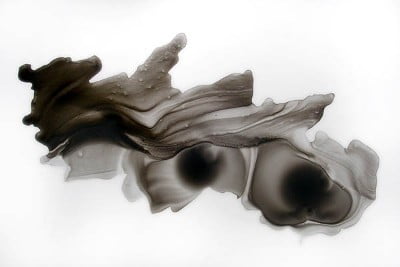

From a series called “Surface Tension,” these ink and water drawings by Marguerite French explore the effects of diffusion, surface tension, and evaporation. The forms left by the thin layer of liquids suggest other natural processes like erosion, weathering, and the rings inside trees. (Photo credits: Marguerite French)
Cavitation in a Bottle
Sudden changes in the pressure or temperature in a liquid can create bubbles in a process known as cavitation. Underwater explosions are just one of the ways to induce cavitation in a liquid. As identified in the above video, the shock waves traveling through the liquid force a change in pressure that creates bubbles. When these bubbles collapse, the container is subjected to an enormous oscillation in pressure, which often results in damage. The same phenomenon is responsible for damage on boat propellers as well as this beer bottle smashing trick. Check out these other high-speed videos of cavitation in a bottle: (Video credit: Destin/Smarter Every Day; submitted by Juan S.)


