
An air bubble trapped inside a viscoelastic fluid is squeezed between two plates in this video, revealing a Saffman-Taylor-like fingering instability stemming from local stress concentrations. (Video credit: Baudouin Saintyves)
Month: March 2012

Winds Across the US

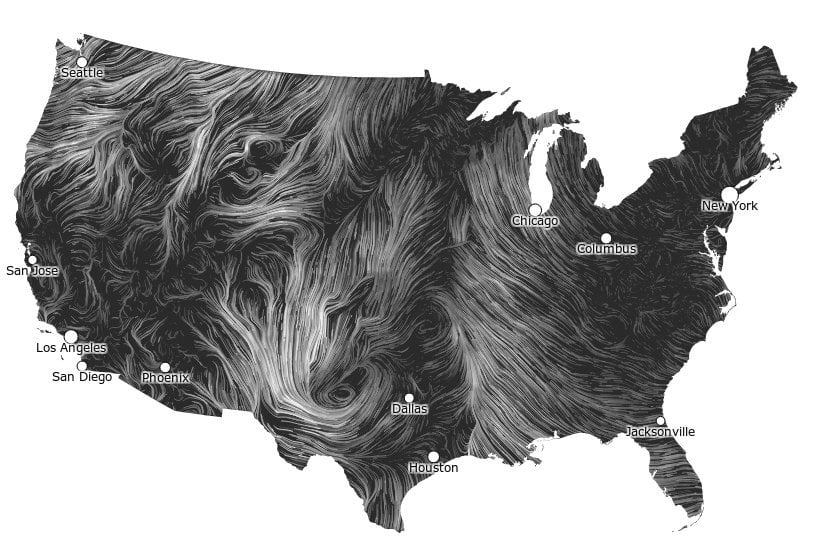
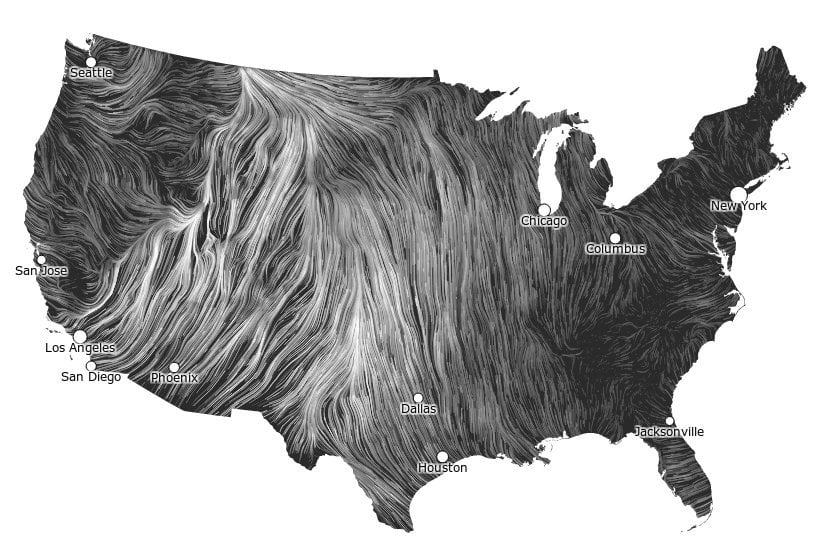
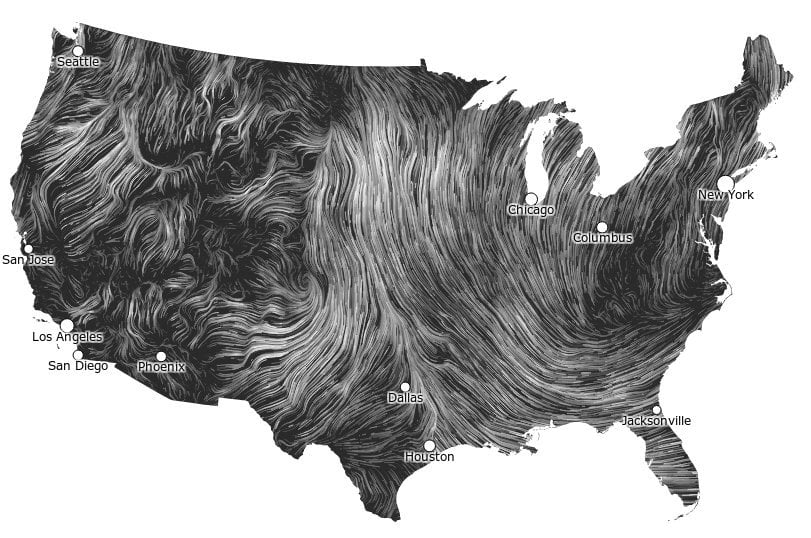
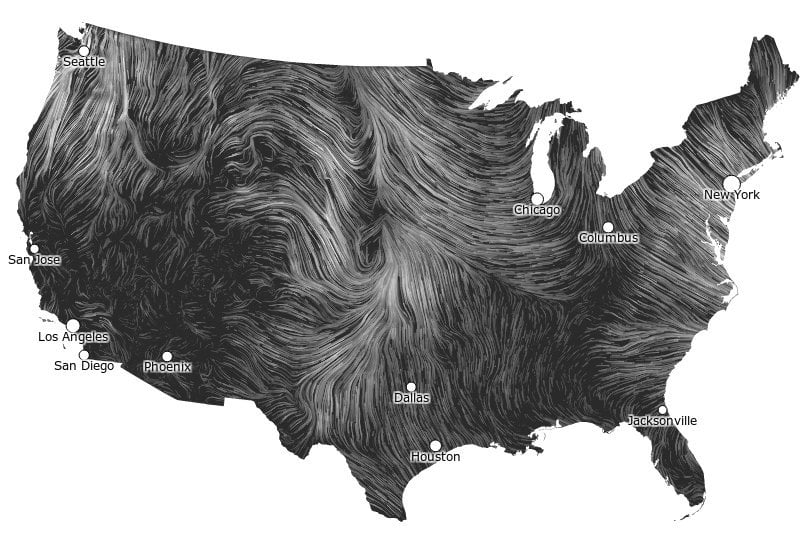
A collaborative project on data visualization brings to life the wind velocity data across the United States. The Wind Map is an interactive, nearly real-time indicator of wind conditions across the country, compiled on an hourly basis from the National Digital Forecast Database. Be sure to click through to see the data in motion. Observing the variety in wind patterns over the scale of days brings to light the swirling motion of surface winds much the way Perpetual Ocean does for surface currents. Fluid dynamics are all around us. (via Gizmodo)

Micro Air Vehicle Flow Viz
A smoke wire shows the deformation of streamlines around a swept-winged micro air vehicle (MAV). These crafts typically feature wingspans smaller than one foot and, thus, never develop the type of flow fields associated with larger fixed-wing airplanes. This complicates theoretical predictions of lift and drag for MAVs as well as making them difficult to control. MAVs have numerous commercial and military applications, including search and rescue operations. (Photo credit: Tom Omer)

Visualizing Ocean Currents
Researchers used computational models of ocean currents to produce this video visualizing worldwide ocean surface currents from June 2005 through December 2007. Dark patterns under the ocean are representative of ocean depths and have been exaggerated to 40x; land topography is exaggerated to 20x. Notice the wide variety of behaviors exhibited in the simulation: some regions experience strong recirculation and eddy production, while others remain relatively calm and unmoving. Occasionally strong currents sweep long lines across the open waters, carrying with them warmth and nutrients that encourage phytoplankton blooms and other forms of ocean life. (Video credit: NASA; submitted by Jason S)
Vortex Cannon
Building a vortex cannon is a great way to demonstrate the power and longevity of vortex rings. As demonstrated here, it’s possible to create one with just a box with a round hole in it. Adding some smoke or stage fog helps visualize the rings. Vortex rings are found frequently in nature: volcanoes make them, some plants use them to distribute spores, and dolphins and whales use them to play. (submitted by @aggieastronaut)
Science Off the Sphere: Liquid Lenses
Astronaut Don Pettit delivers more “Science Off The Sphere” in his latest video. Here he demonstrates diffusion and convection in a two-dimensional water film in microgravity. He notes that the viscous damping in the water is relatively low and that, left undisturbed, mixing in the film will continue for 5-10 minutes before coming to rest, which tells us that the Reynolds numbers of the flow are reasonably large. The structures formed are also intriguing; he notes that drops mix with mushroom-like shapes that are reminiscent of Rayleigh-Taylor instabilities and cross-sectional views of vortex rings. It would be interesting to compare experiments from the International Space Station with earthbound simulations of two-dimensional mixing and turbulence, given that the latter behaves so differently in 2D.
Reader Questions: What Majors Study Fluids?
squky asks:
Your blog has truly inspired me to want to major in the field of fluid dynamics, and for that I wholeheartedly thank you. But I’m having some confusion over which discipline (major) it falls under. Would it fall under physics or engineering? And if engineering, which type? (My two-year college doesn’t have an engineering department or much of an upper-level physics department, so there’s little guidance on the particulars.) If you can give me some clarification it would help me a lot.
Firstly, that’s awesome! I’m thrilled that FYFD has been inspiring as that is one of its goals. The study of fluid dynamics is remarkably interdisciplinary. Researchers who study it can be found most often in physics, engineering, theoretical mechanics, and mathematics departments, though also in meteorology, chemistry, planetary science, or even biology. Which one is most likely depends on the school.
Traditionally, fluid mechanics falls under the topic of classical physics but many physics departments focus on modern physics instead. Mechanical and aerospace engineering departments are the most common places to study fluid dynamics–unlike physicists who moved on to quantum mechanics and relativity, engineers have to understand fluid dynamics due to its practicality and applications. Chemical and civil engineers may also study fluid mechanical topics for these reasons. And because the mathematics of fluid dynamics are so rich and full of unsolved problems, mathematicians are also drawn to the subject.
I would recommend looking into the research interests of the professors in your physics and mathematics departments and see if there’s anyone studying fluid dynamics there already. Even if there isn’t, take what courses you can in physics, calculus, partial differential equations, and numerical methods. All of those will stand you in good stead when looking for further programs down the line.
Tornado in a Bubble
In this video, a miniature tornado-like vortex is created inside a soap bubble. Here’s how it works: after the first bubble is formed and the smoke-filled bubble is attached to the outside, he blows into the main bubble, creating a weak angular velocity, before breaking the interface between the two bubbles. As the smoke mixes in the main bubble, note how it is already spinning slowly due to the free vortex he created. Then, when the top of the bubble is popped, surface tension pulls the bubble’s surface inward. Because the bubble radius is decreasing, conservation of angular momentum causes the angular velocity of the fluid inside to increase, pulling the smoke into a tight vortex, much like a spinning ice skater who pulls her arms inward.
How Dams Affect Rivers
This video shows how the installation of a dam can affect river flow and sediment transport. Before the dam is added, the flow is shallow and the sediment transport is uniform. The installation of the dam creates deep subcritical flow upstream and supercritical flow downstream. This means that wave information–like ripples–can propagate upstream on the subcritical side; on the supercritical side, the wave velocity is lower than the flow velocity and ripples cannot propagate upstream. This is analogous to sub- and supersonic flow in air. The critical flow over the dam is analogous to a shock wave. The lower velocity upstream of the dam is unable to carry sediment downstream and transport essentially ceases until the sediment builds up to a height where the depth of the water above the dam is roughly equal to that below the dam and sediment transport resumes, scouring the downstream supercritical section. Around 0:40, a gate is closed on the downstream side (off frame), creating a hydraulic jump. In the final section of the video, after sediment has built up on both sides of the dam, the downstream gate is re-opened and the jump reforms as sediment is blown out below the dam. (Video credit: Little River Research and Design, with funding from the Missouri Department of Natural Resources)
Supersonic Flow
This video shows a sphere in a small supersonic wind tunnel at Mach 2.7. Once the tunnel starts, a curved bow shock forms in front of the sphere, close to but not touching the model’s surface. Areas of low pressure are visible behind the sphere, as is a weak shock wave caused by overexpansion in those low pressure areas. Contrast this with a sharp cone in the same tunnel at the same Mach number. In the case of the cone, the shock wave is attached at the nose of the model. The attached shock follows the body more closely, resulting in a shock that impacts the walls of the tunnel further downstream than in the sphere’s case.
