This flow visualization shows the wake left by a freely rising sphere. Observations of rising and falling spheres date at least back to Newton, who observed that the inflated hog bladders he used “did not always fall straight down, but sometimes flew about and oscillated to and fro while falling”. That vibration is caused by the vortices seen here in the wake. There are actually four vortices shed per oscillation cycle–two primary vortices (marked P) and two secondary vortices (marked S). #
Year: 2011

Supercritical Fluids
Supercritical fluids live in the region of a phase diagram beyond the critical point. At these temperatures and pressures, a substance is neither strictly liquid nor a gas but exhibits behaviors from both. A supercritical fluid can effuse through a solid like a gas does but can also dissolve substrates like a liquid. As noted in the video above, supercritical fluids are useful substitutes for organic solvents in many industrial applications. Carbon dioxide, for example, is used as a supercritical fluid in the decaffeination process.
It’s Tuesday again! If you enjoy this blog, please take a moment to recommend us in the Tumblr directory. Thanks!
Freezing Soap Bubbles
This is what it looks like when a soap bubble freezes. Perhaps not strictly fluid mechanical in nature, but it’s a nice thermodynamics demonstration.

Saturnian Storm
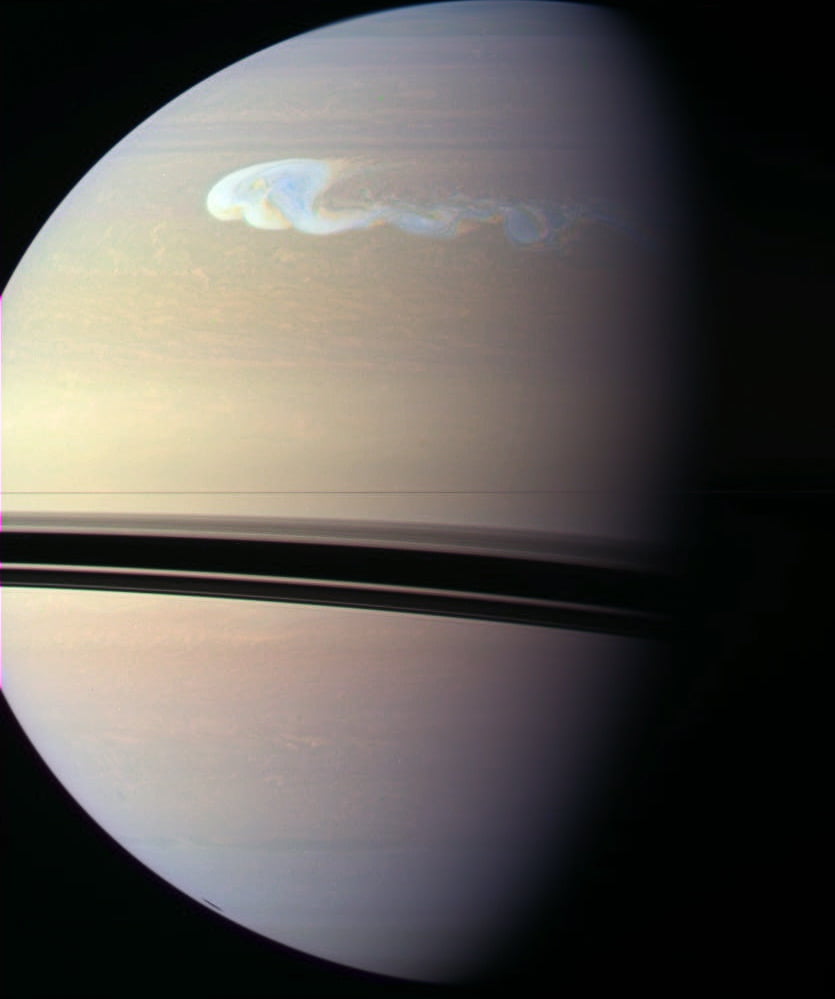
Back in mid-December, amateur astronomers discovered an enormous new storm on Saturn. The Cassini spacecraft captured this image early in the storm’s history (it now stretches farther around the planet). The fluid dynamics of Saturn’s atmosphere are incredibly complex and well beyond our current understanding, but we can certainly appreciate the majesty of a swirling, turbulent storm half the size of our entire planet. (via APOD, Martian Chronicles)

Reader Question: Surface Tension vs. Viscosity
lazenby asks:
How can superfluid liquid Helium have zero viscosity while retaining surface tension? (assuming something like surface tension is required for a liquid to form drops)
The short answer is that surface tension and viscosity are two totally separate properties for a fluid. To illustrate how one can exist without the other in a superfluid, we’ll imagine two different scenarios. For the first, imagine that you have a narrow vertical pipe. Any fluid you put in the pipe will flow downward due to the force of gravity. If you put water through the pipe, you’ll get some rate of outflow. Now imagine putting something like molasses through the pipe. Even with the same external forces on it, the molasses will never move through the pipe as quickly as the water does. This is because the molasses has higher viscosity and resists flowing. In a force balance, viscosity would act like friction, opposing the downward motion of the fluid.
Surface tension arises from a different balance of forces. Now imagine that you have a stationary droplet of one fluid (A) floating in a different fluid (B). Deep inside the droplet, each molecule of Fluid A is being pulled on all sides by other identical molecules of Fluid A. A molecule at the surface of the droplet, though, doesn’t experience that neighborly pull on all sides; it experiences different intermolecular forces from Fluid B. Our imaginary droplet is stationary, though, so all the forces on it and all the forces on its individual molecules have to balance, otherwise there’d be acceleration. Surface tension acts along the interface by pulling molecules of Fluid A in toward one another–much like the elastic of a balloon–thereby balancing the forces in the droplet and equalizing the force across the interface between Fluid A and Fluid B. (Illustration credit: Wikipedia)
In the superfluid, this balance of forces across the interface between air and helium-3 must still exist, despite the superfluid’s lack of viscosity.
Superfluid Helium Leaks from its Container
Below a temperature of 2.17 Kelvin, helium becomes a superfluid, a state of matter boasting several unique properties including zero viscosity (resistance to flow). In this video, scientists demonstrate that property. When they pull the glass “bucket” of helium out at 2:50, the helium starts to leak out. The glass is solid but it contains numerous tiny spaces between its atoms. In its normal state, the viscosity of helium prevents it from escaping through those holes. But as a superfluid, its resistance to flowing goes to zero and it leaks right through the solid glass.
Flying Paint
High speed footage of flying paint demonstrates a world of viscosity and surface tension, as well as another great example of fluid dynamics as art. (via Gizmodo)
If you enjoy FYFD, why not take a minute to recommend us in the Tumblr directory? Thanks!
Ferrofluid Labyrinths
Here’s a different take on ferrofluids. Instead of spikes, we get 2D patterns reminiscent of these ones. Most likely the ferrofluid is trapped under glass as part of a Hele-Shaw cell. The results remind me some of chaotic Rayleigh-Benard convection cells, actually.

Butterfly Soap Spiral
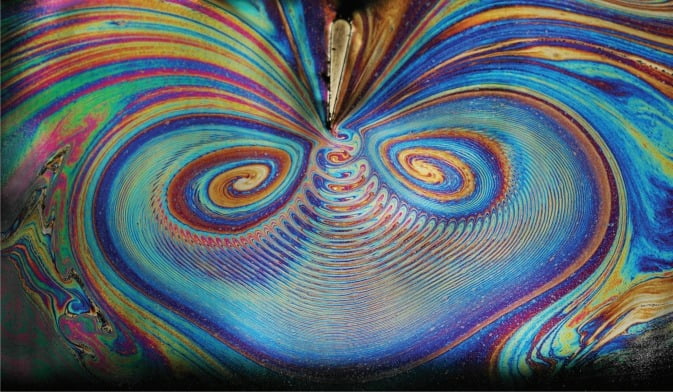
A stationary soap film disturbed by a flapping foil (seen in the top center) creates a butterfly-like double spiral roll. Two vortices form at the tip of the foil each time it changes direction; look carefully and you can see those tiny vortices all the way through the spirals. (From the 2010 Gallery of Fluid Motion; pdf)
Reader Question: Hot Air Balloon Physics
lazenby asks:
and boyancy in air? is the lifting capacity of a hot air balloon equal to the modulo of the weight of the air in the balloon with the weight of the same volume of air outside the balloon?
for that matter, does the lift of a big helium weather balloon decrease as air pressure, and so weight of the air outside the balloon, drops? and is this exactly counterbalanced by the lessening density of the helium in the balloon?
all of these things keep me awake.
Hopefully you won’t be sleepless much longer. Buoyancy in air follows the same principles as buoyancy in water. Determining the lifting capacity of a balloon is a matter of determining how heavy the balloon can be before the buoyant force is equal to the weight. See the free body diagram and little derivation below to see what the maximum payload mass is for a helium balloon. You can click on the picture to enlarge it.

The second part of your question raises some interesting points. As a balloon’s altitude increases, the atmosphere around it gets colder and less dense, all of which should reduce the buoyant force. At the same time, the balloon itself expands to equalize the pressure inside and outside of the balloon, which should increase the buoyant force. (At some point the pressure drops sufficiently that the tensile strength of the balloon material is unable to cope with that expansion and the balloon bursts, but we’ll ignore that here.) For this problem, we’d want to know what payload the balloon can carry without losing lift, and, with a couple assumptions, that’s pretty easy to figure out. I’ve done that derivation below.

The real key to the calculation is assuming that the helium in the balloon maintains the same temperature as the air outside. Since balloons rise slowly, this seemed a more reasonable assumption than imagining that the balloon remains warm compared to its surroundings. That calculation is doable as well but requires more than a couple lines, unfortunately! Thanks for your questions!