Month: June 2011

  • X-51A Scramjet Test Flight

    X-51A Scramjet Test Flight

    The X-51A Waverider hypersonic aircraft had its second test flight earlier this week. Unfortunately, its supersonic combustion ramjet (scramjet) engine failed to transition from its start-up fuel to its primary fuel. According to the US Air Force Research Laboratory:

    A US Air Force B-52H Stratofortress released the experimental vehicle from an altitude of approximately 50,000 feet. After release the X-51A was initially accelerated by a solid rocket booster to a speed just over Mach 5. The experimental aircraft’s air breathing scramjet engine lit on ethylene and attempted to transition to JP7 fuel operation when the vehicle experienced an inlet un-start. The hypersonic vehicle attempted to restart and oriented itself to optimize engine start conditions, but was unsuccessful. The vehicle continued in a controlled flight orientation until it flew into the ocean within the test range. #

    Un-starting is the term used when supersonic flow is lost in an engine or wind tunnel. If the pressure or temperature in the engine deviates too far from the ideal conditions, the upstream mass flow through the engine will be greater than the downstream mass flow and the engine will choke (video). A shock wave forms and travels upstream, leaving subsonic flow in its wake. Loss of supersonic flow inside the engine would likely also result in losing ignition of the fuel/air mixture, resulting in flameout. #

    If you haven’t guessed already, engineers like to make up words.

  • Featured Video Play Icon

    Droplet Impact

    As a droplet impacts a pool, it deforms the surface before rebounding in a Worthington jet and releasing secondary droplets as ejecta. Although we witness this act dozens of times a day, seeing it at 5,000 fps drastically alters one’s perspective.

  • Cloud Wakes Off Islands

    Cloud Wakes Off Islands

    This satellite image shows the cloud wakes of two small, volcanic islands off the coast of Chile. The disruption in airflow caused by the islands results in 100 km long cloud-free V-shaped wakes, even though the islands themselves are barely visible in the image. Such variation in the size of the obstacle compared to its effect is not unusual in fluid mechanics, but the scale, in this case, is impressive. #

  • Featured Video Play Icon

    Ground Effect Vehicles

    Ground effect vehicles (a.k.a. wing-in-ground-effect vehicles) rely on their proximity to a flat surface to inhibit the wingtip vortices that create lift-induced drag. This effectively increases the lifting capabilities of the vehicle in comparison to regular flight, but only so long as the vehicle remains close enough to the ground. This video features many model gliders that rely on ground effect.

  • River Jumps

    River Jumps

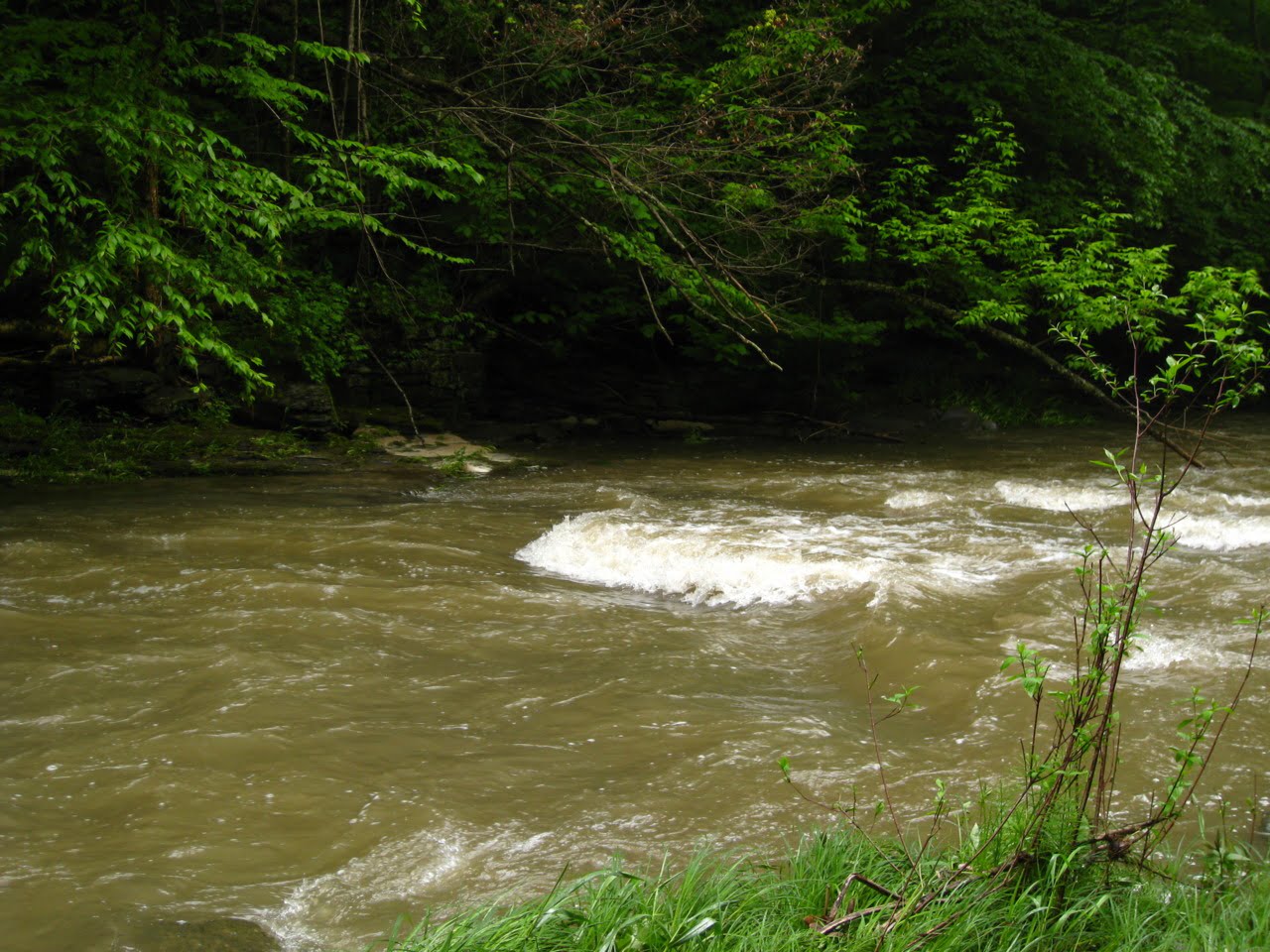
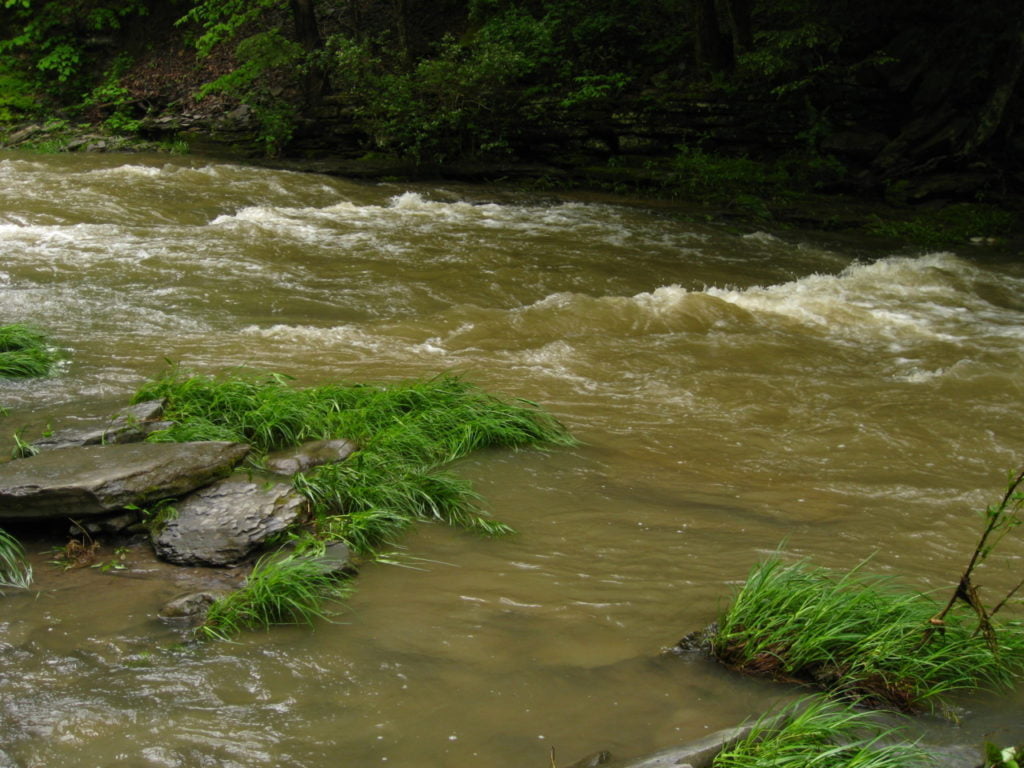
    Hydraulic jumps occur when a high velocity liquid runs into an area of low velocity liquid. The faster moving liquid decelerates rapidly and increases in height, effectively trading kinetic energy for potential energy. The phenomenon is frequently observed in open channel flow, like in spillways or along rivers, as in the photos above. In nature, the hydraulic jump will often be laminar upstream and turbulent downstream. #

  • Featured Video Play Icon

    Vortex Shedding from a Hot Cylinder

    This numerical simulation shows vortex shedding behind a hot cylinder. The behavior is very similar to what one sees behind an unheated cylinder, until the coefficient of thermal expansion increases and the von Karman vortex street is completely distorted. Describing the particulars of the computation, jessecaps writes (links added):

    I wrote an incompressible flow solver to simulate flow past a heated cylinder. The Navier-Stokes equations are discretized on a Cartesian grid and solved explicitly in time. The pressure-Poisson equation is solved implicitly using a bi-conjugate gradient method. The Boussinesq approximation was used (density is constant everywhere except for the gravity term) to account for buoyancy. Reynolds number = 250, Froude number = 1 (gravity is pointing down). The two simulations show the effect of the coefficient of thermal expansion. Each video shows a plot of velocity and temperature.

    (submitted by jessecaps)

  • Featured Video Play Icon

    Coronal Waves

    NASA’s Solar Dynamics Observatory has found evidence of Kelvin-Helmholtz waves in the sun’s corona. These waves, which occur between two fluids of different densities or moving at different speeds, are similar to the iconic waves surfers ride. Researchers suspect that this turbulent motion may help explain why the corona is 1,000 times hotter than the surface of the sun. #

  • Brazilian Barrier Islands

    Brazilian Barrier Islands

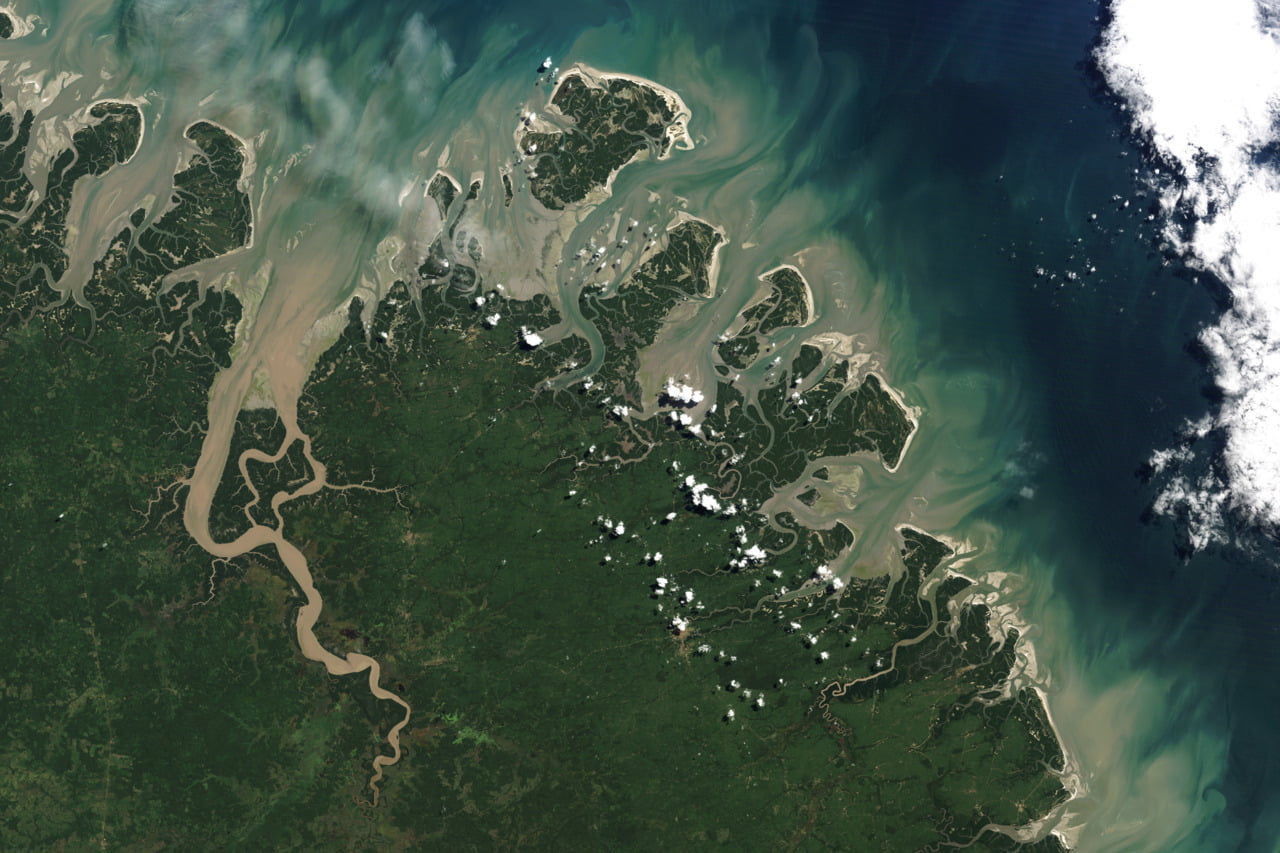
    Barrier islands are in a constant state of flux due to the currents, tides, and winds that surround and shape them. This satellite image of islands off the Brazilian coast shows meandering waterways and the mixing of sediment from the land into the sea. Often, secondary flows are responsible for shaping of these sorts of geographic features. #

  • Featured Video Play Icon

    Landslide

    Landslides, despite their inclusion of solid materials, function essentially as gravity-driven fluid flows. This timelapse video shows a recent earthflow in Wyoming near the Snake River. Rapid snowmelt and heavy rainfall combined to cause a seven day landslide over the highway and into the river. # (via Bad Astronomy)

  • Featured Video Play Icon

    Hot Spheres Sink Faster

    New research shows that the Leidenfrost effect–which causes water droplets to skitter across a hot pan–can drastically reduce the drag on objects moving through a liquid. When raised to a high enough temperature, a sphere falling water will be coated in a protective layer of vapor (see video above) that acts like a lubricant as the sphere moves through the water. If the temperature of the object drops too low, the vapor layer will dissolve into a mess of bubbles (~35 secs into video). One way that this mechanism reduces drag is by keeping flow attached to the sphere for longer as shown in this video. Preventing this flow separation increases the pressure recovered after the point of lowest pressure (the shoulders of the sphere), which reduces overall drag.

    See also: